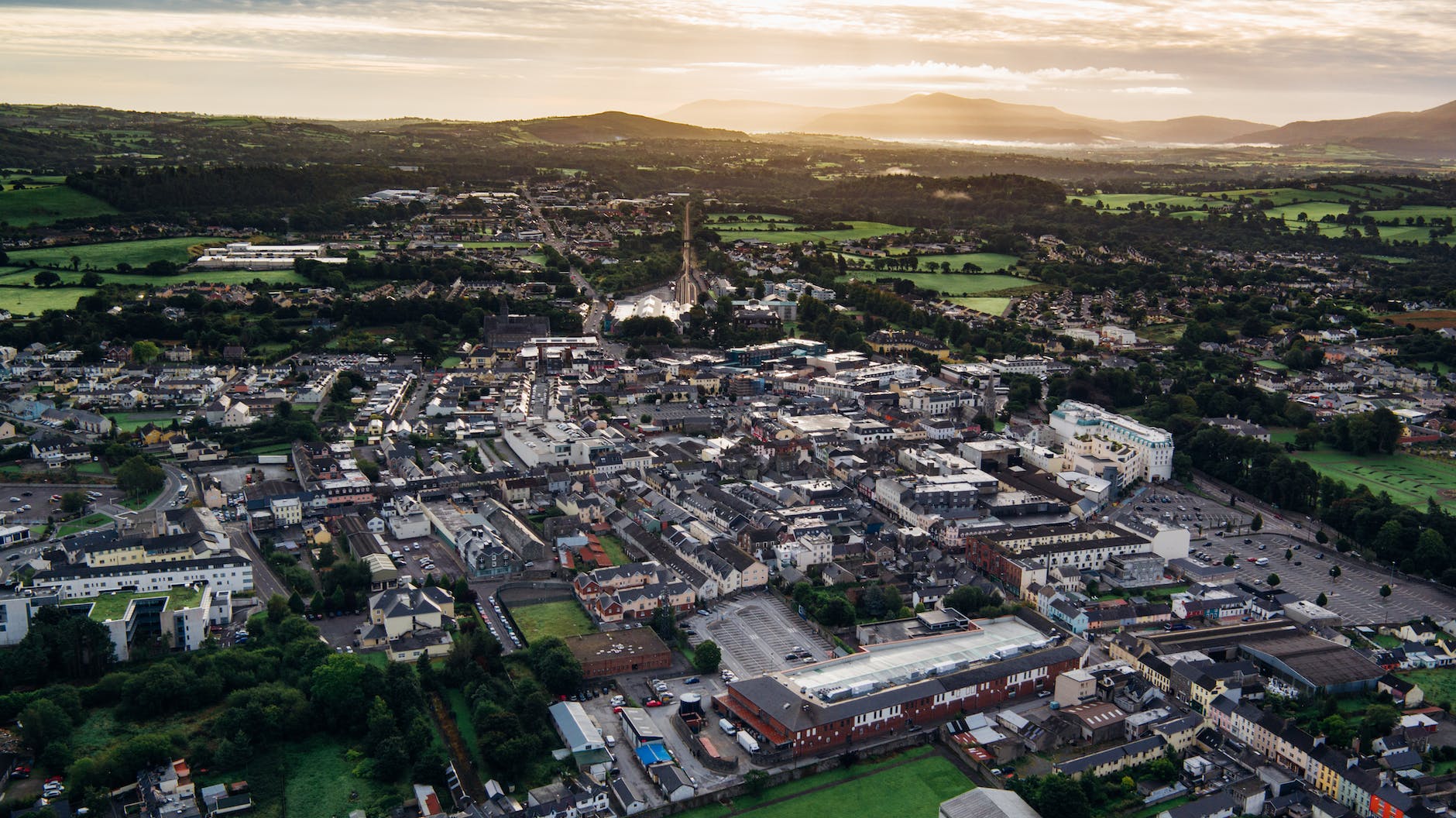
From the “walking cities” of 1815 to the sprawling cities of today

In recently teaching about the development of the American suburbs, I was reminded of the description of “walking cities” in 1815 provided by historian Kenneth Jackson makes in Crabgrass Frontier:

Photo by Ryutaro Tsukata on Pexels.com

The first important characteristic of the walking city was congestion. When Queen Victoria was born in 1819, London had about 800,000 residents and was the largest city on earth. Yet an individual could easily walk the three miles from Paddington, Kensington, Hammersmith, and Fulham, then on the very edges of the city, to the center in only two hours. In Liverpool, Birmingham, Manchester, and Glasgow, the area of new building was not even two miles from city hall. (14)

While the focus here is on congestion, the time it takes to walk through such density in a major city is notable: in a few hours, one could traverse a significant portion of the city.

Introduce technology with more speed – trains, streetcars, cars, etc. – and cities could expand in space. People could live further from work (the proximity of home to work for many is a feature of the 1815 city that Jackson also notes). The city could go on for miles. The suburbs could extend even further. But, the ability to see a significant portion of the city in a single walk became much harder.

Filming a wealthy home exterior, McMansion interior

A film production designer describes the problem of finding a home for filming:

Photo by Mark McCammon on Pexels.com

We were looking for the Voze mansion and having trouble finding an exterior and interior to match, as most wealthy estate-type people heavily renovate their interiors and look more McMansion inside. The exterior was a house in Pasadena.

I think this is saying that they had a problem finding a home fit for wealthy characters because the homes with the gravitas-invoking exterior did not necessarily have the same kind of interior. Having lots of money can be associated with a particular aesthetic. Describing a portion of the home as having a McMansion look is not usually a good thing. It is a negative term. I imagine a McMansion interior could involve the latest trends, having large spaces, and going for shock and awe rather than refined details.

Through the magic of filming and editing, a different exterior and interior can be put together without too much evidence otherwise. Of course, it is also fun to watch for situations where they do not exactly match.

The factors behind the spread of suburban pickleball courts

Pickleball is increasingly popular in the United States and the game has also spread through the Chicago suburbs:

Photo by Raj Tatavarthy on Pexels.com

Bill and Linda Graba of Hoffman Estates are widely considered to be the godparents of pickleball in the Northwest suburbs. They picked up the game after retiring to The Villages in central Florida, where they spend their winters…

Graba said he and his wife started promoting the game locally in about 2009. They helped get indoor courts at what was then known as the Prairie Stone Sports & Wellness Center in Hoffman Estates and outdoor courts at Fabbrini Park in Hoffman Estates. For the past 10 years, they’ve organized a six-county tournament that brings in about 200 participants.

Graba said public outdoor courts are popping up throughout the suburbs, including Palatine, Schaumburg, Streamwood, Hanover Park and St. Charles.

“It’s basically all over every suburb,” Graba said. “If they haven’t had them in the past, people are asking and they will have them soon.”

This seems ripe for some analysis at the community level:

  1. In what communities are pickleball courts showing up?
  2. What are some of the common processes by which pickleball courts come into existence? Who is asking for courts and who is building them? For example, are park districts primarily funding these?
  3. The space and resources for pickleball courts is coming from where? Is this about the transformation of tennis courts or are other spaces being used?

I suspect there are some patterns to who is playing, where they are playing, and how the game is spreading. As the game spreads, there could also be some change to the answers to these questions.

Of changing grocery store markets and food abundance or food deserts

Three decades ago, the Chicago area grocery market was very different:

Photo by Angele J on Pexels.com

For years, Chicago was largely a two-grocery town: as recently as the late 1990s, Jewel and its No. 2 rival at the time, Dominick’s, controlled two-thirds of the local grocery market.

Times have changed:

But the grocery landscape in 2022 is vastly different. Dominick’s has been gone for nearly a decade, while Jewel and 21st-century rival Mariano’s face increased competition from major retailers such as Walmart, Costco and Amazon Fresh as well as specialty grocers, including Trader Joe’s and the Amazon-owned Whole Foods.

Jewel is still the most-commonly cited grocery-shopping destination for Chicago-area families, according to Nielsen data, but Aldi is nipping at its heels, having transformed itself from the stock-up store of the 1990s. Throw in a handful of online delivery startups that popped up during the pandemic and shoppers have more options than ever, squeezing Jewel from all sides.

Yet, newer grocery stores that once signaled hope are changing locations too:

The Whole Foods that opened in Englewood six years ago to live music, TV-ready politicians and out-the-door lines will close Sunday with little fanfare…

The city spent $10.7 million to subsidize the construction of the shopping center in which the store is located. When Whole Foods announced the 832 W. 63rd St. location’s closure in April, local activists said they felt betrayed, adding that the shuttering would limit access to fresh and healthy food in the neighborhood.

The company closed five other stores across the country “to position Whole Foods Market for long-term success” at the time, including a location near DePaul. It also opened an almost 66,000-square foot location in the Near North neighborhood the same week.

Few grocery options remain in the neighborhood. The handful of grocery stores remaining include a location for low-budget grocer Aldi close by and the smaller “Go Green Community Fresh Market” run by the nonprofit Inner-City Muslim Action Network. Another nearby Aldi in Auburn Gresham abruptly closed in June.

This highlights how much change can come to an essential market in a relatively short amount of time. New actors, new methods, new contexts.

The issue of food deserts was commonly discussed not too long ago but is not mentioned in this second article. However, these two articles highlight ongoing patterns even as the stores and brands change: some places have plenty of grocery stores (with Jewel and Mariano’s locations nearby) while others are not attractive to companies and residents have to search harder and further for food options.

Does this rapid pace of change suggest grocery stores will be quite different still in a few years? Can we imagine delivery only or virtual reality grocery shopping?

What if a new social class symbol is leaving your lawn covered in leaves for the good of the earth?

Clearing the leaves from your lawn is part of a set of practices and displays involving the lawn that are related to social class. This includes a green lawn and a weed-free lawn. However, will these practices be disrupted if new recommendations suggest leaves should stay on the lawn because they are good for the grass and soil?

Photo by Kadri Vu00f5sumu00e4e on Pexels.com

I can imagine this as part of a new set of lawn practices in the coming decades. This could include less grass. Grass that is not necessarily green. Fake turf. More stones, gravel, and rock. No watering. Smaller yards or no yards. Overall, less emphasis on a particular kind of lawn and more variety.

But, this could take a while. Practices regarding clearing leaves have a long history. Social norms take time to change. It could happen in a few communities or among influential people that lead the way. Maybe it requires some influential social media actors.

In my own yard, in recent years I have cleared a good number of the leaves and left others. Some get blown away and others buried by snow. Not every leaf has to go. Some stay in the bushes and beds. This year, I piled some leaves in a new garden we started earlier this year. We will see what is left in the spring and how the new growth begins.

Why might suburban leaders head up legal challenge to IL law ending cash bail?

A lawsuit led by suburban officials challenges a new Illinois law in court:

Photo by Pixabay on Pexels.com

When more than half of Illinois’ state’s attorneys go to court in Kankakee County next month in a last-ditch effort to block the controversial SAFE-T Act, the proceedings will have a distinctly suburban flavor.

The offices of McHenry County State’s Attorney Patrick Kenneally and Will County State’s Attorney James Glasgow have been chosen to serve as lead counsel in a lawsuit they and 61 of their peers have filed seeking to have the massive criminal justice reform bill ruled unconstitutional…

The state’s attorneys argue that violates several parts of the state constitution, including the Separation of Powers Clause by stripping judges of their full authority to detain defendants, set monetary bail and revoke bail. They also argue that a portion of the Act that gives police discretion to release defendants without bail on low-level offenses unlawfully takes that authority away from the courts…

The state’s attorneys argue that violates several parts of the state constitution, including the Separation of Powers Clause by stripping judges of their full authority to detain defendants, set monetary bail and revoke bail. They also argue that a portion of the Act that gives police discretion to release defendants without bail on low-level offenses unlawfully takes that authority away from the courts.

Suburban counties are not the only ones party to this lawsuit, but is it meaningful that they are leading the effort? A few general patterns scholars might point to:

  1. The image and ideology of suburbs suggests they are safe places relatively free of crime.
  2. Where does crime happen? It is viewed as a problem of cities and urban centers.
  3. The first two points are connected to long-term suburban patterns of exclusion by race/ethnicity and social class. Who commits crime? Not the typical suburbanite.
  4. Suburbs have a long history of fear of crime. And they act regularly in their suburban communities regarding crime, ranging from creating gated communities to supporting police efforts to choices about development and amenities.
  5. A suburban fear of crime is linked to particular political patterns and activity, including Nixon and the Republican Party’s “Southern strategy” to then-President Trump’s 2020 claim that the suburbs are under threat.

Put these factors together and suburban leadership on this issue may be no surprise.

The problems with suburbs: carelessness, lack of community

Jason Diamond’s book The Sprawl: Reconsidering the Weird American Suburbs argues the suburbs suffer from these problems:

Photo by Kelly on Pexels.com

The overall problem with the American suburbs has always been carelessness. Profit over people; keeping people out to keep up the property value; building up and out without much reason besides making more money. The idea is that what you and your family have is enough. What else could you need? Everything, you’re supposed to think, is fine as it is.

Almost every suburb in America has one thing in common: somebody built the place and moved on. These little subdivisions and towns were built, but they weren’t completed. Developers built houses and stores, but they couldn’t create community. And that’s the piece I saw lacking in so many suburban places from coast to coast: community. You can call the place you live one, but a community is only as good as the people who work to make it stronger. Nothing is complete: we’ve built the suburbs out, and now it’s time to grow them from within. It’s time to look at the past to see what we’ve done wrong, apply it to the present, and learn for tomorrow. Because whether we like it or not, the future is still in suburbia. We just need to reclaim it. (217-218)

Arguably, if you and your family have all you need in your single-family home and middle-class or higher lifestyle, what need do people have for community? People can believe they are self-sufficient enough to avoid reliance on others and can limit conflict with others. Whether this is actually true does not matter. Even as the suburbs have all sort of social networks and social interactions and are built on a long history of policies, decisions, and ideology, the perception that people can be independent and live the good life matters. This all contributes to the idea of individualism.

Reclaiming community at the suburban level is an interesting task. There are multiple communities already present in suburbia, but they do not necessarily advance the interests of the community as a whole or the people who might want to live there and cannot. For example, people are involved with local schools, public and private. Suburbanites care about education and how good school systems support higher property values. These interests and existing connections may be helpful or not for thinking about the community as a whole. Suburbanites like exclusion and local government control, two factors that can work against creating community for everyone.

Suburban voters were split in 2022

As the data trickles out from the midterm elections, here is one summary about how suburbanites voted:

Photo by Anna Shvets on Pexels.com

In 2018, independents went for Democrats 54 percent to 42 percent. Moderates broke for Democrats by a 26-point margin, and the suburbs split. In 2020, according to the national exit poll, independents went for Democrats 54 percent to 41 percent, moderates broke for Democrats by a 30-point margin, and Democrats won the suburbs 50 to 48 percent. Fox had similar results.

This year, independents went for Democrats narrowly. Moderates broke for Democrats by 15 points. And the suburbs narrowly went for Republicans in the national exit poll, while narrowly going for Democrats in the Fox voter analysis. Our national stalemate continued.

In the current state of national politics, both parties want the suburbs to break their way. It appears suburbanites were fairly split this year, meaning that not a whole lot changed. Will either party have a platform or message in 2024 that is more appealing to suburbanites than the other side?

Seeing these results also got me thinking about redistricting, gerrymandering, and how suburban areas are incorporated in districts. Given their volatility and patterns (suburbs closer to big cities lean one way, those on the metropolitan edges lean another way), do party leaders want to consolidate suburban votes or break them up? I would be very interested to see an analysis on this.

UPDATE: In at least one metropolitan region, Democrats continued to make inroads in the suburbs. Referring to DuPage County and the Chicago region as a whole:

The once-impenetrable GOP stronghold was considered purple territory in recent election cycles. But in a watershed moment, Democrats captured the county board chair seat and appeared to hold onto their board majority Tuesday.

The shift in DuPage is part of a political evolution in suburban areas. Four years after Democrats made significant gains in the region, several of the collar counties turned a darker shade of blue on Tuesday.

Democrats flipped key state House districts in the Northwest suburbs. They solidified control of the Lake County Board. The GOP has no representation in Congress from northeastern Illinois. And in DuPage, Democratic state Rep. Deb Conroy became the first woman elected county board chair.

As noted in the article, this is a significant change over the course of several decades.

Do not call it a shopping mall; call it a campus

With the opening of several hundreds units of housing on a former portion of the Fox Valley Mall, one leader used a different term than “mall” to describe what was unfolding on-site:

Photo by Armin Rimoldi on Pexels.com

While the mall has been around since 1975, Samson said he even has stopped calling the burgeoning “live, work, play” development by that name.

“Notice how I didn’t say mall,” Samson said. “It’s a campus.”

A shopping mall is primarily about commercial activity. A campus implies something different. Probably the most common usage of the term refers to college campuses. On such a campus, there is a variety of activity: residential spaces, social spaces, academic spaces, athletic spaces, and more.

Many shopping malls are hoping for transformations that help them move beyond just stores and a few eateries. The shopping malls that survive the next decade or two could include apartments, condos, townhouses, hotels, restaurants, entertainment venues, and cultural attractions in addition to stores. All of these options would help make the mall/campus more lively throughout the full day rather than just during shopping hours. In this sense, the goal is not that different than numerous mixed-use developments in suburbs and cities: create a home base of residents plus a steady flow of visitors who spend money and contribute to social activity.

Will the term campus catch on to describe former shopping malls? Time will tell and certain influential actors, such as developers, architects, and local leaders, can help make it happen.

I received no shortage of political mailers this year and the only thing they may have helped with was name recognition

Our home mailbox has been filled for weeks with mailers for candidates at the national, state, and local level. What have I learned from all of these mailers? Very little.

Photo by Abstrakt Xxcellence Studios on Pexels.com

However, the one use they may have is for candidates’ names to catch my attention. I consider myself a fairly informed voter yet I cannot keep up with all of the local races. In a state with so many taxing bodies, there are numerous races for the Forest Preserve, County Board, municipal positions, and more. Who has the time to look at all of the positions of those candidates? I will enter the voting booth today with limited knowledge about dozens of names for positions that the average suburbanite has little knowledge about.

Thus, a mailer might catch my eye with a name in a way that another medium might not. All those texts from candidates in recent weeks? Most were automatically marked as spam by my phone and the others I did not look at. Political ads on television or radio? Easy to avoid by switching stations or using streaming services. News broadcasts about candidates? Can click past or avoid reading.

At the least, I took each of those mailers out of the mailbox, looked at them quickly, and then recycled them. Could they have planted a name or idea in my head? Perhaps.