On one hand, this is a set of popular posts covering a range of topics from affordable housing to transportation to online real estate to marketing suburbs to community reactions to a proposal from a religious group regarding their property. COVID-19 did not dominate the top of the list nor did politics.
On the other hand, like in 2020, these most popular posts all had to do with place. In particular, four of the five had to do with the Chicago region. Several touched on topics on which I have published research. I vowed at the beginning of 2021 to continue to publish posts about places and this will continue in 2022. I continue to be convinced that place is understudied and not discussed enough as an critical factor in many of the questions facing the United States (and other societies as well).
The streetcar system is no more with numerous works discussing how it was dismantled amid a push for cars and highways. But, the video is a reminder that cars and streetcars operated together for at least a while as the city and region grew quickly. Both provided opportunities to travel throughout the area and utilized the same roadways.
It is also interesting how such altered videos – here with color and sound added – have the opportunity to change perceptions of the past. When even relatively recent history is displayed in black and white, it seems less vibrant and real. Throw in approximate sound and such video could help viewers feel as if they are back in Los Angeles nearly a century ago.
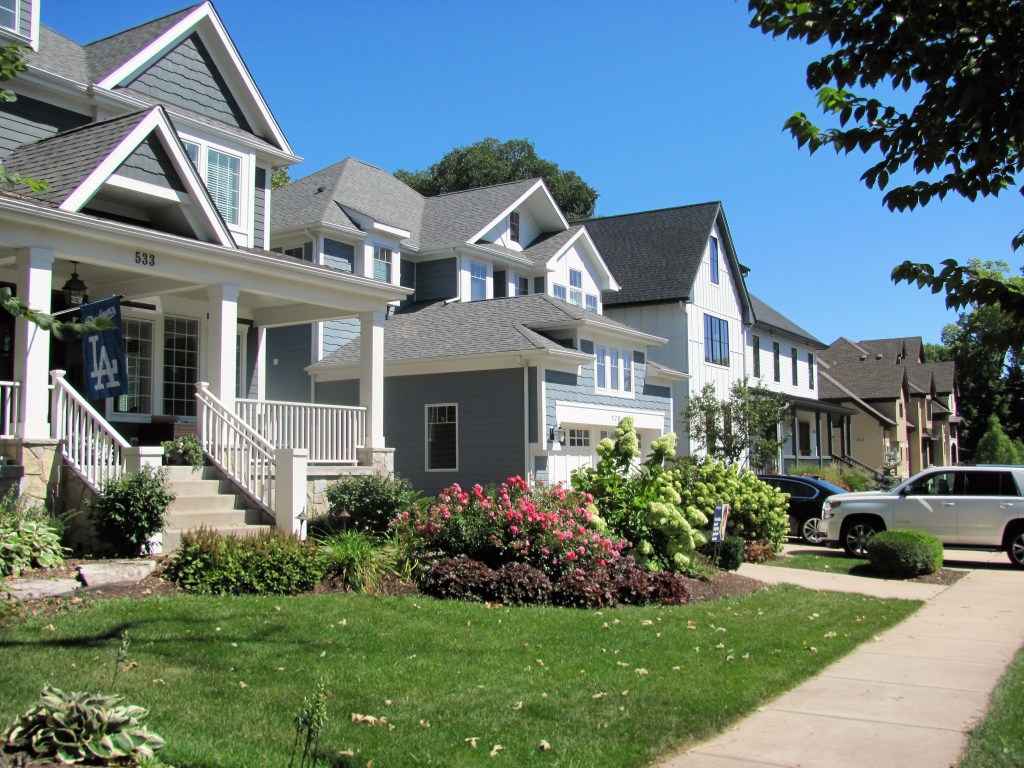
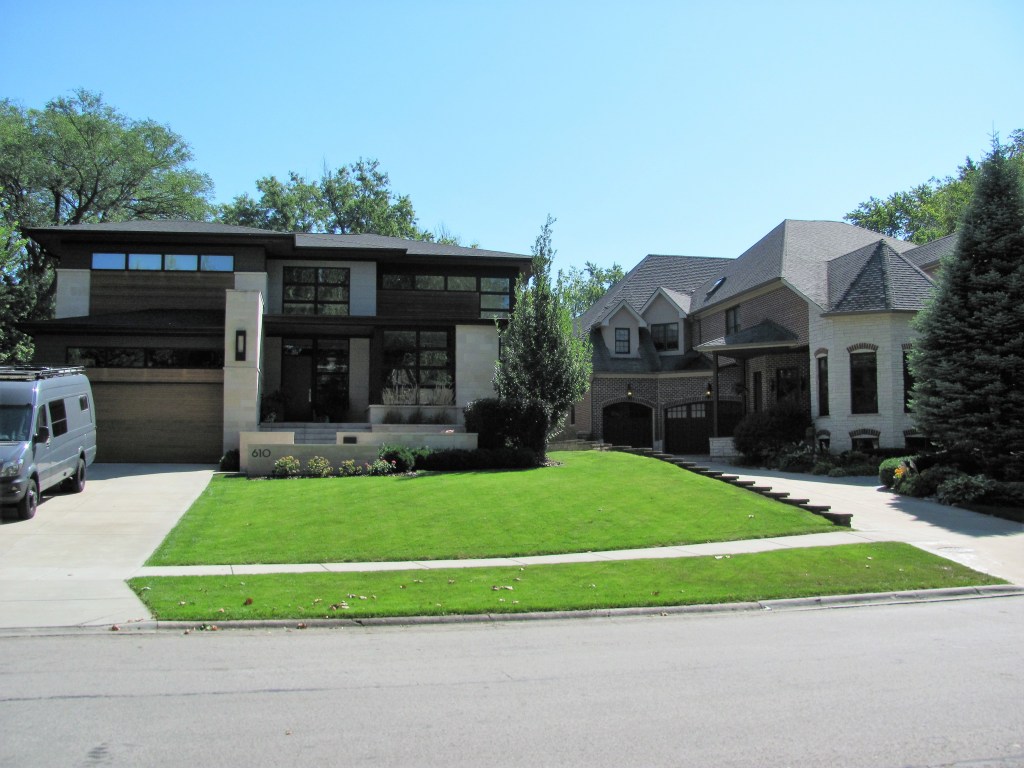
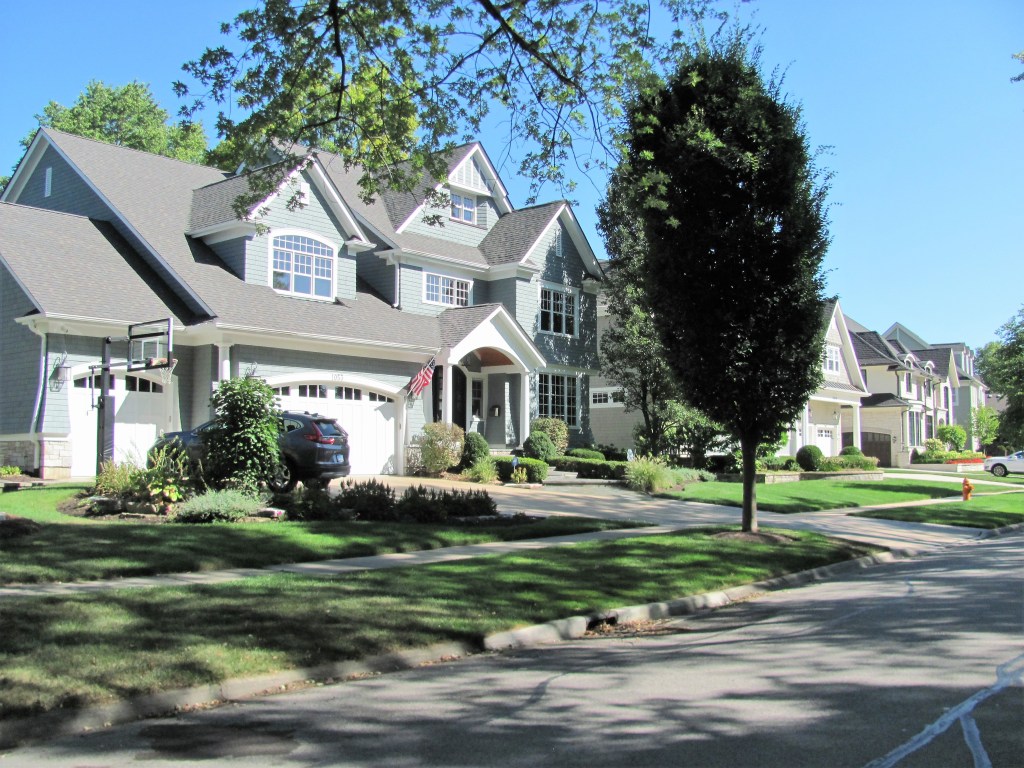
Analyzing before and after images of 349 teardowns between 2008 and 2017 in the wealthy and sprawling suburb of Naperville, Illinois, shows patterns in aesthetic choices and their fit in older neighbourhoods. First, the teardowns are significantly larger and have different features including larger garages and more windows. Second, over 60% of the teardowns feature Victorian styling. Third, the teardowns are often next to other teardowns in desirable neighbourhoods near the suburb’s vibrant downtown. These visual findings show how teardowns that add to the housing stock often imitate common architectural styles yet exhibit disparate features compared to older neighbouring homes.
All three of these streams helped lead to this project. And there is a lot more that could be done in this area as teardowns affect numerous neighborhoods and communities in the United States.
Karen Darch was elected mayor of Barrington in 2005, only two years before the merger of the Canadian National and EJ&E that would increase the freight traffic in Barrington from three trains to up to 20 each day. She understands what worries Roselle and other suburbs along the Canadian Pacific line, as CP and the Kansas City Southern pursue a merger.
The merger could bring six to eight more freight trains a day through Roselle, Itasca, Wood Dale, Elgin, Bartlett, Schaumburg, Hanover Park and Bensenville. Leaders in those towns are concerned about potential traffic backups, emergency vehicle delays, additional noise and more pollution, as vehicles idle for longer…
Under Darch’s leadership, Barrington fought to extend the oversight period over CN, arguing that crossings were being blocked for longer than what the railroad agreed to.
The village also worked for years to get federal money to build an underpass for Northwest Highway at the CN tracks — improving traffic flow and making it easier for ambulances to get to Advocate Good Shepherd Hospital.
I first ran into this issue in the late 2000s while conducting research involving a community that was also affected by the moves of Canadian National. To many leaders and residents in such suburbs, the increased traffic was not just a nuisance; in a region with many at-grade rail crossings, more and/or longer trains has the potential to snarl traffic, limit the ability of emergency vehicles to get around the community, and create more noise and pollution.
The irony is that many Chicago suburbs were founded along railroad lines and the region itself is central to the American passenger and freight rail network. Without the railroad, the Chicago region and many of its communities would not be the same. That same train that makes day to day suburban life more difficult is important for Barrington and the region as a whole.
There still might be solutions to these problems. One solution underway for a while is to move more of the freight train around the outskirts of the region so that it is does end up in communities and the city itself. A second solution is to limit the number of at-grade crossings so that roadways and trains do not interact as much. A third option is to see the whole of the region in these discussions so that what is good for Barrington and other suburbs could also be good for the region and vice versa.
The Gist: It all started with a few white ladies in Naperville, Illinois – because of course it did. In the mid-1990s in the culs-de-sac of the affluent suburban Midwest, where triple-wide driveways flank brick McMansions, Joni, Becky and Mary Beth decided they liked cute little hand-sized stuffies produced by modestly sized toy company Ty Inc., and wanted to collect them all. An inauspicious beginning, yes, but one that would find Ty founder, future billionaire and eventual criminal tax evader H. Ty Warner ignoring how Mary Beth helped stir nationwide consumer frenzies for his products, and suing her for copyright infringement. So this story has its heroes and villains, a couple who fall somewhere in-between, and a nation of millions who caused a subsequent consumer demand for plastic totes so they can shove their hundreds of worthless Beanie Babies beneath the basement steps. (The real winner here? Probably Rubbermaid.)
Based on this short snippet, I am thinking of several possible connections between McMansions and Beanie Babies:
These homes offer lots of space for storing and displaying the toys. All those bonus rooms and square footage mean the owners can have hundreds, no, thousands, of Beanie Babies.
The people who can afford McMansions can afford a lot of Beanie Babies.
Related to #2, those who live in McMansions, homes often criticized for their architecture and design, want to own lots of toys that became a fad.
Perhaps the simplest explanation: roughly 50% of Americans lived in the suburbs by the 1990s, most McMansions are in the suburbs, Naperville’s population was booming at this time, and Ty Warner is from the Chicago area…meaning all of these spaces happened to collide in this toy boom.
Take the long view and take those gifts and turn their value into your own self-storage property. Then, you gain from others who need to use your facility.
This may not be what your family and friends want for Christmas but it could be useful and/or valuable down the road.
In Extra Life: A Short History of Living Longer, Steven Johnson briefly summarizes how the development of big cities around the world in roughly the last two centuries often came at a high cost regarding health. After discussing the first life tables developed in England:
How could any economy that was creating more wealth than any other place on earth produce such devastating health outcomes? The answer that Farr proposed with epidemiological data was similar to the one Marx and Engels were forming at the same time using political science: the mortality rates were plunging because the defining characteristic of being “Advanced” at that moment in history was industrialization, and industrialization seems to come with an unusually high body count in its initial decades, wherever it happens to arrive. The twentieth century would go on to show the same trends happening around the world whenever people left their agrarian lifestyle and crowded into factories and urban slums, even in economies where communist planners were driving the shift to an industrial economy…
The data told an incontrovertible story: industrial cities were killing people at an unprecedented rate. (73-74)
As Johnson goes on to note, this trend did not necessarily last as many cities and the millions living there became healthier over time. But, that transition period in Liverpool and other industrializing cities, whether in the 1800s or in more recent decades with the development of megacities around the globe, comes at a significant cost.
Even though I have not emphasized the health aspects of this in the past, this is part of the reason that I link the beginnings of sociology, urbanization, and industrialization in my courses. The population shift to big cities plus a new economic and production structure are noteworthy enough. But, these are connected to seismic shifts in societal structures and relations. People had lived in relatively small communities for thousands of years and this was shifting to significantly different kinds of communities, governments, and interaction. Sociology as a discipline emerges at this time to help explain and understand these changes. As noted above, Marx was seeing all of this happen and expressedt his concerns of what it all meant.
And all of this affected the human body in significant ways. This shift required poor health and death for many. We may look now and think it turned out okay – and life expectancy around the globe has increased dramatically – but it influenced bodies and social structures in profound ways.
Car sharing services. There are more of these around today. Cut out the middle-man business and just deal with a private car owner for your transportation.
Taxis and/or ride share companies. These are more available in some places than others and do not allow the same freedom as being able to drive a rental car wherever and whenever you would like.
Public transportation. Even less available outside of denser urban areas. And even in places where mass transit is plentiful, many people still opt for private vehicles.
Walking or bicycling. Very difficult and possibly dangerous in many locations.
Borrowing a car from family or friends or doing without it for a time. It could be done but the location and time frame is very important.
Thinking back, I can recall multiple trips where a rental car was a necessity in order to get where we wanted to go. At the same time, some work trips did not require a vehicle because the location of the meeting was in a large city with public transit options. And if you are in a suburban or more rural setting and your car is in the shop for more than a day, a car rental may be very necessary.
There may never be a full recovery for dozens of Naperville residents continuing to struggle in the wake of a devastating tornado that tore through sleepy neighborhoods shortly after 11 p.m. June 20, leaving one house destroyed and more than 200 damaged in an area just south of 75th Street…
Six months later, they and so many others continue to deal with slow-responding insurance companies, negligent contractors, supply-chain issues and a city government that’s never grappled with the long-term effects of devastation on this scale…
Some homeowners are simply choosing to sell for the value of the land. Others are dedicated to rebuilding no matter how long it takes…
City officials say they understand the frustration in the neighborhoods and acknowledge the difficulty in assessing resident needs. They’ve tried to expedite the permitting process — waiving fees is being considered if it directly benefits homeowners and not the insurance companies — and they suspended charging residents for utilities.
The feat of building suburban subdivisions can be impressive in its own right. When the mass construction of neighborhoods occurred regularly after World War Two, it represented a change to how housing was built.
Reconstructing suburban subdivisions might be a more difficult task. Rebuilding numerous homes and reconstructing daily lives amid normal suburban life is not easy. The advantage of building a whole subdivision at once is that all of the equipment, materials, and labor can be in place at the same time. When some homes are destroyed and damaged, it sounds like efforts are more scattered or focused on particular properties.
Since suburbs do experience tornadoes at least semi-regularly in the United States, is there a set of best practices communities and residents can follow? Putting homes and life back together after a calamity is never easy but perhaps there are clearer paths to resiliency.
An Introduction to Sociology course could be renamed “Introduction to Seeing Structural Patterns in Society.” For those not used to looking at the world with this particular lens, such a class can be an education. I recall being in this position as an undergraduate and feeling the challenge; how can you see and understand the world from a structural perspective?
Continually contrast structural perspective to a more individualistic view. As we discuss different topics, I often compare the ways we might individually experience life and particular social phenomena and the collective experience. Additionally, a common American individualistic approach – my decisions explain my circumstances – provides a foil to a sociological perspective. Even as we enact our own agency, we do so within conditions not entirely of our own making (as Marx suggested).
Provide multiple opportunities for students to practice deploying structural perspectives. Some of the assignments I have throughout the semester ask students to connect their own experiences to sociological analysis. To do this, they need to step outside of themselves to see the bigger picture. Is their experience typical, different, and how might a sociological theory or concept explain it? As Mills suggested, history and biography come together in “the sociological imagination.”
By the end of all of this, I hope students will be able to use this sociological lens in different situations. Even as many will not be sociology majors, their work in different disciplines and a variety of careers could be enhanced by thinking sociologically with an emphasis on large-scale patterns and forces.









 Legally Sociable