For five years running and the highest priced real estate by close to $2 million: America’s most expensive zip code

One way to consider the geographic concentration of wealth in the United States is to look at the most expensive zip codes. The leader is both persistent and has housing costs significantly above others on the list:

Photo by cottonbro on Pexels.com

“Reaching a new record median sale price at $7,475,000, Atherton’s 94027 remains the #1 most expensive zip code in the U.S. for the fifth consecutive year — nearly $2 million ahead of the runner-up,” the real estate property firm said in a news release. “Not only that, but the billionaire favorite also saw its median rise 7% year-to-year, suggesting that this exclusive enclave may continue to retain its leading position in the future.”…

The list of the ten most expensive zip codes includes several locations in the Bay Area, one in the Boston area, one outside New York City, one in Miami, several in southern California, and one outside Seattle. These are not surprising given the money in such locales plus the high real estate values in these markets.

At the same time, the Atherton zip code stands out. The housing is almost $2 million higher than other desirable locations. This does not necessarily it has the most expensive properties in the United States but it does speak to the uniformity across the zip code. And this has been the most expensive zip code for five years running. There is consistency which could be related to development activity (or a lack thereof), demand for housing in that particular place, and local regulations and zoning.

Even as numerous scholars have studied the concentration of poverty in certain locations or gentrification and changes in particular locations, I have not read as much on the concentration of wealth. How often does top-end wealth change locations? I would guess at least some of the zip codes in the top ten have been significantly wealthy for a long time. However, locations can change, new industries arise, and capital can move and real estate fortunes change. How different would a similar list be several decades ago or a century ago in the United States?

The newest skyscraper attraction/commodification: climbing the outside with just a safety harness

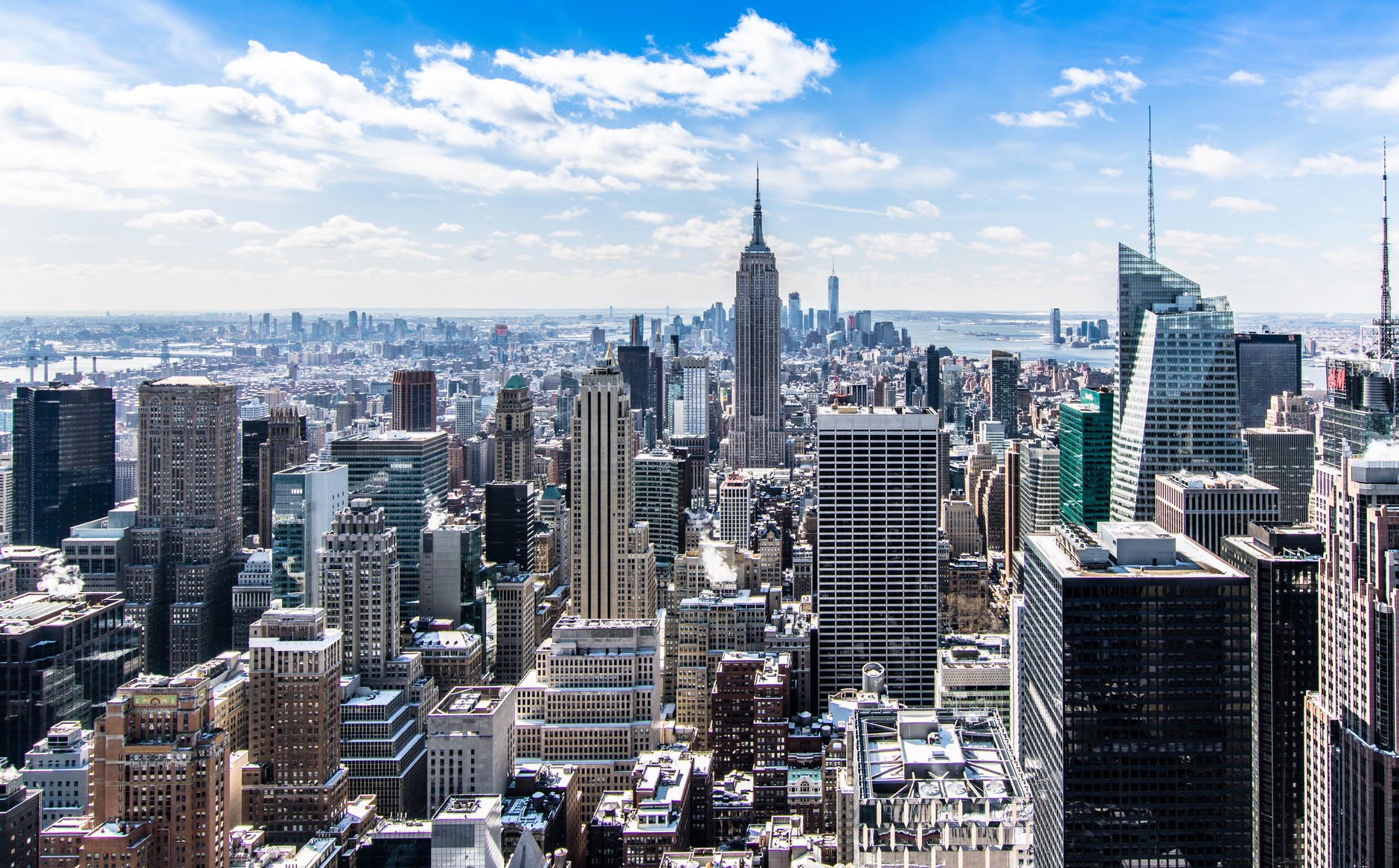
It may not quite be climbing the Burj Khalifa in Mission: Impossible but a new attraction in New York City offers the opportunity to climb at 1,300 feet up with just a safety harness:

Photo by Lukas Kloeppel on Pexels.com

This was City Climb, an attraction opening Tuesday at 30 Hudson Yards, one of the city’s tallest buildings. It gives thrill-seekers a unique perspective on New York that no observation deck could hope to match: No walls, no glass windows, no railings. Just skyline…

Climbers are equipped with specially designed safety harnesses that let them ascend an outdoor staircase, from the first lookout known as the Cliff, to the top platform called the Apex, located 1,271 feet (387 meters) above 10th Avenue.

There, they can lean out over the edge and look down at the Empire State Building. City Climb will operate rain, snow or shine, but will close if the temperature drops below 23 degrees Fahrenheit (minus 5 degrees Celsius) or if there is dangerous weather in the area…

Then, she leaned back, arms stretched out, hanging over the city as a cable tether kept her from falling to the streets below.

I find two features of this striking:

  1. The quest for humans to conquer obstacles and/or natural forces in two ways. First, the goal of building tall structures that stretch far beyond the size of people and many natural features. Second, the willingness of many to test their limits, conquer their fears, to try something new. And do it all on one of the tallest buildings in a city and country known for stretching these limits. What comes after this?
  2. The ongoing commodification of the skyscraper experience. Skyscrapers emerged because of a land for space where land was limited and expensive. With the rise of skyscrapers came sky decks and seeing from such a great height. Then came new experiences, ranging from glass floors to tilting parts to now being outside. People are used to seeing the world from the air – airplanes offer even better views – and also desire new experiences. All of this for $185 a person.

Driverless trucks, dark stores, and getting groceries

How Americans get their groceries might be on the edge of a big change with the introduction of autonomous vehicles and dark stores into the mix:

Photo by Quintin Gellar on Pexels.com

Walmart and Silicon Valley start-up Gatik said that, since August, they’ve operated two autonomous box trucks — without a safety driver — on a 7-mile loop daily for 12 hours. The Gatik trucks are loaded with online grocery orders from a Walmart fulfillment center called a “dark store.” The orders are then taken to a nearby Walmart Neighborhood Market grocery store in Bentonville, Arkansas, where Walmart is headquartered…

Walmart, the nation’s biggest seller of grocery items, is testing the Gatik autonomous vehicles as part of its transition to a “hub and spoke” model for grocery delivery where dark stores are closer to the consumer and used to serve several retail stores. Walmart said the use of automated vehicles will also allow store associates more freedom to perform “higher level” tasks, including picking and packing online orders and customer assistance.

“The old architecture of delivery where you have a giant distribution center four or five hours away from the end consumer does not work anymore. Grocers are forced to set up these fulfilment centers close to the customer, and once you get close to the customer you have to shrink the size of your warehouse,” Narang said. “As the size shrinks there is a growing need for doing repeated trips from the fulfillment centers to the pickup points. That’s where we come in.”

The Kroger supermarket chain has tested autonomous delivery with start-up Nuro since 2018 and said it’s now completed thousands of “last mile” deliveries in the Houston, Texas area. Kroger is also using automated warehouses to launch online grocery delivery in Florida and other states where it does not have brick and mortar locations.

The driverless trucks are interesting in their own right. The United States needs a lot of trucks to move goods all over the place. They are a familiar sight on both local roads and highways. Would it matter much to the typical driver if the semi next to them had no driver?

Additionally, it would be worth hearing more about fulfillment centers/”dark stores.” Where are they located? How do they operate? How many of them are needed in a sizable metropolitan region to fulfill orders? Depending on some of these answers, this could change where warehouses are located (can they be as concentrated, such as in Will County?) How much more efficient is this system compared to now? Somewhere, a particular community could figure out how to maximize dark stores and reap the benefits.

Design standards, paint, and appearances in a suburban downtown

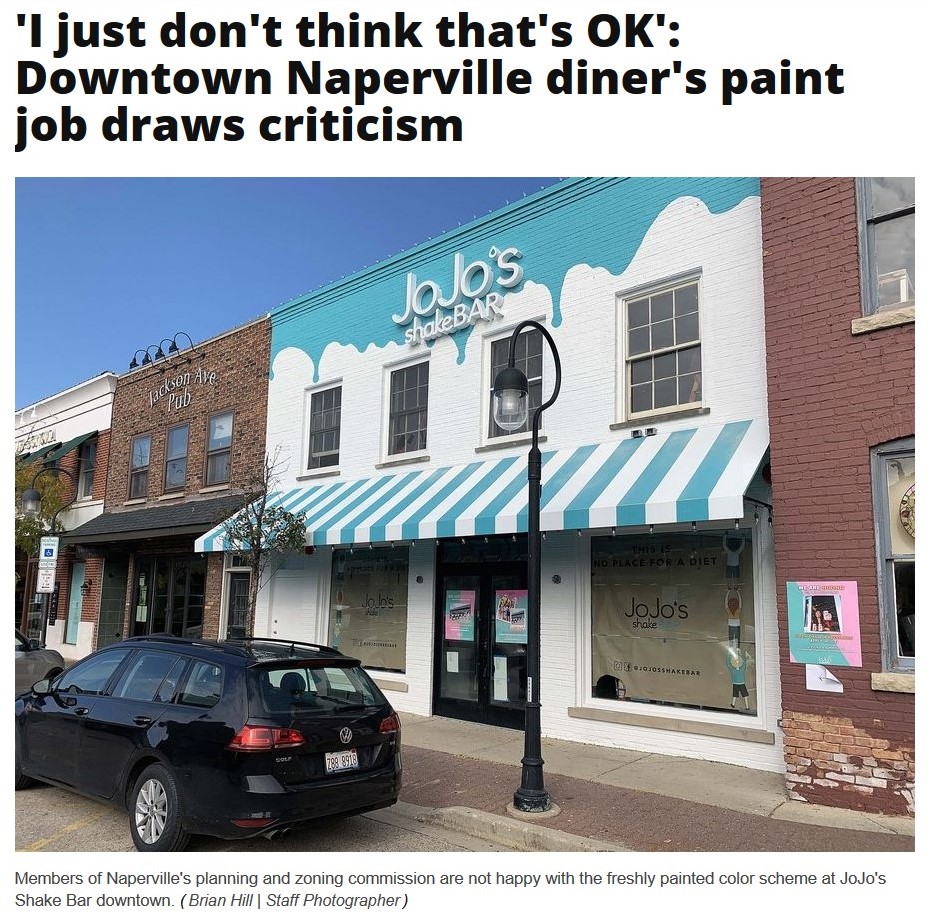
A new business in downtown Naperville chose a different paint job compared to nearby establishments and this led to some discussion:

Members of the city’s planning and zoning commission gave a chilly reception to the freshly painted exterior at JoJo’s, a self-described “next generation diner” with milkshakes, milk and cookie flights and diner classics that’s scheduled to open this month at 5 Jackson Ave.

But because JoJo’s adhered to city codes regarding its main color choice and the amount of accent color it used, there’s not much the commission or the city can do except possibly ask JoJo’s to change the facade and create stricter guidelines for the future…

Behind white raised letters reading “JoJo’s Shake Bar” is a turquoise background stretching across the two-story building that looks like dripping ice cream extending down past the top of the second-floor windows.

Commission members said a uniform block of turquoise across the top would have been acceptable. They believe the dripping effect, however, isn’t appropriate for downtown Naperville…

The issue came up at the end of Wednesday’s meeting when Commissioner Anthony Losurdo said he saw the facade while driving by, labeling it a “sore thumb.” Stressing he wouldn’t have approved the look had it been subject to a vote, Losurdo said he has received complaints about the paint scheme from residents.

Many communities have guidelines for signs and facades. This helps create a more uniform look, ensures that no single property sticks out too much from others, and can limit concerns from nearby residents (such as signs that are too bright or too big). The aesthetics help contribute to an overall character the community wants to promote.

Naperville’s downtown is important for the community. With its revival in recent decades, the city is proud of the bustling business and social activity downtown. It wants to both nurture and protect that for the future. The downtown helps the community stand out from other suburbs and generates revenue.

So, protecting the look of downtown buildings makes sense. On the other hand, concerns about this new business could send out other signals. It sounds like JoJo’s followed existing guidelines. The end result may not be what some leaders and residents desire but it was within regulations. This commission is supposed to talk about issues like these; their task is to see how properties align with the city’s guidelines. The regulations can be changed to prevent such outcomes.

Even having an article with a headline like this might contribute to perceptions that Naperville is a snobby place. The appearance of dripping paint is a big problem for the community? Does a negative reaction welcome the new business? Is it helpful to have these conversations through a local newspaper?

It is unclear how many people and leaders in Naperville have concerns with the paint job. Will it soon be changed and/or the regulations updated to avoid a similar case? Or, can one building stand out a little in a successful downtown?

Rising real estate values in affordable markets make it harder to enter that market

Whether reading about rising real estate values in Elkhart, Indiana or Chicago area locations, this has an effect on who can enter the market as homeowners:

Photo by Markus Winkler on Pexels.com

But after prices soared during the COVID-19 pandemic, even the lower-priced homes became out of reach for many low-income households, according to a recent report from the Joint Center for Housing Studies of Harvard University…

In June 2020, a home slightly below the median price was comfortably in that range, selling for $196,450, Hanifa found.

But one year later, a home that was 80% of the median price would sell for $220,562, meaning even lower-priced homes were no longer affordable for low-income buyers.

The loss of affordability was not limited to Chicago. Hanifa found low-income families could afford a home in just 20 of the country’s 100 largest metro areas in 2021, down from 39 the year before…

The hot housing market has had a trickle-down effect on neighborhoods such as Garfield Park, Humboldt Park and Belmont Cragin, he said. As buyers have been priced out of more expensive neighborhoods, they begin looking at a lower or middle-income neighborhoods where they can make offers over asking. Then residents of those neighborhoods can’t afford the homes for sale.

Rising home values are often viewed very positively. Those who own homes can benefit from the increase in prices without much work of their own. Over time, homeowners hope prices go up and they can get a strong return of investment at a sale.

But, this data is a reminder of the flip side of those same rising prices. If prices go up faster than other factors including accessing mortgages and rising incomes, those who want to enter the housing market – and reap the benefits of increasing real estate values – have a harder time doing so.

This dynamic is recognized in particularly expensive real estate markets. When people discuss Manhattan, San Francisco, Seattle, Los Angeles, and a few other locations, people know there is a limited or nonexistent cheaper market for homeownership. This does not come up as often in cheaper markets, often in the Midwest or South, where prices are not as high and there are more options. If prices increase there as well to beyond what lower-income residents could afford, then what happens?

My quick takeaway: the need for affordable housing is great all over the place. If Americans continue to think that homeownership is a laudable goal, there is a lot to do to help make that possible for all.

The collective joy of millions who came out to celebrate the Cubs’ World Series win five years ago went where?

In wining a game that started November 2, 2016, the Chicago Cubs secured their first World Series in over 100 years. Two days later – five years and one day ago – the city of Chicago hosted a parade and rally for the winners. According to estimates, millions turned out. Between the end of Game 7 and the Chicago celebration that Friday, Cubs fans felt relief, sadness, and joy.

Photo by Aleksandar Pasaric on Pexels.com

Where did all that collective joy and energy go? I recently noted a few things that have happened since that victory and celebration that make it seem like a lifetime ago:

-Just a few days later, the 2016 elections occurred with a result that surprised many. This was part of a particularly contentious period in American politics. What are athletic victories and losses in such an environment?

-COVID-19 came several years later. While this had an effect on sports, it predominated life for an extended period. Looking back through the COVID era can obscure even relatively recent events.

-The Cubs themselves became more like all other teams. After winning, fans and observers had high expectations for more victories. While they did make the playoffs in subsequent years, they did not win an additional World Series and the team traded the remaining core of the team away in the summer of 2021.

Are championships won by local sports teams transformative for communities? I continue to argue no. Those millions who marched and the many others who enjoyed the victory had a good time. It remains a good memory. It can counter long-held sports anguish. But, it does not necessarily translate into changed communities. Did the Cubs win and then fortunes of neighborhoods and organizations improved (beyond the Cubs)? Did people and communities have more courage and trust to tackle issues of common interest? Did the Cubs become a symbol of what can be accomplished with principles or patterns that could be applied elsewhere? Or, did they have a good season, reverse a long-held curse, and life went on?

If Schaumburg is advertising business opportunities and a central location, this means…

I heard again a radio ad recently from the suburb of Schaumburg extolling the benefits for businesses, including a central location, if they relocate there. I thought about this in January 2021 and I wonder now if this ad hints at three patterns:

Photo by Nicholas Githiri on Pexels.com
  1. Schaumburg is an edge city with a lot of office and retail space. The suburb grew rapidly between 1960 and 1980, going from under 1,000 residents to over 50,000 residents. It is home to Woodfield Mall and numerous sizable office buildings. It is featured in Joel Garreau’s book Edge City. If Schaumburg has a lot of vacant space and is struggling to find businesses to sell goods and services or to set up operations, what hope is there for other suburbs that do not have these concentrations that were successful in the past? Brick and mortar operations are declining and COVID-19 has encouraged working from home and this has particular effects on communities highly dependent on both.
  2. This may be less about the troubles of Schaumburg and more about the game that suburbs have to play today. Suburbs market themselves and attempt to differentiate themselves from other suburban communities. The Chicago area has a number of these, including Elk Grove Village hoping to attract makers and Bedford Park touting its industrial space and resources. It is less clear how successful these efforts are but more communities seem to think they need a media presence.
  3. Is there something preferable in advertising a place on the radio? Are people listening in the car more likely to be mobile and/or move? Communities have other options but I do not how attractive they might be. Television is a very broad audience. Targeted Internet or social media ads could be worthwhile if particular categories could be identified. Print may only work in certain outlets. Would billboards catch people’s attention? This may be an emerging branding landscape for which I have not yet found an overview.

If these trends continue, I can imagine a media landscape where ads for suburbs and cities play back to back or near each other, directly juxtaposing their different perceived advantages and trying to chase the elusive businesses and residents who might move.

Patterns among suburban voters in 2021 elections

With election results from Virginia, New Jersey, and other races coming in this week, a narrative about recent elections continue: suburban voters continue to sway elections. Here are the suburban patterns I have seen and heard observers discuss:

Photo by Altaf Shah on Pexels.com

-Enthusiasm among suburban Democrats was down in 2021 compared to 2020.

-Suburbanites were worried and/or angry about schools, whether that was for prolonged closures due to COVID-19 or concerns over curriculum and administrator control as opposed to parents.

-While Biden won over more suburban independent voters, enough tilted back to Republicans in these elections.

-This is a backlash involving race where white voters are exercising their influence.

As pundits, politicians, and academics sort out these multiple and possibly overlapping factors, this is a reminder of two things: (1) suburban voters continue to remain important in American elections (and both Democrats and Republicans are trying to appeal to them) and (2) the patterns and consequences of complex suburbia are not necessarily easy to predict.

Itasca the second suburb to reject an addiction treatment facility – where might it end up?

Last night, leaders of the suburb of Itasca unanimously voted against a proposal to convert a hotel to an addiction treatment facility:

Photo by cottonbro on Pexels.com

After more than 35 public hearings devoted to the Haymarket project, the decision seemed almost anticlimactic. It took barely 15 minutes for board members to cast their vote. Haymarket President and CEO Dan Lustig said he wasn’t surprised by the board’s verdict.

Only Pruyn and Trustee Ellen Leahy explained their opposition, framing the decision in mostly fiscal terms. Both agreed with opponents that the scale of the proposed treatment center was too much for a town of less than 10,000 people to absorb. “A facility this large belongs at the county seat or affiliated with a hospital where appropriate emergency medical services can be provided,” Leahy said.

However, the same organization already tried to open the facility in the county seat:

From nearly the start, Haymarket faced an uphill battle in its second attempt at offering treatment services within DuPage to help combat the scourge of opioid addiction. The county last year reported 112 opioid overdoses, a record high.

Almost four years ago, Haymarket, a Chicago-based nonprofit provider, was denied a bid to start a 16-bed satellite program in Wheaton.

Neither of these decisions are unusual in that suburbs often prefer land uses that they feel will enhance the single-family home character of the community. Other land uses, whether industrial and commercial properties or religious buildings or less desirable properties, need to be sufficiently far from homeowners.

While such decisions may be common, the larger effect is problematic. What DuPage County community would permit this land use? When there is a need to address opioid use, where could struggling local residents and families turn?

If each suburb follows in a similar logic, this contributes to uneven development patterns. Communities with resources and organized political movements can regularly keep less desirable land uses away from them. Other communities may not be able to do the same thing or feel like they have to take advantage of any opportunity that comes their way.

Where will this treatment facility end up? At this point, any effort to locate in DuPage County may be doomed as local residents have developed multiple successful lines of argument against the facility.

(See earlier posts on this saga including suburban opposition to drug treatment facilities and a march against the facility in Itasca.)

Starting work on a 105 mile long linear city in Saudi Arabia

The proposed linear city of Neom is underway:

Photo by Edgar Hernandez on Pexels.com

Saudi Arabia has started moving earth and tunneling through mountains to build a futuristic linear city that officials hope will host its first residents in 2024, the project’s chief executive said.

Employees are still developing regional master plans and a “founding law” for the mega-project called Neom, Nadhmi Al-Nasr said in an interview in Riyadh. But they’ve already started early infrastructure work on its main feature – a 170-kilometre (105-mile) long car-free city called “The Line” that could begin welcoming inhabitants and tourists as early as the first quarter of 2024, he said…

His plans to turn the remote region on the kingdom’s northwest Red Sea coast into a futuristic tech hub encapsulates the major elements of his so-called ‘Vision 2030’ to diversify away from crude, loosen social restrictions and boost investment…

One of the next steps could be the approval of the special regulations that will govern Neom as a “free zone”, with different laws than the rest of Saudi Arabia, Al-Nasr said. That could be completed around the first quarter of next year, he said.

Two features of this possible city are not a surprise. The emphasis on tech is a feature of many city plans, whether for whole new cities or for existing places. Everyone sees opportunity, money, and status in tech. Similarly, the idea of a “free zone” is common as it opens possibilities for business and international culture. Theoretically, a country could reap the benefits of such a location while also overseeing a uniquely setting with fewer regulations.

What may be most unique here is the concept of a linear car-free city. The world’s largest cities today are huge sprawling areas. But, starting with no cars and having a linear city rather than one expanding out from some center sound different. How exactly such a large expanse could be connected to itself so hat it feels like the same community remains to be seen.

Such construction will be a lengthy process, even in a country with lots of resources. And then there is a process of developing a community which adds time. At some point, Neom might join other free zone cities as new kinds of global places.