Reconsidering social media and Internet use after an online-filled COVID-19

The Internet and social media were critical tools for many during COVID-19 with uses ranging from connecting with family and friends to work to activism to going to school. As COVID-19 winds down, does this mean we should reconsider how much time we spend with these technologies? Here is one conclusion:

Photo by Andrey Grushnikov on Pexels.com

Two years ago, I was deleting and undeleting my Instagram account, begging every expert I could find to tell me exactly how to live healthily with the internet in my pocket. In 2021, to do the same would seem a little silly. Netflix’s subscriber growth may be slowing, and Tinder videochats may soon fall out of favor, but it’s hard to imagine that a Great Offlining is really in the cards. Instead, we could be heading for a Great Rebalancing, where we reconfigure how we do our work and how we organize our time on the internet. We’ve grown more aware of how we rely on one another—online as well as off—and of the tools we have or could build for responding to a crisis. The biggest tech companies’ accrual of power remains one of the most serious problems of my lifetime, but I no longer talk about the internet itself as if it were an external and malignant force, now that I’ve lived in such intimate contact with it for so long.

I’m sure I’ll change my mind about everything I’ve just said, but sometimes you just need to time-stamp the moment. Going back through my essays from 2019, I was struck by how easily I had misremembered what the cultural conversation was about back then. Jenny Odell never argued that people should go offline completely. Rather, she told me that deleting your apps or throwing your phone in the ocean would represent a failure to recognize that “we actually really need something like social media.” The desire to go online is human, and “there’s nothing wrong with that part.” We just have to keep reminding ourselves why we’re doing it.

I think it is always a good idea to ask this question about many things with which we spend this time: how important is this to me? Is my time use what I want or did I just fall into this pattern? For better or worse, sometimes it takes a drastic change or crisis to ask this question. It is one thing to use a computer for work or browse social media, another to be on Zoom for hours because you cannot be in the office or go to school. If COVID-19 offers people the opportunity to step back and think again about what they want to do with their time, that would be good.

And I would hope that many would say they do not need social media or the Internet as much as they did in the past year. There are many worthwhile things to do, ranging from movement and exercise, reading, pursuing a non-work project or hobby, playing a game, interacting with the people around you, among other options.

More broadly, it is relatively easy to slip into particular time patterns during the day that may or may not be desired. The average American watches 4+ hours of television a day; is that planned and/or desired or does it just happen? Do people take the time they want to eat or not? Is work more time-consuming that people want? If you add up all of these hours across days, weeks, months, and years, it can be shocking to see how much is spent on certain activities. If people have priorities in what they want to do in life, it should be evident in their time use.

(On the other hand, I do not think it is that useful to micromanage your time to the level some have. I recently read about someone famous who scheduled their day in five minute increments in order to make sure things got done. There is a level of attention and time needed to do this that I would not find worthwhile.)

The rise and fall of the filing cabinet as critical infrastructure

Even before computers and the Internet, the world was awash in information. The filing cabinet provided a way to get a handle on all of it:

Photo by Element5 Digital on Pexels.com

It is easy to dismiss the object: a rectilinear stack of four drawers, usually made of metal. With suitable understatement, one design historian has noted that “manufacturers did not address the subject of style with regard to filing units.” 3 The lack of style figures into the filing cabinet’s seeming banality. It is not considered inventive or original; it is simply there, especially in 20th-century office spaces; and this ubiquity, along with the absence of style, perhaps paradoxically contributes to the easy acceptance of its presence, which rarely causes comment. In countless movies and television shows, one or more filing cabinets line the walls of newsrooms and advertising agencies or the offices of doctors, attorneys, private eyes, police inspectors. Their appearance defines a space as an office but rarely draws attention to the work it does in that office. Occasionally, the neatness or disorder of a filing cabinet gives us an insight into the mental state and work habits of the office’s occupant. Sometimes, the filing cabinet plays a small but vital role in dystopian critiques of bureaucracy.

But if it appears to be banal and pervasive, it cannot be so easily ignored. The filing cabinet does not just store paper; it stores information; and because the modern world depends upon and is indeed defined by information, the filing cabinet must be recognized as critical to the expansion of modernity. In recent years scholars and critics have paid increasing attention to the filing systems used to store and retrieve information critical to government and capitalism, particularly information about people — case dossiers, identification photographs, credit reports, et al. 4 But the focus on filing systems ignores the places where files are stored. 5 Could capitalism, surveillance, and governance have developed in the 20th century without filing cabinets? Of course, but only if there had been another way to store and circulate paper efficiently. The filing cabinet was critical to the infrastructure of 20th-century nation states and financial systems; and, like most infrastructure, it is often overlooked or forgotten, and the labor associated with it minimized or ignored. 6

One thing that humans do, particularly in the modern era, is try to bring order to the world around them. This can come out in physical changes – such as remaking nature or creating megacities – or in discovering and working with knowledge and information in new ways. The filing cabinet is an object that helps with distributed cognition, storing and sorting information for people so that they do not have to keep the thoughts in their own heads.

This history would fit well alongside the history of the modern office as told in Cubed. Alongside arrangements of desks and other equipment and ideas about what offices should accomplish are the humble and essential filing systems. They may even require a lot of space to hold all that important paper but they would rarely feature on an office tour or be the subject of excited conversation.

What is the acceptable amount of neighborhood or community change for current residents?

A look at possible ways to provide more housing in Los Angeles runs into a problem common to many communities in the United States: how much change is allowed?

Photo by Roberto Nickson on Pexels.com

What’s missing? The low-rise, multifamily housing that the city banned in the 1970s and ’80s. Which is why Christopher Hawthorne, the city’s chief design officer, held a competition, “Low-Rise: Housing Ideas for Los Angeles” to solicit new blueprints for so-called “missing middle” housing. “There’s a narrative in L.A., as in many cities, that neighborhoods are changing too fast; but in reality, L.A. is changing less rapidly than at any point in its history,” Hawthorne told me. A former architecture critic at the Los Angeles Times (and for this magazine), he plans to use these designs to win hearts and minds in the community forums where upzoning goes to die.

The winning entrants, announced on Monday, are a reminder that multifamily housing does not need to look much different than single-family housing. Instead, these models weave apartments right into the neighborhood, with understated architecture and clever use of space. In theory, these modest plans ought to take the “neighborhood character” argument against housing growth off the table.

Then again, the whole dialectic of NIMBY vs. YIMBY, Hawthorne contends, doesn’t accurately describe the situation on the ground. “When we actually talk to communities and neighborhoods, we find most people are in the middle. A lot of recent scholarship has clarified historic issues”—such as single-family zoning’s legacy of racial exclusion—”pandemic and wildfire have clarified others. Most people are ready to say our approach of land use and zoning in low-rise neighborhoods is not a sustainable pattern for the 21st century.” They just need help visualizing what change looks like.

There are multiple layers of issues present in these three paragraphs. Here are a few of the issues as I see them:

  1. There is a continuum of change within a neighborhood ranging from frozen in time for decades to immediate massive change in a relatively short amount of time (perhaps in urban renewal style after World War Two). All communities change to some degree but this is affected by time, demographics, and other factors. I wonder how effective it is, as above, to note the relative lack of change to people in a neighborhood who might perceive it differently. I cannot quantify it but I would guess there are plenty of people who move into a location and expect it not to change (or only change in ways that they approve).
  2. The change in character, often equated with adding anything different to single-family homes of the same kind, is hard to combat. Perhaps more people see the need for more housing but how many want it on their block or immediate area as opposed to somewhere else in the city?
  3. I agree that design can help ameliorate these issues. It might be worthwhile to build one of these options with no one’s knowledge and then see who notices. There are ways to construct affordable or even subsidized housing in ways that do raise the attention of nearby residents who might otherwise oppose any efforts to have cheaper housing.
  4. How much would local politicians push for these changes as opposed to representing the existing residential interests? This could matter less if local politicians are at-large representatives but this would also raise the ire of particular neighborhoods.
  5. Neighborhoods with more resources – higher-income residents , people with more connections to politicians and community groups – may be able to slow down or delay possible change more than others. And if the new housing might bring in people not like them, the race/class/”others” issues could be more at play than any actual debate about housing options.

How much change in a neighborhood or character change is desirable? It could vary from community to community and depend on numerous factors.

McMansions as a symbol of excessive consumption, end of life satisfaction edition

One of the more interesting definitions of McMansions I encountered in my 2012 study involved the homes serving as a symbol of excessive consumption. Here is a recent example:

Photo by Gary Barnes on Pexels.com

The survey shows—and it’s not even close—that the No. 1 way in which people define a good life is “having family and friends that love me.” The answer was nearly universal, cited by 94% of respondents. After this came “making a positive impact on society (75%). Having a high-powered job or bunking down each night in a McMansion might be nice, but in the end such things don’t mean that you’re loved or respected or that you’ve made your community a better place.

This finding is a common one: people at the end of life say relationships matter more than what they bought or consumed. For example, see the results of the Grant Study:

“When the study began, nobody cared about empathy or attachment. But the key to healthy aging is relationships, relationships, relationships,” Vaillant says. Close relationships, the data indicates, are what keep people happy throughout their lives. The study found strong relationships to be far and away the strongest predictor of life satisfaction, and better predictors of long and happy lives than social class, wealth, fame, IQ, or even genes. That finding proved true across the board among both the Harvard men and the inner-city participants.

Yet, the comparisons made to what really matters – relationships – are interesting as they target key markers of success in the United States. The first is a high-status job. Adults often define their worth and status by their job. Second is the home. In a country that idealizes owning a single-family home, this makes for a striking alternative to prioritizing people.

Why pick a McMansion here as opposed to a typical suburban single-family home? There could be several reasons. A McMansion is a particular symbol of success, a home whose facade tries to exude status. A McMansion is larger than a typical single-family home, usually coming in between 3,000 and 10,000 square feet. And, perhaps most important here, the McMansion is a symbol of the wrong kind of consumption. Owners are trying too hard with their home to show off. The home is poorly designed. Compared to life-giving relationships, the McMansion pales in comparison. Rather than think of people who are McMansion-rich but house poor, think of people who own a McMansion but have poor relationships…a furthering of a long-standing suburban plot where people look like they have achieved the American Dream but their lives are falling apart.

Flamin’ Hot Cheetos: from urban corner stores to suburban corporate headquarters back to cities

Where exactly did Flamin’ Hot Cheetos come from? According to Frito-Lay, the impetus for the popular Flamin’ Hot Cheetos came from Northern cities and Plano, Texas:

Flamin’ Hots were created by a team of hotshot snack food professionals starting in 1989, in the corporate offices of Frito-Lay’s headquarters in Plano, Texas. The new product was designed to compete with spicy snacks sold in the inner-city mini-marts of the Midwest. A junior employee with a freshly minted MBA named Lynne Greenfeld got the assignment to develop the brand — she came up with the Flamin’ Hot name and shepherded the line into existence…

Six of the former employees remember inspiration coming from the corner stores of Chicago and Detroit. One of the earliest newspaper articles about the product corroborates that detail: A Frito-Lay spokesperson told the Dallas Morning News in March 1992 that “our sales group in the northern United States asked for them.”…

Over the next few months, Greenfeld went on market tours of small stores in Chicago, Detroit and Houston to get a better feel for what consumers craved. She worked with Frito-Lay’s packaging and product design teams to come up with the right flavor mix and branding for the bags. She went with a chubby devil holding, a Cheeto, Frito or chip on a pitchfork, depending on the bag’s contents, she recalls, a memory independently corroborated by newspaper archives…

“In response, Frito-Lay launched a test market of spicy Lay’s, Cheetos, Fritos and Bakenets in Chicago, Detroit and Houston” beginning in August 1990, the company wrote in a statement.

The article focuses more on the controversy of exactly how Flamin’ Hot Cheetos came about but I think the geography is pretty fascinating. Here is why I think the geography matters:

  1. The impetus were existing products in urban stores. Even as more Americans lived in the suburbs than cities by the 1980s, a large company like Frito-Lay cannot ignore consumers in the city.
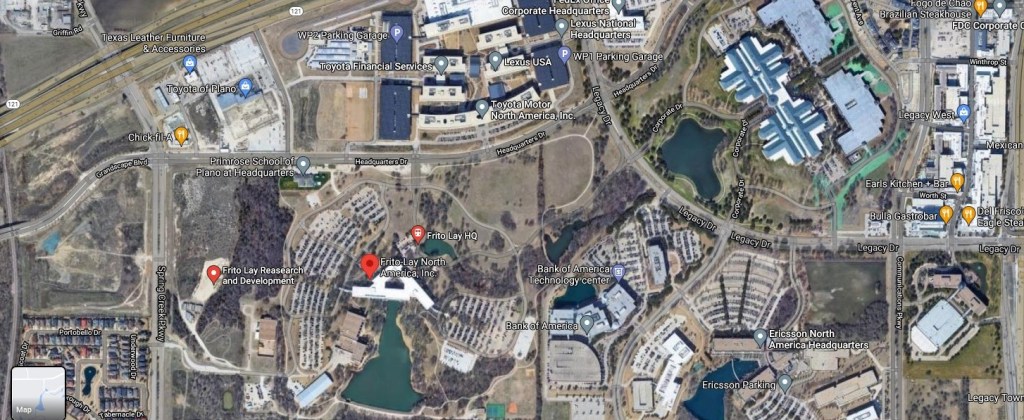
  2. The product was developed in the Dallas suburbs. Plano is a notable suburb because of its growth and wealth (and McMansions). But, there are plenty of suburban office parks where ideas are discussed. Who knew the snacking fate of America was decided in a relatively anonymous suburban facility by business professionals? (And how many other products have a similar story?) Across the street is Toyota American Headquarters and then each direction on major roads leads to strip malls, fast food, and highways.
  3. The product was tested in cities and the idea developed in the suburbs took flight. Now, Flamin’ Hot Cheetos are widely available (though it would be interesting to see the sales breakdown by geography).

Modern capitalism was able to span these disparate locations and churn out a product loved by many. From a suburban office park to snack aisles everywhere…

Trying to add round-the-clock, year-round activity at a suburban football stadium

If the Chicago Bears are to move to the suburbs, the change would not just include a stadium: the land all around would be valuable and needed to generate the kind of revenues the team and community would hope for:

Photo by Juan Salamanca on Pexels.com

SoFi Stadium was built on the former site of Hollywood Park racetrack, presenting a solid comparison to Arlington Park. According to Noll, the reason SoFi Stadium is in position to be financially successful is the mixed-use development also being built on the property.

Noll believes a stand-alone stadium is no longer a realistic option for NFL franchises because a $5 billion stadium can’t be financed by eight football games a year and the random big-name concert. Year-round revenue must be part of the package…

Glendale city officials, for example, added residential neighborhoods to the area so the entertainment establishments would be frequented at night and on weekends when no game is in town. They added office space so workers would patronize the restaurants in the daytime and not take up parking at night.

“If you’re not able to capture benefit in a meaningful way outside of the football games, it’ll be an expensive proposition,” Phelps said. “We’re seeing tremendous growth in and around the stadium, kind of creating this sports and entertainment hub. I think that’s the future where these kinds of venues are going.”

Creating this sort of suburban entertainment center is a dream of many larger suburbs. Not only would this boost the status of the community, it would add jobs and tax revenues. Metropolitan areas only have so many stadiums and major revenue generators and this could be viewed as a once-in-a-lifetime opportunity (or gamble).

But, this would also be a major change. The article noted that this site in Arlington Heights is surrounded by residences; would a mixed-use area of denser housing, restaurants, and entertainment venues be welcomed? Can Arlington Heights go full[speed into such a project?

As the article notes, it could turn out poorly. There is a lot of money at play. Getting any taxpayer dollars involved could be a risk. It all could take time to develop fully into a true center for suburban football as opposed to a football stadium stuck in the middle of single-family homes near highways.

Given all the history of the Bears in the city, I would be more than 50% confident that they stay in Chicago. The allure of a new, large stadium that could serve other uses much of the years is incredibly appealing. There is money to be made in the suburbs. But, it would certainly be a change for all involved, including Chicago leaders who would have much to answer for if the Bears become the Chicagoland Bears.

When two suburban residential developments border each other and have clear differences

A typical suburban single-family home, the symbol of the American Dream, is often in the middle of a subdivision surrounded by similar homes. Yet, some of these homes are on the edges of developments. This boundaries can be interesting: what do the homes back up to? What is nearby? Three local examples that I see regularly highlight how adjacent suburban residential developments can lead to some sharp contrasts.

Photo by Pixabay on Pexels.com

First, I know of a 1970s neighborhood of primarily raised ranches and split-levels of roughly 1,500-2,000 square feet. One side of this neighborhood borders a late 1980s development of larger homes built more in the style of 3,000 square foot McMansions with brick or Tudor facades. These two sets of homes back up to each other and the line of homes that do this are quite different: there is a significant size difference, the style of the homes – siding versus different materials – varies, and the newer development is slightly uphill so the larger, newer homes loom over the older, smaller homes.

Second, there are numerous single-family home neighborhoods where houses are across a residential street or next to a small apartment building. Or, next to a townhouse development. The scale of the buildings is not that different but the density and size are clearly contrasting.

Third, I know of one location where there are two neighborhoods that could have been constructed separately as they both have outlets to the neighboring arterial roads. But, there is a connecting road between the neighborhoods and there are houses of each neighborhood type, again different size and style side by side, on this connector.

Single-use zoning in the United States is intended to protect single-family homes from other less desirable land uses. But, this zoning system does not necessarily buffer certain residential neighborhoods from each other. Many suburbanites would object to significant changes in their nearby surroundings if the new residences were quite different. I ran into this in my suburban research where new small homes nearby or apartments were not welcomed, particularly if they were replacing open space. Yet, today many suburbs have different developments side by side, sometimes with a buffer – nature, a berm, a walkway, etc. – but sometimes not.

These neighboring dwellings could signal some significant differences. A larger home suggests a different social class. Residents of apartments are not always regarded fondly by homeowners. Densities and lot sizes can be different. The exteriors imply different status.

These boundaries are symbolic and clearly marked in physical space. What are the consequences: are the residences on these boundaries less desirable or go for a reduced price? How many people care about the clear boundaries? Do the people from the two or more sides interact within these boundary zones?

The boundaries between suburbia and other types of communities is often clear to see and experience but the internal boundaries are also fascinating.

The Robert ruins in Gallery 218

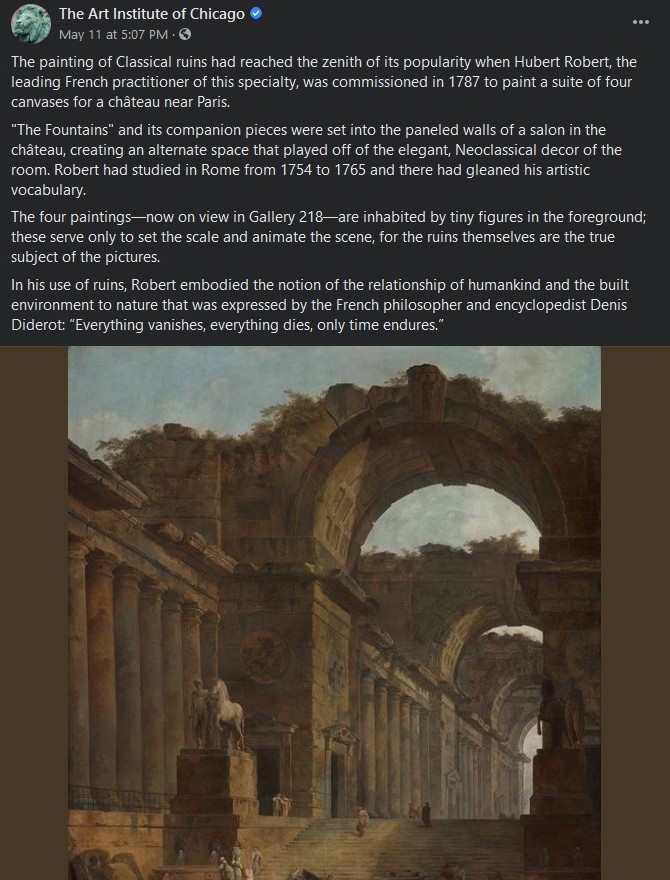
The Art Institute of Chicago recently featured on social media a painting by Hubert Robert:

Among the many worthwhile works on the second floor of the Art Institute are these four works in one room. I have always enjoyed them. Building off yesterday’s post about how today’s buildings could become tomorrow’s fossils, these paintings romanticize ruins from past civilizations. Imagine walking through such structures. There may have been centuries when people could wander through such ruins in Rome, Greece, Egypt, and more. Today, such a site would be hard to find as many ruins are swarming with tourists.

What always impressed me about these paintings was the scale of the buildings. As the social media post notes, the people at the bottom are very small. The buildings are massive and impressive. They connote great civilization and activity. Imagine this building above with a full vaulted ceiling and full of people. The buildings have lived on even as the individual leaders and residents changed.

The Diderot quote above is an interesting one. These buildings are falling apart and time will conquer them. At some point, the pillars will fall, the arches will be no more, and the scene will look very different. But, rulers and leaders construct such buildings in the first place so that the structures outlive them. They will not last forever, but even as ruins or remains in the ground they can still attest to a past era.

A fossilized Shanghai Tower

I have read numerous versions of how modern civilization might appear in the future archaeological record. However, I liked this particular exploration of what Shanghai Tower, a 2,000 foot structure, might become over millions of years.

Photo by Manuel Joseph on Pexels.com

Almost immediately, water making its way down to the lowest levels it will react with the calcareous material in concrete, to form cathelmites – stalactite- and stalagmite-like growths that form in human-made environments. These will continue to grow for thousands of years, transforming the shopping mall into something akin to a horror movie set. If humanity is still around, most things of value will have been stripped out before the Tower is completely abandoned, but perhaps not everything. Aluminium in the ventilation system, stainless steel in the food court – maybe even a few cars in the garage levels will be left to perform remarkable transformations…

The story continues even deeper underground. The entire Shanghai Tower sits on top of a concrete raft, one metre thick and covering nearly 9,000 sq m (97,000 sq ft). Beneath this are 955 concrete-and-steel piles, each a metre in diameter, driven up to 86m (282ft) deep into soft ground. After several million years, as the weight of the sea water and sediment warps the subterranean layers beyond recognition, some of the foundation piles will fracture, twisting within compacting mudrock formations like the fossil roots of an immense, long-vanished tree.

As millions of years stretch into tens of millions, the transformations come more slowly. Rare earth minerals, leached from discarded mobile phones and other electronic devices, may begin to form secondary mineral crystals. Glass from windshields and shop windows will devitrify, darkening just as obsidian does after long burial. By now, the entire city is compressed to a layer perhaps only a few metres thick in the strata. All that is left of Shanghai Tower is a geological anomaly studded with the fossil outlines of chopsticks, chairs, sim cards, and hair clips.

All of this will be deeply buried, in some cases thousands of metres down. But geology never stands still. After around one hundred million years, as new mountain ranges begin to form, the layer of compacted rubble that was once Shanghai Tower may be pushed upwards, and revealed. 

A tower is not just a modern landfill or a single-family home; it is a monument to modern society in a similar way to the massive temples of past civilizations.

The idea that the tower would emerge again as part of a new mountain range is an interesting one. The assumption in a lot of these modern fossil/future archeology writings is that modern civilization will mostly disappear from the Earth’s surface. Many science fiction writings have the same idea: all that modern humans prize in the Industrial Revolution and urbanization will fade away just as everything else has in the past. Certainly, modern structures and infrastructure will only last for so long. What exactly is the predicted lifespan of a major skyscraper, let alone a single-family home or a big box store? Or, all of it will go away due to disaster, war, or the accumulation of garbage and self-induced environmental catastrophe.

Given how we dig and reconstruct the past, I still find it interesting to ponder that someone might come along and dig down and discover a major city that looks abandoned. What was life like there? Why did the city disappear? This was a global city?

Considering Jane Jacobs’ advice for parks when planning a major suburban park

Jane Jacobs is famous for her observations regarding sidewalks in the opening chapters of The Death and Life of Great American Cities. Right after this is a chapter on parks. In summary, she suggests are not automatically good as they can easily become problem areas if there is not regular foot traffic in and through the park.

Photo by Felix Mittermeier on Pexels.com

I thought of this when seeing a plan of how the former Motorola Campus in Schaumburg might be turned into “a Millennium Park for suburbs”:

Schaumburg trustees Tuesday will consider approving a $1.1 million bid for construction of the first phase of a 12-acre, urban-style park ultimately envisioned as a sort of Millennium Park for the suburbs.

Planned for the former Motorola Solutions campus, the park when completed could house such amenities as a large outdoor performance venue, a sculpture garden, a dog park and a winter ice rink.

Phase one, however, will focus on the basic outline of the park and providing passive recreation opportunities to serve residents of the area, before the next set of upgrades are budgeted and built.

A suburban park, no matter how beautiful it is or how many amenities it has, could easily fall prey to the issues that Jane Jacobs describes. Do people live around the park? Will there be people regularly walking through the park? Will it have the same kind of lively pedestrian activity and interaction that she recommends for sidewalks?

A park built on a former office park campus might not have any of these. Located in a sprawling suburb, would the majority of users have to drive here? Would people be there just for the park and its particular amenities or are there nearby activities that would keep them in the area such as shops or restaurants? Are there enough residents within walking distance who can informally help keep an eye on the park and those who use it?

This could all be in the eventual plans. In the Chicago suburbs it is currently popular to suggest mixed-use developments to replace office parks, shopping malls, and other large properties. But, it takes time for such developments to happen and for community to arise. Parks do not automatically work like they do in Simcity where placing a park next to commercial or residential property boosts property values. Just because there is a pristine park in the plans does not mean that the park becomes the kind of asset Jacobs suggests they can be in the right conditions.