The data above appears to follow the patterns from the last few elections. Cities go for Democrats. Rural areas and exurbs go for Republicans. The suburbs are contested ground. The splits are bigger in the table above: 9% advantage for Trump in small city or rural areas, 23% advantage for Biden in cities. And the suburbs are close with just a 3% gap.
Going even further, the suburbs of the true battleground states may be home to the truly important voters. In this election, the residents outside Atlanta, Charlotte, Raleigh-Durham, Cleveland, Columbus, Cincinnati, Pittsburgh, Philadelphia, Detroit, Grand Rapids, Milwaukee, Minneapolis, Phoenix and more might have just decided the election. That national 3% difference might not seem like much but it could matter a lot when state races are tight.
I am sure there will be more fine-grained analysis of the suburban vote by itself as well in comparisons to other demographic factors that influenced vote totals. But, this early data seems to suggest suburban voters will continue to be important in coming elections.
I watched briefly a number of election night broadcasts last night. One conclusion I came to: there is way too much data to fit on a television screen. And if you want more of the data, you need the Internet, not television.
The different broadcasts tried similar variations: flipping back and forth between a set of anchors and pundits at desks and analysts at a smart board showing election results from different states and locations. They have done this for enough election nights that the process is pretty established.
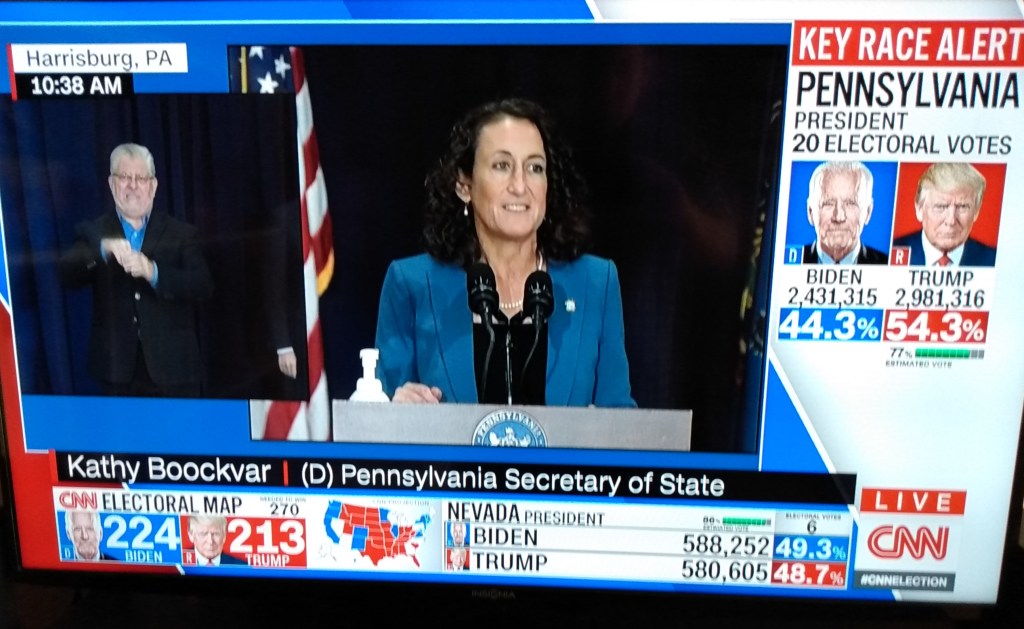
While they do this, there is often a lot of data on the screen. This could include: a map of the United States with states shaded; a chryon at the bottom with scrolling news; another panel at the bottom flipping through results from different races; and people talking, sometimes in connection to the data on the screen and sometimes. If the analyst at the smart board is on the screen, there is another set of maps to consider.
CNN broadcast, November 4, 2020
This is a lot to take in and it might not be enough. The broadcasts try to balance all of the levels of government – from the presidential race to congressional districts – and are flipping back and forth. I appreciated seeing the more simple approach of PBS which went with a lot less data on the screen, bigger images of the talking heads, and simple summary graphics of the winners.
But, if you want the data, the television broadcast does not cut it. Numerous websites offered single pages where one could monitor all of the major races in real-time. Want to keep up on both local and national races? Have two pages open. Want reaction? Add social media in a third window. Use multiple Internet-connected devices including smartphones, tablets, and computers (and maybe Internet-enabled televisions).
On one page, readers could see multiple presentations of data plus explanations. Want to scroll through in 10 seconds and see the headlines? Fine. Want to spend 5 minutes analyzing the various graphics? That works. Want to click on all the links for the metholodogy and commentary? A reader could do that too.
The one big advantage television offers is that it offers commentary and faces in real-time plus the potential for live coverage from the scene (such as images of gatherings for candidates) and feeling like the viewer is present when major announcements are made. The Internet has approximations of this – lively social media accounts, live blogs – but it is not the same feeling. (Of course, when you have more than ten live election night broadcasts available on your television, the audience will be pretty split there as well.) Elections are not just about data for many; they also include emotions, presence, and the potential for important memories.
Given these differences in media, I did what I am guessing many did last night: I consumed both television and Internet/social media coverage. Neither are perfect for the task. I had to go to sleep eventually. And whoever can figure out how to combine the best elements of both for election nights may do very well for themselves.
A church turned real estate office in Orland Park, Illinois. Image from Google Street View, August 2018.
But not every flock-less church faces an afterlife as living spaces stuffed full of “exceptional quirks around every corner” for hipsters. Many have become different kinds of creative spaces and communal gathering spots, often providing what might be considered “secular ministry.”
It is unclear how many religious buildings are repurposed. Roughly 1 percent of the nation’s 350,000 congregations — or 3,500 — close each year, based on an analysis from Mark Chaves, a sociology professor at Duke University and director of the National Congregations Study. But not all find new uses and some buildings are filled by different congregations.
The eight subsequent profiles of transformed religious spaces are indeed interesting. And this follows a pattern of news reporting on these conversions: look what cool spaces can be created from church buildings! (See earlier blog posts on converting churches to residences here and here.)
Many of these buildings are reused by other religious groups. These can sometimes be groups in the same religious traditions and other times not. A number of congregations are willing to use an existing religious building and then modify it to their own purposes. This might provide a unique opportunity to acquire a building or location for a cheaper price and/or borrow the tradition in an older structure.
Some religious buildings are converted into other uses. I would guess that the percent of all sold or abandoned religious buildings converted into cool uses – ones that become architectural marvels for other uses or feature the kind of activity to be featured in a newspaper – is relatively low.
Some of these church buildings are eventually torn down. It can be expensive to maintain aging structures. It can be costly to convert old structures. The land may be too valuable to be taken up by a religious building. The building might be in a neighborhood or community with limited resources or declining fortunes.
If the buildings are indeed repurposed, the new owners may or may not keep some of the original features. It is hard to tell exactly from the images with the New York Times story but it looks most of these conversions tried to keep some of the church-specific features like stained glass windows, organs, lighting, and ceilings. This may not be desirable for all uses or even for religious groups reusing the building.
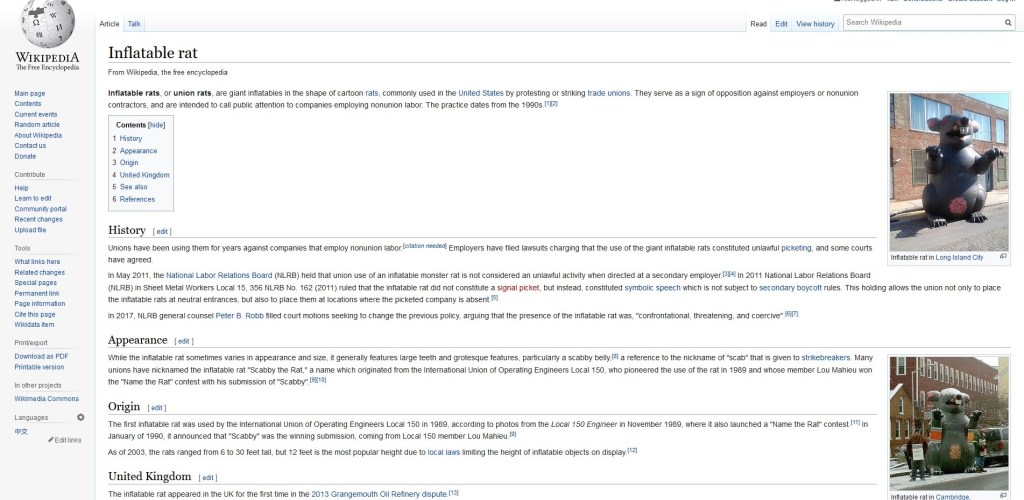
Scabby is a giant inflatable rodent, up to 25 feet tall, with angry red eyes, exceptionally prominent front teeth and sharp claws. Created some 30 years ago in Chicago, it’s a favorite device of unions trying to draw attention to their grievances, and it works. “Before, you could drive by and see six guys with picket signs and probably never notice them,” James Allen, president of District Council 1 of the International Union of Bricklayers, told the Tribune last year. Scabby is harder to miss…
But the NLRB’s general counsel, appointed by Donald Trump, is not smiling. Peter Robb, previously a management lawyer, “hates the rat,” one unidentified senior NRLB official told Bloomberg Law. At his direction, the agency is trying to eradicate Scabby.
The effort isn’t likely to succeed. Under Barack Obama, the NLRB ruled that putting this huge air-filled mascot outside the entrance of a hospital, accompanied by a union member holding a leaflet, was a form of free expression protected by the First Amendment…
“The rat balloon itself was symbolic speech,” said the board. “It certainly drew attention to the union’s grievance and cast aspersions on (the nonunion employer), but we perceive nothing in the location, size or features of the balloon that were likely to frighten those entering the hospital, disturb patients or their families, or otherwise interfere with the business of the hospital.”
Read a little more on how Scabby was developed in the Chicago area in this 2018 blog post.
Having seen Scabby in action several times, there at least three reasons the symbol works:
No one wants to be associated with a rat. Even if there are people who like rats as pets, they are not viewed as cuddly or likeable creatures in the same way that many others animals are. A rat is a negative symbol, a reminder of urban squalor or dishonorable behavior.
The size of Scabby and the particular look is not pleasant. This is not just a rat on a sign that is a cartoonish figure; this is a large inflatable that towers over the sidewalk. The eyes are red, teeth are showing, front legs are out. This is not a pleasant figure to look at.
Putting #1 and #2 together, organizations or employers would not like the connotation of the inflatable rat nor the presence of it in front of what they hope to present as a welcoming or pleasant place of business or activity.
This means Scabby could help attract attention to a labor cause. As noted in the story above, it is a visceral image that grabs the attention of people passing by. Without such a large symbol, it could take a lot more work to garner attention including larger pickets or significant media attention. Whether the prolonged presence of Scabby leads to a better outcome for the union or employees is another matter.
Until the pandemic hit, the city’s housing market was so tight that would-be renters lined up for viewings and arrived with thousands of dollars in cash, ready to sign a lease on the spot.
But now landlords are hard-up for tenants and some are offering several months free, said Coldwell Banker realtor Nick Chen, who recently rented out a one-bedroom for $3,150 that before would have easily gone for $4,300.
“San Francisco rents have been really inflated over the past couple years,” Chen said. “It will come back, but I think the question is: Will it come back to the level it was at previously? Maybe not.”
This is a sizable drop in rent, roughly 25% in a short time frame. Yet, that is still a price that few Americans across the country could meet. Even with significant changes in social life in cities like San Francisco and New York, this does not mean these places are now accessible to many.
Presumably, there is a bottom floor below which rents will not drop. The person who owns the property has their own bills to pay. Some people will see this as an opportunity to get a place in San Francisco at a lower rent and jump at lower prices.
Or, does COVID-19 shift housing prices in high-priced markets for a longer time? If businesses decide to continue work from home and employees are skittish about being around a lot of people in a dense city, do rents drop even further? Is there an opportunity for developers, buildings owners, housing groups, and local governments to jump in and acquire and/or offer cheaper housing? I would not guess expensive housing markets like San Francisco, Seattle, or Manhattan will soon become reasonable but perhaps there will be some opportunities for more people in the region to take advantage.
Cleaning up the leaves in a suburban lawn is rarely enforced or legislated. It is just an expected task for the suburban homeowner: thou shall not have many (or any) leaves in your lawn by the end of the fall season. Why is this the case? Here are a few possible reasons:
A well-kept lawn, from green grass neatly kept to an absence of weeds to being cleared of leaves, is a marker of social class. It is part of keeping up the neighborhood and supporting property values. Lack of attention paid to the lawn signals less-invested homeowners, less valuable properties.
Clearing leaves is an unquestioned social norm that simply continues on because people did it before. That leaves could be beneficial for lawns and garden beds may not matter; the inertia is already there for clearing leaves and it could take time for new patterns to emerge.
There are commercial and industrial forces invested in making sure lawns are seeded, treated, and cleared. There are rakes and leaf blowers to sell. It is big business helping Americans remove leaves.
Suburbanites pass along this social norm to each other through conversation and exhibited behavior. Neighbors share words while outside about their lawns. One suburbanite rakes their leaves because they see their neighbors doing it.
Perhaps this practice will pass into history at some point. But, as long as we have a suburban emphasis on single-family homes and their lawns, there will be more years of raking, bagging, mulching, and clearing leaves.
The larger monthly bills could vary quite a bit across suburban homes depending on the size of the home, the costs in each municipality, and whether the home is updated (think insulation, efficient appliances, etc.). Best to check on these costs in each possible residence.
There are multiple ways to get cheaper furniture to reduce costs. Not all rooms have to be fully furnished (perhaps less entertaining during COVID-19 helps with this). Rather than focusing on furniture, why not buy a smaller house? Wait, Americans need somewhere to put all their stuff (including furtniture)…
Yes, most suburban living will require a car unless living within walking distance of needs and work or living in an inner-ring suburb with great public transportation. Cars are not cheap once you add up car payments, insurance, gas, and maintenance. And cars need parking and storage space with many desiring a garage on their property for that, adding to property costs. But, Americans like their driving in the suburbs.
Commuting can be financially costly as well as stressful. The time might not be as much of an issue (though certain routes in certain locations certainly add up) as the inability to do much else while driving.
Thinking more broadly about suburban costs, I wonder if presenting potential suburban residents the full array of problems with suburbs – financial costs, exclusion, limited cultural amenities, moral minimalism – would change people’s minds. The suburbs have a certain appeal in American life and the suburban single-family home is a strong draw to many.
The latest iteration creates dedicated, work-from-home spaces inside apartments. South Bend, Indiana-based Holladay Properties is looking at installing voice-activated elevators to limit touch points. The project also would incorporate small conference rooms and phone booths where residents could take a call or prepare for a presentation.
“It’s hard to ignore the global pandemic,” Holladay Vice President T. Drew Mitchell said. “It’s in front of us everywhere, so some of the things that we’re doing inside of the units is sort of a reaction to that.”…
“What we’ve encountered in our product in suburban Chicago is overwhelming demand,” said Mitchell, who’s based in the firm’s LaGrange office. “We have a waitlist right now at Burlington Station in downtown Downers Grove, and what we’re seeing unfortunately for Chicago is people are returning to the suburbs.”
In Glen Ellyn, rents would range from about $1,400 to nearly $3,000. Glenwood Station amenities would target young professionals working in the city, empty nesters seeking a lower-maintenance lifestyle and other demographic groups.
From the picture provided, this looks like a fairly typical apartment building for a wealthy suburban downtown. The building is not too tall; height is a problem in many suburbs as residents do not want structures to dwarf other buildings, particularly houses). There is room on the sidewalk for pedestrians with streetlights and plantings. While there is some variation to the exterior, the design is not too crazy for a bedroom suburb. The building is not too large; there are just 86 units. There are American flags flying at the street corner.
The changes, according to the article, seem to focus on interior spaces. If you live in an apartment, how do you find space to separate home and work? This may be easier in large homes. What additional spaces could an apartment building or complex contain that gives residents some variety without having to leave? The suggestion above is to provide private spaces elsewhere in the building. It will be interesting to see how apartment developers and owners will in the future modify public spaces – gyms, pools, gardens, dog areas, party rooms, etc. – when restrictions may not allow apartment dwellers to use them in the same way.
In other words, suburban development continues in fairly normal ways: the developer gets TIF financing, the city gets a building that fits its character and aesthetic, and suburban downtowns become a little denser.
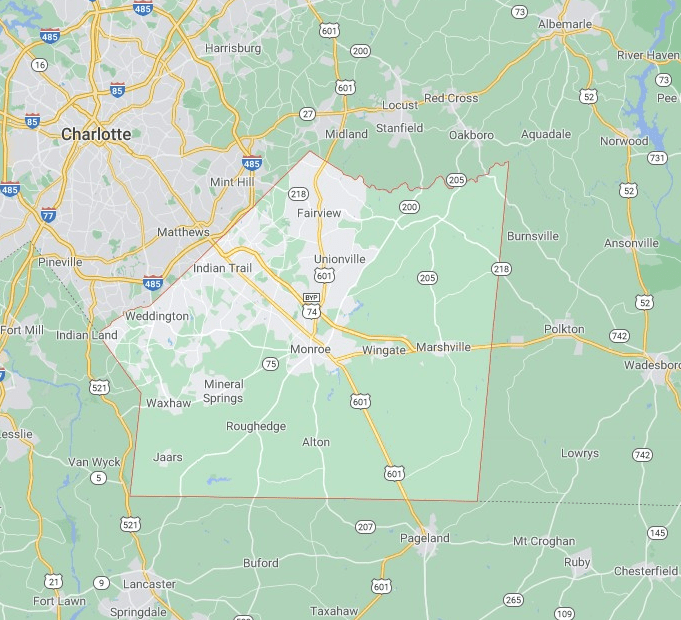
Union County is what one scholar terms a “countrypolitan” place: Under federal government designations, it lies within a metropolitan area, but it also has a strong rural and agricultural history. For the most part, it doesn’t look like a cookie-cutter suburb, nor is it impoverished. In fact, Union is North Carolina’s wealthiest county, according to the Census Bureau. There are places like it around the United States. They are distinct from rural areas, which are mostly Republican, and cities, which are heavily Democratic; many voters in these places are neither die-hard Trump fans nor urban liberals. That makes them pivotal counties, in 2020 and in the future.
Everyone agrees that Union County is changing. The question is how it’s changing, and how fast. There’s no doubt that Republicans will carry the county up and down the ticket this year—Carter, ensconced at East Frank, was the last Democratic presidential candidate to win here, back in 1980—but the GOP’s overall success in the state will hinge largely on how big a margin it is able to run up in exurban counties such as this one. Democrats’ control of inner-ring suburbs continues to strengthen, and the future of the Republican Party nationally depends on keeping firm control over places like Union County…
The reason Union County is changing is simple math. When Helms was born, about 4,000 people lived in Monroe. Today, nearly 36,000 do. Since 1990, the overall county population has almost tripled, from about 84,000 to roughly 240,000. As I traveled around the county, I began to notice something peculiar: Virtually everyone I talked with was a transplant. Some of them had moved only recently, and others had been around for 10 years, or 20…
“Union County when Jesse was in the Senate was a very rural county,” Wrenn says. “Now it’s got a big chunk of suburban in it. If the long-term trends continue, the Republicans are going to have to find a way to compete in the suburbs. It can be done, but you just have to change your whole way of thinking.”
The temptation in such stories about suburban voters is to look at counties and communities and just see political change. And it sounds like Union County has had its share comparing before the Civil Rights Era, after, and today.
The basic explanation for this recent change is new residents. The population has grown and new residents, not as familiar with the ways of Union County, have moved in. What was once a small population with low density is now much larger and in bigger cities and towns.
But, is this all that has changed: new people moved in and they came with some new political views? I suspect there is more going on here that both contributes to the political change and also exists outside of it. Here are a few possible factors at play:
The decline of agriculture, particularly family-owned farms and opportunities, could be at play here. As farming becomes more difficult or less desirable for subsequent generations, the land can be sold off and be turned into subdivisions. This is a significant change in land use as well as who lives there: farmers and those connected to agriculture versus middle-class suburbanites.
Connected to #2, the economic landscape has changed tremendously in the last half-century or so, moving away not just from agriculture but also manufacturing and moving more toward retail, services, and a knowledge economy. Union County and many other locations in the United States are still trying to adapt to these large shifts that affect employment, tax bases, and local businesses.
Numerous local institutions have likely had to adjust in light of growing populations. Schools need more space for kids. Local governments need to provide more services (and they might now have larger tax bases to draw on) and local officials are addressing new issues. Established churches now compete with new congregations. In sum, the civic and social institutions that may have existed for decades in roughly the same form now need to adapt. This can present challenges in any community.
In sum, this is not just about politics. A shift toward a suburban lifestyle in Union County has many consequences and politics may just be one of them.
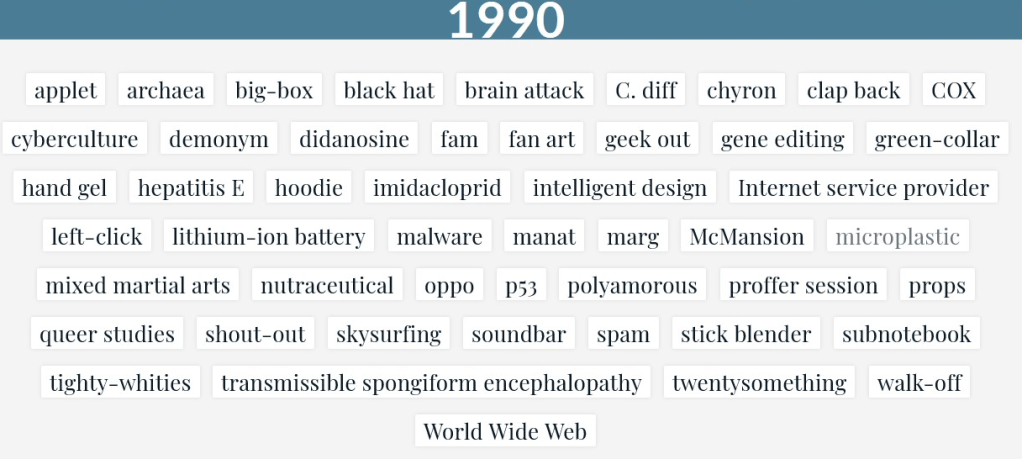
This is an interesting list of terms that have now existed for thirty years. Like the McMansion, these refer to newer phenomena that either did not exist prior to 1990 or did not have a reason to be named.
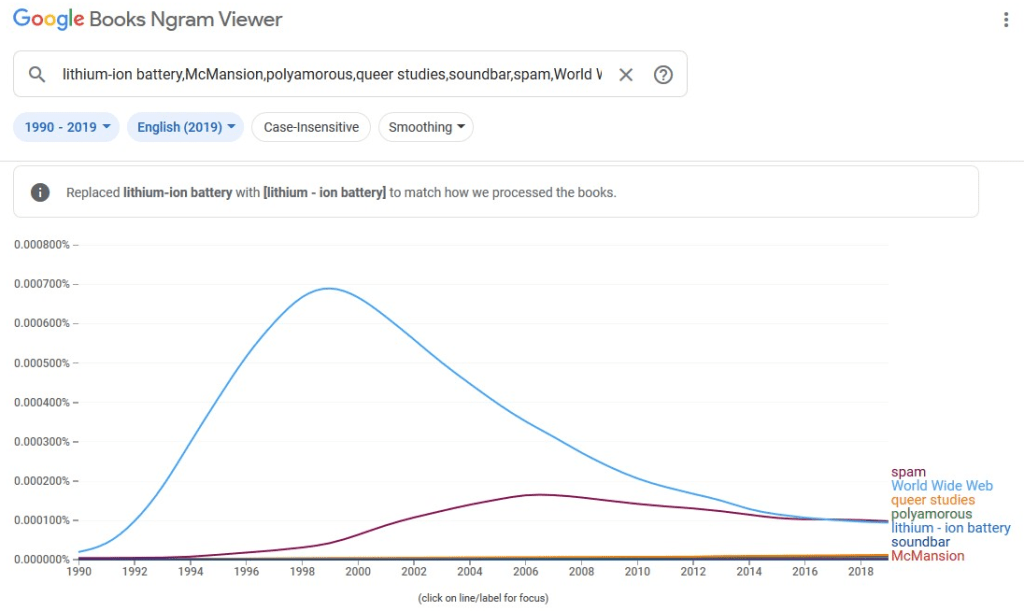
But, just because terms were introduced does not necessarily mean that they were used at the same rate over time. Using Google NGram Viewer, here are some of the terms in comparison:
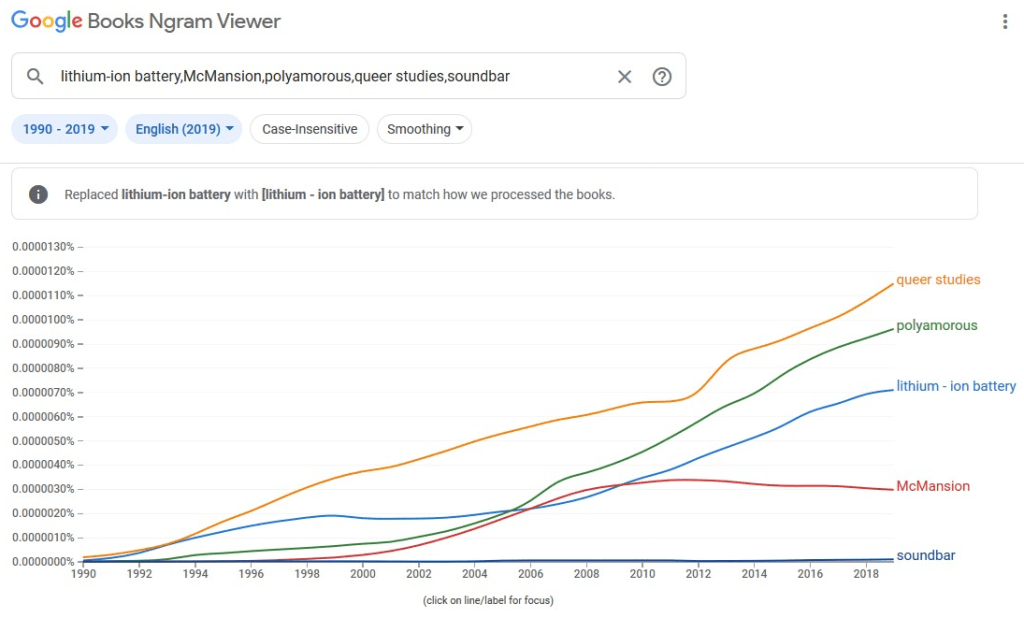
Take out the tech terms – World Wide Web and spam – and now some of the patterns regarding other social phenomena are more clear:
Since this covers books, there might be a lag compared to other sources. For example, my own analysis of the use of the term McMansion in the New York Times and Dallas Morning Newsfound the term had higher rates of usage from roughly 2005 to 2008 (and then plateaus, just as it does with book usages several years later). But, it also takes some time for terms to be used widely. Indeed, three of the five terms above steadily rise in usage.
Given the time travel back to 1990, it might be hard for any new words to compete with computer or Internet related terms. The introduction and spread of the Internet shaped many aspects of society. At the same time, new understandings of sexuality and relationships are pretty influential as well. Perhaps thirty years is not enough to judge the impact of these words just yet.







 Legally Sociable