
In total, this Urban Tiny home on wheels is 8.2 feet wide, 14.1 feet tall, and 24.3 feet long, including its drawbar. The drawbar, which is 4.6 feet long, allows the 7,363-pound tiny home to be towed by several vehicle types, including pickup trucks and SUVs…
The inside of the home looks no different than a typical loft apartment…
The bathroom and kitchen source its water from the drinking and grey water tanks. But for those who want a more consistent stream of water and power, there are water and generator power connection points in the tiny home.
Addressing race without addressing residential segregation?
Residential segregation is a long-standing problem in American society. Through legal and illegal means, formal and informal practices, whites often sought and still seek to keep others, particularly blacks, out of their communities and neighborhoods. While residential segregation has lessened in recent years, it is still persistent and numerous communities disadvantaged decades ago are still struggling because of this.

The Racial Dot Map available at https://demographics.coopercenter.org/racial-dot-map
The ability of people of different races and ethnicities to live near each other is not just about proximity to work and access to jobs (though this is helpful too); there are numerous consequences.
-local schools
-access to local governments, and social services
-interaction with neighbors and people in the community
-political representation at higher levels such as state officials or Congress
-nearby cultural opportunities
-health as well as recreational opportunities
-could provide more options for housing and building wealth
-the chance to address local or community problems together
And the list could go on.
As one example, more minorities living in the American suburbs does not necessarily a guarantee them a better life. When many suburbs were built on and operate on the logic of exclusion, suburban residential segregation subverts the idea of the suburban single-family home representing the American Dream.
Tackling residential segregation is a difficult task. Whiter, wealthier communities are not likely to be on board (see how this plays out with affordable housing conversations). Addressing housing at a national level is hard. But, that does not mean it is not worth addressing.
A long history of violence in American society
From the beginning, the story of the United States of America is a violent one. From violence against indigenous people to slavery to armed rebellion to colonial conquests to the Civil War to vigilante violence to violence-enforced residential segregation military intervention around the Western Hemisphere and then the globe to police brutality to gun violence to celebrating the military to assassinations.
Take vigilante violence as an example. I read Sundown Towns: A Hidden Dimension of American Racism at the recommendation of a colleague and having read multiple works by sociologist James Loewen. He argues that a significant number of Northern towns and cities had informal sundown laws that prohibited minorities from being in the community after dark with violence implied if the norms were not followed.
Or, take the example of the role of violence in residential segregation. After violence at a South Shore beach set off moreviolence in Chicago in 1919, residential segregation was enforced not just with restrictive covenants and blockbusting and redlining: actions involved bombings and attacks. Historian Stephen Grant Meyer detailed some of this in his book As Long As They Don’t Move Next Door: Segregation and Racial Conflict in American Neighborhoods, a book I read for a class paper. In places like Cicero, Illinois and Levittown, Pennsylvania, violence accompanied attempts of blacks to move to the suburbs.
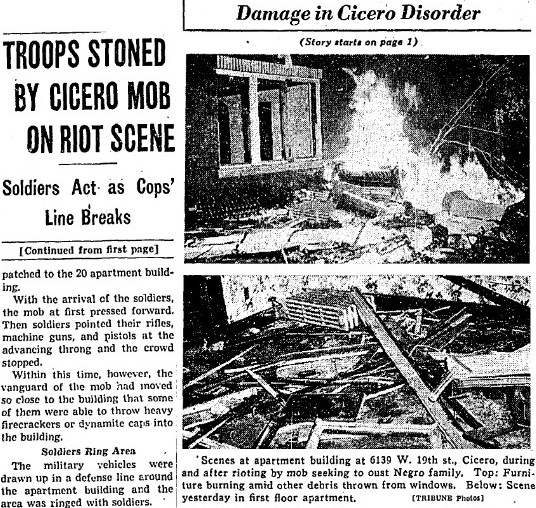
Photo by Chicago Tribune, July 13, 1951
Or, take the last in the list as an example. The book that really brought this to my attention as a student was Philip Agee’s Inside the Company: CIA Diary. This led me to read a lot about the Church Committee’s work in 1975-1976 as well as assassinations in the United States and ones in which the United States played a role abroad. In several papers, I worked with the idea of assassinations, discovered databases of political violence in countries around the world that political scientists have collected for decades, and found that the political violence rates in the United States are high.
All together, the United States is awash in violence. It is part of American history, it is regularly promoted, and it is often excused or justified. Thinking about some of the examples I noted above, I found out about these through reading and research because these stories are widely taught, known, or experienced by significant segments of the population. Yet, violence is antithetical to numerous aspects of American society and ideals, including the religious beliefs of many Americans, particularly when harnessed alongside other destructive ideologies such as white supremacy or colonialism.
Divided By Faith, race, and religion
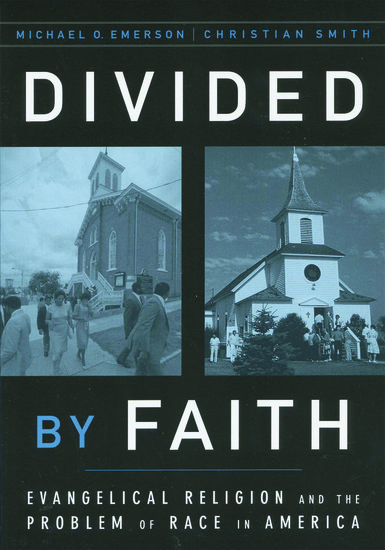
When I teach Introduction to Sociology, one of the texts I use is Michael Emerson and Christian Smith’s 2000 book Divided By Faith: Evangelical Religion and the Problem of Race in America. Here are parts of Chapter Four (“Color Blind: Evangelicals Speak on the “Race Problem””) that seem very pertinent:
The racially important cultural tools in the white evangelical tool kit are “accountable freewill individualism,” “relationalism” (attaching central importance to interpersonal relationships), and antistructuralism (inability to perceive or unwillingness to accept social structural influences). (76)
But, these perspectives are not just tied to race:
Unlike progressives, for them individuals exist independent of structures and institutions, have freewill, and are individually accountable for their own actions. This view is directed rooted in theological understanding… (76-77)
A summary later in the chapter:
On careful reflection, we can see that it is a necessity for evangelicals to interpret the problem at the individual level. To do otherwise would challenge the very basis of their world, both their faith and the American way of life. They accept and support individualism, relationalism, and anti-structuralism. Suggesting social causes of the race problem challenges the cultural elements with which they construct their lives. This is the radical limitation of the white evangelical tool kit. This is why anyone, any group, or any program that challenges their accountable freewill individualist perspectives comes itself to be seen as a cause of the race problem. (89)
And back to race:
But white evangelicals’ cultural tools and racial isolation curtail their ability to fully assess why people of different races do not get along, the lack of equal opportunity, and the extent to which race matters in America. Although honest and well intentioned, their perspective is a powerful means to reproduce contemporary racialization…
This perspective misses the racialized patterns that transcend and encompass individuals, and are therefore often institutional and systemic. It misses that whites can move to most any neighborhood, eat at most any restaurant, walk down most any street, or shop at most any store without having to worry or find out that they are not wanted, whereas African Americans often cannot. This perspective misses that white Americans can be almost certain that when stopped by the police it has nothing to do with race, whereas African Americans cannot… (89-90)
The book is twenty years old and has led to productive listening, conversations, action, and scholarship. Yet, the intersection of race and religion, the deeply embedded assumptions in faith and other spheres of life, still matters today.
(See this 2016 post titled “How white evangelicals define themselves – and what is missing” for an earlier discussion involving Divided By Faith.)
When protests make it to the wealthier suburbs, this means…
With protests spreading across the United States, including wealthy suburbs like Naperville, Illinois and Dunwoody, Georgia, this could hint at several forces at play:

-Americans dislike or disapprove of blatant injustice. (Whether that extends to making significant changes or sacrifices is another story. The suburbs are built in part on race and exclusion.)
-The population composition of suburbs has changed in recent decades. As William Frey of Brookings Institution details in Diversity Explosion, minority populations have grown across suburbs.
-The image of primarily conservative voters in wealthy suburbs may not be as valid as it was in the past. The outcome of the 2020 election depends in part on suburban voters with suburbanites closer to big cities leaning toward Democrats and suburbanites on the metropolitan edges leaning toward Republicans. And appealing to suburban women are important for candidates.
-Certain upscale suburban locations have become important sites for attracting attention because of their status. For example, Occupy Naperville occurred in 2012 and Naperville attracts other protestors as the largest community in DuPage County, its walkable downtown with lively stores, restaurants, and recreational options, and its status.
Addressing race at Wheaton College and in Wheaton, Illinois
In late 2015, Solidarity Cabinet at Wheaton College asked me to give an evening talk alongside one of my colleagues, David Malone, then Associate Professor of Library Science and head of Special Collections at Wheaton College (and now Dean of University & Seminary Library at Calvin College). We gave talks about the history of race at Wheaton College and in Wheaton, Illinois. Afterward, we discussed how even though these had been independent projects, the data and patterns we had uncovered across the two communities appeared to overlap.

The synopsis from the journal’s website:
Our final article traces the trajectory of racial attitudes and policies in an affluent Chicago suburb. In “Race, Town, and Gown: A White Christian College and a White Suburb Address Race,” Brian J. Miller and David B. Malone summarize the evolution of Wheaton College and the larger community of Wheaton, Illinois on matters of race. Before the Civil War both college and town were well-known for abolitionism and relatively enlightened racial views. By the late nineteenth century, however, that earlier openness to African American uplift was waning fast. At the college, the reform ferment of the antebellum era gave way to evangelical fundamentalism, steering the college in more conservative directions. Meanwhile, as the town of Wheaton suburbanized after World War II, the new affluence it residents enjoyed corresponded with a more conservative approach to racial integration at the heart of the postwar Civil Rights Movement. The history of racial tolerance that had defined both college and town at their founding, while remaining a point of pride to be remembered, seemed only that, a distant memory. Miller and Malone, however, point to this history to make an important point–that structural economic and social change, coupled with new ideas, profoundly influence institutional and cultural change over time. Wheaton College and the larger suburb of which it is a part can, and no doubt will, continue to evolve, perhaps in surprising directions.
In certain ways, these communities exemplify broader trends in American society: how white evangelicals and white and wealthy suburbs address race. What is more unique in these two particular cases is that at certain points in their history, they were welcoming toward Blacks and minorities, particularly compared to some of their counterparts. Then, a combination of internal decisions and larger societal pressures which then shaped subsequent actions and experiences led to them being less welcoming. The character of places and communities is malleable even as a certain inertia takes hold over time. As as we note (and the editor notes in the paragraph above), communities and institutions can change again.
Leaving the big city for the suburbs – and then pulling up the drawbridge
In yet another article about the possibility of people leaving cities for suburbs – this time in The Washington Post – the narrative ends with this:
Photo by Francesco Ungaro on Pexels.com
Those who study cities say they will remain in the long term and that many jobs will come back. People such as Bailey, who moved away from the Bay Area, are banking on that. He declined to name the town where he moved for fear more people will relocate there, driving up prices.
“I like keeping the local culture and the area is relatively affordable now,” he said. “I’d rather not see the same price inflation that happened in the Bay happen to smaller communities as well.”
On one hand, this could reflect housing market realities in some of the priciest markets in the country. Prices are so high in New York, San Francisco, Seattle, and a few other places that finding reasonably priced housing is something people want to protect. If more people can work remotely, certain places could become more attractive and experience an influx of residents.
On the other hand, is this similar logic to the exclusion in suburbia practiced for decades? This exclusion tended to be along race and class lines; suburbanites wanted to be around those like them and keep others out. When they moved into new subdivisions or what used to be small towns, they later use NIMBY logic to limit opportunities for others. What was an opportunity for them could not become an opportunity for others.
Those with resources and connections will likely have advantages in a race for more attractive or affordable locales. Some will be able to pay more for the privilege of leaving the city. Those moving to the suburbs may simply contribute to ongoing patterns of residential segregation across metropolitan regions, whether they officially live in a city or suburb.
Moral minimalism and addressing social issues
In the 1989 study The Moral Order of a Suburb, sociologist M. P. Baumgartner argued that suburban order rested on what she called “moral minimalism”:
A kind of moral minimalism pervades the suburbs, in which people prefer the least extreme reactions to offenses and are reluctant to exercise any social control against one another at all. (3)
In a later description of moral minimalism, she writes:
Moral minimalism entails a considerable degree of indifference to the wrongdoing of others…If people in such places cannot be bothered to take action against those who offend them or to engage in conflicts, neither can they be bothered to help those in need. (131)
Most residents do not want to involve third parties when conflict arises (unless it involves strangers) – it would be better to do nothing at all.
The pervasive moral minimalism found in the suburbs contrasts sharply with claims that American society is particularly violent or litigious. However true such characterizations may be for other settings, they do not reflect suburban reality. Residents of suburbs like Hampton rarely aggress against one another physically, and for them, law remains primarily a theoretical option for handling grievances that arise in their everyday lives. They are happy to have police at as their champions in preventing and resolving trouble that unknown persons might cause, but beyond this, they have very little use for law. When problems occur, most people do not seriously consider recourse to legal officials, and, in fact, they generally act as if law did not exist at all. In this sense, suburbia is a king of limited anarchy. (127)
In conclusion:
suburbia is a model of social order. The order is not born, however, of conditions widely perceived to generate social harmony. It does not arise from intimacy and connectedness, but rather from some of the very things more often presumed to bring about conflict and violence – transiency, fragmentation, isolation, atomization, and indifference among people. The suburbs lack social cohesion but they are free of strife. They are, so to speak, disorganized and orderly at the same time. (134)
All of this does not lend itself to addressing social issues or community problems. If people are used to leaving each other alone and avoiding conflict, what happens when legitimate structural issues arise? Or, what happens when others make the case that addressing a structural issue is necessary or helpful? Or, if there is need, how do people used to moral minimalism respond? Convincing suburbanites to move on from moral minimalism, particularly when it seems to “work” in wealthier, whiter communities where people have the resources and agency to generally do what they want (having a single-family home, a good life for their kids, etc.), is a difficult task.
Repost: race matters in American life until we can show it does not
Watching police brutality and the response from all sides reminds me of a post I made on a similar topic on September 28, 2011:
I like how Harris-Perry flips this objection: looking at the broad sweep of American history, from its days of more overt racism to more covert racism today, why don’t we assume that racism plays a role in everyday life in this society? Can we really assume, as many seem to do, that the issues with race ended at some point, either in the Civil Rights legislation of the 1960s or in the election of minority politicians or the ending of segregationist society in the South? With plenty of indicators of racial disparity today, from online comments from young adults to incarceration rates to homeownership to wealth to residential segregation, perhaps we should we see racism as a default feature of American society until proven otherwise.
I would argue the story is not any different in 2020. The disparities are still present, police actions repeat themselves, and there are predictable disagreements about what it all means (with the calls to choose between opposing police violence and “law and order”).
Maps, distortions, and realities

Photo by NastyaSensei on Pexels.com
The original topic was to do an exhibition of a classic category of maps called persuasive cartography, which tends to refer to propaganda maps, ads, political campaign maps, maps that obviously you can tell have an agenda. We have those materials in our collections of about a quarter million flat maps, atlases, globes and other cartographic materials. But we decided in recognition of what’s going on now to expand into a bigger theme about how maps produce truth, and how trust in maps and other visual data is produced in media and civil society. So rather than thinking about just about maps which are obviously treacherous, distorting, and deceptive, we wanted to think about how every map goes about presenting the world and how they can all reflect biases and absences or incorrect classifications of data. We also wanted to think about this as a way to promote data literacy, which is a critical attitude towards media and data visualizations, to bring together this long history of how maps produce our sense of reality…
We commissioned a special set of maps where we compiled geographic data about the state of Massachusetts across a few different categories, like demographics, infrastructure, and the environment. We gave the data to a handful of cartographers and asked them to make a pair of maps that show different conclusions that disagree with each other. One person made two maps from environmental data from toxic waste sites: One map argues that cities are most impacted by pollution, and the other says it’s more rural towns that have a bigger impact. So this project was really meant to say, we’d like to think that numbers speak for themselves, but whenever we’re using data there’s a crucial role for the interpreter, and the way people make those maps can really reflect the assumptions they’ve brought into the assignment…
In one section of the show called “How the Lines Get Bent,” we talk about some of the most common cartographic techniques that deserve our scrutiny: whether the data is or isn’t normalized to population size, for example, will produce really different outcomes. We also look at how data is produced by people in the world by looking at how census classifications change over time, not because people themselves change but because of racist attitudes about demographic categorizations that were encoded into census data tables. So you have to ask: What assumptions can data itself hold on to? Throughout the show we look at historic examples as well as more modern pieces to give people questions about how to look at a map, whether it’s simple media criticism, like: Who made this and when? Do they show sources? What are their methods, and what kinds of rhetorical framing like titles and captions do they use? We also hit on geographic analysis, like data normalization and the modifiable area unit problem…
So rather than think about maps as simply being true or false, we want to think about them as trustworthy or untrustworthy and to think about social and political context in which they circulate. A lot of our evidence of parts of the world we’ve never seen is based on maps: For example, most of us accept that New Zealand is off the Australian coast because we see maps and assume they’re trustworthy. So how do societies and institutions produce that trust, what can be trusted and what happens when that trust frays? The conclusion shouldn’t be that we can’t trust anything but that we have to read things in an informed skeptical manner and decide where to place our trust.
Another reminder that data does not interpret itself. Ordering reality – which we could argue that maps do regarding spatial information – is not a neutral process. People look at the evidence, draw conclusions, and then make arguments with the data. This extends across all kinds of evidence or data, ranging from statistical evidence to personal experiences to qualitative data to maps.
Educating the readers of maps (and other evidence) is important: as sociologist Joel Best argues regarding statistics, people should not be naive (completely trusting) or cynical (completely rejecting) but rather should be critical (questioning, skeptical). But, there is another side to this: how many cartographers and others that produce maps are aware of the possibilities of biased or skewed representations? If they know this, how do they then combat it? There would be a range of cartographers to consider, from people who make road atlases to world maps to those working in media who make maps for the public regarding current events. What guides their processes and how often do they interrogate their own presentation? Similarly, are people more trusting of maps than they might be of statistics or qualitative data or people’s stories (or personal maps)?
Finally, the interview hints at the growing use of maps with additional data. I feel like I read about John Snow’s famous 1854 map of cholera cases in London everywhere but this has really picked up in recent decades. As we know more about spatial patterns as well as have the tools (like GIS) to overlay data, maps with data are everywhere. But, finding and communicating the patterns is not necessarily easy nor is the full story of the analysis and presentation given. Instead, we might just see a map. As someone who has published an article using maps as key evidence, I know that collecting the data, putting it into a map, and presenting the data required multiple decisions.
 Legally Sociable