The ongoing politics of the 2020 Census

The dicennial Census is not just a counting exercise; it is a political matter as this commentary suggests.

According to recent documents from the Census Bureau and the Government Accountability Office, the bureau plans to substantially cut back on door-to-door surveying and, instead, use the internet, the Post Office and other means to determine who is living where.

The bureau thinks the 2020 survey will cost $5.2 billion less than the last one (an estimate the GAO questions), but the accuracy could be called into question. There will also likely be worries about fraud because many of the conclusions will be drawn through “imputations” — educated guesses.

In fact, fraud could affect the House of Representatives elections for years to come if someone isn’t watching.

During a recent hearing before the House Oversight Committee, which maintained control over the Census Bureau after the Obama-Emanuel caper, a key technology officer for the 2020 decennial admitted that a fraud prevention system won’t be fully in place until just a few months before the polling starts.

If the Census Bureau – often led by sociologists and other social scientists who have expertise in collecting and analyzing data – is fraudulent because certain parties don’t like the result, what can be left alone?

Sampling and estimation alone does not have to be a problem. Just because the Census can’t reach everyone – and they have certainly tried at points – doesn’t mean that there is room for fraud. If done well, the estimates are made based on accurate samples – meaning they generally match the proportions of the total population – and responsible people reporting on this data will always note that there is not 100% certainty in the data.

The clustering of wealthy counties in the United States

With recently released data, the Census Bureau describes the patterns in the wealthiest counties in the United States:

A Census Bureau report on the “highlights” of the data released yesterday noted that the nation’s wealthiest counties are disproportionately in the corridor of territory that runs from Virginia and Maryland and then north along the East Coast.

“Seventy-seven counties had a median household income within the highest range ($81,129 to $125,900),” said the “highlights” report. “Forty-two of these high-income counties were located in the Northeast region, Maryland and Virginia.”…

Nationwide, the median household income in 2015 was $55,755, according to the Census Bureau. That means the local median household income in each of the nation’s three richest counties—all of which are Washington suburbs in Northern Virginia—are more than twice the national median household income.

Of the Top 20 richest counties in the nation, nine are suburbs of the city that serves as the seat of a federal government

It then wouldn’t be too hard to look for patterns in other demographic data across these wealthier counties. One marker – noted in this article – is that many of these wealthier counties are suburban. But, I’m guessing these counties are also well educated and largely white.

It would also be interesting to see how those concerned with inequality would deal with county level data. Many American counties don’t have a lot of control compared to municipalities or states. There can be a lot of variation within counties, both really wealthy and really poor pockets. Usually, recommendations about poverty or affordable housing are made at a municipal or regional level. Is there a way to leverage counties to address particular issues?

Local note: it appears that three Chicago area counties – Lake, DuPage, and Kendall – fit into the highest range in the data. See page 3 of the Census highlights.

Push continues to add Middle Eastern race/ethnicity to Census

This project has been in the works for at least a few years and now the White House is joining the effort to add a Middle Eastern race/ethnicity to government forms:

Under current law, people from the Middle East are considered white, the legacy of century-old court rulings in which Syrian Americans argued that they should not be considered Asian — because that designation would deny them citizenship under the 1882 Chinese Exclusion Act. But scholars and community leaders say more and more people with their roots in the Middle East find themselves caught between white, black and Asian classifications that don’t fully reflect their identities…

On Friday, the White House Office of Management and Budget advanced the proposal with a notice in the Federal Register, seeking comments on whether to add Middle Eastern and North African as a separate racial or ethnic category, which groups would be included, and what it should be called.

Under the proposal, the new Middle East and North African designation — or MENA, as it’s called by population scholars — is broader in concept than Arab (an ethnicity) or Muslim (a religion). It would include anyone from a region of the world stretching from Morocco to Iran, and including Syrian and Coptic Christians, Israeli Jews and other religious minorities.

But the Census Bureau, which has been quietly studying the issue for two years, also has gotten caught up in debates about some groups — such as Turkish, Sudanese and Somali Americans — who aren’t included in that category. Those are issues the White House is trying to resolve before adding the box on 2020 census forms.

This is a good reminder of how social science categories can develop: through a lot of effort. There are social changes to account for here: how groups understand themselves changes over time. In this particular context, immigrating to the United States and facing particular challenges and opportunities leads to groups that wouldn’t necessarily group themselves together to now desire such a thing. Does the Middle East as Americans often understand it line up with how the region is understood elsewhere (let alone in that part of the world)? There are politics involved: who gets to define such groups? How is the data used? There are measurement issues: who would count in such a category? What are the boundaries? Is it a racial category or ethnicity? How many racial/ethnic categories are needed to understand the world?

All that said, the category of white – typically based on skin color – is very broad and often not very useful considering the social changes in the United States in the last few decades.

Middle-class incomes have biggest year to year rise – with a catch

New data suggests middle-class incomes rose in 2015:

The incomes of typical Americans rose in 2015 by 5.2 percent, the first significant boost to middle-class pay since the end of the Great Recession and the fastest increase ever recorded by the federal government, the Census Bureau reported Tuesday.

In addition, the poverty rate fell by 1.2 percentage points, the steepest decline since 1968. There were 43.1 million Americans in poverty on the year, 3.5 million fewer than in 2014…

The 5.2 percent increase was the largest, in percentage terms, ever recorded by the bureau since it began tracking median income statistics in the 1960s. Bureau officials said it was not statistically distinguishable from five other previous increases in the data, most recently the 3.7 percent jump from 1997 to 1998.

Rising incomes are generally good. But, note the catch in the third paragraph cited above: officials cannot say that the 5.2% increase is definitively higher than several previous increases. Why not? The 5.2% figure is based on a sample that has a margin of error of at least 1.5% either way. The data comes from these Census instruments:

The Current Population Survey Annual Social and Economic Supplement was conducted nationwide and collected information about income and health insurance coverage during the 2015 calendar year. The Current Population Survey, sponsored jointly by the U.S. Census Bureau and U.S. Bureau of Labor Statistics, is conducted every month and is the primary source of labor force statistics for the U.S. population; it is used to calculate the monthly unemployment rate estimates. Supplements are added in most months; the Annual Social and Economic Supplement questionnaire is designed to give annual, national estimates of income, poverty and health insurance numbers and rates.

According to the report (page 6), the margin of error for the percent change in income from 2014 to 2015 is 1.6%. Incomes may have risen even more than 5.2%! Or, they may have risen at lower rates. See the methodological document regarding the survey instruments here.

The Census has in recent years moved to more frequent reports on key demographic measures. This produces data more frequently. One of the trade-offs, however, is that these estimates are not as accurate as the dicennial census which requires a lot more resources to conduct and is more thorough.

A final note: it is good that the margin of error is hinted at in the article on rising middle-class incomes. On the other hand, it is mentioned in paragraph 12 and the headline clearly suggests that this was a record year. Statistically speaking, this may or may not be the case.

Chicago’s loss of nearly 3,000 residents in 2015 is an estimate

Chicago media were all over the story this week that Chicago was the only major American city to lose residents in 2015. The Chicago Tribune summed it up this way:

This city has distinguished itself as the only one among the nation’s 20 largest to actually lose population in the 12-month stretch that ended June 30.

Almost 3,000 fewer people live here compared with a year earlier, according to new figures from the U.S. Census Bureau, while there’s been a decline of more than 6,000 residents across the larger metropolitan area.

Chicago’s decline is a mere 0.1 percent, which is practically flat. But cities are like corporations in that even slow growth wins more investor confidence than no growth, and losses are no good at all.

The last paragraph cited above is a good one; 3,000 people either way is not very many and this is all about perceptions.

But, there is a larger issue at stake. These population figures are estimates. Estimates. They are not exact. In other words, the Census Bureau doesn’t measure every person moving in or leaving for good. They do the best the can with the data they have to work with.

For example, on May 19 the Census released the list of the fastest growing cities in America. Here is what they say about the population figures:

To produce population estimates for cities and towns, the Census Bureau first generates county population estimates using a component of population change method, which updates the latest census population using data on births, deaths, and domestic and international migration. This yields a county-level total of the population living in households. Next, updated housing unit estimates and rates of overall occupancy are used to distribute county household population into geographic areas within the county. Then, estimates of the population living in group quarters, such as college dormitories and prisons, are added to create estimates of the total resident population.

If you want to read the methodology behind producing the 2015 city population figures, read the two page document here.

So why doesn’t the Census and the media report the margin of error? What exactly is the margin of error? For a city of Chicago’s size – just over 2.7 million – couldn’t a loss of 3,000 residents actually be a small gain in population or a loss double the size? New York’s gain of 55,000 people in 2015 seems pretty sure to be positive regardless of the margin of error. But, small declines – as published here in USA Today – seem a bit misleading:

I know the media and others want hard numbers to work with but it should be made clear that these are the best estimates we can come up with and they may not be exact. I trust the Census Bureau is doing all it can to make such projections – but they are not perfect.

Census 2020 to go digital and online

The Census Bureau is developing plans to go digital in 2020:

The bureau’s goal is that 55% of the U.S. population will respond online using computers, mobile phones or other devices. It will mark the first time (apart from a small share of households in 2000) that any Americans will file their own census responses online. This shift toward online response is one of a number of technological innovations planned for the 2020 census, according to the agency’s recently released operational plan. The plan reflects the results of testing so far, but it could be changed based on future research, congressional reaction or other developments…

The Census Bureau innovations are driven by the same forces afflicting all organizations that do survey research. People are increasingly reluctant to answer surveys, and the cost of collecting their data is rising. From 1970 to 2010, the bureau’s cost to count each household quintupled, to $98 per household in 2010 dollars, according to the GAO. The Census Bureau estimates that its innovations would save $5.2 billion compared with repeating the 2010 census design, so the 2020 census would cost a total of $12.5 billion, close to 2010’s $12.3 billion price tag (both in projected 2020 dollars)…

The only households receiving paper forms under the bureau’s plan would be those in neighborhoods with low internet usage and large older-adult populations, as well as those that do not respond online.

To maximize online participation, the Census Bureau is promoting the idea that answering the census is quick and easy. The 2010 census was advertised as “10 questions, 10 minutes.” In 2020, bureau officials will encourage Americans to respond anytime and anywhere – for example, on a mobile device while watching TV or waiting for a bus. Respondents wouldn’t even need their unique security codes at hand, just their addresses and personal data. The bureau would then match most addresses to valid security codes while the respondent is online and match the rest later, though it has left the door open to restrict use of this option or require follow-up contact with a census taker if concerns of fraud arise.

Perhaps the marketing slogan could be: “Do the Census online to save your own taxpayer dollars!”

It will be interesting to see how this plays out. I’m sure there will be plenty of tests to (1) make sure the people responding are matched correctly to their address (and that fraud can’t be committed); (2) the data collected is as accurate as going door to door and mailing out forms; and (3) the technological infrastructure is there to handle all the traffic. Even after going digital, the costs will be high and I’m guessing more people will ask why all the expense is necessary. Internet response rates to surveys are notoriously low so it may take a lot of marketing and reminders to get a significant percentage of online respondents.

But, if the Census Bureau can pull this off, it could represent a significant change for the Census as well as other survey organizations.

(The full 192 page PDF file of the plan is here.)

Census Bureau releases supplemental poverty figure

There is the official poverty rate from the Census Bureau – and now also a supplemental measure.

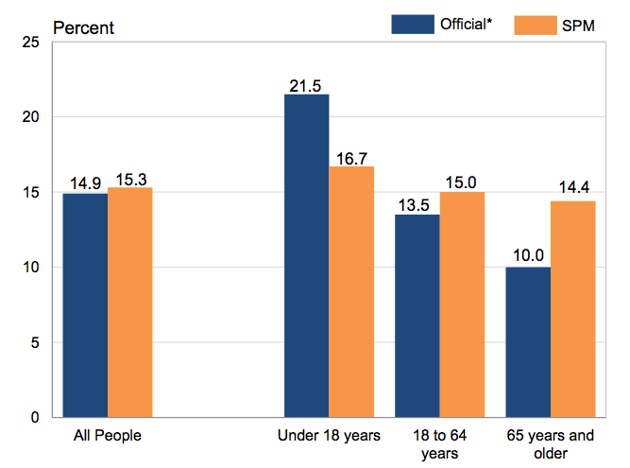
That’s why for the first time, the bureau released a supplemental poverty measure along with its official figures. According to the supplemental data, the poverty rate in the U.S. was about 15.3 percent—0.4 percentage points higher than the report’s official rate. But the additional measure shows differences in age groups. For instance, those under the age of 18 have a poverty rate of 16.7 percent—quite a bit lower than the 21.5 percent reported in the main findings. For older Americans, the tweaked metrics paint a grimmer picture, with the share of seniors living in poverty reported as nearly 5 percentage points higher than the official measure.


Poverty Rates: Official Versus Supplemental

Census

The more inclusive measures might  help monitor the effectiveness of programs meant to increase the well-being of specific populations, such as children or the elderly. Still, the use of an official, blanket income level remains a crude means of identifying families that are having a difficult time putting roofs over their heads or food on the table, especially considering the vast differences in cost of living around the country. To better understand the persistent poverty problem requires greater attention to nuanced and localized data that can better illustrate areas where the cost of essentials are outstripping income and benefits, and where families continue to suffer.

An interesting development. Now the vetting of the new measurement tool can begin and I’m guessing that this won’t satisfy too many people.

A political question: would any administration allow the official government definition of poverty to change if it meant that the rate would increase during their time in office? This isn’t just about measurement; there are political considerations as well.

“The Myth of a White Minority”

Sociologist Richard Alba wrote a NYT op-ed in June about the fluidity of being white in the United States amidst a growing multiracial population:

But the forecast of an imminent white minority, which some take as a given, is wrong. We will seem like a majority-white society for much longer than is believed…

Some of the mixed children now classified as minorities surely will think of themselves mainly as whites when they grow up; researchers have already found a significant group of American adults who declare themselves as non-Hispanic whites to the census, but acknowledge having some Mexican ancestry. Others may have mixed or even minority identities, but will be “sociologically white,” integrated into white communities and family networks and seen as essentially no different from anyone else.

According to the new Pew report, adults from mixed white and Asian backgrounds feel they have more in common with whites than they do with Asians; almost half have friendship circles that are mostly made up of whites; and two-thirds live in mostly white neighborhoods. Two-thirds of the multiracial Americans in the report who have some white ancestry are themselves married to whites.

We can grasp these emerging social realities by remembering our history of assimilation. At midcentury, religious boundaries were highly salient in white America. Catholics, Jews and Protestants were distinct populations, whose social lives were largely confined within their own group. Yet in only a few decades, the differences faded, and interaction across the boundaries proliferated. It was not that people ceased being Catholic or Jewish. But the public faces of those identities became much more muted and rarely intruded on everyday life. The Jewish intermarriage rate, around 10 percent in 1950, climbed to 58 percent by 2013.

What racial and ethnic categories mean are not static. And if white continues to be a privileged status, some will want to identify with it among their options and other might not. And, of course, existing whites might contest these dynamic boundaries. For example, would southern whites accept as white a growing number of Latinos who have both Latino and white heritage?

This all makes measuring race and ethnicity more interesting moving forward. The Census Bureau is already thinking of changes for the 2020 decennial census.

Ah, another story of an overzealous Census surveyor

Worried the Census Bureau is going to force compliance in answering its surveys? Here is another story of a zealous employee:

An East Dallas woman is outraged after she claims one U.S. Census worker showed up at her door for a housing survey and would not take “no” for an answer…

“She’s ringing the bell, knocking on the door. And I’m like, ‘I don’t want to participate.’” Said Platz. The East Dallas resident said it started with a series of three letters from the U.S. Census Bureau. A few days later after receiving the third later, a census worker showed up. Her husband verbally declined.

But a few days later, a different worker showed up at their home and would not leave according to Platz…

The census worker sat on the bumper of her van for the next 30 minutes. Sonia said the worker would only get up from the back of her van every few minutes to see if she had changed her mind about taking the housing survey…

It was a real federal census worker according to the regional office that covers Dallas. A supervisor confirmed more than 100 other workers are out in the area conducting the same work. The regional office said employees are encouraged to be “pleasantly persistent” and never take “no” for an answer at first.

I would guess that at least 95%+ of Census workers don’t cause such problems. But, an occasional case of Census workers who really want survey responses may be enough to keep people worried. And it would be interesting to hear how the Census Bureau deals with such employees.

To be snarky about it, perhaps people shouldn’t worry too much about the zealous Census worker as the NSA could just gather the relevant information without anyone knowing…

Possibly dropping the word “race” from Census 2020

The Census Bureau is considering whether to use the term “race” in future surveys:

The U.S. Census Bureau is experimenting with eliminating the word “race” altogether in its 2020 survey, according to a report from the Pew Research Center on Thursday.

As part of its final research push before finalizing its 2020 wording, test-census forms will be sent to 1.2 million households later this fall in without any references to “race” or “origin.” Instead, the forms will ask: “Which categories describe person 1?” Respondents will then be able to choose from the usual list of racial and ethnic categories.

According to Pew, Census officials want to be clearer with their questions so that officials can gather more accurate data as required by law. Past testing and focus-group research has indicated confusion among found that the terms “race,” “ethnicity” and “origin” can mislead or confuse respondents, they can mean different things depending on the person answering.

“We recognize that race and ethnicity are not quantifiable values. Rather, identity is a complex mix of one’s family and social environment, historical or socio-political constructs, personal experience, context, and many other immeasurable factors,” the Census Bureau noted in a 2013 report on past testing efforts in the 2010 census. The report also recommended continued research on optimizing the use of examples for each racial and ethnic category, among other strategies…

The Bureau is also testing the use of a “Middle Eastern or North African” category within the current lineup.

It is not surprising to see such changes as the societal and Census definitions of race and ethnicity have changed quite a bit over time. Additionally, social researchers have to keep up with the changing societal definitions and understandings.

If major changes are coming in future Census surveys, how easy will it be to compare this data with past data?