Add political ads to political yard signs in a third season

On Monday, I proposed adding political yard sign season to the Chicago seasons of winter and construction. I want to amend that third season: include political ads with political yard signs.

Photo by Home Decor Interiors on Pexels.com

Political ads are everywhere this time of year and they are hard to avoid:

-During all TV broadcasts. Whether watching football games or news broadcasts or sitcoms, candidates are all over the screen.06

-Internet and social media ads. I do not see many of these due to using adblockers but the ads are over the place.

-Mailings as candidates flood mailboxes with appeals and glossy photos and policy positions.

-Texts asking you to vote for candidates or support a candidate. How many of these numbers do we need to block?

-On the radio. Perhaps not as pervasive as TV but still there.

And I do not even live in a battleground state where I would guess there are even more ads.

The political ads must work to some degree as millions are spent on them. Who exactly is convinced by them? Do they primarily rile up a base who then votes in larger numbers? At the same time, I remember hearing a talk by a sociologist who interviewed campaign managers who reported that social media ads are preferable because it is easier to measure who responds or engages compares to mass media ads.

Commercials are part of the American way of life. Anywhere you turn, you see brands, logos, and appeals for particular products. Given that landscape where we see thousands of ads, why not throw in politicians and parties and issues as just another brand or product to sell?

Like the political yard signs, the ads will disappear after Election Day. They will be back for the next races as different actors try to position their candidates in front of the public in a truly American way.
Cannot unsee the studio backlot, snowy Christmas commercial edition

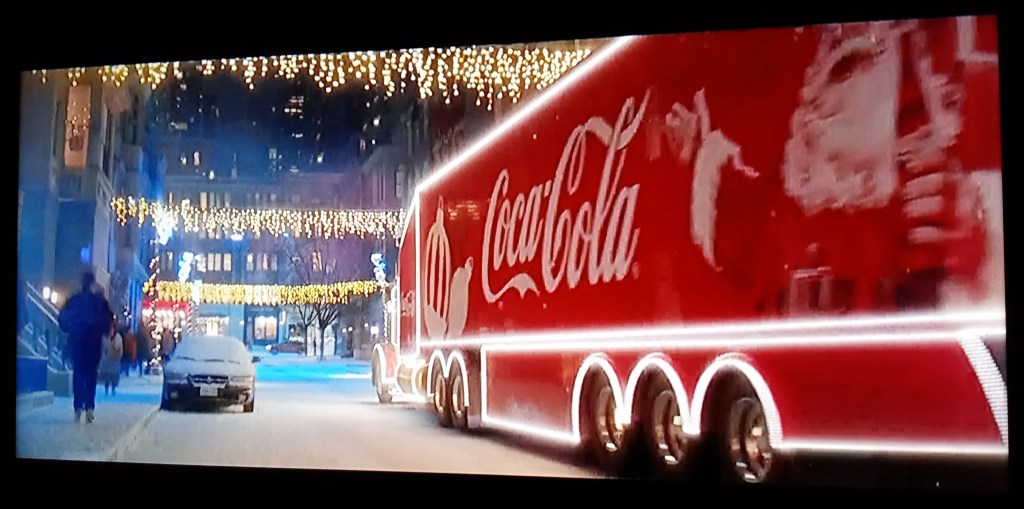
After touring several Hollywood backlots years ago, I see them pop up in many places. Here is a Coca-Cola television advertisement with a closing scene from a southern California backlot:

I am pretty sure that this scene was filmed here.

On one hand, it is exciting to be watching a film, TV show, or commercial and recognize a place. It pops out at you out of the other anonymous scenery. On the other hand, this is not a real place. It is a backlot where all sorts of “places” can be made. With some work and added elements, these backlots can look like a lot of different places.

As I have found in studying suburbs on TV shows, places are presented on screens in particular ways. It is hard to communicate the feel and experience of a place on a two-dimensional screen when the emphasis is often on a few characters. Backlots can be changed up but if you know what you are looking for, you can spot them in all sorts of displays. Or, films, shows, and commercials tend to be shot in some places and not others. With these patterns, we do not necessarily see real places or the range of places within the United States.

Basketball “from suburbia to Serbia”

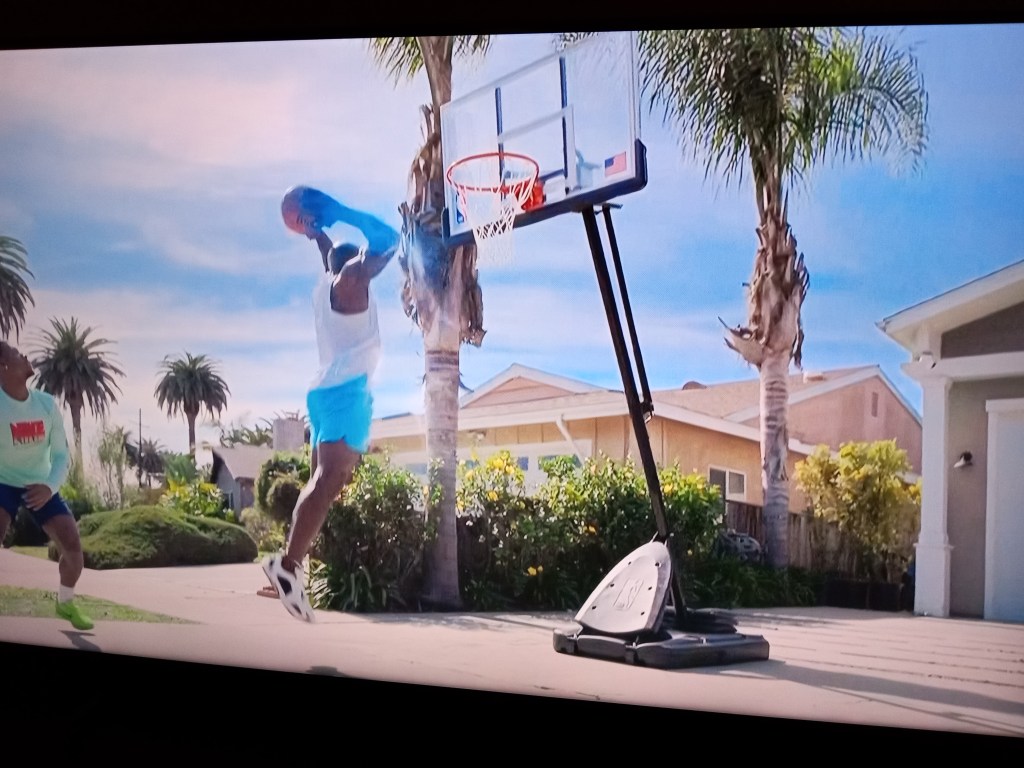
An NBA Playoffs commercial touting “playoff mode” includes the line “from suburbia to Serbia, it’s unbelievable” alongside this image of suburban basketball:

What stands out in this depiction of suburbia? A few things:

  1. Outdoor basketball with palm trees on a beautiful day of sunshine. Is this southern California? I assume this is a good spot to play basketball outdoors for most of the year. Not all places in the United States can claim this.
  2. This is a hoop in the driveway of a single-family home. The two players are not at the park playing basketball; they are playing in a private setting (though the street is presumably just out of view).
  3. How many players can dunk on the hoop set up in their driveway? It is hard to tell from the angle of the shot – the camera is just a foot or two off the ground – whether the hoop is at ten feet.

It does look like fun is being had with two guys playing hoops in the American suburbs…or a studio backlot made to look like one. While the line in the commercial tries to drive home the appeal of playoff basketball in two places with alliterative names, are the driveways of the American suburbs one of the key sites for basketball?

“Driving in ‘American Dream mode'”

Driving during a stretch of pleasant fall weather, I thought of a phrase I heard a few months back in a radio conversation: “driving in ‘American Dream mode’.” The idea was this: putting the windows down, turning up the radio or music, and enjoying the drive is an ideal expression of the American Dream. Freedom. Cars. Moving quickly through the landscape.

Photo by cottonbro on Pexels.com

Many car commercials play off this idea. These commercials rarely feature traffic and stopping for traffic lights or stop signs. The driving is often through pleasant landscapes. The drivers and the passengers are enjoying the experience. The cars are new and loaded with features.

Numerous social forces converged to this point where a particular driving experience embodies the American Dream. The construction of roads and highways. Sprawling suburbs. The rise of fast food, big box stores, and road trips. Driving is an essential part of the American way of life.

Even if relatively few people get to regularly drive in “American Dream mode,” it is a powerful symbol.

New LA bridge getting all the (wrong) attention

A bridge recently opened in Los Angeles was closed earlier this week after too much of the wrong kind of attention:

Photo by Travis Saylor on Pexels.com

The bridge opened to the public back on July 10, just over two weeks ago, but in that brief time, it’s been the center of attention in Los Angeles for all the wrong reasons. Street takeovers, graffiti, and crashes have plagued the bridge since its reopening. The LAPD has given out 57 citations on the bridge over the last four days, according to LAPD Chief Michel Moore.

“The 6th Street Bridge will be closed until further notice due to illegal activity and public safety concerns,” the LAPD posted on Twitter Tuesday night.

The construction of the bridge took six years and cost nearly $600 million. Ahead of its grand reopening, LA city Councilmember Kevin de León said the bridge would “rival the Hollywood Sign and Griffith Park as iconic images of our city.”

The bridge has been closed multiple times, most recently every night this past weekend for what LAPD called “questionable activity.” On Tuesday, Moore announced that speed bumps were being installed on the bridge to deter street takeovers and that a center median and fencing to discourage people from scaling the archways could also be installed soon on a temporary basis.

I imagine the city will want to channel the attention for the new bridge in positive directions. They can highlight the new infrastructure, road, and design. Here is a city getting things done and in style. How about harnessing that energy for exciting yet legal TikTok and social media videos?

With the role of Los Angeles bridges in car commercials, how long until we see this bridge all over screens?

If every life event was sponsored, baseball edition

I enjoy listening to baseball games on the radio. The pace of the game, the voices of the announcers, and the ability to do other things while listening add up to an enjoyable experience.

Photo by Anthony on Pexels.com

Except for one growing trend: the number of commercial reads throughout the game. At this point, it seems like almost every baseball event has a sponsor. Strikeouts, walks, doubles, home runs, the fifth inning, the seventh inning…you get the idea. Baseball has a lot of small events and apparently they can be attached to an advertiser for the right price.

I am aware of multiple factors behind this. Radio is a dying business. Live sports is one of the few shining spots where there are certain to be listeners (or viewers). Commercialization is alive and well. There is money to be made here.

But, I can only imagine how this might spread to all areas of life. Go beyond the Internet and social media ads tied to your browsing and shopping habits. You tie your shoes; brought to you by [blank]. You run the dishwasher; brought to you by [blank]. You read a book; brought to you by [blank].

At this point, there do not seem to be any officials guardrails against more and more of this happening. People can push back but this has consequences. If I do not like the baseball ads, I can stop listening. But, if we move to more immersive devices – Google Glass, virtual reality headsets, a house full of Internet equipped objects – this will be very hard to push against or escape.

Soccer won’t make it big in the US because it doesn’t have enough time for commercials?

Forget cultural differences; perhaps soccer won’t make it big in the United States because there is not enough money to be made.

“Soccer is the least profitable sport on the planet,” says Stefan Szymanski, professor of sports management at the University of Michigan and co-author of Soccernomics. “The whole structure of soccer is totally at variance with the America model.”…

In America, TV contracts have a lot to do with a sport’s profitability. MLS recently took a step toward the big leagues with new contracts that will generate around $90 million in revenue per year, the most ever for the league. But that’s puny compared with leagues such as the NFL, which takes in about $5 billion per year from TV rights. The visibility generated by saturation TV coverage helps the NFL earn even more revenue from sponsorships, ticket fees and licensing deals.

It might be unfair to compare the MLS with the NFL, which is the world’s most profitable sports league and an almost unexplainable phenomenon. But pro soccer in the U.S. may face a chicken-and-egg problem that prevents it from ever following in the NFL’s cleats. Most NFL, NBA, MLB and NHL teams manage to be profitable whether they win or lose. That’s because of revenue-sharing deals, salary caps and other equalizers meant to keep leagues competitive and owners satisfied…

“The MLS is pursuing the America business model, which means it’s not pouring billions into making it successful but is actually limiting player spending,” Szymanski says. “There are probably 30 soccer leagues that spend more on wages per team than the MLS — including the Romanian soccer league.”

I wonder how American sports fans would react to the idea that sports “work” in the US because owners can make lots of money. Sure, the sports may be interesting and the athletes impressive but the owners have to make money and there have to be lots of commercials. The average football game has about 11 minutes of gameplay. It’s more like the sports play around the commercial breaks.

Does this mean American sports don’t really follow a free market model? It sounds more like team owners work together to guarantee their profitability and then others on the outside, like various corporations and television networks, can try to make money.

TV execs, advertisers, going after graying TV audience

After years of chasing the 18-to-49 demographic, TV may be shifting its target audience as the American population ages.

The median age of a broadcast television viewer is now the highest ever at 54. Twenty years ago, it was 41. The most-watched scripted series in the 1993-94 season was “Home Improvement,” with a median viewer age of 34. Today, it’s “NCIS,” with a median viewer who is 61.

Confronted with these realities, the networks are aggressively making the case to advertisers that older viewers are valuable — especially the affluent and influential 55-to-64-year-olds they’re calling “alpha boomers.” The 50-and-up crowd of today, they contend, is far different than the frugal and brand-loyal group that came of age during the Great Depression and World War II…

Younger adults, busy with school, careers, socializing and child-rearing, have always watched less TV. Now they’re even harder to find, thanks to technology that allows them to watch TV whenever and wherever they want, and to skip over commercials…

A decade ago, networks primarily sold ad inventory for prime-time shows based on how many 18-to-49-year-olds were watching at home. Now, network sales teams are emphasizing other metrics, such as income and education level of viewers.

The population bulge known as the baby boomers continue to influence American society. There was a really nice infographic in the Chicago Tribune version of this story (I can’t seem to find it online) that clearly shows some of the patterns across networks: CBS has the highest median age where even their “younger shows,” like How I Met Your Mother and 2 Broke Girls, have a median viewer around 50. The youngest network, by far, is Fox with six shows with a median age under 40 whereas no other network has 1 show under 40 and each only have a few under 50.

It would be interesting to then compare these shifts on television to other areas of advertising and marketing. Can advertisers move away from targeting young people on television because it is so much more effective to target them on social media and websites? Or is television still such a big deal even with declining numbers that Internet advertising still can’t compare?

Linking the Ace Hardware home and Wisteria Lane

Following up on a post regarding an odd-looking home in recent Ace Hardware commercials and a comment on the post that the Ace home was located on Wisteria Lane in the TV show Desperate Housewives, here is another look at the home courtesy of Wikipedia:

File:KathrynsHouse.JPG

While the Ace commercial made the house gave the house even more odd proportions in order to fit an Ace sign on the front, the house is still odd. Too many gables that stick out too far plus a really odd second story window that barely fits between the two gables.

Here is more about Wisteria Lane:

In preparing for the pilot, the Desperate Housewives production team searched a 30-minute radius of Hollywood for a suburb in which to film the show, but nothing was quite right. The production team initially looked into purchasing a block of actual houses for filming, however they felt the houses looked too similar and lacked character. So they went with Plan B – a studio backlot.

Only two studios in Hollywood have significant backlots, Warner Brothers and Universal. Warner Brothers had half a street, with houses on one side and a park on the other, but there was no sense of community, but Universal had Colonial Street – a collection of rundown house fronts that lined both sides of the street, and were close enough together to look good on camera.

The only problem was that the houses are only three-quarter scale. The team had to deal with the challenges of the unnatural – the houses being too small and too close and the sidewalks not as wide as the real thing, but the show is a parable and a slightly less-than-real look became an advantage, and added to the suburban perfection on film…

At first, the houses were just facades, with interiors built on a sound stage, but once Housewives was picked up, something unique was done for the show, interiors were created, including Susan’s kitchen and Mary Alice’s living room, and Gabrielle could go in the front door and into the main floor of her house. This created a unique filming style which allowed viewers to watch a scene inside a house and look out through the windows into the street – creating a real sense of community.

To help audiences identify the different characters quickly, the team devised a colour palette system based on the characters personality and traits. They looked for colours that were intriguing, and then matched them up, these colour palettes are carried out in each character’s house exterior and interior. For example Gabrielle Solis was set with warm orange-yellow tones to hint at her spicy Latino nature. Whereas Susan Mayer’s character has more feminine sensibilities, demonstrated by the use of pastel colours.

So perhaps the real problem with the poorly proportioned house was that it was a 3/4 scale. Still, even a full scale version of the house might look at little busy in the front.

Thanksgiving football game = 11 minutes of action, over 100 ads

Football is America’s favorite sport but the average NFL broadcast doesn’t actually contain much football:

The NFL’s popularity is all the more remarkable when you inspect the fare it has to offer each week on television. An average professional football game lasts 3 hours and 12 minutes, but if you tally up the time when the ball is actually in play, the action amounts to a mere 11 minutes…

The 11 minutes of action was famously calculated a few years ago by the Wall Street Journal. Its analysis found that an average NFL broadcast spent more time on replays (17 minutes) than live play. The plurality of time (75 minutes) was spent watching players, coaches, and referees essentially loiter on the field.

An average play in the NFL lasts just four seconds.

Of course, watching football on TV is hardly just about the game; there are plenty of advertisements to show people, too. The average NFL game includes 20 commercial breaks containing more than 100 ads. The Journal’s analysis found that commercials took up about an hour, or one-third, of the game.

As this piece correctly notes, this is partly due to the rules of the game where there is down time between plays. At the same time, the NFL broadcasts go out of their way to add commercial breaks. Consider a sequence like this: touchdown scored, kick the extra point, commercial break, kickoff, commercial break. This happens all the time.

For contrast, watch high school or lower level college football. These games still have breaks between plays but the drop-off in wasted time for commercials is astounding.

One other note: if it weren’t for all the commercials, would the networks still show football games?