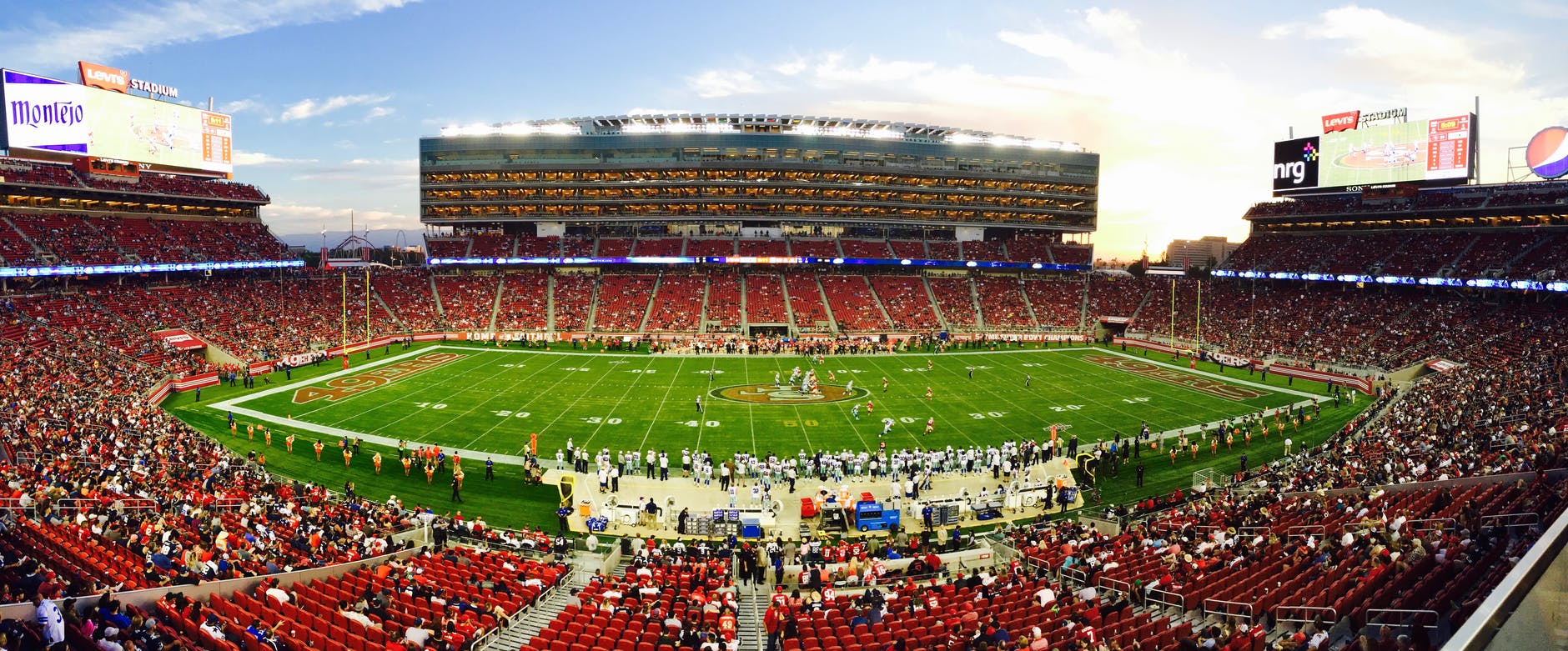
A championship football game played in a suburban shopping mall = peak American Dream?

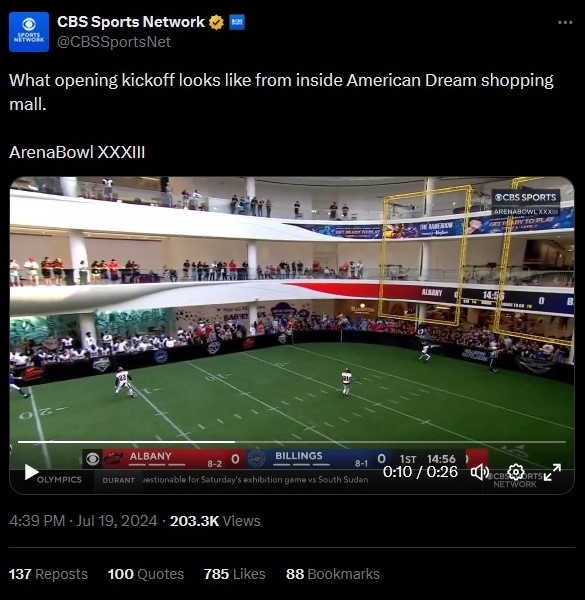
The Arena Football League recently played their championship in a New Jersey shopping mall:

As shopping malls seek to add more entertainment options, why not add sports? It could be at the professional level or amateur level. Imagine a high school basketball tournament hosted inside a mall with space for sports. Or a kids baseball tournament. Or a tour pickleball tournament. Sports could help bring in more visitors. It puts more people in proximity to the shops and restaurants.

Even though malls are big, many may not be big enough to do this. The American Dream Meadowlands in East Rutherford Mall, New Jersey is the second-largest mall in the United States and has plenty of entertainment options – a ski slope, a hockey rink, an amusement park, an aquarium, and more – in addition to 450 stores and lots of food options. This complex has sports already in mind. Many malls would need to reconfigure space or add facilities.

Given how much Americans like football and shopping malls (even with their decline), how many events can get more American than this? And held at a place named American Dream?

Naperville is the equivalent of 4th and 29 for a Bears opponent

Naperville is a highly-ranked suburb but is rarely described in sports terms. On the Fox broadcast of Bears-Lions yesterday, play-by-play announcer Adam Amin invoked Naperville in a difficult late-game situation for the Lions:

Why Naperville? Two quick theories. First, Amin announces a lot of games in Chicago due to being the play-by-play guy for the Chicago Bulls. He would be more familiar with the region and local communities. The Bulls do not have many ties to Naperville but it is the third largest community in the region (after Chicago and Aurora).

Second, Naperville is sufficiently far from Chicago and Soldier Field to be the distance equivalent of needing 29 yards for a first down. Naperville is roughly 30 miles southwest of downtown. Fourth and 40 might get you to Elgin and Fourth and 45 might get you to Joliet. I am up for more yard-to-mileage comparisons in Bears broadcasts though it might work better on a local radio call than a national broadcast.

And if the Bears end up in Arlington Heights or Naperville or another suburb, then can the fourth down distance go the other direction? “It’s fourth-and-Bronzeville” or “fourth-and-Logan Square”.

Trying to maintain hope in the pep band with a HS football team that wins 4 games over 4 years

I recently saw the football team at the high school I attended has a chance to make the playoffs for the first time in over two decades. This brought back memories…of lots of football losses.

Photo by cottonbro studio on Pexels.com

Even though I like football, I would not have been at any of these games unless I had to be. And I saw many of the games in the 4-32 record over four seasons because I was in the pep band. Usually playing alto saxophone (and one season on the sidelines playing keyboards), I was at every home game and a few of the away games. I remember some of the halftime scores where the other team had thirty points or more, we had none, and we had a halftime show to do.

What happens to the pep band amid these results? We did not pay much attention to the football action. We played our parts loudly. The crowds at football games – and those who might hear us – were limited. We did our thing and did not think much about football.

Since I also had some pep band experience in college, I can compare and safely say that it was more enjoyable to play upbeat music when your team could regularly win. Someone has to lose the game and those teams have bands, cheerleaders, and fans as well. Trying to enjoy the music and band experience is harder when it occurs during loss after loss.

Put this together with my Cubs and Bears fandom and I am used to lost games and seasons. I wish teams who tend not to have success over time do at least occasionally have times of winning. Even just a year or a few games of success can help sustain enthusiasm and hope.

Do sports fans want shorter games, more action, or a higher action to time ratio?

Baseball has taken significant steps this season to shorten the game through new features like a clock for pitchers and batters. A growing consensus over recent years has suggested fans want shorter games. College football is considering shortening games. However, in the absence of data I have encountered about what fans actually want, I wonder if it is really about shorter games. These might be two other options that sports fans in America want:

-More action. Studies have shown sports like baseball and football actually do not have much game action across the multiple hour experience. Pitch clocks make the action happen quicker but do not necessarily mean there will be more balls in play or runners on base. Baseball has moved in recent years to more three true outcomes: strikeouts, walks, and home runs. These involve limited action.

-A higher action to time ratio. Perhaps what fans want is not shorter time but more action within the time of the game. Shortening the time with no change to the action would provide a higher ratio. Shortened times plus more action would further increase the ratio. Other sports have more flow or continuous action, like hockey or soccer (though many American fans might consider these action low-stakes or boring action). Or, watching a condensed game where the time between all pitches or all football plays is removed can be an interesting experience.

I suspect there might be plenty of experimentation in the coming years regarding finding formulas for sports in order to retain or attract the attention of fans. This will also happen with ongoing interaction with other forms of entertainment that offer different experiences and timelines.

Divided fan loyalties: QB1 is on my team, my opponent’s team, and my home team

In recent weeks, I have run into a situation unique to Chicago Bears fans: do I always cheer for our quarterback who is scoring points at a prodigious rate? Here is where loyalties can be divided:

Photo by Pixabay on Pexels.com
  1. In one fantasy football league, I drafted Justin Fields at the beginning of Round 5. This put him after all of the established quarterbacks and somewhere in the middle with a number of other unproven players. (Trevor Lawrence went next, I drafted Tua Tagovailoa at the beginning of Round 7, etc.)
  2. In other fantasy leagues, I have now played Justin Fields as the opposing QB in multiple weeks. He is scoring a lot of points recently – but now against me.
  3. As a fan of the Chicago Bears, I almost never draft Bears players because for decades the Bears have not scored consistently. Even with an exciting young quarterback, the Bears are still not winning. Should they lose more for a higher draft pick? Should they do more for their young QB?

Fantasy sports and gambling has introduced this conundrum for years: do I enjoy watching sports or do I reduce my teams and the players to individual components that I can profit from?

If I had to decide, I go with my lifelong fandom with the Chicago Bears. I want them to do well. Even as I have played fantasy football for almost two decades and Madden football for three decades, I enjoy being a sports fan, even of an unsuccessful team.

It is less clear whether others sports fans agree with this. It is much easier to follow particular players or certain teams as they become famous and successful. Why stick with the Bears when you can enjoy the play and exploits of others? Why not turn it into a matter of my own success?

Perhaps sports fandom will look very different in the coming decades. Sports will continue and I suspect the push toward individualizing the fan experience, particularly prioritizing those teams and players who are successful, will as well.

10 of 32 NFL teams play in the suburbs of the city whose name they hold

Ten NFL teams have a big city in their name but play in the stadiums located in the suburbs of that big city. Here are the 10 (sourced from here and here):

Photo by Robert Hernandez Villalta on Pexels.com

-Buffalo Bills play in Orchard Park

-Dallas Cowboys play in Arlington

-Los Angeles Chargers play in Inglewood

-Los Angeles Rams play in Inglewood

-Miami Dolphins play in Miami Gardens

-New York Giants play in East Rutherford (New Jersey)

-New York Jets play in East Rutherford (New Jersey)

-San Francisco 49ers play in Santa Clara

-Washington Commanders play in Landover (Maryland)

Two bonus suburban teams: the Arizona Cardinals, not named after a city but a state, play in suburban Glendale and the New England Patriots, named after a region and not a city, play in suburban Foxborough.

If the Bears end up in Arlington Heights, that would push the number of suburban NFL teams up to 13 total.

The winners when communities fight over sports teams are the team owners, not the communities

The Daily Herald editorializes about who will win as Chicago, Arlington Heights, and other taxing bodies consider where the Chicago Bears might end up:

Photo by Bhargava Marripati on Pexels.com

In a pair of radio interviews last week, Lightfoot poo-pooed a potential move, saying Arlington Heights can’t match the offer Chicago will make — or its tourist trade…

While the prospect of reelection is much more imminent for Lightfoot than where the Bears end up, any signs that she is relenting to Arlington Heights would be the death of her political career.

It was just a few months ago that Lightfoot was overtly dismissive of the Bears’ purchase agreement for the 326 acres at Arlington Park Racecourse — enough land for a world-class stadium plus all manner of ancillary entertainment businesses from which the team could profit…

If Lightfoot thinks she can keep the Bears at Soldier Field — even with a dome — she’s nuts. The constraints of the NFL’s smallest and oldest stadium won’t allow Soldier Field to host a Super Bowl or, as is important to the team, to allow the Bears to do what has become commonplace around the league: develop the stadium as an entertainment complex that generates more cash…

The only sure winner in this tug of war will be the football team.

The research consistently finds that team owners are the biggest winners in the battle to provide tax breaks, monies, and other benefits for sports teams who consider relocation. Yes, it would be a PR and status blow to Chicago to lose the Chicago Bears to a suburb – even a denser Arlington Heights – but people will still spend money in the city and the team will still be in the region. Do not go into taxpayer debt just to enrich a private football team.

It will be very interesting what kind of “best offer” Chicago will provide. And how public will this all get as the city tries to avoid losing the team?

Bears stadium at Arlington Park? Just keep the taxpayers out of it

With the announcement that Arlington Park will be for sale, ideas are swirling about how the land could be used. I have heard a few times already the possibility of the Chicago Bears constructing a new stadium there. Here is one example:

The Loop from the North End of Soldier Field

Now it is urgently incumbent upon regional politicians and civic planners to begin a campaign to get a global-class Chicago Bears stadium built as a profitable symbol of the rebirth of the 326-acre site.

Fulfillment of such a bold and visioned plan would bring about a marriage of an NFL team and a suburb that was first discussed between “Papa Bear” George Halas and then-AP empress Marje Everett in 1968…

The question of “How?” can only be answered if there is an enormously creative and concerted joint effort put forth by such potential game changers as Bears chairman George McCaskey, Arlington Heights Mayor Tom Hayes and Gov. J.B. Pritzker…

Said Mayor Butts: “From my experience — and I’m talking about my suburb, which is 52 percent Hispanic, 47 percent Black and 1 percent ‘other’ — if you have an inspired plan, proper financing that does not put the host municipality at risk and a resolute ‘will-get-done’ attitude, toss in hard work and you can make a great thing happen.”

On one hand, this is a unique opportunity. It is rare for parcels of land this large to open up in suburbs developed decades ago. Filling a large parcel can be difficult; what can add to the existing community without threatening the current character? This particular location provides easy access to highways, easing travel for thousands of fans. The surrounding area is already used to sporting events on the sites. A suburb could become home to a major sports stadium.

On the other hand, the “creative and concerted joint effort” required to pull this off could become an albatross to taxpayers who often fund large stadiums for wealthy team owners. This is a tax break of massive proportions for a feature economists argue does not necessarily bring added economic benefits to a community. The stadium may provide status to a suburb but this does not always translate into financial gains. And Illinois has a history of this already: just see the state deal where taxes are still funding the White Sox stadium.

How to balance these competing perspectives? Many suburbs would jump at the opportunity as growth is good, having a pro sports teams is an important status symbol, and hearing the Bears are playing in Arlington Heights could be part of a branding strategy. But, I would recommend leaving the taxpayers out of this: they will likely not benefit economically from a new stadium.

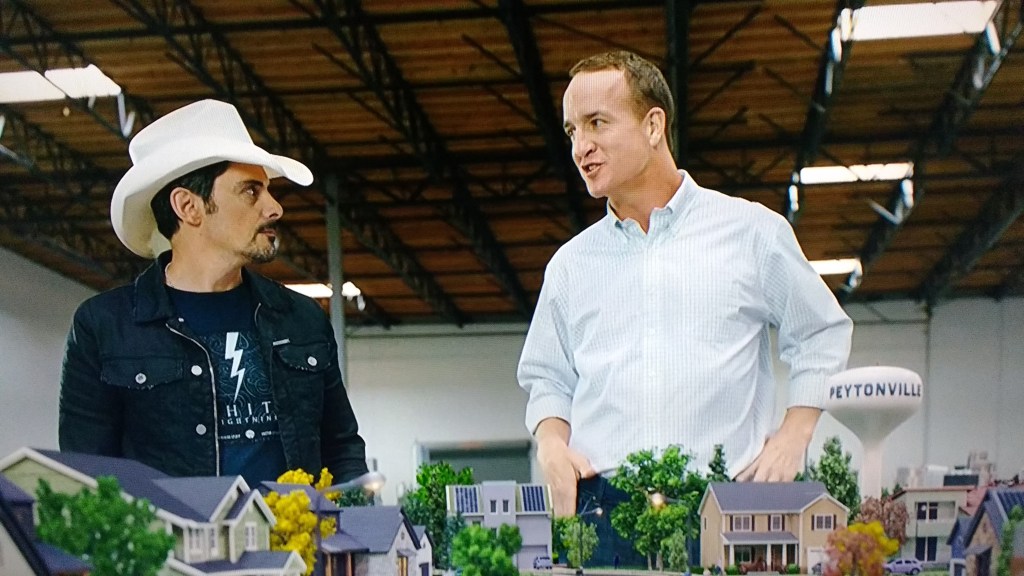
Peytonville, the suburbs, and football

With the return to the airwaves of Peytonville ads from Nationwide, I noticed something in the commercials I had not thought about before (see Peytonville Parts 1, 2, 3, 4, and 5): the possible connection between suburbs and football. Notwithstanding a possible caveat that Nationwide might want to appeal to suburban customers, here are some ways the suburbs, football, and Peyton Manning might go together.

First, the majority of Americans live in suburbs. It is a slight majority but the percent in suburbs outnumbers the percent living in cities by a little more than 20%. Where is football played the most? Which communities have the most interest in football? The romanticized image of a football community might be a small town in the Heartland obsessing about football on fall Friday nights but much of the activity might be happening on suburban fields and on suburban television screens.

Second, the Peytonville commercials at least hint at college and pro football as well as suburban and urban life. For both college and pro football, where are the majority of fans? For college, perhaps the thousands of alumni for major football schools have largely settled in suburbs. With a college degree, people have the opportunity for higher-paying jobs and put those resources into suburban single-family homes. For pro teams, the majority of residents in a metropolitan region are suburbanites. Take Chicago as an example: there may be a lot of Bears fans in Chicago but there are over 6 million more residents in the suburbs than the city.

Third, the social and cultural life of the suburbs might lend itself to football (and other sports as well). With games on the weekend, many suburbanites are free to sit at home and watch or attend games. For kids, families have the resources to enroll them in activities and there are plenty of organizations ready to funnel kids into high school and college football.

Perhaps this is off yet certain sports are associated with certain places. Is football truly a suburban sport or does it belong to all of American places?

A Patrick Mahomes word cloud, strengths and weaknesses

The season-opening NFL broadcast included a word cloud of descriptions of Chief’s quarterback Patrick Mahomes from his teammates:

On the broadcast, they noted that “leader” was mentioned the most times and several people mentioned “smart” and “competitive.” And, since this came right after a conversation of Mahomes’ record contract, it was noted that no teammate said “rich.”

A few thoughts on this graphic:

  1. It highlights the popularity and/or spread of word clouds. If it makes it to a football broadcast, it is all throughout the United States.
  2. It remains a way to highlight words or themes across a series of interviews or texts. It can take time to relay thoughts from multiple interactions; the word cloud tries to summarize the concepts. But…
  3. The size of the words do not easily convey their frequency in this particular graphic. Leader is clearly the biggest, competitive and smart are somewhere in the middle, and then there are a lot of other words. Yet, the length of certain words – “courageous” or “extraordinary” – take up a lot of space even if they were just mentioned once.
  4. The colors of the word cloud are tied to the Chiefs’ colors. But with the background changing a bit behind the words (“add a dynamic background to that boring word cloud!”), it can be hard to read some of the words in red (see “smart” above).
  5. Without knowing the number of interviews or how many total descriptors were given, it is hard to know how many words stand out.

An interesting choice of graphic and still some work to do to make this even a better presentation of data.