Itasca’s plan commission on Wednesday unanimously agreed to recommend the village board deny Haymarket’s proposal. The Chicago-based nonprofit group is seeking permission to convert a former hotel along Irving Park Road into a 240-bed facility for adult patients with drug and alcohol use disorders.
The final decision rests with the village board. But trustees don’t want to rush their decision.
On Thursday, Mayor Jeff Pruyn said the village board plans to have at least two special meetings beginning in the middle of October. The first would allow public comment about the proposal. Haymarket representatives would make their case before the village board during the second.
As a result, the village board will not vote on the proposal until late October or early November.
Making a hasty decision may be in no one’s best interest. Particularly given the controversy surrounding the proposal, making sure everyone has a chance to voice their opinion and the board has all the time to make up their mind seems reasonable.
At the same time, what would change between now and then that would have a big effect on how the board members are viewing the situation? The proposal has been under discussion from some time and community members have made their voices heard.
This is not an easy decision for a smaller community to make. There could be consequences for life in the community and future development. Either way, some people will be upset. The village board decision will either agree with the plan commission or go the other direction (and the board is able to choose either option).
Yet, a decision needs to be made. I will be interested to see what happens: how will Itasca respond? Will Haymarket look for another suburban location? More broadly, what suburban communities might welcome land uses like these that are needed in metropolitan regions?
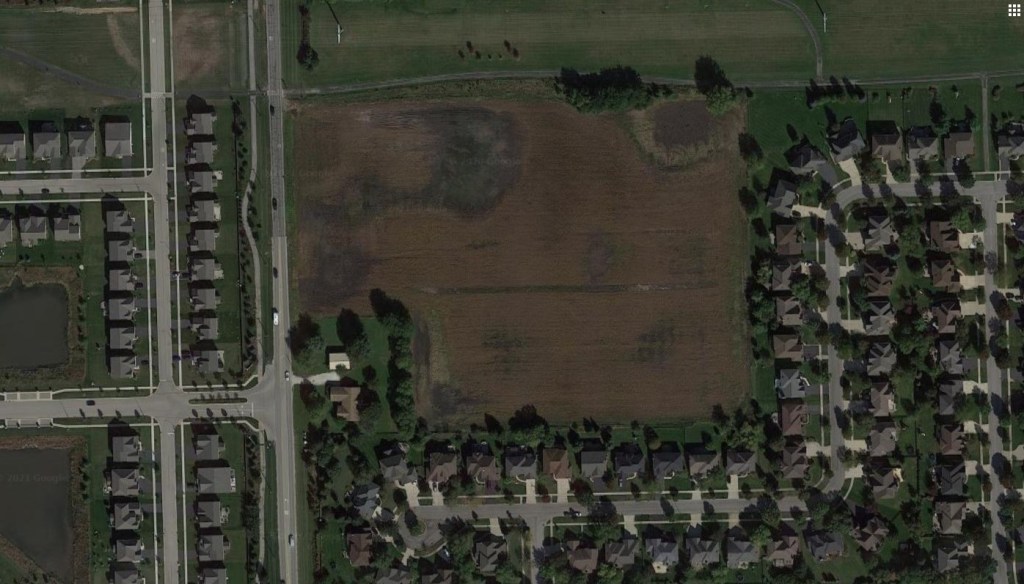
The developers propose to build a three-story building on approximately 2.5 acres at 874-920 N. Quentin Road, on the southwest corner with Poplar Street. All of the apartments — one-, two- and three-bedrooms — would be set aside for tenants whose income is between 30% and 80% of the area’s median income.
Village staff members recommended denying the plan, and the plan commission did the same after a public hearing Tuesday night. The village council will have final say and is expected to discuss the matter Aug. 9.
Plan commissioners praised the developer’s successful record of affordable housing developments, but they didn’t like the plan for the Palatine site, saying it’s too dense. The area consists of single-family homes and townhouses, with an apartment complex further north…
Several residents spoke Tuesday against the plan, saying they are worried about traffic, noise and light pollution, and changing the character of the neighborhood.
The final word will come in a few weeks. In the meantime, this set of arguments is a common one when suburbs consider apartments or even townhomes and condos. A key issue is the density of the project. What this often means is the community prefers to have single-family homes. Denser housing is often thought of as smaller housing or cheaper housing. Here, that is clear in that it is affordable housing where, through a sizable tax credit ($15 million) from an Illinois agency, residents will not need to pay full market rate.
Additionally, people often have concerns about the aesthetics and daily experiences around apartments. Apartment buildings are taller and are bulkier compared to homes on grassy lots. Because of more residents on less land, there will be more traffic on local roads. This particular proposal is close to a busier intersection but it also would be adjacent to single-family homes. It just looks different than single-family homes. If there are too many denser developments, the impression may be that single-family homes are not valued.
In sum, this density and kind of housing is perceived as a threat to the character of single-family home communities. Municipalities will sometimes respond to such proposals by asking the developer to reduce the number of units. Or, they might reject it all together by saying that it is not a good fit. And the search for land for affordable housing continues.
Come 1970, there was broad support for a portentous shift: Los Angeles would abandon the top-down planning that prevailed during a quarter century of postwar growth in favor of an ostensibly democratized approach. The city was divided into 35 community areas, each represented by a citizen advisory committee that would draw up a plan to guide its future. In theory, this would empower Angelenos from Brentwood to Boyle Heights to Watts.
In practice, it enabled what the Los Angeles land-use expert Greg Morrow calls “the homeowner revolution.” In his doctoral dissertation, he argued that a faction of wealthy, mostly white homeowners seized control of citizen advisory committees, especially on the Westside, to dominate land-use policy across the city. These homeowners contorted zoning rules in their neighborhoods to favor single-family houses, even though hardly more than a third of households in Los Angeles are owner-occupied, while nearly two-thirds are rented. By forming or joining nongovernmental homeowners’ associations that counted land-use rules as their biggest priority, these homeowners managed to wield disproportionate influence. Groups that favored more construction and lower rents, including Republicans in the L.A. Area Chamber of Commerce and Democrats in the Urban League, failed to grasp the stakes.
The Federation of Hillside and Canyon Associations, a coalition of about 50 homeowners’ groups, was one of the most powerful anti-growth forces in California, Morrow’s research showed. It began innocently in the 1950s, when residents living below newly developed hillsides sought stricter rules to prevent landslides. Morrow found little explicit evidence that these groups were motivated by racism, but even if all the members of this coalition had been willing to welcome neighbors of color in ensuing decades, their vehement opposition to the construction of denser housing and apartments served to keep their neighborhoods largely segregated. Many in the coalition had an earnestly held, quasi-romantic belief that a low-density city of single-family homes was the most wholesome, elevating environment and agreed that their preferred way of life was under threat. Conservatives worried that the government would destroy their neighborhoods with public-housing projects. Anti-capitalists railed against profit-driven developers. Environmentalists warned that only zero population growth would stave off mass starvation.
Much like the Reaganites who believed that “starving the beast” with tax cuts would shrink government, the anti-growth coalition embraced the theory that preventing the construction of housing would induce locals to have fewer kids and keep others from moving in. The initial wave of community plans, around 1970, “dramatically rolled back density,” Morrow wrote, “from a planned population of 10 million people down to roughly 4.1 million.” Overnight, the city of Los Angeles planned for a future with 6 million fewer residents. When Angelenos kept having children and outsiders kept moving into the city anyway, the housing deficit exploded and rents began their stratospheric rise.
Far worse than corporations taking a few thousand units off the market for owners are the governments and noisy NIMBYish residents taking millions of units off the market for owners and renters alike—by blocking construction projects in the past few decades. (California alone has an estimated shortage of 3 million housing units.) From New York to California, deep-blue cities and states have amassed a pitiful record of blocking housing construction and failing to meet rising demand with adequate supply. Many of the people tweeting about BlackRock are represented by city councils and state governments, or are surrounded by zoning laws and local ordinances that make home construction something between onerous and impossible.
One of the issues at play here is a numbers one: who exactly is acting within the US housing market and how much sway do they have. Concerns about corporations and housing can be placed in the larger context of how many housing units there are and how many are being built. Here are the numbers Thompson provides:
The U.S. has roughly 140 million housing units, a broad category that includes mansions, tiny townhouses, and apartments of all sizes. Of those 140 million units, about 80 million are stand-alone single-family homes. Of those 80 million, about 15 million are rental properties. Of those 15 million single-family rentals, institutional investors own about 300,000; most of the rest are owned by individual landlords. Of that 300,000, BlackRock—largely through its investment in the real-estate rental company Invitation Homes—owns about 80,000. (To clear up a common confusion: The investment firm Blackstone established Invitation Homes, in which BlackRock, a separate investment firm, is now an investor. Don’t yell at me; I didn’t name them.)
If I am calculating correctly, institutional investors currently own 2% of the single-family rentals. Of course, this number could grow if these firms find this to be a good investment.
Thompson settles on local actors – governments and residents – as holding back housing construction. In this numbers game, restrictions on a local level collectively are holding back the construction of single-family housing. If these restrictions were lifted or lessened, concerns about institutional investors would presumably diminish because there is a larger supply of houses to choose from.
One problem I see with this among the larger numbers: while local actors might in the aggregate have oversight over millions of units, they individually have control over relatively few units. Let’s say a particular suburb in the Bay Area (and this NIMBY argument often comes back to California) is against building new single-family homes. Depending on the size of the community and the availability of land, this might affect just a few homes to several thousand. This is not many. Zoom out to the whole region and many suburbs doing this adds up to tens of thousands of potential homes. Do this across all of California’s metro areas and the numbers add up. Similarly, you could do this across all the metro areas in the United States.
All of this does not necessarily mean Thompson is wrong. Yet, to get to the numbers of new homes constructed that would make a significant difference – whether in reducing the need many metro areas have for more affordable housing or outweighing the actions of investment firms – would require a lot of change across many communities. State or federal legislation may or may not be successful and would be unpopular in many places without a significant public groundswell of support that this is an issue that all or even most communities need to address.
Together, municipal changes regarding zoning and NIMBY could add up. But, changes would need to come across communities to make a big difference.
What’s missing? The low-rise, multifamily housing that the city banned in the 1970s and ’80s. Which is why Christopher Hawthorne, the city’s chief design officer, held a competition, “Low-Rise: Housing Ideas for Los Angeles” to solicit new blueprints for so-called “missing middle” housing. “There’s a narrative in L.A., as in many cities, that neighborhoods are changing too fast; but in reality, L.A. is changing less rapidly than at any point in its history,” Hawthorne told me. A former architecture critic at the Los Angeles Times (and for this magazine), he plans to use these designs to win hearts and minds in the community forums where upzoning goes to die.
The winning entrants, announced on Monday, are a reminder that multifamily housing does not need to look much different than single-family housing. Instead, these models weave apartments right into the neighborhood, with understated architecture and clever use of space. In theory, these modest plans ought to take the “neighborhood character” argument against housing growth off the table.
Then again, the whole dialectic of NIMBY vs. YIMBY, Hawthorne contends, doesn’t accurately describe the situation on the ground. “When we actually talk to communities and neighborhoods, we find most people are in the middle. A lot of recent scholarship has clarified historic issues”—such as single-family zoning’s legacy of racial exclusion—”pandemic and wildfire have clarified others. Most people are ready to say our approach of land use and zoning in low-rise neighborhoods is not a sustainable pattern for the 21st century.” They just need help visualizing what change looks like.
There are multiple layers of issues present in these three paragraphs. Here are a few of the issues as I see them:
There is a continuum of change within a neighborhood ranging from frozen in time for decades to immediate massive change in a relatively short amount of time (perhaps in urban renewal style after World War Two). All communities change to some degree but this is affected by time, demographics, and other factors. I wonder how effective it is, as above, to note the relative lack of change to people in a neighborhood who might perceive it differently. I cannot quantify it but I would guess there are plenty of people who move into a location and expect it not to change (or only change in ways that they approve).
The change in character, often equated with adding anything different to single-family homes of the same kind, is hard to combat. Perhaps more people see the need for more housing but how many want it on their block or immediate area as opposed to somewhere else in the city?
I agree that design can help ameliorate these issues. It might be worthwhile to build one of these options with no one’s knowledge and then see who notices. There are ways to construct affordable or even subsidized housing in ways that do raise the attention of nearby residents who might otherwise oppose any efforts to have cheaper housing.
How much would local politicians push for these changes as opposed to representing the existing residential interests? This could matter less if local politicians are at-large representatives but this would also raise the ire of particular neighborhoods.
Neighborhoods with more resources – higher-income residents , people with more connections to politicians and community groups – may be able to slow down or delay possible change more than others. And if the new housing might bring in people not like them, the race/class/”others” issues could be more at play than any actual debate about housing options.
How much change in a neighborhood or character change is desirable? It could vary from community to community and depend on numerous factors.
The Islamic Center of Naperville, or ICN, is seeking zoning variances so members can develop a mosque, school, multipurpose hall, gymnasium and worship-area expansion in five phases over the next 40 years…
Naperville city planner Gabrielle Mattingly said the city received “an unprecedented volume of public participation” for the hearing, including nearly 2,000 names in support or opposition, 770 written comments and 160 people who signed up to speak…
The commission was able to spend 20 minutes at their meeting this week scrolling through the 1,610 signatures favoring ICN’s plans and the 305 in opposition…
ICN’s development plans show the first phase, expected to start this year, includes constructing a two-story mosque with 26,219 square feet of space to provide space for 692 worshippers, said Len Monson, the attorney representing ICN. It also will include space for offices, conference rooms, storage, multipurpose spaces and washrooms.
One interesting aspect of this proposal is that it lays out several stages that progressively increase the size of the mosque over the next forty years. Building in stages could make sense for a lot of religious groups: they could wait and see how many people are attending and it could help spread out the need for financial resources.
When the Islamic Center of Naperville requested in 2011 that Naperville annex this land with the goal of eventually constructing a facility on the property, neighbors expressed concerns. The City Council unanimously approved the request but the reactions in Naperville occurred around the same time as several other mosque proposals in DuPage County encountered opposition.
Additionally, this property is surrounded on all sides by residences. I have found in my research that locations near homes tends to increase concerns raised by community members. In Naperville and numerous other communities in the United States, residents used to nearby open spaces or agricultural land can hope the land always stays in that form rather than become home to a new building or development.
It is hard to know from this article how many of the public comments are in support of the proposed changes and how many are opposed. Even if the number of supporters is large or a majority, that would still suggest a sizable number of people with concerns.
With suburban residents expressing concerns about a possible waste transfer station, this Daily Herald article explains how suburban garbage reaches its final destination:
The waste transfer station would allow filled garbage trucks to temporarily dump refuse on the ground. The refuse would be hauled away from the site by semi trucks to landfills, meaning no garbage would be stored at the West Chicago facility.
Suburbanites do not want to think about or smell garbage around their single-family homes. They want to be able to put out the cans, have it picked up quickly with little fuss or noise, and then taken away. All at minimal cost and inconvenience to their life.
Yet, Americans generate a lot of garbage. Packaging. Wasted food and food scraps. Plastic everything. Old clothes. Accumulated junk. The weekly garbage pick-up has to happen and the garbage has to go somewhere. Just keep it away from the nice residential neighborhoods.
Hence, the need for a waste transfer station. After making their daily rounds, the trucks need a central point where they can put their garbage. Landfills would not be acceptable near many suburban communities. The transfer station is just that: the garbage is transferred to another truck to take to the far-off landfill.
Of course, it may not always have been like this. The landfills used to be closer before the suburbs kept growing further and further out from the city. Not too far from the proposed waste transfer facility suburbanites can find old landfills now serving as parks.
Presumably, the current landfills are sufficiently far from suburban residences that the suburbanites have little knowledge of where the garbage goes and fewer people live near the new sites. All the suburbanites know is that the garbage is gone – until the next trash day.
Those who study cities say they will remain in the long term and that many jobs will come back. People such as Bailey, who moved away from the Bay Area, are banking on that. He declined to name the town where he moved for fear more people will relocate there, driving up prices.
“I like keeping the local culture and the area is relatively affordable now,” he said. “I’d rather not see the same price inflation that happened in the Bay happen to smaller communities as well.”
On one hand, this could reflect housing market realities in some of the priciest markets in the country. Prices are so high in New York, San Francisco, Seattle, and a few other places that finding reasonably priced housing is something people want to protect. If more people can work remotely, certain places could become more attractive and experience an influx of residents.
Those with resources and connections will likely have advantages in a race for more attractive or affordable locales. Some will be able to pay more for the privilege of leaving the city. Those moving to the suburbs may simply contribute to ongoing patterns of residential segregation across metropolitan regions, whether they officially live in a city or suburb.
The fate of a shuttered hotel in Itasca took another strange turn this week when local officials briefly thought it might be used to quarantine COVID-19 patients suffering mild symptoms or those at heightened risk from the virus.
It turned out to be a false rumor, but its circulation illustrates the opaque process through which government officials are trying to line up buildings for use in the response to the coronavirus pandemic.
The Illinois Emergency Management Agency has asked its county-level counterparts to create “an alternative housing plan” to assist at least 25 people. The federal government would reimburse counties for sheltering those who have been exposed to or tested positive for COVID-19 but don’t require hospitalization, and “asymptomatic high-risk individuals needing social distancing as a precautionary measure.”
Some counties, though, aren’t saying much about their searches. Asked for specifics, a spokesman for the DuPage County Office of Homeland Security and Emergency Management said only that “we are working with our municipal agencies to identify needs as well as identifying potential community partners for potential housing.”
Read on for more details of official letters from the mayor to the medical company and back, bureaucratic vagueness, sharing theories on a local Facebook group, and the official denial.
Given how this played out, is it a wonder that some officials might follow an “opaque process”? If a county or state feels they need a facility as it has particular advantages, opposition from local residents could make it very difficult to move forward.
According to the DuPage County Department of Health COVID-19 Dashboard (as of 4/10/20), Itasca had seven cases of COVID-19. This is where the typical NIMBY concerns – reduced property values, a threat to an existing way of life or the character of the community – makes less sense: COVID-19 is present in Itasca. Granted, it is less present there than in other DuPage County communities. But, a facility in Itasca could be helpful for local residents. The same question arose with the proposed drug treatment facility; is drug rehab an issue in Itasca, surrounding suburbs, and DuPage County or is it only an issue that occurs elsewhere? In both of these cases, the medical conditions can affect people across all sorts of communities.
California’s shelter-in-place order has forced millions of people to stay home and businesses to close to prevent the spread of the novel coronavirus. Some construction workers, however, are still reporting for work to build and renovate Silicon Valley mansions and San Francisco luxury condos because of carve-outs in shelter-in-place orders that exempt any housing construction as “essential” business.
Local officials say residential construction of all kinds is necessary to address the region’s housing crisis. The exemption means affordable housing projects are moving forward, too…
In Palo Alto, where the median property value is $3 million, according to Zillow, residential construction has been so ubiquitous that the city’s new coronavirus support line was inundated with calls about what kind of construction was permitted under shelter-in-place, according to the city’s daily coronavirus newsletter Monday. This past week, crews showed up to work on single-family homes valued on Zillow at $7.3 million for an eight-bedroom house and $9.6 million for a five-bedroom house…
Backlash from concerned neighbors is predictable, said Laura Foote, executive director of YIMBY Action, a Bay Area network of advocates for increased housing supply at all economic levels. “People find new reasons to believe what they have always believed,” she said. “We have a housing shortage and that is what’s driving up cost. More housing also helps bring down the overall cost.”
The article goes into more detail about the debates over the continued housing. There appear to be multiple issues: whether any construction should go on, whether construction should go on for building luxury or expensive housing, and if construction goes on, whether workers and developers should follow rules about social distancing.
Perhaps the question coming out of the pandemic will be this: will the Bay Area, the Seattle area, New York City, and other tight housing markets be more open to affordable housing conversations and action after everyone had to unite (or at least agree to stay away from each other) for a common cause? Crises tend to reveal inequalities but they do not always lead to efforts to address and rectify the problems.