The ongoing transformation of the Bell Labs site that helped create modern Naperville

A large office building is coming down at the northwestern corner of Naperville and Warrenville Roads in Naperville. This is not just any office building; this is the site that helped jumpstart Naperville’s growth and status. Here are some details on the changes:

Constructed in 2000 at the northwest corner of Naperville and Warrenville roads, the five-story glass and steel complex at one time was touted as a technological hub with the potential to sustain thousands of jobs.

But with the recent arrival of cranes, excavators and other heavy equipment, a new era is beginning for the 41-acre site that’s part of the city’s Interstate 88 corridor.

Oak Brook-based Franklin Partners — which in April finalized the purchase of 1960 Lucent Lane for $4.75 million — in June received a demolition permit from the city to raze the 500,000-square-foot building and the three-story parking garages on either side…

Discouraged by city officials to develop warehouses on the property, Franklin Partners replied by saying it would seek a technology-based alternative.

I describe this property’ contribution to Naperville in a 2016 article titled “A Small Suburb Becomes a Boomburb” in the Journal of Urban History:

The arrival of a high-status tech company on this suburban plot helped give rise to more white-collar employers in Naperville plus numerous subdivisions.

This property has been ripe for change for a while now. Last year, I noted the amount of available parking behind the facility and a new subdivision back there as well (sign for the development, a new park).

It is too simple to say that the fate of this land could do much to affect Naperville’s future trajectory. At the same time, it is a large parcel of land that once helped affect Naperville’s future. It sounds like the city clearly does not want the property to become warehouses, but what could arise here that contributes to a vibrant future?

Potentially different logics for land: from a church that “nourished thousands” to million dollar homes

Reflecting on the tearing down of a Catholic church in Chicago, one long-time parishioner describes what will replace the structure:

Photo by Pixabay on Pexels.com

It’s a “good’ neighborhood now. And the land that Transfiguration once occupied will be turned into about a dozen single-family homes, where, in an area that was zoned for and still is largely home to two- and three-flats, the starting price of a new house is $1.35 million. Talk to me about the zoning on that one.

This week is the one I dreaded: the physical building, Transfiguration of Our Lord, is being torn down. I held out hope that the building that had welcomed and taken care of so many would be preserved. At the very least, I hoped that the land that nourished thousands of families would house a few more of them in the middle of a nationwide affordable housing crisis. But why build homes for two or three families when you can get rich selling a house to just one?

So the fences have gone up, and the building is coming down.

Processing the closing of a long-time religious congregation can be difficult.

But, there is also a suggestion above that these are two very different uses of land. According to this member, the church nourished families and the community. The church welcomed immigrants. Its school educated kids. The church was a gathering place. Churches in the United States do not pay property taxes, but they can provide services for the neighborhood.

In contrast, the buildings that will replace the church will be expensive single-family homes. These will provide private space for households within a desirable neighborhood. There is money to be made in the developing and selling of the buildings.

This could lead to a question: is land better used for organizations that serve the community or for single-family homes? If people care more about money, creating more real estate is the answer. If people want to emphasize community, there might be room for religious congregations and other neighborhood organizations, but they may need to sustain themselves. Americans value single-family homes and like making money. When congregations close, it is a relatively easy step in many communities to redevelop this land or reuse the buildings in ways that generate money and revenue.

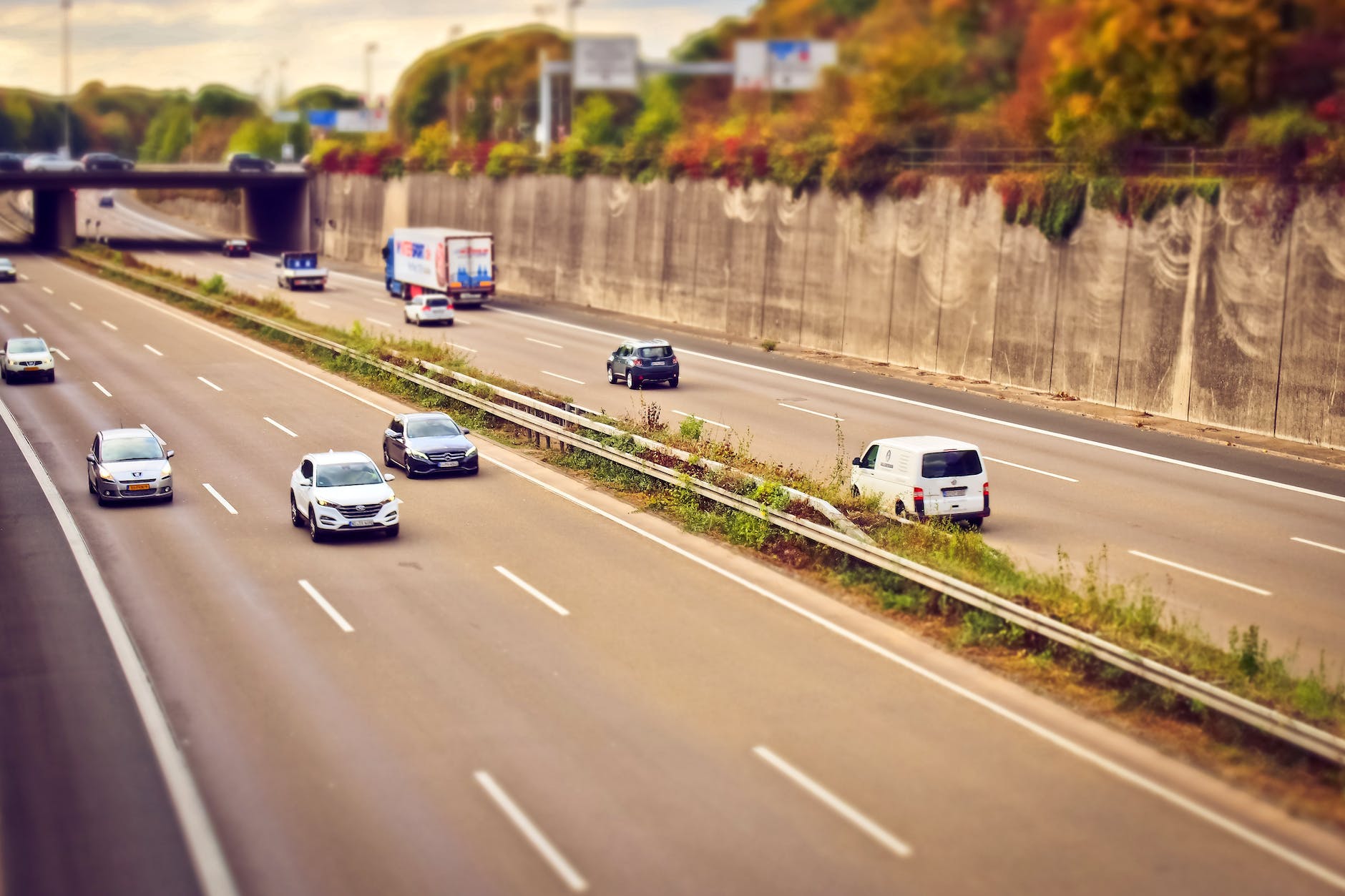
Trying to put back together urban neighborhood split decades ago by highways

New monies from the federal government are intended to help neighborhoods deeply affected by highway construction:

Photo by Pixabay on Pexels.com

Kansas City officials are now looking to repair some of the damage caused by the highway and reconnect the neighborhoods that surround it. To date, the city has received $5 million in funding from the Biden administration to help develop plans for potential changes, such as building overpasses that could improve pedestrian safety and better connect people to mass transit.

The funding is an example of the administration’s efforts to address racial disparities resulting from how the United States built physical infrastructure in past decades. The Transportation Department has awarded funding to dozens of projects under the goal of reconnecting communities, including $185 million in grants as part of a pilot program created by the $1 trillion bipartisan infrastructure law.

But the project in Kansas City also shows just how difficult and expensive it can be to reverse long-ago decisions to build highways that slashed through communities of color and split up neighborhoods. Many of the projects funded by the Biden administration would leave highways intact but seek to lessen the damage they have caused to surrounding areas. And even taking out a roadway is just a first step to reinvigorating a neighborhood.

“Once you wreck a community, putting it back together is much more work than just removing an interstate,” said Beth Osborne, who served as an acting assistant secretary at the Transportation Department during the Obama administration and is now the director of Transportation for America, an advocacy group.

In the name of fast travel between outlying areas and the city, such highways removed people and buildings, disrupted economic corridors, and created barriers between neighborhoods.

From the examples provided in this article, it sounds like this money will be used to try to reestablish streetscapes. Wide highways made it difficult for pedestrians to walk between places. Businesses had to rely on vehicle traffic. Decades after the highways were constructed, there may be relatively little activity on roadways near the highways.

Simply creating better paths over a major highway could be helpful. Removing a highway can also help, as evidenced by at least a few projects in American cities. But, there is a lot that goes into a streetscape. It takes time and resources to recreate thriving neighborhoods with multiple factors at play. Even then, vibrant sidewalks and streetscapes are relatively hard to find in American communities given the other priorities Americans emphasize.

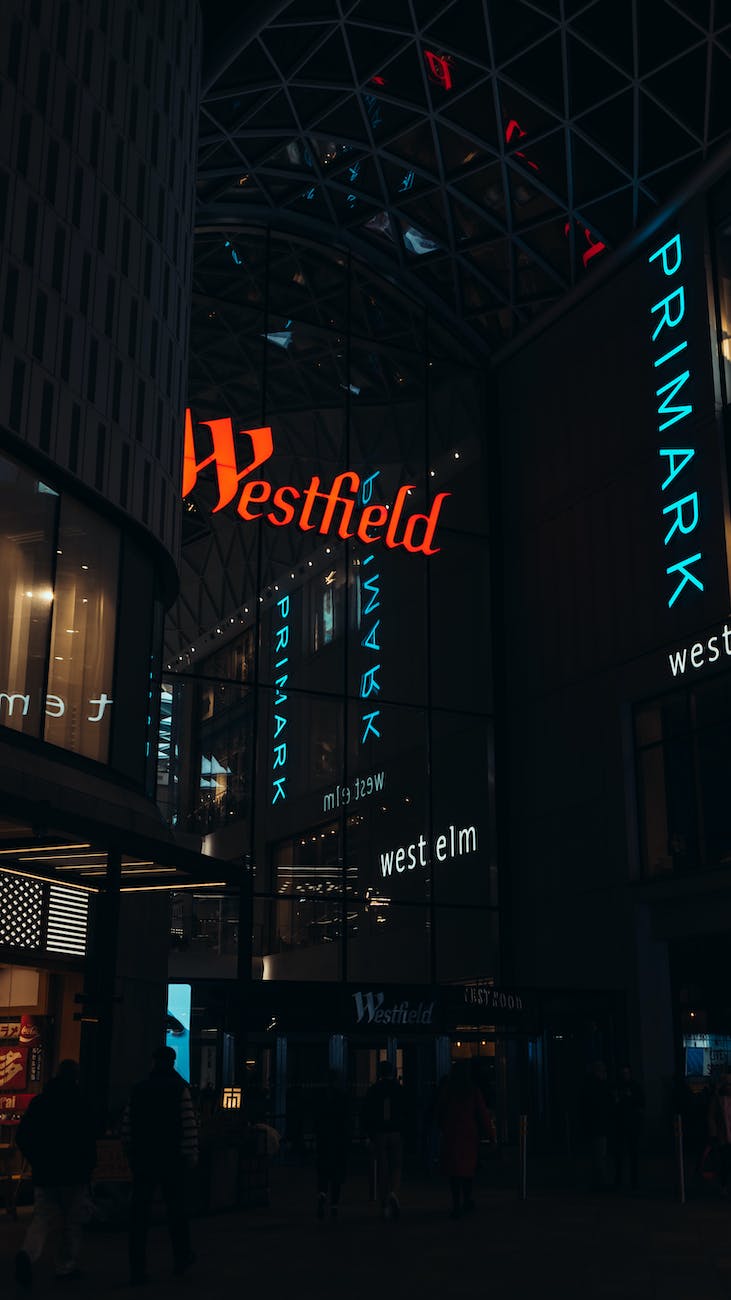
What could go wrong if a suburb buys up a vacant shopping mall to redevelop it?

The suburb of Bloomingdale, Illinois got fed up with the lack of redevelopment a formerly thriving shopping mall so they are buying up the property:

Photo by Aldiyar Seitkassymov on Pexels.com

Frustrated by years of inaction by the owners of Stratford Square Mall, Bloomingdale has spent more than $5.6 million to buy former department store buildings and open space near the mostly deserted shopping center.

Now the village is trying to use its powers of eminent domain to take over the core of the mall itself. Bloomingdale has filed a condemnation lawsuit aimed at acquiring the property. Village President Franco Coladipietro called it an “act of last resort.”…

Bloomingdale has been buying mall real estate to facilitate a full-scale redevelopment of Stratford Square. The village paid $2.4 million for the vacant Carson’s department store, $2.15 million for the former Burlington building and $1.1 million for a vacant parcel east of the mall, between townhouses to the north and medical offices to the south…

“You have the potential of a brighter future. I understand that there’s risk. We look at it as a calculated risk,” he said. “And we’ve done the due diligence prior to engaging in the purchase of the properties.”…

To that end, the village opened a line of credit, or short-term loan, to pay for the purchase of the Carson’s, Burlington and undeveloped properties. The village also filed condemnation lawsuits targeting Kohl’s and the vacant Sears store to “keep everything on the same track,” Coladipietro said.

If all turns out well, the suburb will be able to say in ten or twenty years that the former shopping mall property is an asset for the community with new, vibrant uses.

But, this could also turn out poorly. The suburb has borrowed money to buy property. They are in court. The developer has not successfully pursued redevelopment; will the village be able to do better? What happens when the bills come due and/or the community cannot agree about what the mall property should become and/or potential developers are still not interested in the property?

The Village President says this is a “calculated risk.” Indeed. Suburbs do not like dealing with significant vacant retail space and this mall is not the only one in the area facing these issues. I hope they have a manageable floor for the mall property if all does not go as planned.

An influential Naperville office building now with plenty of available parking

In 1964, Bell Labs announced plans to construct a new building just north of Naperville, Illinois and near an interchange on the East-West Tollway. That facility would later come to contain thousands of workers; “about 11,000,” according to Wikipedia. As I discuss in “A Small Suburb Becomes a Boomburb: Explaining Suburban Growth in Naperville, Illinois,” this suburban property helped set Naperville on a particular trajectory.

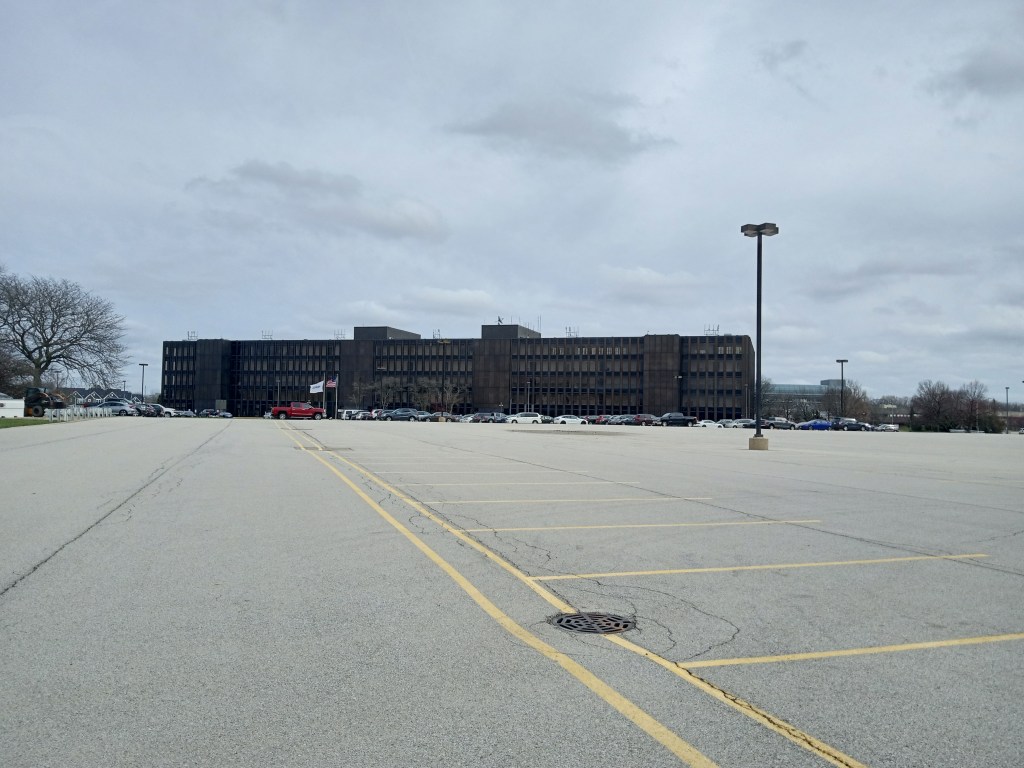
Here is a recent view of the back parking lot:

I know this is a far out view of the parking lot but it struck me that there were a limited number of cars here for such a large set of buildings. The number of workers on site is a lot smaller in recent years:

The 175-acre property near the intersection of Naperville and Warrenville Roads has the address of 1960-2000 Lucent Lane.

Nineteen-sixty Lucent Lane includes a vacant five-story 613,620-square-foot steel and glass office building, two three-story parking decks and surface parking lots. Nokia has consolidated its offices into the five-story 1-million-square-foot steel and glass building at 2000 Lucent Lane. The company occupies about 33% of the building, according to city documents.

At the north end of this property, behind where this picture was taken, is a new residential neighborhood of townhouses and single-family homes from Pulte.

What will become of this full property in the next few decades? Could it become a “metroburb” like another Bell Labs facility in a northwest Chicago suburb? The same property that helped lead Naperville to white-collar jobs and office buildings could become part of numerous transformations of suburban office parks into new uses.

Paris discourages use of cars so underground parking garages need to change

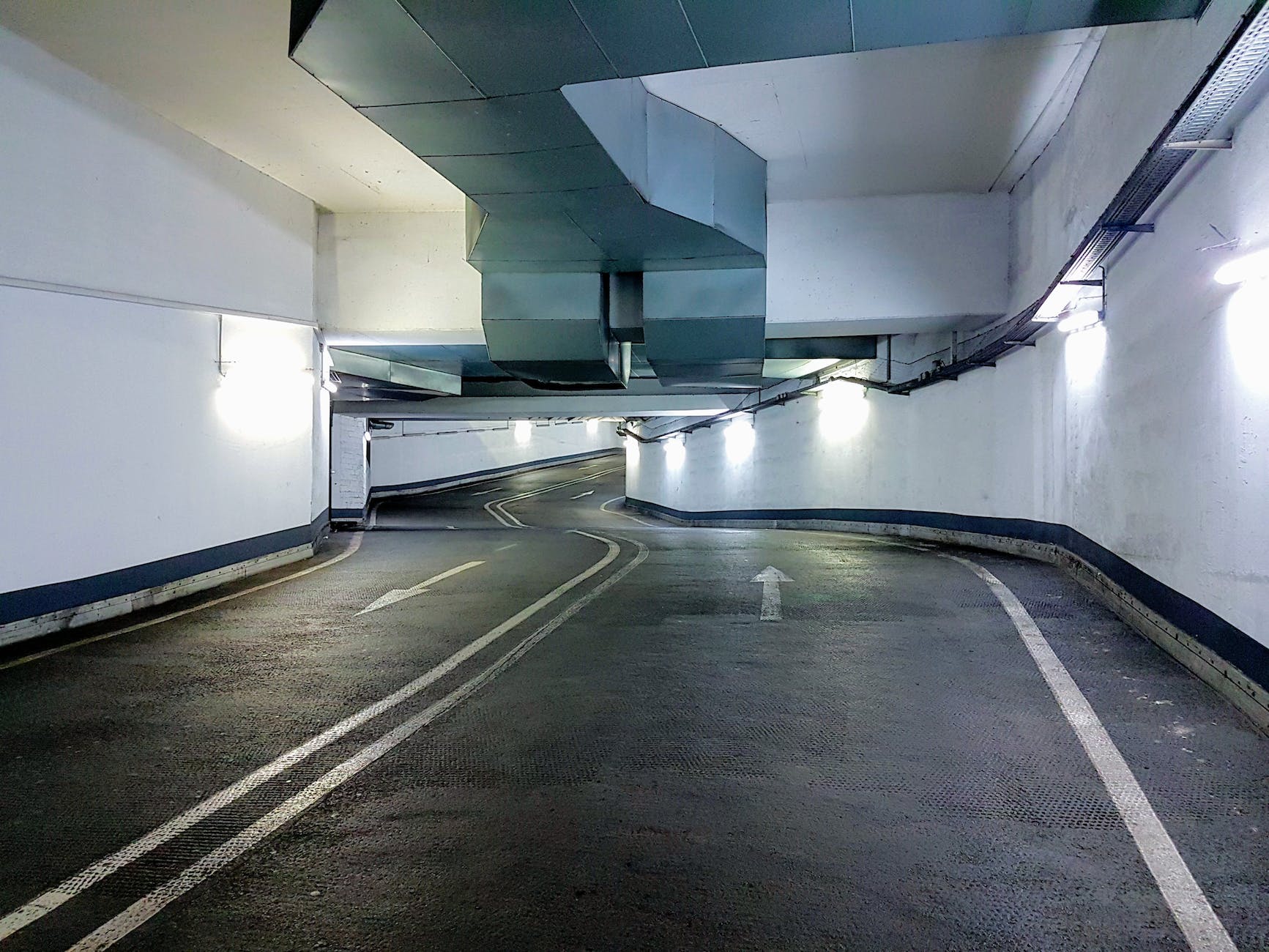
If Paris has fewer cars on its streets, what happens to its underground parking?

Photo by Daniel Frese on Pexels.com

Today Indigo operates 2,700 garages on three continents. But it’s here in Paris, where the company now manages more than a third of publicly accessible garage parking, that Indigo is beginning to develop a new underground commercial ecosystem. There are car repair shops, car rental offices, and click-and-collect lockers from Amazon. Larger-scale ventures the company is pioneering for lower levels include storage facilities and data centers. One private, non-Indigo garage has even been turned into a farm for mushrooms and endives.

Retrofitting parking is complicated, said Arnaud Viardin, Indigo’s director of partnerships. Counterintuitively, garage floors have less load-bearing capacity than homes or offices. Garages also have very low ceilings, threaded with beams and utility conduits that can limit adaptive reuse: It’s hard to market a storage facility that’s not accessible by box truck. Energy-intensive vehicle chargers require drilling through concrete to lay new electrical cables, and just about anything you do demands a time-consuming review with the Fire Department. Rarely do these new leases pay more than a constant stream of drivers charged hourly parking rates. But they pay more than an empty parking garage.

Indigo’s underground real estate has few competitors. Hundreds of thousands of square feet are now dedicated to alternative uses across France, mostly in Paris. “Finding real estate under Place Vendôme, under Place Dauphine?” Fraisse put it to me, pointing to two of the capital’s ritziest addresses. “We’re capable of proposing square footage at prices that have nothing to do with what you’ll find aboveground. Ten, 20, 50 times cheaper.”…

For logistics clients, the value of Indigo’s space is hard to beat. MonMarché is a spinoff of a larger French grocery chain, Grand Frais, whose stores are suburban big boxes with ample parking. “We had to find another solution for the Parisian market, which is the biggest,” said Demond, slicing open the packing tape on a Styrofoam box of durian, the odoriferous East Asian fruit. “The cost of real estate is so high.”

Cities have gone underground for numerous reasons: space above ground is limited, certain land uses are less desirable, underground uses can be more efficient. Putting cars underground made a lot of sense in previous decades when there was a lot of traffic and parking aboveground takes up a lot of space.

How far can underground redevelopment of parking garages go? Would people be willing to spend long amounts of time in such spaces if they were adapted for commercial, office, or residential use?

If these underground spaces become desirable opportunities, how high might rents and resale values go?

How much easier is it to build a new Chipotle than repurpose a vacant storefront nearby?

Near our suburban house is a shopping center consisting largely of strip malls and several anchor grocery stores. This development constructed in the late 1980s has fallen had hard times in recent years with numerous vacant storefronts.

Thus, it was surprising to see the construction that started last year at the site of a former national chain restaurant in this shopping center. This spot had been vacant for several years. The building came down and a new strip mall is going up. The new commercial space has an easy turn-in off a busy arterial road.

I have heard that it is easier to build a new big box store than to repurpose an old one. For example, numerous grocery stores in the Chicago region sat empty for years. Some big box businesses have moved out of older buildings and reopened in new structures not that far away.

The new Chipotle building will certainly be geared toward exactly what this business needs. Additionally, there will be at least one new storefront next to the restaurant. The old building had a different layout inside, one more fitting for a sit-down restaurant, and with on additional commercial space.

At the same time, how many strip malls, shopping malls, big box stores, and restaurants are torn down each year because the space they have is not exactly what a different business wants? What happens to all of these materials? How much time goes into tearing down? How substantially are these shopping areas changed by adding a few new buildings here and there? This Chipotle could have moved into a vacant property within the shopping center.

I could imagine more modular structures or incentives for reusing buildings or asking businesses to adapt to existing spaces. But, if it is cheaper or more efficient to tear down one building and redevelop another, then that is what businesses will do.

A suburban hospital creating a medical and commercial district

Northwestern Medicine is developing and opening multiple properties around its hospital in the small suburb of Winfield, Illinois:

Photo by Pixabay on Pexels.com

The once-blighted corner now boasts a $38.8 million medical office building designed to anchor the redevelopment of Winfield’s Town Center…

The health system also has built a parking garage and amenities in Riverwalk Park since forming an agreement with the village to inject new life into Winfield’s small-town downtown. Northwestern has set aside commercial and restaurant space on the ground floor of both the parking deck and the medical office building…

Winfield Station, a five-story apartment complex, is almost fully leased, Sorgatz said.

The site that once housed John’s Tavern is available for development directly west of the medical office building. The restaurant owner closed the business in 2017 after deciding to retire. Northwestern purchased the property.

The hospital and the town have not always seen eye to eye.

This story highlights the potential for a hospital to drive redevelopment. The hospital has money, nearby property is available. The new projects can theoretically benefit everyone: the hospital needs space, the village has property that would benefit from new buildings, the municipality can get more tax revenues, community members could hold jobs.

Bigger question: should hospitals drive development and redevelopment? There is a lot of money in health care, they provide employment, and they are often a long-term presence. Numerous communities in the United States have long-standing facilities that drive activity and local status. How many communities, cities, suburbs, or more small towns can happily connect in public-private partnerships involving hospitals?

How much time it could take to get the municipal funding to redevelop a shopping mall

As shopping malls decline, finding the money to redevelop the property could prove difficult. Here is the experience of one Chicago area suburb:

Photo by Karolina Grabowska on Pexels.com

When West Dundee trustees approved a special taxing district in 2016, they were hopeful it would breathe new life into Spring Hill Mall.

The mall showed some signs of hope when a new theater opened in late 2016. Overall, however, the mall stagnated and key anchors closed shop. By 2021, the village saw the property value of its share of the mall drop from a base value of $7.6 million in 2016 when trustees created a tax increment financing district for the mall to $2.5 million in 2021.

Now trustees are considering scrapping the 2016 TIF district and creating a new — and larger — one. The new TIF district would extend to Huntley Road to the north, Route 31 to the east and Route 72 to the south and would take in a Jewel grocery store to the west. And much like in 2016, officials are hopeful a new TIF with larger borders and a lower base property value would help transform the mall…

Despite the failure of the first TIF district, developers have indicated to village officials the money a TIF district could bring for redevelopment would be key to any transformation of the mall area, West Dundee Village President Chris Nelson said.

A successful TIF can help a municipality capture property tax revenues to put toward redevelopment, often in the form of infrastructure. This means that a developer does not need to pay for some of the necessary improvements – and presumably could profit more.

But, how much time and money is enough to entice a develop to go through with a significant redevelopment? At this point, the first TIF has existed for roughly six years. It did not work as intended; property values fell so there was not tax revenue to capture. Will expanding the district create enough revenue?

TIFs have timelines built into them; they are not intended to last forever. Should a suburb commit to decades for a TIF? At what point does a community throw in the towel in efforts to raise revenue or a commitment to a particular tax structure?

Many communities with shopping malls, big box stores, and other brick and mortar establishments will face these questions in the coming years. TIFs are one tool to use; what other options will emerge as popular and/or successful paths for communities to follow for redevelopment?

Do not call it a shopping mall; call it a campus

With the opening of several hundreds units of housing on a former portion of the Fox Valley Mall, one leader used a different term than “mall” to describe what was unfolding on-site:

Photo by Armin Rimoldi on Pexels.com

While the mall has been around since 1975, Samson said he even has stopped calling the burgeoning “live, work, play” development by that name.

“Notice how I didn’t say mall,” Samson said. “It’s a campus.”

A shopping mall is primarily about commercial activity. A campus implies something different. Probably the most common usage of the term refers to college campuses. On such a campus, there is a variety of activity: residential spaces, social spaces, academic spaces, athletic spaces, and more.

Many shopping malls are hoping for transformations that help them move beyond just stores and a few eateries. The shopping malls that survive the next decade or two could include apartments, condos, townhouses, hotels, restaurants, entertainment venues, and cultural attractions in addition to stores. All of these options would help make the mall/campus more lively throughout the full day rather than just during shopping hours. In this sense, the goal is not that different than numerous mixed-use developments in suburbs and cities: create a home base of residents plus a steady flow of visitors who spend money and contribute to social activity.

Will the term campus catch on to describe former shopping malls? Time will tell and certain influential actors, such as developers, architects, and local leaders, can help make it happen.