Wrestling with the ongoing – and increasing – numbers of pedestrian deaths in the United States

After a pedestrian death in her neighborhood, one writer considers the issue in the United States:

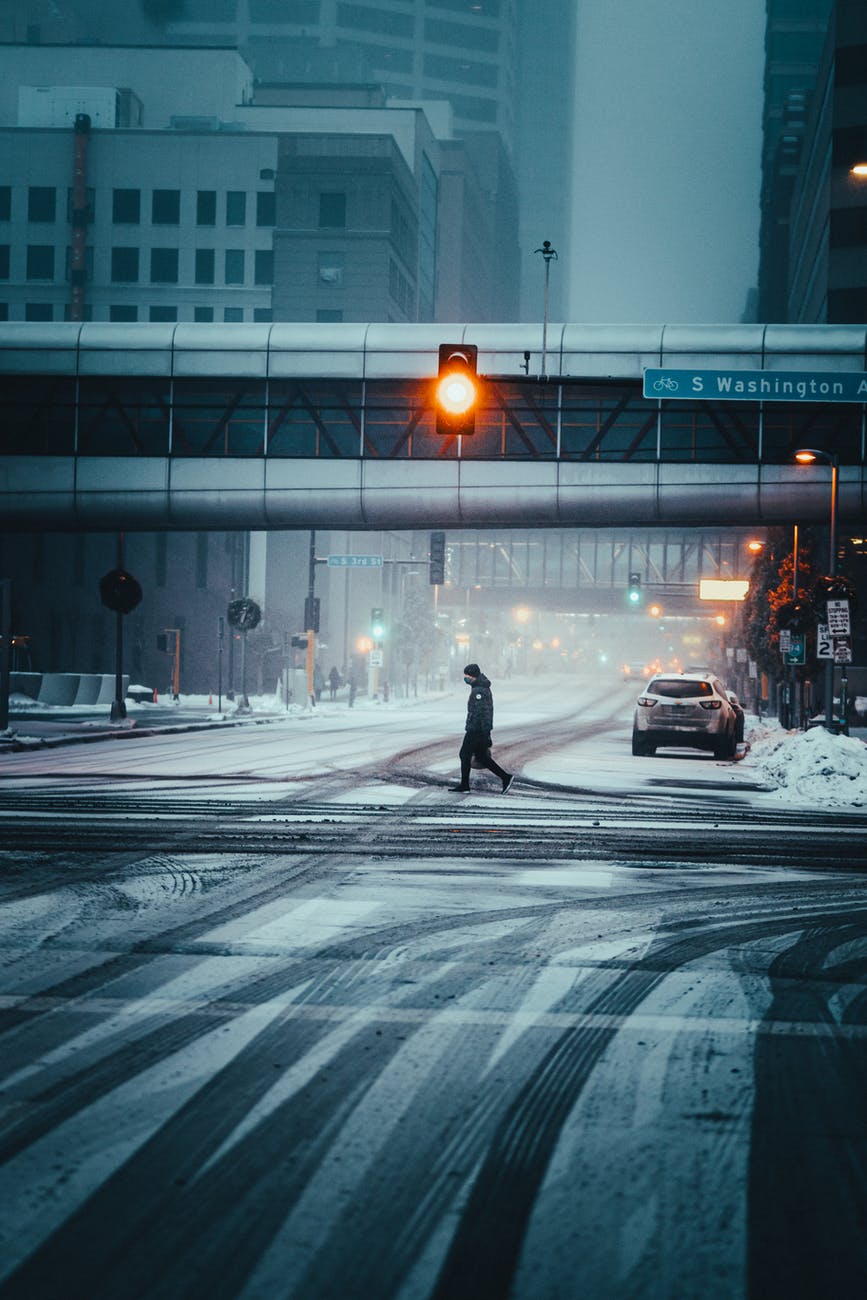
Photo by Josh Hild on Pexels.com

My neighborhood isn’t unique. So far this year, 15 pedestrians have been killed by drivers in the nation’s capital, and total traffic fatalities are up to 37-the highest number since 2008. This is all despite Mayor Muriel Bowser’s goal to end traffic deaths by 2024 as part of the Vision Zero program signed on to by leaders of D.C. and other major U.S. cities. The District Department of Transportation has made some changes to protect walkers and cyclists, such as reducing speed limits and installing more bike lanes. Ironically, total traffic fatalities have increased steadily since the program began.

The same trend is reflected in cities across America. Part of the increase in pedestrian deaths is probably because our vehicles are bigger than ever. “Our pickup trucks and SUVs are gigantic compared to the sizes they used to be,” giving drivers less visibility and a greater sense of security, which makes them more aggressive on the road, says Rohit Aggarwala, a fellow at the urban Tech Hub at Cornell Tech and the former director of long-term planning and sustainability for New York City. During the pandemic’s early days, as fewer Americans drove to work or school, it seemed safe to assume that fewer pedestrians would die Instead, fatalities have jumped. Conclusive research isn’t out yet, but the increase is likely at least in part due to a drop in traffic congestion and an ensuing increase in speed: “People were still walking around their neighborhoods during lockdown, and you had a [small] number of people on the streets driving very, very fast,” Aggarwala told me. Older adults, people walking in low-income areas, and Black and Native Americans are all overrepresented in pedestrian-death statistics.

Most pedestrian deaths are preventable, and experts believe that the solutions are straightforward. Aggarwala and his team at Cornell Tech are pushing for three major changes to America’s driving infrastructure: more robust traffic-camera enforcement, to capture not just speeding but all kinds of moving violations; road redesign that would decrease lane size and add speed bumps to nudge drivers to slow down; and finally, upping the standards for vehicle safety. Car manufacturers in Europe are required to test cars for pedestrian impact; they design hoods to slope downward so that drivers can see anyone who might wander into the road. American automakers could do the same, or add pedestrian-detection systems or speed limiters to cars. Many of these changes would not only make roads safer for pedestrians but also could reduce police violence at the same time. “The U.S. hasn’t considered any of this,” Aggarwala said. “We have a tradition of focusing on vehicle safety as only being about the occupant.”

This is an ongoing issue as long as roads are primarily for cars and vehicles. The priority for decades in the United States has been to make roads optimal for vehicles. Pedestrians and other street level activity is, on the whole, not as important.

When I read this, I thought about the efforts to include equipment in all new cars that would test to see if the drivers was driving impaired. How did this come about? Drunk driving has been a recognized issue for years with organized groups making sure it was on the public’s radar screen. Is a social movement against pedestrian deaths and promoting pedestrian safety necessary to make significant changes? The solutions might be straightforward but the political and societal will is lacking.

Editorial calling for better maintained sidewalks

The Chicago Tribune on Monday asked residents and municipalities to pay attention to the condition of their sidewalks:

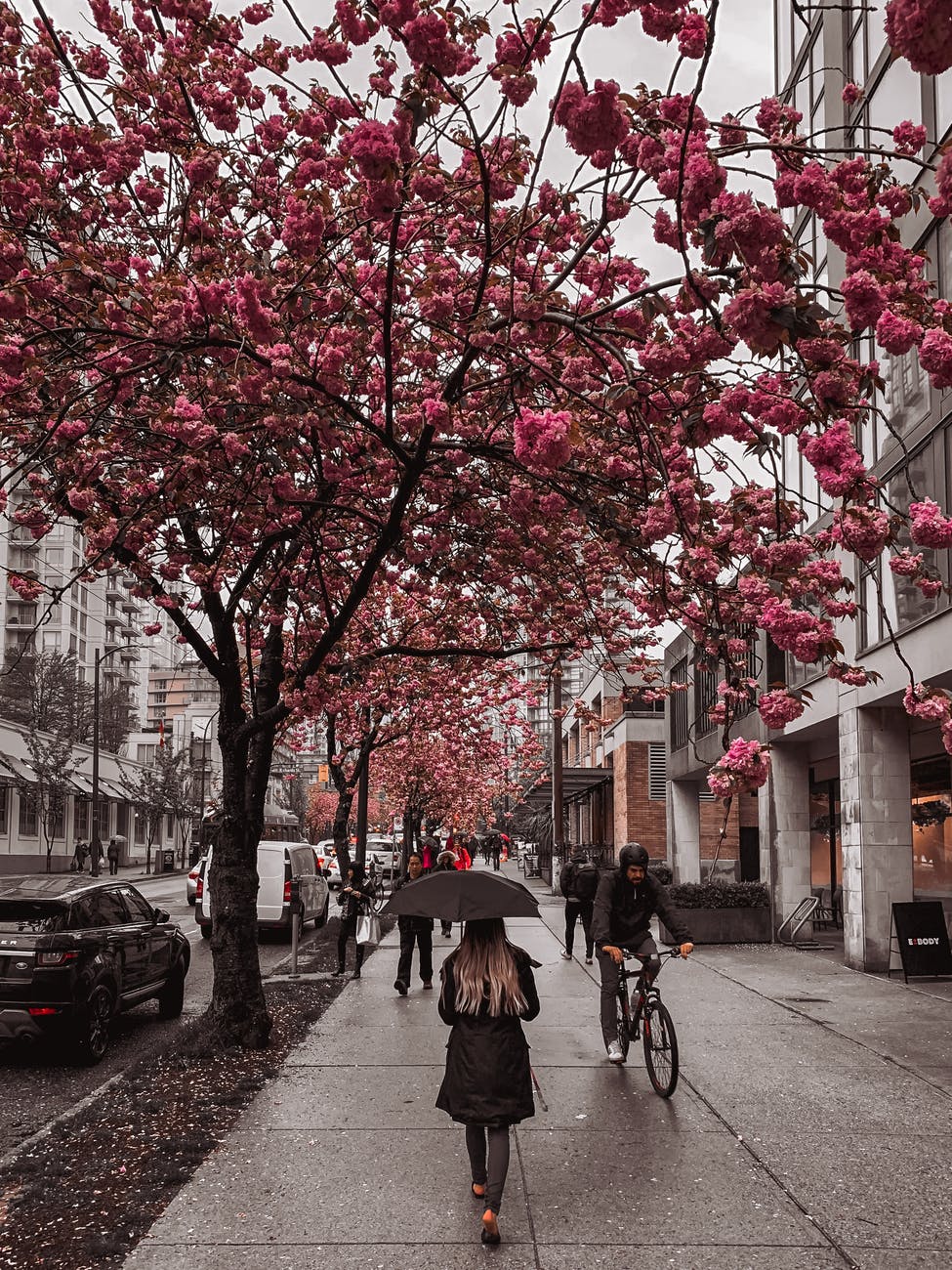
Photo by Aldiyar Seitkassymov on Pexels.com

Today we write instead about the humble sidewalk. It’s prosaic. Unromantic. Mundane.

But to patrons of two-footed transportation – and to wheelchair users, kids on scooters and people consigned to canes or crutches – the humdrum sidewalk is either a safe glide path or a menacing minefield .It’s as crucial to its users as vast roadways are to motor vehicles. The difference is that drivers and passengers in the vehicles are better protected than is the postal carrier who each day risks tumbling onto your concrete.

We’re thinking about cracked sidewalks in part because of Chicagoland’s snowstorms last winter. If you’re the beneficiary of a Snow Samaritan – one of those thoughtful neighbors who helpfully pushes her snowblower down the whole block – imagine how she feels when her machine trips on a sidewalk that’s broken, caved low or heaved up by freeze-thaw cycles. When that happens once too often, she has to cue the costly repair.

So on behalf of all those who encounter your sidewalk, step outside and inspect. And if it’s damaged, call or email whoever oversees public works in your neighborhood – the ward superintendent, the village manager, the city council member, the local street department foreman.

This is the practical argument to make for sidewalks: safety and costs. Cracks and other sidewalk problems make it more difficult to navigate. I know this from my own experience walking, running, and biking. I am able to effectively move around sidewalk issues but not everyone can. These negative sidewalk experiences can then add additional costs, whether from addressing injuries from falls or damaged bicycles and other vehicles.

But, the practical argument may not be convincing or elegant enough. It strikes me as a very Midwestern way to address the problem. An additional way to make this pitch might be to appeal to what sidewalks make possible. The most famous part of The Death and Life of American Cities by Jane Jacobs is the opening section which speaks to all the possibilities available because of thriving sidewalks. Repairing sidewalks is not just about safety or costs; it is about opening space for people to go back and forth and others to utilize. With the right mix of surrounding uses, the sidewalk then becomes a public space that enriches the neighborhood.

Put all of these arguments together and the humble sidewalk is pretty important. In communities dominated by cars, sidewalks offer an alternative path for transportation and sociability.

Driving down, traffic deaths up in Illinois and across the US

Usually traffic deaths decrease when people drive less. This has not been the case in Illinois or the United States as a whole in the last year:

Photo by Steven Arenas on Pexels.com

About 1,166 people died in motor vehicle crashes in Illinois in 2020, a nearly 16% increase over 2019, according to the Illinois Department of Transportation. That’s a provisional number, said IDOT spokesperson Guy Tridgell, since it takes the state agency 12-18 months to finalize annual data…

Speeding and traffic fatalities typically go down during recessions, according to an October study published by the National Highway Traffic Safety Administration. In Illinois, for example, deaths dipped sharply in 2008 and 2009 according to state data, though they’ve been up slightly since…

About 28,190 people died in crashes from January to September 2020, more than a thousand more fatalities than in the same period in 2019, the federal agency estimated. A full annual report is expected to be released in the late fall…

What’s more, traffic deaths nationally were down from March to May, but jumped back up after states began reopening in June, according to the agency’s estimates.

This suggests safety is not solely a function of the number of miles driven or trips taken. How people drive and the conditions matter quite a bit. In this case, the article hints at multiple possible reasons for this jump. This includes speeding, more impaired drivers, and less seat belt use among those hurt.

I wonder if there are several other factors at play. With many public and private locations shut down, did driving become an even more important escape for some Americans? With limited places to go, driving and doing so dangerously could be a kind of release not available elsewhere.

Second, is there a safety feature to a certain level of traffic? With fewer people out, does this encourage riskier driving compared to having to navigate more vehicles on the road? Too many cars likely leads to more accidents but what about too few compared to typical conditions?

Looking at suburban crime and police activity across suburbs

With the popularity of suburban surveillance and discussions of police behavior in suburbs, it is helpful to have data about suburban police activity and crime:

hotrod die cast model on board

Photo by Suzy Hazelwood on Pexels.com

Since 1990, arrest rates have trended downward nationwide. In suburbs, though, they have been leveling off or actually increasing since 2015, says Leah Pope, a senior research fellow at the Vera Institute of Justice, a nonprofit that aims to address the causes of mass incarceration and the loss of public trust in law enforcement. Arrest rates have declined faster in cities than suburbs.

This largely comes from a drop in “Part II” crimes, she says, which covers “less serious” offenses such as vandalism, drunkenness, disorderly conduct, loitering, and more. More serious, “Part I” crimes—including murder, rape, and robbery—have been declining as well, but arrests for Part II crimes have seen a sharper drop in cities than suburbs. These are arrests for crimes that many don’t think should necessitate an arrest anyway, Vera Institute research associate Frankie Wunschel notes: They could be citations, or warnings, or simply decriminalized, in the way that marijuana has been decriminalized, but not legalized, in some states.

Some suburbs are seeing their jail populations grow, too. According to 2015 data, nearly 9 in 10 large urban counties saw their jail populations decline. Between 2014 and 2015, the jail population in the country’s 61 large urban counties fell by more than 18,000 people total—equivalent to emptying Los Angeles County jails. The jail population grew, though, in 40% of suburban, small, and midsize counties.

Racial disparities also play a role in arrests for Part II crimes. Narcotic drug laws fall under these “less serious” crimes, and in 2015, more than one in four people arrested for drug law violations were Black, although drug use rates do not differ substantially by race. “There are huge racial disparities in arrests, and those racial disparities are more prevalent in suburban areas than they are in urban areas,” Pope says.

There are long-standing perceptions about the safety of suburbs as well as presumption that suburban police act better. But, this data and analysis suggests this can differ dramatically across suburban communities and suburban populations. At the least, this is a reminder of the complex suburbia of today: discussions of a monolithic suburbia simply do not line up with suburban realities. Going further, crime and policing can differ across suburbs, just as it can across urban neighborhoods or cities.

From this analysis, I wonder how the variation in crime and police activity across suburbs compares to the variation between wealthier urban neighborhoods versus those urban neighborhoods not as well off.

Suburban video doorbell surveillance and race

Suburbanites have more electronic “eyes on the street” with video doorbells and other devices. Comments from sociologist Simone Brown about surveillance and race provide context for this shift:

police blue sky security surveillance

Photo by PhotoMIX Company on Pexels.com

If you think about TV, like Cops being taken off the air or Gone With the Wind or whatever it is, there are all these ways black life is framed that shapes people’s viewing. I think it’s what Judith Butler calls a “racially saturated field of visibility,” where these stereotypes form our field of our vision. So, Rodney King bracing himself from the hits from the police, that video gets read by some folks as an act of aggression by him, as an act of violence because black men’s bodies are always figured as potentially violent…

It’s policing, but it’s like policing that now is mediated through these platforms, like Instagram and Facebook and other things. That’s not literal police, but it still is about the governing of black life and black resistance by the state or state-adjacent entities. And we know that Facebook is hand in hand with the Trump administration. So how do we then reconcile the seeming necessity of these technologies?…

That’s part of why I have this reaction when people say technology isn’t neutral, technology is biased. The fact that that needs to be said just shows you how comfortable people are with even the concept of neutral.

Exactly. And that requires like an entire upending of a lot of white folks’ ways of seeing that whiteness isn’t a neutral, police aren’t neutral. All of these things are framed by their histories. To let go of the idea of a technology, and perhaps the technology being used in the exercise of white supremacy of misogynoir or transphobia or being trans-antagonistic is a lot for many people to see. It’s an easy alibi, I think, to say that the technology made me do it.

What exactly is behind the move to install more personal cameras (and share that information with police and others on social media)? Fear of crime, intruders, destruction of personal property? Over recent decades crime rates have dropped yet the perceived need for safety at home has increased. The suburbs in general have a history of exclusion, a fear of the other, looking to avoid “urban” issues. Cameras provide the opportunity to constantly view who is around the sacred single-family home. Even if someone is just walking by on the public sidewalk or driving on the public street, these home cameras could pick them up.

Put together the racialized history of suburbs, assumptions about crime and danger in the United States, and the increase in cameras and this connects with what Browne says above. Who are the suburban cameras there to watch?

Will the suburbs be more appealing moving forward because of COVID-19?

With discussion of COVID-19 in cities plus urban residents leaving for suburbs, does this mean people will view suburbs differently going forward? Ian Bogost suggests this will be the case:

photo of roadway during daytime

Photo by Myburgh Roux on Pexels.com

But after the anxious spring of 2020, these defects seem like new luxuries. There was always comfort to be found in a big house on a plot of land that’s your own. The relief is even more soothing with a pandemic bearing down on you. And as the novel coronavirus graduates from acute terror to long-term malaise, urbanites are trapped in small apartments with little or no outdoor space, reliant on mass transit that now seems less like a public service and more like a rolling petri dish. Meanwhile, suburbanites have protected their families amid the solace of sprawling homes on large, private plots, separated from the neighbors, and reachable only by the safety of private cars. Sheltered from the virus in their many bedrooms, they sleep soundly, dreaming the American dream with new confidence.

Safety has always warmed the suburban soul. The American dream is sometimes equated with property ownership and the nuclear families such properties house—but really, they are just hulls for a more fundamental suburban aspiration: individualism, which the suburban home demarcates and then protects…

The pandemic will improve suburban life, perhaps in lasting ways. Take the automobile commute: The exodus from the office has dramatically decreased traffic and pollution, a trend that will continue in some form if even a fraction of the people who abandoned their commutes continue to work from home. Dunham-Jones, who is also my colleague in Georgia Tech’s college of design, thinks that even a modest rise in telecommuting could also increase the appeal of local walking and bike trips. Families have two cars, but nowhere to go. They are rediscovering the pleasures of pedestrianism…

The suburbs were never as bad as their stereotypes. The little boxes might have been all the same, but the ’50s suburban plots also flowed continuously into one another, with unobstructed front and backyards, forming unified communities. And those communities were in some ways far less homogeneous than their legacy recalls, even despite the scourge of redlining and its serious, long-term effects.

There is a lot to consider here. A few categories of thoughts in response:

  1. There is an underlying contrast between how elites and urbanites viewed suburbs versus how many Americans have viewed suburbs for decades. Even as majorities of Americans now live in suburbs, there is a well-established line of suburban critiques. Is the individualism Bogost discusses a feature of suburban life or a terrible thing to promote? Do suburbanites really have individualism or does it end up looking the same across suburban single-family homes?
  2. The suburbs are aspirational. This reminds me of the argument by historian Jon Teaford in The American Suburb: The Basics: “Suburbs are an expression of the American desire for freedom and the right to pursue one’s own destiny.” (219) At the same time, the path taken to pursue these aspirations involved exclusion. Can these two competing interests – private freedom in a single-family home yet excluding who can access this – be reconciled in the future, let alone in assessments of the past?
  3. It is hard to know exactly what suburbia is under discussion. Complex suburbia is here. Bogost mentions at least a few visions of suburbia today including New Urbanist communities and neighborhoods of McMansions but we could also consider ethnoburbs, working-class suburbs, suburban job centers, and more. Which suburbia is the preferred one in the minds of Americans or which one should policy try to promote or is a varied suburban landscape more ideal?
  4. COVID-19 is theoretically a temporary issue to face. Once it passes or is controlled or societies learn to live with it, it is hard to know what consensus regarding places might emerge.

This debate which stretches at least to the early 1900s is not over even as COVID-19 changes the terms.

Less traffic, faster driving

Reports suggest more drivers are going fast on emptier roads:

Despite there being far fewer vehicles on the road due to COVID-19 stay-at-home orders, state highway safety officials across the country are seeing a severe spike in speeding. Many states have reported alarming speed increases, with some noting a significant surge in vehicles clocked at 100 mph or more.

Being a safe driver should always be a priority, but during the coronavirus pandemic, traffic safety experts at the Governors Highway Safety Association (GHSA) say it is more important than ever. “While COVID-19 is clearly our national priority, our traffic safety laws cannot be ignored,” said GHSA Executive Director Jonathan Adkins. “Law enforcement officials have the same mission as health care providers — to save lives. If you must drive, buckle up, follow the posted speed limit and look out for pedestrians and bicyclists. Emergency rooms in many areas of the country are at capacity, and the last thing they need is additional strain from traffic crash victims.”

During the past month, pedestrian and bicycle traffic are reported to have increased exponentially, while motor vehicle traffic is down. Adkins noted that GHSA is encouraged to see so many communities across the country making roadways more accessible to pedestrians and bicyclists. To keep roads safe for everyone, traffic safety officials nationwide are pleading with motorists to slow down and respect traffic safety laws…

A 2019 report on speeding by GHSA, “Speeding Away from Zero: Rethinking a Forgotten Traffic Safety Challenge,” highlights excessive vehicle speed as a persistent factor in nearly one-third of all motor vehicle-related fatalities, while a 2020 GHSA report on pedestrian fatalities, published in February, finds that pedestrians now account for 17% of all traffic-related fatalities.

In many metropolitan regions, traffic is pretty constant throughout the day. COVID-19 has reduced the number of daily work trips plus some of the other reasons for cars and trucks on the road.

With more open road, perhaps it is “natural” for drivers to feel they can go faster. I am reminded of the argument by New Urbanists that narrower roads lined with parked cars and trees close to the street push drivers to slow down. The illusion is that with fewer potential obstacles on the road, a driver can be safe even while going faster. Of course, going faster reduces the time drivers have to correct and avoid things in their path.

It would be interesting to note how much local police forces are responding to speeders now. Is it worth stopping them if there is a risk of transmitting COVID-19? Are police resources needed more elsewhere? At this point, what other options do officials have in reducing speeds on less crowded roads?

Infectious diseases in urban and suburban life

Americans already have a predilection for suburban life; might a global pandemic push even more people out of cities and to the edges of metropolitan regions? One take regarding safety in suburban life:

As maps like this show, major metropolitan areas are bearing the brunt of the Covid-19 infections spreading across North America. And that makes sense: Though there’s no way to know for sure how the virus arrived, it almost certainly came by way of an international flight to a major airport (or several of them). But while infectious disease spreads faster where people are more densely clustered — hence the strategy of social distancing to contain the coronavirus — that doesn’t necessarily make suburban or rural areas safer, health experts say…

That is not to say that cities aren’t Petri dishes — they are. Relative to rural areas, urban centers do provide stronger chains of viral transmission, with higher rates of contact and larger numbers of infection-prone people. And historically, urbanites paid a price for this vulnerability…

Modern transportation networks have made the population shield that rural areas once provided much more porous. Now that humans and freight can travel from, say, Hong Kong to Los Angeles in less than 13 hours — and arrive by vehicle to somewhere sparsely populated hours after that — outbreaks can happen just about anywhere. New pathogens tend to arrive sooner in global hubs, but that doesn’t mean they can’t quickly reach rural locales and proliferate from there, says Benjamin Dalziel, a professor of mathematics at Oregon State University who studies population dynamics…

But while the CDC recommends decreasing social contact to limit the spread of the virus, that’s just as doable in a downtown apartment as a countryside manor. Says Viboud: “If you’re staying at home and limiting outside contact, you’d achieve the same purpose.”

Three thoughts come to mind:

  1. This highlights the connectedness of cities and suburbs today, even if there is significant physical distance separating communities. The rate at which people travel around the world, to other regions, and throughout regions is high compared to all of human history and is relatively easy to do. Cities and suburbs are not separate places; they are parts of interdependent regions that are highly connected to other places.
  2. Safety and health was a part of creating the suburbs in the United States but it is hard to know how this might matter in the future. Given all the reasons people now settle in the suburbs, would avoiding communicable diseases be a top factor? I would think not, particularly compared to factors like housing prices or amenities (schools, quality of life, etc.), or demographics.
  3. If particular places are not that much safer, does the sprawl of American life then limit the response to any illness? Imagine the Chicago region with dozens of hospitals that need to be equipped spread throughout the region as opposed to that same number of people packed into a smaller area where it is easier to get supplies and people to medical facilities. Or, the need to supply grocery stores throughout a huge region.

Imagining tipping points for when Americans will not be hesitant about getting into a self-driving vehicle

A recent survey from AAA suggests Americans are not ready for self-driving vehicles:

The survey shows only 1 in 10 drivers say they would trust riding in a self-driving car, and 28% say they don’t know how they feel about the technology.

According to AAA, trust in automated vehicles can improve with more tangible information on key issues, as well as quality education and experience.

For instance, six in 10 Americans say they would like to have a clear understanding of who is legally responsible in a crash with a self-driving vehicle.

Seven in 10 Americans said they would feel safer riding in a self-driving vehicle if they had the ability to take over control is something goes wrong.

There are a few different issues to address here. Addressing just one, such as who is legally responsible, might not be enough to get people into a vehicle.

I wonder what the tipping point will be on this. Several scenarios could present themselves:

1. A government ruling or edict that makes self-driving cars more attractive. Imagine a guideline that 20% of vehicles must be self-driving in five years.

2. A company that does not make these vehicles invests heavily in them. Think a ride sharing or rental car company goes all in with a fleet of vehicles.

3. Trucking companies switch over to self-driving trucks to cut costs. Would Americans be okay with a self-driving cars if trucks are already doing this (and the alternative might be higher prices for delivered goods)?

4. There is a cool self-driving vehicle that just catches everyone’s attention. Tesla seems to capture attention but does not have a fully-functional self-driving feature yet.

5. There is a significant safety issue that arises with regular vehicles or driving is soon seen as a significant health issue. Perhaps at some point Americans will get fed up with the 30,000+ deaths a year in car accidents. (Could be connected to #1.)

Given the concerns people have, it is hard to know when self-driving vehicles will become a significant presence on the road. 2030? A number of things will need to come together for fears to subside.

A nation beholden to cars: a record number of pedestrians die in US in 2019

A new report highlights the dangers to pedestrians in the United States:

Based on data from the first six months of 2019, the Governors Highway Safety Association predicts there were 6,590 pedestrian deaths that year, which would be a 5 percent increase over the 6,227 pedestrian deaths in 2018.

The 2019 figure is the highest number of such deaths in more than 30 years, according to the association…

While there’s been a significant increase in pedestrian deaths over the past decade, the number of all other traffic deaths increased by only 2 percent…

“Following 30 years of declining pedestrian fatalities, there has been a complete reversal of progress,” Retting said in the release. “Pedestrians are at an inherent disadvantage in collisions, and we must continue to take a broad approach to pedestrian safety.”

While there are particular aspects of driving and pedestrian behavior that could be debated and addressed, there is a larger point that can be made with such data: the priority on American roadways goes to vehicles. This has been the case for decades and will continue to be the case for years to come. While efforts to make streets more amenable to walkers and bikers, these efforts are often limited to only a few areas. The goal of roadways in many places, included dense, populated areas, is to move as many vehicles as quickly as possible to where drivers want to go.  Tackling specific issues may help reduce the number of deaths but still leave the larger problem: Americans like cars and driving and our lives are often organized around driving.