Some suburbanites do not like more explicit divisiveness or racism

With the 2020 presidential election riding on the suburbs, some suburban voters do not like the rhetoric and policies of President Trump:

young frustrated woman screaming with closed eyes

Photo by Andrea Piacquadio on Pexels.com

From North Carolina to Pennsylvania to Arizona, interviews this week with more than two dozen suburban voters in critical swing states revealed abhorrence for Trump’s growing efforts to fuel white resentment with inflammatory rhetoric on race and cultural heritage. The discomfort was palpable even among voters who also dislike the recent toppling of Confederate statues or who say they agree with some of Trump’s policies.

As the president increasingly stakes his candidacy on a message of “law and order,” casting himself as a bulwark against “angry mobs” and “thugs,‘’ there are signs that he is alienating voters in bedroom communities who approach the debate over racial justice with a far more nuanced perspective than the president does.

The disconnect is especially pronounced in the swing state suburbs like Cornelius — traditionally a conservative-leaning area — and along the Main Line outside Philadelphia, where some educated white voters, including some former Trump supporters, are repelled by the president’s divisive rhetoric…

While Trump won suburban areas overall by 4 percentage points in 2016, according to exit polls, white college-educated suburban women have rapidly moved away from his Republican Party, and they helped deliver the House of Representatives to the Democrats in 2018. And now, as some polling shows Trump facing competitive races even in deep-red states, he cannot afford to lose all of those voters again.

What could be behind this discomfort among some suburban voters? A few possible answers:

  1. Suburbanites do not often like open conflict or confrontation in their personal interactions with fellow suburbanites. This could also apply to contentious social issues. If a candidate, party, or figure is openly combative, this may be too much for suburbanites who prefer more polite, refined discourse. Suburbanites have a particular status to protect, particularly those with education, good jobs, and homes.
  2. Suburbia has changed quite a bit in recent decades. Suburbanites themselves, particularly in middle suburbs (stuck between the exurban Republican voters and the inner-ring suburb Democratic votersthe exurban Republican voters and the inner-ring suburb Democratic voters), may have changed views of the world. Perhaps more well-off suburbanites than before do now care about race.
  3. Perhaps this is all still unclear or undecided months out from the election. Some suburbanites are caught in the middle and right now do not like Trump’s approach. If the economy picks up and COVID-19 winds down, will these same voters show less concern about polarizing views? If social movements, which are now in the suburbs too, wane, will this make it easier to support Trump?

Which way these voters go could indeed help decide the 2020 election. Among other things, it will be interesting to see how the candidates pitch themselves to middle suburbia (even as they balance pitches to other groups).
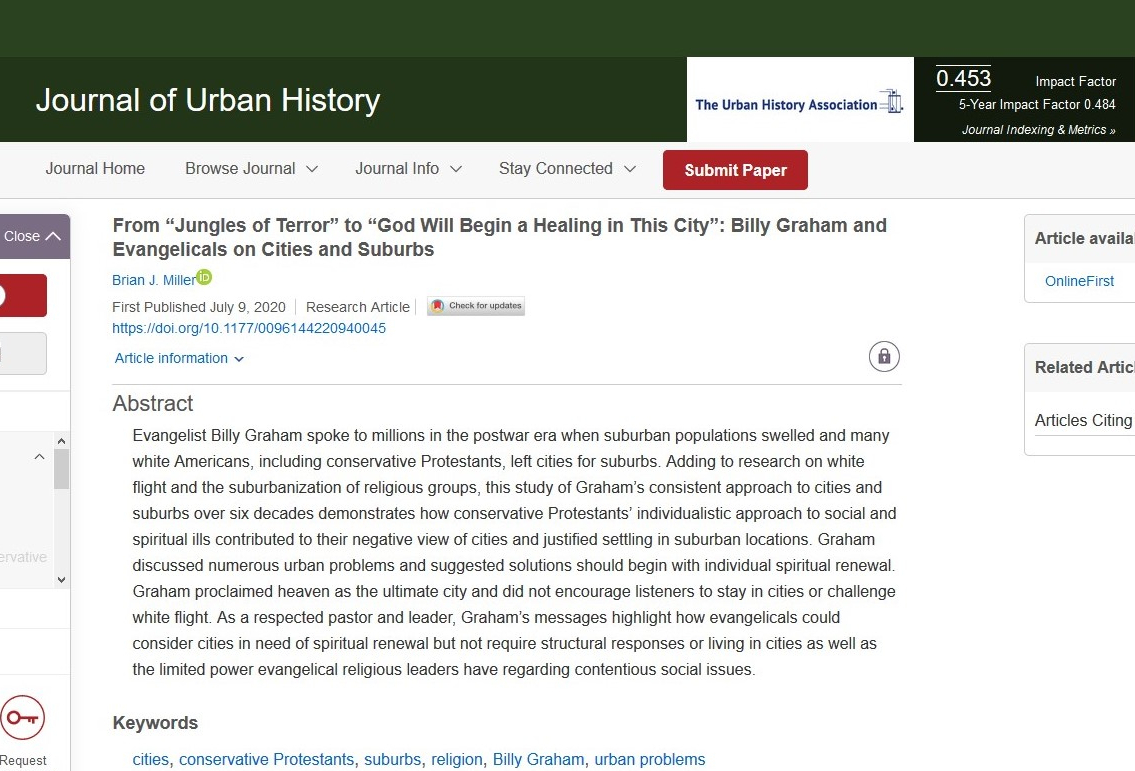
Publication online in Journal of Urban History: “From “God Will Begin a Healing in this City” to “Jungles of Terror”: Billy Graham and Evangelicals on Cities and Suburbs”

Yesterday, the Journal of Urban History published online an article I had worked on for a few years:

BillyGrahamArticleJul20Online

This project began when I became aware of an online archive of Billy Graham’s messages through the Billy Graham Center at Wheaton College. Given Graham’s popularity and influence while thinking as a sociologist about how religion and place are connected, I wanted to see how he addressed the substantial social change brought about by suburbanization during his post-World War II evangelistic career. Here is a summary of the findings from the abstract:

Graham discussed numerous urban problems and suggested solutions should begin with individual spiritual renewal. Graham proclaimed heaven as the ultimate city and did not encourage listeners to stay in cities or challenge white flight. As a respected pastor and leader, Graham’s messages highlight how evangelicals could consider cities in need of spiritual renewal but not require structural responses or living in cities as well as the limited power evangelical religious leaders have regarding contentious social issues.

The anti-urbanism common among white evangelicals has numerous roots. Graham exemplified several of these: a focus on individual action and salvation, consistent reminders of urban problems (meant to help prompt a spiritual response), and a focus on heaven. At the same time, his evangelistic efforts required holding events in major cities and meeting and talking with numerous influential leaders found in cities. I hope this study can help contribute to an ongoing scholarly conversation about the mixing of religion and place and its consequences for American society.

Asking Americans where they live to determine what exactly a suburb is

A recent project asked over 55,000 Americans where they live and the researchers used this to classify what counts as a suburb:

aerial shot of buildings

Photo by Benjamin Suter on Pexels.com

Kolko and his colleagues got a survey sample of 55,000 households to sound off about whether their neighborhoods were urban, rural or suburban. That let them build a model looking at which factors predict how respondents will answer.

Unsurprisingly, many people defined their neighborhoods in part by their population density. But a whole host of other factors also made the prediction more accurate. For example, areas with higher median incomes were more likely to be called suburban. Areas with older homes were more likely to be called urban. Areas with lots of senior citizens were more frequently called rural.

The researchers—Kolko, Shawn Bucholtz of the U.S. Department of Housing and Urban Development, and Emily Molfino of the U.S. Census Bureau—have released data online showing how their model classifies every neighborhood in the U.S., as well as an academic working paper detailing their methods and findings.

It’s a question that matters quite a bit because, by the researchers’ survey, more than half of American households identify as suburban: 52%, versus 21% rural and 27% urban.

A few thoughts based on this summary:

  1. This suggests defining places requires more than just political or geographic boundaries: how people perceive communities and neighborhoods matters. There is a cultural, meaning-making dimension to where people live that is often not picked up in these kinds of definitions.
  2. The next step after #1 is this: if residents of some places may technically live in a big city but they perceive it to be more suburban, they may act differently. Or, if they think of their suburban area as urban, they could lead different lives and favor different policies.
  3. I wonder how this overlaps with previous survey data suggesting Americans prefer small towns which could fit into suburban or rural settings. Here, the feel of a small town might be more important than the actual designation.
  4. The overall proportions of Americans living in different settings are not that different than what the Census Bureau calculates. What then makes this useful information is the ability to provide micro-level data about specific neighborhoods and communities.
  5. Without looking at the working paper, my guess is some of the discrepancies between this model and the Census definition is on the edges of areas: the fringes of big cities where residents could be suburban or urban and on the edges of suburbia where areas could be suburban or rural. These areas straddling municipal boundaries as well as lifestyles could be in flux for a long time.
  6. All of this points to an ongoing recognition of “complex suburbia.”

Seinfeld on the suburbs (and city)

I have watched a few episodes of Comedians in Cars Getting Coffee. I recently saw the opening episode of Season 4 where Jerry Seinfeld talks with Sarah Jessica Parker that included Seinfeld discussing the suburbs:

I grew up in the suburbs, didn’t like it — always wanted to live in the city. Now, I want to live in the suburbs.

This could be the story of many Americans. Jerry Seinfeld was born in 1954, the era of a postwar population boom and mass suburbia. Millions grew up in new and expanding suburbs organized around single-family homes and driving. At some point, Seinfeld was drawn to the city where I’m guessing comedy and entertainment possibilities beckoned. His iconic television show Seinfeld revolved around quirky New York characters doing city things. Yet, whether he was in the suburbs or cities, he wanted to be elsewhere.

Seinfeld’s line in the episode is enhanced both three features of the episode: the 1976 Ford Squire station wagon Parker owns and loves, the discussion Parker and Seinfeld have about their growing up in the suburbs (with Parker just outside the suburban Baby Boomers but sounding like she had some similar experiences), and they drive out of Manhattan to the suburbs.

This could simply be the case of the grass is always greener on the other side. Seinfeld and Parker seem caught up in some nostalgia about simpler times. Or, it might hint at a larger conundrum in American life for many residents: is the suburban or urban life preferable? The big city offers cultural opportunities, jobs, unique communities, and often an urban identity. The suburbs offer private space, perceived safety and opportunities for kids, the American Dream.

There may even be places that offer some of both. New York City, Chicago, Los Angeles, and numerous other major cities offer urban residential neighborhoods that have single-family homes where urbanites can escape to private dwellings and still be close to the urban excitement. Or, there are some suburbs, often inner-ring suburbs, with denser residences and downtowns, that feel more lively than the stereotypical suburban bedroom community.

This also gets to the crux of Seinfeld as a show. While it was massively popular and helped lead to a run of popular television shows on network television in the 1990s, Seinfeld’s quote above makes me wonder: is it a critique of cities or is it a celebration of them? Just as the characters turn out in the series to now be nice people, how does New York City fare in the end? The individual characters are not happy or content people; is this because of their personalities (the types that would never be happy anywhere) or is it provoked by the setting? Jerry lives in the city but the city always presents problems, from people who get in their way to unusual settings.

Even though these might just be television shows and personal memories, how these are later interpreted – positive sentiments regarding the suburbs or city? – can later influence whether Americans pursue a suburban or urban future.

Looking at suburban crime and police activity across suburbs

With the popularity of suburban surveillance and discussions of police behavior in suburbs, it is helpful to have data about suburban police activity and crime:

hotrod die cast model on board

Photo by Suzy Hazelwood on Pexels.com

Since 1990, arrest rates have trended downward nationwide. In suburbs, though, they have been leveling off or actually increasing since 2015, says Leah Pope, a senior research fellow at the Vera Institute of Justice, a nonprofit that aims to address the causes of mass incarceration and the loss of public trust in law enforcement. Arrest rates have declined faster in cities than suburbs.

This largely comes from a drop in “Part II” crimes, she says, which covers “less serious” offenses such as vandalism, drunkenness, disorderly conduct, loitering, and more. More serious, “Part I” crimes—including murder, rape, and robbery—have been declining as well, but arrests for Part II crimes have seen a sharper drop in cities than suburbs. These are arrests for crimes that many don’t think should necessitate an arrest anyway, Vera Institute research associate Frankie Wunschel notes: They could be citations, or warnings, or simply decriminalized, in the way that marijuana has been decriminalized, but not legalized, in some states.

Some suburbs are seeing their jail populations grow, too. According to 2015 data, nearly 9 in 10 large urban counties saw their jail populations decline. Between 2014 and 2015, the jail population in the country’s 61 large urban counties fell by more than 18,000 people total—equivalent to emptying Los Angeles County jails. The jail population grew, though, in 40% of suburban, small, and midsize counties.

Racial disparities also play a role in arrests for Part II crimes. Narcotic drug laws fall under these “less serious” crimes, and in 2015, more than one in four people arrested for drug law violations were Black, although drug use rates do not differ substantially by race. “There are huge racial disparities in arrests, and those racial disparities are more prevalent in suburban areas than they are in urban areas,” Pope says.

There are long-standing perceptions about the safety of suburbs as well as presumption that suburban police act better. But, this data and analysis suggests this can differ dramatically across suburban communities and suburban populations. At the least, this is a reminder of the complex suburbia of today: discussions of a monolithic suburbia simply do not line up with suburban realities. Going further, crime and policing can differ across suburbs, just as it can across urban neighborhoods or cities.

From this analysis, I wonder how the variation in crime and police activity across suburbs compares to the variation between wealthier urban neighborhoods versus those urban neighborhoods not as well off.

Suburban video doorbell surveillance and race

Suburbanites have more electronic “eyes on the street” with video doorbells and other devices. Comments from sociologist Simone Brown about surveillance and race provide context for this shift:

police blue sky security surveillance

Photo by PhotoMIX Company on Pexels.com

If you think about TV, like Cops being taken off the air or Gone With the Wind or whatever it is, there are all these ways black life is framed that shapes people’s viewing. I think it’s what Judith Butler calls a “racially saturated field of visibility,” where these stereotypes form our field of our vision. So, Rodney King bracing himself from the hits from the police, that video gets read by some folks as an act of aggression by him, as an act of violence because black men’s bodies are always figured as potentially violent…

It’s policing, but it’s like policing that now is mediated through these platforms, like Instagram and Facebook and other things. That’s not literal police, but it still is about the governing of black life and black resistance by the state or state-adjacent entities. And we know that Facebook is hand in hand with the Trump administration. So how do we then reconcile the seeming necessity of these technologies?…

That’s part of why I have this reaction when people say technology isn’t neutral, technology is biased. The fact that that needs to be said just shows you how comfortable people are with even the concept of neutral.

Exactly. And that requires like an entire upending of a lot of white folks’ ways of seeing that whiteness isn’t a neutral, police aren’t neutral. All of these things are framed by their histories. To let go of the idea of a technology, and perhaps the technology being used in the exercise of white supremacy of misogynoir or transphobia or being trans-antagonistic is a lot for many people to see. It’s an easy alibi, I think, to say that the technology made me do it.

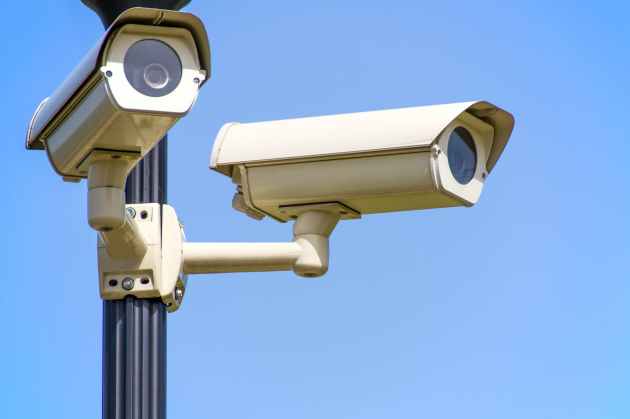
What exactly is behind the move to install more personal cameras (and share that information with police and others on social media)? Fear of crime, intruders, destruction of personal property? Over recent decades crime rates have dropped yet the perceived need for safety at home has increased. The suburbs in general have a history of exclusion, a fear of the other, looking to avoid “urban” issues. Cameras provide the opportunity to constantly view who is around the sacred single-family home. Even if someone is just walking by on the public sidewalk or driving on the public street, these home cameras could pick them up.

Put together the racialized history of suburbs, assumptions about crime and danger in the United States, and the increase in cameras and this connects with what Browne says above. Who are the suburban cameras there to watch?

Taking protests for racial justice to the suburbs

Data collected over the last few years hints at new venues for protests in the United States:

woman holding a sign in protest

Photo by Life Matters on Pexels.com

The engagement of Brown and others also represents one of the most striking aspects of the current protests against police violence in the U.S., compared with previous ones. They’re everywhere, in suburbs and small towns as well as major cities. Count Love, a data-collecting effort launched in 2016 to document protest activity in the U.S., has cataloged more than 1,500 distinct racial justice events since George Floyd was killed on May 25, and the site’s founders, Tommy Leung and Nathan Perkins, expect to add many more, since they have an extensive backlog of local media and reports to review. Even in the wake of the 2017 Women’s March and widespread anti-gun actions in 2018, the physical scale of these Black Lives Matter protests is striking.

While it’s challenging to generalize, given the sheer number of events that have and continue to take place, conversations with eight protest organizers, as well as historians and researchers, suggest some commonalities amid the vibrant, multiracial, and predominantly peaceful demonstrations taking place outside of large cities. They’re often led by first-time organizers in their teens and 20s, often women, who have adapted the traditional models of urban-style political demonstrations to suburban sprawl or rural areas. And they’ve done so at incredible speeds by leveraging social media.

“One of the reasons we’re seeing these protests in suburban and exurban places is because organizers don’t need connections to movements or Black institutions or churches,” says Ashley Howard, a historian and professor at the University of Iowa working on a book about urban rebellions of the ’60s. “They already have networks in place through social media.”

These protests also reflect the demographic shifts and diversification of U.S. suburbs and exurbs in recent decades, a challenge to the stereotype of a monochromatic suburbia. While much has been said about how unexpected it may be for the current wave of protests to have moved beyond urban centers, many organizers and activists say the suburbs — where many residents may not believe there are issues of systemic racism — are exactly where these protests belong.

And Naperville, wealthy suburb home to recent racist events and protests in the last decade, gets a mention.

See my own recent thoughts on the spread of protests to wealthy suburbs. As noted above, the combination of more racially diverse suburbs, the high status of numerous suburbs, and political change in suburbs means suburban protests are more normal. Whether this translates into (1) changed suburban communities – reduced residential segregation? – and (2) changed state and national politics – led by suburban voters? – remains to be seen.

I’m glad this data is being collected and I would guess it has a lot of potential for academic research. As previous research has examined, how did these protests diffuse across the United States? What are the patterns in the communities that had protests?

Will the suburbs be more appealing moving forward because of COVID-19?

With discussion of COVID-19 in cities plus urban residents leaving for suburbs, does this mean people will view suburbs differently going forward? Ian Bogost suggests this will be the case:

photo of roadway during daytime

Photo by Myburgh Roux on Pexels.com

But after the anxious spring of 2020, these defects seem like new luxuries. There was always comfort to be found in a big house on a plot of land that’s your own. The relief is even more soothing with a pandemic bearing down on you. And as the novel coronavirus graduates from acute terror to long-term malaise, urbanites are trapped in small apartments with little or no outdoor space, reliant on mass transit that now seems less like a public service and more like a rolling petri dish. Meanwhile, suburbanites have protected their families amid the solace of sprawling homes on large, private plots, separated from the neighbors, and reachable only by the safety of private cars. Sheltered from the virus in their many bedrooms, they sleep soundly, dreaming the American dream with new confidence.

Safety has always warmed the suburban soul. The American dream is sometimes equated with property ownership and the nuclear families such properties house—but really, they are just hulls for a more fundamental suburban aspiration: individualism, which the suburban home demarcates and then protects…

The pandemic will improve suburban life, perhaps in lasting ways. Take the automobile commute: The exodus from the office has dramatically decreased traffic and pollution, a trend that will continue in some form if even a fraction of the people who abandoned their commutes continue to work from home. Dunham-Jones, who is also my colleague in Georgia Tech’s college of design, thinks that even a modest rise in telecommuting could also increase the appeal of local walking and bike trips. Families have two cars, but nowhere to go. They are rediscovering the pleasures of pedestrianism…

The suburbs were never as bad as their stereotypes. The little boxes might have been all the same, but the ’50s suburban plots also flowed continuously into one another, with unobstructed front and backyards, forming unified communities. And those communities were in some ways far less homogeneous than their legacy recalls, even despite the scourge of redlining and its serious, long-term effects.

There is a lot to consider here. A few categories of thoughts in response:

  1. There is an underlying contrast between how elites and urbanites viewed suburbs versus how many Americans have viewed suburbs for decades. Even as majorities of Americans now live in suburbs, there is a well-established line of suburban critiques. Is the individualism Bogost discusses a feature of suburban life or a terrible thing to promote? Do suburbanites really have individualism or does it end up looking the same across suburban single-family homes?
  2. The suburbs are aspirational. This reminds me of the argument by historian Jon Teaford in The American Suburb: The Basics: “Suburbs are an expression of the American desire for freedom and the right to pursue one’s own destiny.” (219) At the same time, the path taken to pursue these aspirations involved exclusion. Can these two competing interests – private freedom in a single-family home yet excluding who can access this – be reconciled in the future, let alone in assessments of the past?
  3. It is hard to know exactly what suburbia is under discussion. Complex suburbia is here. Bogost mentions at least a few visions of suburbia today including New Urbanist communities and neighborhoods of McMansions but we could also consider ethnoburbs, working-class suburbs, suburban job centers, and more. Which suburbia is the preferred one in the minds of Americans or which one should policy try to promote or is a varied suburban landscape more ideal?
  4. COVID-19 is theoretically a temporary issue to face. Once it passes or is controlled or societies learn to live with it, it is hard to know what consensus regarding places might emerge.

This debate which stretches at least to the early 1900s is not over even as COVID-19 changes the terms.

Remember the suburban voters in 2020

As COVID-19 and police brutality pushed the 2020 presidential election off the front pages for months, recent poll data suggests suburban voters are breaking one way in national polls:

And while Trump has an edge with rural voters, Biden crushes him in the suburbs – which often decide how swing states swing.

Fifty per cent of suburban registered voters told the pollster they planned to vote for Biden, while 36 per cent said they’d vote for Trump.

And in Texas metropolitan areas:

A Quinnipiac University survey released last week found Trump leading Biden by 1 point in Texas. Trump leads by 2.2 points in the RealClearPolitics average.

Texas Republicans are primarily worried about their standing in the suburbs, where women and independents have steadily gravitated away from the GOP since Trump took office.

Republican support has eroded in the areas surrounding Houston, Dallas, Austin and San Antonio, four of the nation’s largest and fastest growing metro areas. Democrats defeated longtime GOP incumbents in Houston and Dallas in 2018.

More background on trying to find a suburban “silent majority”:

The suburbs — not the red, but sparsely populated rural areas of the country most often associated with Trump — are where Trump found the majority of his support in 2016. Yet it was in the suburbs that Democrats built their House majority two years ago in a dramatic midterm repudiation of the Republican president.

Now, Trump’s approach to the violence and unrest that have gripped the nation’s big cities seems calibrated toward winning back those places, in the hopes that voters will recoil at the current images of chaos and looting — as they did in the late 1960s — and look to the White House for stability…

Five months before the general election, according to national polls, the political landscape for Trump is bleak. But there is a clear window of opportunity: Trump remains popular in rural America, and he won the suburbs by 4 percentage points in 2016 — largely on the backs of non-college-educated whites.

There are millions more potential voters where those came from — people who fit in Trump’s demographic sweet spot but did not vote. They live in rural and exurban areas, but also in working class suburbs like Macomb County, outside Detroit. They are who Republicans are referring to when they talk about a new “silent majority” — the kind of potential voters who, even if disgusted by police violence, are not joining in protest.

This probably bears repeating: the American suburbs of today are not solely populated by wealthy, white, conservative voters. This is the era of complex suburbia where different racial and ethnic groups as well as varied social classes live throughout metropolitan regions.

Relatively little media coverage has examined how COVID-19 or police brutality has affected suburbs or how suburbanites feel about all the change. While just over 50% of Americans live in suburbs, coverage emphasized urban areas. And what do suburbanites think when they see these images of urban life, policing, and protest that they may or not understand on an experiential or deeper level?

“The Great Reshuffling,” “extension cords” to suburban living

New terms are arising to describe the possibility of more people moving to the suburbs with remote work becoming more popular:

green rectangular corded machine on grey wall during daytime

Photo by Mike on Pexels.com

Zillow Chief Executive Rich Barton has coined the coming changes in where and how workers live their lives “the great reshuffling.” Redfin’s lead economist Taylor Marr says his company is registering stronger demand in terms of homes under contract in places like Seattle and Austin, Texas, where there has been spillover from bigger cities. These are tech hubs where a lot of remote work was already happening and they have been more insulated in terms of layoffs, he said.

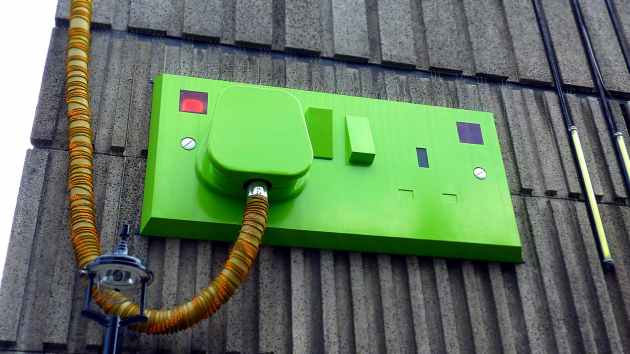
Zillow’s chief economist, Svenja Gudell, says she doesn’t expect residents to cut the cord entirely from their cities, but that they may opt for an “extension cord” into the suburbs where they can get more space, more outdoor areas and, of course, a home office.

To be honest, I’m not sure I like either term that much. “The Great Reshuffling” could apply to all sorts of population changes. Suburbs as “extension cord” implies that suburbs could not exist without cities; this has some truth to it but is also open to some scholarly debate.

All of this is fairly speculative at this point. Yet, given the tendencies of Americans toward the suburbs, it may not take much to push people out of cities and to more property for their money. Cities appeal to many Americans but the suburbs are the places many default to.

It is also interesting to consider what cities might benefit the most from people fleeing high prices in particular places. If the residents of Manhattan or the Bay Area or Seattle could go anywhere, where would they go? Would other locations in those metro areas prove attractive (people get to maintain their connections, access culture and familiar places) or would they leave for cheaper housing markets, family elsewhere, or locations with other kinds of amenities (warm weather, access to nature, etc.)? The ultimate winner here might the ever-expanding Sunbelt.