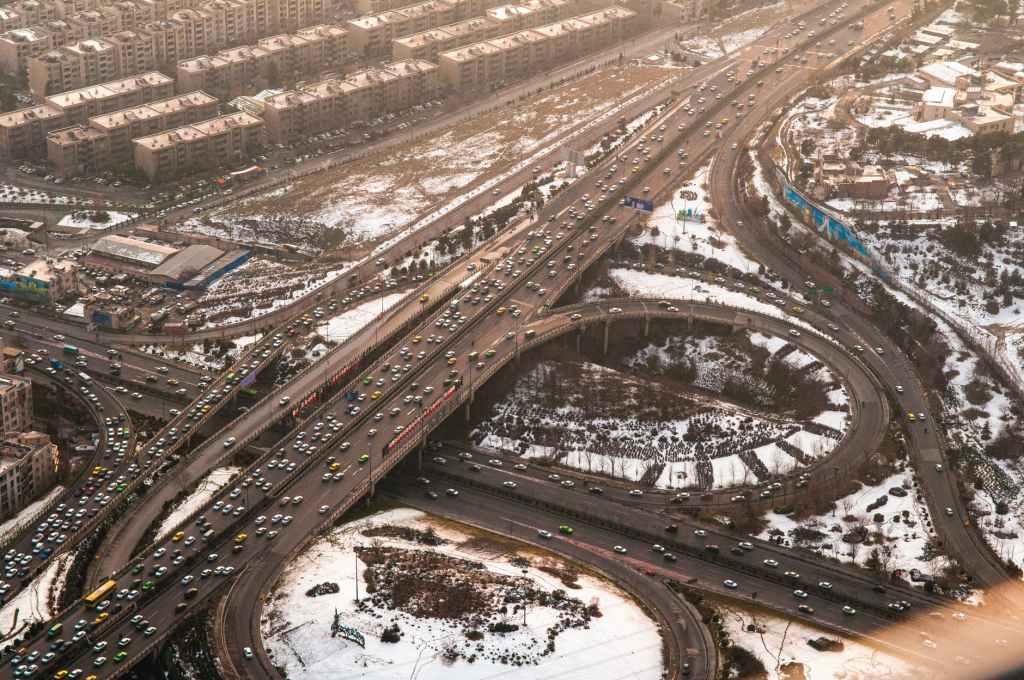
Travel times have already returned mostly to normal on Chicago’s expressways, according to the Illinois Department of Transportation. On the Eisenhower, it’s taking drivers an average of 40 minutes to get from Wolf Road to the Jane Byrne Interchange during morning rush hour, compared with 32 minutes in June 2019. Drivers taking the Kennedy from downtown to O’Hare International Airport in the afternoon spent about an hour on the road in both June 2019 and 2021.
Who’s on the road might be changing, though. Truck traffic is up, and more people are working remotely. Among those heading out, more people who were taking public transit before the pandemic seem to be driving, IDOT spokesman Guy Tridgell said.
Imagine a post-COVID-19 traffic nightmare: trucks all over the place delivering goods as the economy continues to rebound. More cars on the roads because of fears about mass transit. People who were home for months and/or were used to less congestion on the road now stuck in worse traffic. Are there any good short and long-term solutions to addressing this while the mass transit efforts also continue?
From 2010-2020 the Dallas-Fort Worth metro area added 438,000 new housing units, increasing the housing stock by 18%. Dallas’s growth in new housing ranks No. 9 fastest among the nation’s 100 largest metros, Zillow’s stats show.
Over the same period, Dallas added 802,000 new jobs, an increase of 29%. A healthy housing market should add a new housing unit for every 1-2 new jobs as the local economy grows, according to the Zillow report and industry rule of thumb
.In Dallas-Fort Worth, 1.8 jobs have been added for every new housing unit, indicating that the area is building enough new housing to keep pace with demand, according to Zillow, although many realtors, homebuilders, and would-be buyers argue that’s not the case, at least right now.
Many American communities would like to have this problem: more residents and more jobs. Growth is good. Yet, growth in one area that outpaces the ability for other areas to keep up could become a problem.
In this case, the issue is housing. A flood of new workers could lead to higher demand for housing, driving up prices and increasing competition. In the long run, this could be discouraging both to new workers as well as long-term residents who find themselves in a different housing market.
I could imagine other issues in the Dallas area and elsewhere where growth happens. Take schools. This often comes up in booming suburbs where new residences are plentiful. This puts a strain on local schools and construction has to take place rather quickly to avoid having a lot of students in temporary settings. But, at some point, population growth will slow down and then there might be too much education infrastructure and costs that are difficult for the community to sustain.
Another example could be traffic and congestion. Adding all these jobs and housing units means many more people have to travel between them. Can the current roads and mass transit (roads in the case of most American metropolitan areas) handle all of this? New lanes can be added but putting in additional roads or highways is expensive and time-consuming. And studies show that adding road capacity just leads to more driving and more traffic.
The Dallas area might be fine in the long-run with roughly 1.8 new jobs per new residence but it will take some time to catch up with and settle in to the growth.
About 1,166 people died in motor vehicle crashes in Illinois in 2020, a nearly 16% increase over 2019, according to the Illinois Department of Transportation. That’s a provisional number, said IDOT spokesperson Guy Tridgell, since it takes the state agency 12-18 months to finalize annual data…
Speeding and traffic fatalities typically go down during recessions, according to an October study published by the National Highway Traffic Safety Administration. In Illinois, for example, deaths dipped sharply in 2008 and 2009 according to state data, though they’ve been up slightly since…
About 28,190 people died in crashes from January to September 2020, more than a thousand more fatalities than in the same period in 2019, the federal agency estimated. A full annual report is expected to be released in the late fall…
What’s more, traffic deaths nationally were down from March to May, but jumped back up after states began reopening in June, according to the agency’s estimates.
This suggests safety is not solely a function of the number of miles driven or trips taken. How people drive and the conditions matter quite a bit. In this case, the article hints at multiple possible reasons for this jump. This includes speeding, more impaired drivers, and less seat belt use among those hurt.
I wonder if there are several other factors at play. With many public and private locations shut down, did driving become an even more important escape for some Americans? With limited places to go, driving and doing so dangerously could be a kind of release not available elsewhere.
Second, is there a safety feature to a certain level of traffic? With fewer people out, does this encourage riskier driving compared to having to navigate more vehicles on the road? Too many cars likely leads to more accidents but what about too few compared to typical conditions?
Synchronizing traffic lights. Los Angeles did this a few years ago to help traffic flow. As a kid, I recall sitting in the car in Chicago and hearing tell of how Clark Street on Chicago’s North Side was set up this way: follow the speed limit and a driver should hit multiple greens in a row. This could be harder to accomplish across a range of municipalities and the various traffic volumes intersecting with the main road. Additionally, this might not help much if there is just too much traffic on the road.
Providing more lanes, more driving options. Americans tend to like this strategy: more lanes, more roads equals more space for vehicles, right? Research suggests otherwise: if you add road capacity, drivers will tend to fill that up. Americans like driving in the suburbs and this is not a long-term solution. In fact, road diets may be more helpful: reduce capacity and it pushes drivers toward other options. Furthermore, expanding roads in an already developed suburban area can get quite expensive and may be controversial.
Encouraging more mass transit use, more walking and bicycling, and less driving. If there are simply too many cars, limiting trips would help ensure smoother driving experiences. All of these options are tough sells in the suburbs. It is hard to provide mass transit in a decentralized landscape and wealthier residents are unlikely to use it. Residential neighborhoods might be set up for biking and walking but connecting to other uses – grocery stores, schools, businesses – is often not possible or is dangerous.
This suggests that there may be some short-term solutions but the bigger issue would take more time and effort: American suburbs are built around driving.
The arrival of 2021 means we’ll soon be in Construction Season Nine of a notorious project that the Illinois Department of Transportation initially said would take four and a half years to complete.
We refer of course to the glacially paced reconstruction of The Jane Byrne Construction Museum. We use that respectful moniker — always capitalize The, like The Ohio State University — for what old-time Chicagoans used to call the Jane Byrne Interchange…
Whatever the reason, drivers who didn’t abandon the interchange years ago have, in recent days, found the final four rebuilt ramps open. Museum work has shifted to the mainline Dan Ryan and Kennedy expressways — although we trust that, somewhere, IDOT also is building a museum wing to house its excuses for the years of delays and cost overruns: poor soil conditions, unhelpful rules from Chicago’s City Hall, mistakes by engineering firms, utility rerouting, the diversion of resources to emergency repair projects elsewhere, and on and on…
Surely you aren’t surprised that the cost has grown by some 48%, from $535.5 million to $794 million. Most museums recruit donors to cover their big projects. The Jane Byrne Construction Museum instead gets public dollars. Which has us wondering how many gazillion gallons of amply taxed gasoline burned into the atmosphere as all those mummified motorists sat and sat.
Highways often get greenlit for expensive work because they require engineering upgrades or significant maintenance. The projects in PIRG’s least-wanted list go beyond those basic needs. Like the group’s previous boondoggle roundups, this one calls attention to taxpayer-funded projects set to consume environmental resources, cut through existing communities, and lock in decades of new carbon emissions, for what PIRG argues is little payoff in congestion relief or economic growth. The 2020 report arrives as the ongoing pandemic clobbers state and local budgets and dramatically reshuffles travel patterns.
The largest on the list is Florida’s M-CORES project, a $10 billion, 330-mile plan to build three toll roads through rural southwest and central Florida. Dubbed the “Billionaire Boulevard” by critics who characterize the project as a handout to developers, a state task force recently found a lack of “specific need” for any of the roads, which would run through environmentally sensitive areas.
There’s also the Cincinnati Eastern Bypass, a $7.3 billion highway set to loop around the eastern side of Cincinnati. Originally proposed by a local homebuilder as a replacement (and then some) for the aging bridge that leads into downtown Cincinnati, the 75-mile, four-lane bypass is designed to divert trucks passing through the region on Interstate 75, easing congestion for local drivers, boosters claim. But the report’s authors state that the highway is projected to add thousands of new vehicle trips per day, encouraging sprawl and contradicting Cincinnati’s goals to increase “population density and transit-oriented development” and decrease fossil fuel use by 20%.
No highway policy critique would be complete without a contribution from Texas. The $1.36 billion Loop 1604 Expansion in San Antonio would add four to six additional lanes on 23 miles of an existing four-lane highway, as well as new frontage roads and a five-tier interchange with Interstate 10. Texas DOT says that the new lanes are needed to keep up with population growth, but transportation planners say that the principle of induced demand would cancel out the benefits while adding pollution. The PIRG report puts it this way: “Additional capacity causes more driving and congestion.”
These summaries of major highway projects provide good reminders of several features of such undertakings:
They often require years of planning and years to complete. From start to finish, this could cover a decade-plus. They take a lot of effort to get going across numerous agencies, governments, and actors and have their own kind of inertia as they move toward completion.
These projects are often intended to make driving easier. Adding lanes and capacity can also attract more drivers. In a country devoted to driving, these contradictory ideas can go together. And the roads and systems for driving keep expanding and evolving.
The costs are huge and the efforts required massive. Yet, the average driver may think about nothing but the congestion caused by the construction.
When completed, such roads (and other significant infrastructure projects) can be impressive in their scale. (Whether this is the best use of the land or moving people around leads to other arguments.)
While these articles do not address this, are there significant infrastructure projects that drivers and residents would be pleasantly surprised to find that had been completed during COVID-19?
On Tuesday, Musk announced on Twitter that, after a full year in the making, The Boring Company’s first operational “loop tunnel” in Las Vegas is “almost done.”…
The Boring Company built a test tunnel in 2018 near its headquarters in Hawthorne, California. A year later, it landed a commercial contract in Las Vegas to build a loop tunnel system for public use. According to The Boring Company’s proposal, the final system will be able to shuttle passengers in self-driving Tesla cars between any two destinations in Sin City within minutes.
Construction of the initial twin tunnels near the Las Vegas Convention Center (LVCC) was complete in May. The system is expected to be ready for public use for the Consumer Electronics Show (CES) in January 2021. But the event has been moved online due to the coronavirus pandemic.
Last month, The Boring Company won a county approval to expand its LVCC transportation Loop to include an underground station at the new Resorts World hotel located at the north end of the Vegas Strip. Ultimately, the company aims to connect all major tourist destinations along the Strip, as well as two terminals of the nearby McCarran International Airport and downtown Vegas.
This location makes sense when tourism is in full swing in Las Vegas. While the airport is relatively close to the strip, it is not necessarily close time-wise and a quick, automated car ride could please a lot of visitors. It is also fun to imagine this in other cities. The tunnels bring to mind memories of playing the Lower Wacker track on Cruis’n USA. Chicago has some of this infrastructure already in place while other cities might be able to convert or expand existing tunnels.
How this could positively affect streetscapes is fascinating. Imagine major American cities with less traffic in their denser areas, more room for pedestrians, more space for properties to extend past the building. Cars would still be in use – just moved to a different plane – but the emphasis on vehicles would be reduced. More streets could be closed, the scale of social life could change (though the towering buildings in some districts would still loom), and the streets would be safer. (I imagine taxis and others might not be pleased to have the business moved underground.)
This is likely a long project to pursue in any city; making big changes underground in many locations is very difficult. It does keep cars around (just more out of sight) and both the money spent to put the system in place and the ongoing commitment to the system could continue to inhibit other options such as promoting mass transit.
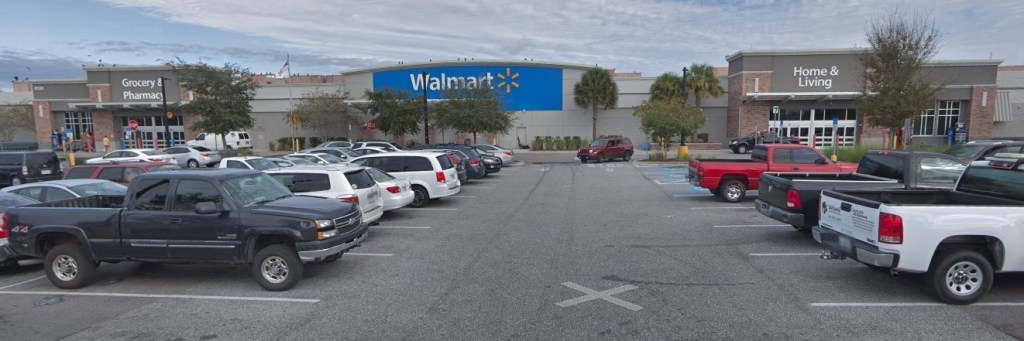
I have driven through many Walmart parking lots and while doing this, I often wonder how a better parking lot experience could help avoid regular issues. Here are some of the big concerns:
There are often a lot of vehicles, people, and carts moving around. It is hard to keep track of all the activity.
Depending on the traffic flow of the location, some of the traffic can be routed right in front of the store as vehicles turn in from a street or adjoining parking lot.
At least a few cars always seem to be lingering right at the front doors or nearby, waiting for people.
Carts are strewn throughout the parking lot; most are in corrals but there are often other ones on medians, in parking spots, and even several parking lots over. (Imagine if the Walmart lot had Costco sized shopping carts!)
A few solutions come to mind:
Everyone needs to be very attentive. Having to pay close attention is not necessarily bad for drivers or pedestrians.
It is better to have the majority of drivers enter the parking lot area from the back rather than from the sides and drive directly in front of the store.
I started thinking about this recently after realizing that I have been in multiple parking garages at Target locations but never at a Walmart. In these locations, there are advantages to having the parking further away from the store and/or having the store on a different level from the traffic flows.
Figuring this out could have multiple benefits including: drivers and pedestrians would feel safer, the parking lot experience could be less fraught and more pleasant, and fewer work hours might need to be devoted to the parking lot.
Perhaps this is just the price Americans are willing to pay for their love of driving and sprawl: complicated parking lots. This is not an issue exclusive to Walmart as many big box stores demonstrate similar patterns. But, since Walmart has so many locations and so many customers, solving issues there could be a big deal.
World Business Chicago, a public-private nonprofit agency that promotes the city, estimates that on a given workday there about 406,000 office workers in downtown Chicago, making it the country’s second-biggest central business district after Manhattan.
Many of those people arrive by trains and buses, with the CTA and Metra providing almost 1.9 million rides combined on an average, pre-coronavirus weekday. That includes 1.6 million total one-way CTA rides and 263,000 Metra trips…
Riders’ hesitation may come in part from the Centers for Disease Control and Prevention’s recommendation in May that people drive to work alone. That guidance rankled public transportation advocates and created concerns of major traffic and environmental impacts in densely populated cities…
“We’re hearing stories from New York and (Washington) D.C. about employers saying if you’ve taken public transportation you can’t come in the building,” Lavin said. “We want to be sure there’s nothing against public transportation here. In order to do that, we need to have a dialogue.”
6. Providing more incentives for fleets of vehicles (electric or otherwise) so that not every household has so many cars.
Any one of these or several of them could be pursued at multiple levels with actions from individuals, local groups and municipalities, states, regions, and the federal government.
With activity picking back up, traffic and driving is trending up. Will people go back to accepting the typical commute at just over 27 minutes one way? Or, will people get behind options that might reduce traffic?
More working from home would reduce traffic. This seems popular and limits the need for commuting. (Bonus: no one is changing roadways like some of the below options.)
Americans like driving yet COVID-19 does provide an opportunity to rethink how much driving Americans do on a daily basis. Is this the system people want or is it more of what happened given American interests in suburbs and single-family homes?
In March 1996, men’s clothier Bigsby & Kruthers painted an image of Rodman on the side of a building just off the Kennedy Expressway. The 32-foot-high mural stared eastbound traffic in the eye, causing gapers delays in both directions that snarled traffic as badly as road construction.
An operations manager for a traffic-data company said the larger-than-life image added 20 to 30 minutes to morning commutes on the Kennedy and the Edens Expressway. And that was before Rodman’s hair was even on it.
“The 75-foot-wide advertisement included a color image of Michael Jordan looking down on traffic,” a March 26, 1996, Tribune story read. “But it’s the oversize Rodman who has taken the rush out of rush hour. His power glower is punctuated with three earrings and a nose ring; his arms are crossed, and his natty suit has the sleeves ripped out to reveal his collection of tattoos. He is even leaning forward, as if he just might want to butt heads.”
Standing just before the North Avenue exit, the painting was wider and taller than billboard laws normally would have allowed. But because the building was being used as a Bigsby & Kruthers warehouse, the advertising was not limited in size.
While most of the mural was black and white, the hair was in color — and changed as Rodman’s dye did, only adding to the traffic headaches.
Alas, the mural didn’t last. Bigsby & Kruthers covered it up a little more than two weeks after it first appeared in response to the concern of traffic officials.
A few quick thoughts:
Cities have regular spots that come up on traffic reports and the Kennedy is typically on the list in Chicago (“from O’Hare to downtown”). These spots can be on the list for a variety of reasons: a chokepoint for traffic, an odd curve or different road design (such as narrowing of lanes), and/or regular accidents. Billboards probably are not common contributors to this.
At the same time, certain billboards or advertisements can be become part of the urban highway experience. As commuters travel regular routes, they get used to seeing particular signs. New signs can also garner attention if they are a significant change or unusual. The other sports one that comes to mind from the Chicago region involved a series of Brian Urlacher balding treatment billboards along I-294 that popped up several years ago. I’m not sure if it caused any delays but it certainly caught people’s eyes as one of the city’s most recognizable recent sports stars suddenly had hair.
The particular Rodman billboard came as part of a perfect storm. Take a regularly congested stretch of highway plus an incredible basketball team that set the record that year for most wins in a season plus a truly unique player on the billboard (and not one who fit the typical Chicago image). The billboard did not last long but it left a mark.