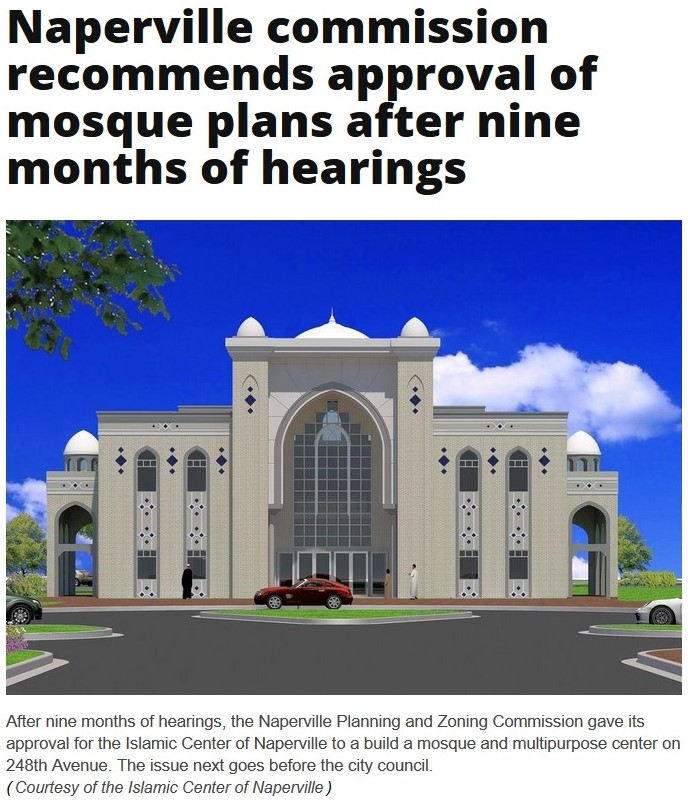
A large crowd in the city council chamber erupted in applause when the vote was completed. Each council member and Chirico expressed gratitude for the work put in by all parties throughout the process that played out over nine months in the city’s planning and zoning commission with 500 speakers in 15 meetings.
“We all know it was painful,” Chirico said. “There were times where I was entertained. There were times where I was angry. There were times where I was throwing my shoe at the TV. Every emotion it seemed like it went through.”
Even as life will now continue with the different actors involved, acknowledging the difficult process is noteworthy. In my study of such proposals, the religious groups do not always reach the outcome they desire nor do communities and residents always get what they want. Here, describing the process as “painful” could refer to a number of things – the time it took, figuring out the particulars, working with all of the interested parties, etc. – and very involved may have attained exactly what they wanted at the beginning.
It is also worth noting that the same group and site may be up for conversation again in the future. In order to help the proposal succeed, the Islamic Center of Naperville agreed to submit future changes for the building and property for review:
The final step pushing the proposal over the finishing line was a concession by the Islamic Center to submit its third, fourth and fifth phase to additional city council review when the time comes. A group representing the nearby subdivisions of Ashwood Pointe, Pencross Knoll and Tall Grass agreed to accept the proposal with those conditions.
Will the process at that point be less painful? The group has made two proposals and both times has encountered numerous questions from neighbors and community members. Some of the particular actors involved in those two discussions may be gone but the underlying questions may not.
How can we democratize land use policies through greater public participation to ensure healthy living conditions?
The second perspective highlights a structural perspective in two ways.
Healthy behavior leans more toward an individualistic perspective. A person who has health concerns should adapt their behavior in order to be more healthy. In contrast, healthy living conditions suggests there is a broader context for the individual’s health. Healthy living conditions can help lead to healthier individuals.
With healthy living conditions in mind, the new question highlights two ways that healthy living conditions come about: land use policies and greater public participation. This likely refers to research and experiences certain communities have with decisions made about where to locate land uses – ranging from coal power plants to landfills to manufacturing facilities with toxic output and more – that then affect health. Such decisions involve power, race/ethnicity, and social class as well as decision-making processes.
After more than 35 public hearings devoted to the Haymarket project, the decision seemed almost anticlimactic. It took barely 15 minutes for board members to cast their vote. Haymarket President and CEO Dan Lustig said he wasn’t surprised by the board’s verdict.
Only Pruyn and Trustee Ellen Leahy explained their opposition, framing the decision in mostly fiscal terms. Both agreed with opponents that the scale of the proposed treatment center was too much for a town of less than 10,000 people to absorb. “A facility this large belongs at the county seat or affiliated with a hospital where appropriate emergency medical services can be provided,” Leahy said.
However, the same organization already tried to open the facility in the county seat:
From nearly the start, Haymarket faced an uphill battle in its second attempt at offering treatment services within DuPage to help combat the scourge of opioid addiction. The county last year reported 112 opioid overdoses, a record high.
Almost four years ago, Haymarket, a Chicago-based nonprofit provider, was denied a bid to start a 16-bed satellite program in Wheaton.
While such decisions may be common, the larger effect is problematic. What DuPage County community would permit this land use? When there is a need to address opioid use, where could struggling local residents and families turn?
If each suburb follows in a similar logic, this contributes to uneven development patterns. Communities with resources and organized political movements can regularly keep less desirable land uses away from them. Other communities may not be able to do the same thing or feel like they have to take advantage of any opportunity that comes their way.
Where will this treatment facility end up? At this point, any effort to locate in DuPage County may be doomed as local residents have developed multiple successful lines of argument against the facility.
The Villages at West Neck was also Foster’s baby. He developed the community of 934 homes for ages 55 and older to complement the golf course. Its serene streets are lined with neatly manicured lawns and ranch houses…
About six months after the golf course closed, in the spring of 2020, W.C. Capital bought it in foreclosure. The company was organized in New Mexico, but it’s unknown who owns it. The sole member is a citizen of Florida, according to Attorney John McIntyre of Norfolk, the company’s registered agent. McIntyre declined to identify the owner.In the beginning, W.C. Capital sporadically mowed the golf course grounds, but it wasn’t as frequent as when the golf course was operating, Luckman said…
Residents rallied to try to save the golf course and formed an advisory committee. They reached out to a local, prominent developer to see if he would consider buying it. They tossed around the idea of the homeowners association stepping up, Luckman said. It would require millions of dollars just to restore it, let alone buy it.
Over the summer, the City of Virginia Beach sued W.C. Capital for not maintaining the golf course property. A bench trial is scheduled for April 2022, according to Deputy City Attorney Christopher Boynton.
In July, W.C. Capital met with Virginia Beach’s planning staff to propose developing senior living apartments on the golf course land. It would require a change in zoning; the land is zoned for preservation. At the urging of the staff, the company has held meetings with residents to garner feedback.
This is a classic issue that residents might face: they move to a neighborhood or community and then that same place changes. Here, a golf course is a sizable feature as it offers green space, relatively undeveloped land, higher property values, and opportunities to play golf for those interested. Filling the space left by a golf course is not necessarily easy for communities.
To some degree, all places change over time. People move in and out, outside conditions change, leaders make decisions. Few places can remain frozen in time.
And regardless of the change, it can be a difficult process for the property in transition and neighbors. The place is changing, developing a new character. Some people will leave in response, some will stay, others will fight the changes.
If indeed the property ends up becoming senior living apartments, in a decade or two the golf course may be a distant memory. The neighbors will move on. The new residents may only hear word of the former land use. The community will go on. But, the memories and experiences of that golf course may still linger among residents and the community even if its physical forms are long gone.
The city’s planning and zoning commission reviewed the plan over the course of 15 hearings and heard from about 500 speakers. On Wednesday, the panel voted 6-1 in favor of the project.
The proposal now heads to the city council for final approval, although that likely won’t happen until November, according to Naperville Director of Communications Linda LaCloche…
The vote came after three hours of closing statements, and after city staff detailed 12 conditions for the ICN to accept. Eleven were accepted by ICN attorney Len Monson and the wording of a 12th was adjusted before being accepted.
Among the conditions agreed to were the ICN’s responsibility for traffic management during the facility’s busiest times, no construction after the second phase of the project until 248th Avenue is expanded, a school pickup plan for the second phase, splitting the cost with the city for a traffic signal at 248th Avenue and Honey Locust Drive, and no outdoor amplification of sound.
Several points of my research may be relevant here:
Compared to other religious groups, Muslim groups do seem to encounter a lot of opposition when they make proposals.
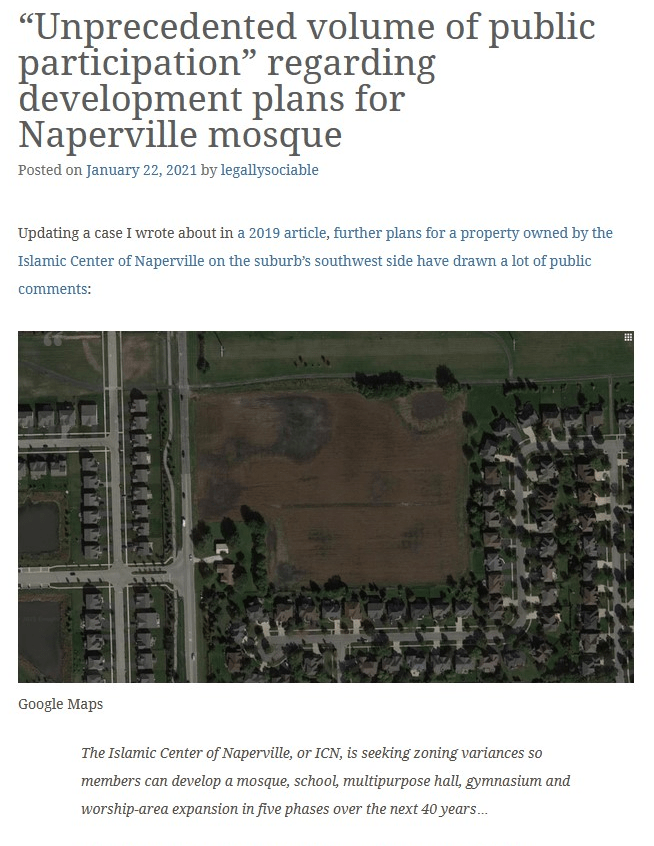
This proposal is also for a property surrounded by residences. My research suggests such a location near single-family homes can lead to more opposition from neighbors.
Conditions or negotiations between communities and religious groups do happen.
The conditions described above sound like they address some of the concerns raised by neighbors (and community members generally in my research): traffic and the residential/single-family home character of the area.
This particular proposal has received a lot of public comment and if it is approved by the City Council, it would be interesting to follow the neighborhood and community relations between Naperville residentsand ICN at this location and in Naperville more broadly
The developers propose to build a three-story building on approximately 2.5 acres at 874-920 N. Quentin Road, on the southwest corner with Poplar Street. All of the apartments — one-, two- and three-bedrooms — would be set aside for tenants whose income is between 30% and 80% of the area’s median income.
Village staff members recommended denying the plan, and the plan commission did the same after a public hearing Tuesday night. The village council will have final say and is expected to discuss the matter Aug. 9.
Plan commissioners praised the developer’s successful record of affordable housing developments, but they didn’t like the plan for the Palatine site, saying it’s too dense. The area consists of single-family homes and townhouses, with an apartment complex further north…
Several residents spoke Tuesday against the plan, saying they are worried about traffic, noise and light pollution, and changing the character of the neighborhood.
The final word will come in a few weeks. In the meantime, this set of arguments is a common one when suburbs consider apartments or even townhomes and condos. A key issue is the density of the project. What this often means is the community prefers to have single-family homes. Denser housing is often thought of as smaller housing or cheaper housing. Here, that is clear in that it is affordable housing where, through a sizable tax credit ($15 million) from an Illinois agency, residents will not need to pay full market rate.
Additionally, people often have concerns about the aesthetics and daily experiences around apartments. Apartment buildings are taller and are bulkier compared to homes on grassy lots. Because of more residents on less land, there will be more traffic on local roads. This particular proposal is close to a busier intersection but it also would be adjacent to single-family homes. It just looks different than single-family homes. If there are too many denser developments, the impression may be that single-family homes are not valued.
In sum, this density and kind of housing is perceived as a threat to the character of single-family home communities. Municipalities will sometimes respond to such proposals by asking the developer to reduce the number of units. Or, they might reject it all together by saying that it is not a good fit. And the search for land for affordable housing continues.
Come 1970, there was broad support for a portentous shift: Los Angeles would abandon the top-down planning that prevailed during a quarter century of postwar growth in favor of an ostensibly democratized approach. The city was divided into 35 community areas, each represented by a citizen advisory committee that would draw up a plan to guide its future. In theory, this would empower Angelenos from Brentwood to Boyle Heights to Watts.
In practice, it enabled what the Los Angeles land-use expert Greg Morrow calls “the homeowner revolution.” In his doctoral dissertation, he argued that a faction of wealthy, mostly white homeowners seized control of citizen advisory committees, especially on the Westside, to dominate land-use policy across the city. These homeowners contorted zoning rules in their neighborhoods to favor single-family houses, even though hardly more than a third of households in Los Angeles are owner-occupied, while nearly two-thirds are rented. By forming or joining nongovernmental homeowners’ associations that counted land-use rules as their biggest priority, these homeowners managed to wield disproportionate influence. Groups that favored more construction and lower rents, including Republicans in the L.A. Area Chamber of Commerce and Democrats in the Urban League, failed to grasp the stakes.
The Federation of Hillside and Canyon Associations, a coalition of about 50 homeowners’ groups, was one of the most powerful anti-growth forces in California, Morrow’s research showed. It began innocently in the 1950s, when residents living below newly developed hillsides sought stricter rules to prevent landslides. Morrow found little explicit evidence that these groups were motivated by racism, but even if all the members of this coalition had been willing to welcome neighbors of color in ensuing decades, their vehement opposition to the construction of denser housing and apartments served to keep their neighborhoods largely segregated. Many in the coalition had an earnestly held, quasi-romantic belief that a low-density city of single-family homes was the most wholesome, elevating environment and agreed that their preferred way of life was under threat. Conservatives worried that the government would destroy their neighborhoods with public-housing projects. Anti-capitalists railed against profit-driven developers. Environmentalists warned that only zero population growth would stave off mass starvation.
Much like the Reaganites who believed that “starving the beast” with tax cuts would shrink government, the anti-growth coalition embraced the theory that preventing the construction of housing would induce locals to have fewer kids and keep others from moving in. The initial wave of community plans, around 1970, “dramatically rolled back density,” Morrow wrote, “from a planned population of 10 million people down to roughly 4.1 million.” Overnight, the city of Los Angeles planned for a future with 6 million fewer residents. When Angelenos kept having children and outsiders kept moving into the city anyway, the housing deficit exploded and rents began their stratospheric rise.
The first rung on the homeownership ladder has long been an affordable “starter home.” These houses, with their smaller footprints and selling prices, allowed young homeowners to build wealth and upsize as they started their families…
Supply of “entry-level housing”—which Freddie Mac defines as homes under 1,400 square feet—is at a five-decade low.
Surging prices and stiff competition mean there aren’t enough smaller, more affordable starter homes to go around in many regions. The pandemic and subsequent recession, along with the student debt crisis and delayed family formation, contributed to frustration and despair among younger house hunters…
Lately, data from the National Association of Home Builders shows new construction is again giving priority to higher square footage for single-family homes, a trend likely spurred by the widespread shift to working from home and house hunters’ need for more space.
I wonder about the role of local governments. How many urban neighborhoods and suburban communities allow for or encourage the construction of smaller homes. It might take some extra work for a community to work with a developer who is willing to construct smaller and cheaper homes. At the same time, some of the existing members of the community might not be happy about the change as smaller homes are often interpreted as dragging down values and the character of the community. At the least, wealthier communities are unlikely to encourage such homes unless they are at a higher price point – and then it is no longer a starter home.
The Bay Area has become more racially segregated since 1990, mirroring a long-running national trend of cities and neighborhoods dividing more starkly along ethnic lines, according to a new study by UC Berkeley researchers.
Oakland, Fremont, San Francisco and San Jose are all among cities ranked as “highly segregated” by the university’s Othering & Belonging Institute…
Menendian said land use policies, including restrictions on denser housing and apartments, have driven segregation, particularly in the Bay Area. “It’s crystal clear that excessive restrictive zoning plays a significant role.”…
The impact of segregation, Berkeley researchers say, is clear: residents in communities of color have lower future economic gains, educational achievement and poorer health.
In some ways, the Bay Area is seen as a success story. Exciting cities and and cultural opportunities. Proximity to Silicon Valley and the tech industry. Diversity. A striking setting. But, this report hints at a darker side of this success: an ongoing process of homogenization. Divisions by location based on race and class. Zoning that keeps uses and people separate.
Do the two trends – success and division – necessarily go together? One does not have to lead to the other or vice versa. The same project found high levels of residential segregation in cities in the Midwest and Northeast, places without the same level of success as the Bay Area in recent years.
One way to think about this is to look at how the region as a whole could address this. Individual municipalities could address particular topics – like affordable housing or zoning issues – but might only help so many people and push the problem into other communities. A region-wide approach would help think about how gains can be shared and how concerns can be addressed by all. Even the biggest cities cannot go it alone when they rely on nearby places for workers and amenities.
Another matter to think about as addressed in the final paragraph above: residential segregation has cascading effects that can last for a long time. Where people live affects many aspects of life, ranging from what jobs can be accessed, the quality of housing, what is available through local schools and other institutions, and more. This is not an issue of people choosing to live some places rather than others; residential segregation speaks to patterns that can become reified and can physically establish different social worlds.
Finally, I am reminded of the Emerson and Smiley book Market Cities, People Cities. Is the long-term goal of the region to put the economy first? Or, is there enough interest in promoting more people friendly policies? The reputation and history of the area suggests there are resources and collectives to move toward more people oriented policies. However, this is a difficult move for any American city as social, political, and economic forces push toward placing the economy first.
Far worse than corporations taking a few thousand units off the market for owners are the governments and noisy NIMBYish residents taking millions of units off the market for owners and renters alike—by blocking construction projects in the past few decades. (California alone has an estimated shortage of 3 million housing units.) From New York to California, deep-blue cities and states have amassed a pitiful record of blocking housing construction and failing to meet rising demand with adequate supply. Many of the people tweeting about BlackRock are represented by city councils and state governments, or are surrounded by zoning laws and local ordinances that make home construction something between onerous and impossible.
One of the issues at play here is a numbers one: who exactly is acting within the US housing market and how much sway do they have. Concerns about corporations and housing can be placed in the larger context of how many housing units there are and how many are being built. Here are the numbers Thompson provides:
The U.S. has roughly 140 million housing units, a broad category that includes mansions, tiny townhouses, and apartments of all sizes. Of those 140 million units, about 80 million are stand-alone single-family homes. Of those 80 million, about 15 million are rental properties. Of those 15 million single-family rentals, institutional investors own about 300,000; most of the rest are owned by individual landlords. Of that 300,000, BlackRock—largely through its investment in the real-estate rental company Invitation Homes—owns about 80,000. (To clear up a common confusion: The investment firm Blackstone established Invitation Homes, in which BlackRock, a separate investment firm, is now an investor. Don’t yell at me; I didn’t name them.)
If I am calculating correctly, institutional investors currently own 2% of the single-family rentals. Of course, this number could grow if these firms find this to be a good investment.
Thompson settles on local actors – governments and residents – as holding back housing construction. In this numbers game, restrictions on a local level collectively are holding back the construction of single-family housing. If these restrictions were lifted or lessened, concerns about institutional investors would presumably diminish because there is a larger supply of houses to choose from.
One problem I see with this among the larger numbers: while local actors might in the aggregate have oversight over millions of units, they individually have control over relatively few units. Let’s say a particular suburb in the Bay Area (and this NIMBY argument often comes back to California) is against building new single-family homes. Depending on the size of the community and the availability of land, this might affect just a few homes to several thousand. This is not many. Zoom out to the whole region and many suburbs doing this adds up to tens of thousands of potential homes. Do this across all of California’s metro areas and the numbers add up. Similarly, you could do this across all the metro areas in the United States.
All of this does not necessarily mean Thompson is wrong. Yet, to get to the numbers of new homes constructed that would make a significant difference – whether in reducing the need many metro areas have for more affordable housing or outweighing the actions of investment firms – would require a lot of change across many communities. State or federal legislation may or may not be successful and would be unpopular in many places without a significant public groundswell of support that this is an issue that all or even most communities need to address.
Together, municipal changes regarding zoning and NIMBY could add up. But, changes would need to come across communities to make a big difference.