The Biden proposal would set up a $5 billion fund for local governments to compete for grants to pay for new schools, roads or bridges if they agreed to loosen zoning rules.
“This is a new approach that is purely carrot, no stick,” said a White House official on condition of anonymity…
Trump himself explicitly campaigned against the idea last year, warning “suburban housewives” that crime would spike and home values drop if zoning rules were relaxed.
Housing experts praised Biden’s proposal, but said it may do little to influence affluent communities that have the tightest zoning laws, which have little need for federal assistance.
It will be interesting to see which communities would accept the carrot and loosen zoning. My guess: suburban communities that are already in the midst of demographic and community change and looking for funds that could help point the community in a particular direction.
Once you’ve made some money, there’s one more way to get richer. Buy a home in a neighborhood with a lot of zoning restrictions. For example, 84 percent of the land in Charlotte, N.C., and 94 percent of the land in San Jose, Calif., is zoned for detached single- family homes. These restrictions keep the supply of housing low and jack up the value of homes for people wealthy enough to already own one.
My main message is that if you want to get rich, don’t invent a new and useful product, start a company and try to sell it. That seems risky. Put the effort into entering a clubby line of work in which legislators and professional associations are working to make you rich. It’s easier!
While the majority of the argument is about particular professions, I think the connection between jobs and exclusive homes is this: in both cases, the structures are set up to enrich those that can participate. Just as regulations and structures may privilege particular careers, zoning in the United States is often meant to protect single-family homes. If a homeowner can purchase a residence with particular features and in a specific setting, the zoning helps ensure that the property will be worth more in the future. The homeowner is responsible for some upkeep and updating – and may even go so far as to pursue a teardown – but the protections for the property are almost enough in themselves to let the investment grow in worth just be sitting there.
Connected to this, the zoning for single-family homes restricts the number of residences in that immediate area. More density does not necessarily mean lower property values; numerous urban centers – such as Chicago and New York – are home to new tall buildings whose units are only available to the super-wealthy. At the same time, proximity to amenities and particular neighborhoods are desirable and fewer residences there can help drive up the value of existing properties.
To some degree, many Americans are hoping for this to work for them. Go to college and get a good degree from a good school to gain the right skills, qualifications, and access to social networks. This leads to a better job with higher pay. Then, purchase a home in a reputable community where prices will continue to rise. Wait a few decades and let the pay, home investment, and other benefits accrue. This may not lead to being rich but it reduces anxiety about later decades in life.
Of course, the system could be set up in other ways. Do Americans want homes to be investment vehicles? Should there be such differences in pay and compensation across fields or job positions? Is zoning about the good of the community as a whole or about particular land owners? Combating existing patterns is no easy task, particularly in times when any discussion of inequality can quickly get heated.
Despite a global pandemic and an economic downturn, U.S. home prices pushed new boundaries last year: The national median sale price for existing homes hit $310,800 in November, marking 105 straight months of year-over-year gains, according to data from the National Association of Realtors.
This could reinforce the now common viewpoint that homes are investments. Increasing median values for over eight suggests reinforces the idea that homes generally go up in value. Except for big economic crises – think the burst housing bubble of the late 2000s – houses accrue value over time. Even COVID-19 could not derail this.
This is often viewed as a good thing. Homeowners like that their homes are increasing in value because they can make more money when they sell. Communities take this as a marker of status. Realtors and others in the housing industry benefit. No one wants a drop in housing values across the board. (Of course, this is the median so the values can differ a lot by location.)
The commodification changes how owners, developers, and communities think about houses. They are not just the private spaces to escape the outside world – an established idea in the American Dream – but goods to profit from. An increasing value must be good and steps in other areas should be taken to protect home values.
This has numerous effects. It encourages Americans to invest resources in buying housing when that money could be put to use elsewhere. It contributes to single-use zoning where homes are protected from any other possible uses. It can exacerbate the inequality gap between those who can buy homes and those who cannot or between those with homes in places where the values keep going up versus those with homes in places with stagnant values.
Joe DiStefano sees boulevards like El Camino Real as more than just spots for takeout or an oil change. He sees a “perfect storm of opportunity.” Cofounder and CEO of UrbanFootprint, a software company that builds urban planning tools, DiStefano has done numerous studies on the housing potential hiding in California’s commercial strips. According to UrbanFootprint’s analysis of El Camino Real, this lone corridor could theoretically accommodate more than 300,000 new units if the road was upzoned to allow residential development and its parking lots and big-box stores became low-rise apartment complexes…
Converting underutilized retail and office space into apartments is not a novel idea, but it’s gaining fresh attention from California lawmakers, especially as pandemic-fueled e-commerce and remote work trends continue to empty brick-and-mortar stores and business parks across the state. In December, California State Senator Anna Caballero, who represents the Central and Salinas valleys and cities such as Merced, helped introduce Senate Bill 6, which would fast-track the creation of walkable infill development and make it easier to turn land zoned for commercial uses into housing. Another member of the state’s legislature, Assemblymember Richard Bloom, has a similar proposal to encourage commercial-to-residential conversions, Assembly Bill 115. (California has a bicameral legislature.) And Senator Anthony Portantino introduced AB15, which would incentivize turning vacant big box sites into workforce housing…
But more than 40% of commercial zones in California’s 50 largest metros prohibit residential development, according to a recent report from the Terner Center for Housing Innovation at Berkeley. “Residential Redevelopment of Commercially Zoned Land in California” highlights the growing potential of such rezoning proposals. “It’s a perfect infill option,” says David Garcia, a co-author and policy director at the Terner Center. While legislation like these proposed bills hasn’t been passed in other states, he believes they address a universal problem. “You’re really plugging in gaps left by shifts in the commercial marketplace, by Covid and the shift to e-commerce.”
There are three main types of projects ripe for this kind of reuse, Garcia says: commercial strips in more urban areas, often along existing transit lines; former big box retailers in more suburban areas; and vacant land in the exurban landscape that’s been reserved for future development. Researchers found there was actually more acreage of available commercial space per person in more suburban/outlier areas, an opportunity that, if paired with increased investment in transit, could quickly bring more density and valuable walkable development to fast-growing and diversifying suburban centers, some of which have already done a relatively good job of building new housing. “Instead of thinking about a bill like this as another state mandate cities need to adhere to, it should be looked at as a tool for doing the good planning they need to do anyways,” Garcia says.
This might be hard sell before COVID-19 but the severe issues for retailers and businesses may make a lot of properties available.
Even with these issues, I wonder how many communities would quickly give up commercial properties to be rezoned for residential use. Many communities rely on commercial properties along major roads for sales tax revenue. If commercial property disappears from the local zoning map, how would a community make up those revenues?
Of course, providing possibly cheaper housing could be desirable to residents, even if it comes at the expense of commercial properties. And new residential units might even revive some local commercial activity.
If this is enabled at the state level, it would be interesting to see how quickly communities and developers would move. Vacant property is not desirable for any municipality. Would this move more quickly in certain kinds of communities compared to others?
But, perhaps those who claim these four strategies are necessary would say that each point addresses something that holds the tiny house movement back. I would put these four into two broader categories that are worth exploring more.
The first category has to do with important local zoning regulations. Communities are prepared to handle single-family homes and many would be prepared to address multi-family housing. But, tiny houses are out of the ordinary and present unique challenges and opportunities. Should they be allowed on the same lot as an existing home? Do they go with micro-lots? Do they threaten the character of single-family homes? How many could be put on a regular residential plot of land? What are their water and services needs? Are these going to be cheaper or more luxury tiny homes? It would take some time to figure this out in many communities.
The second category involves the next three points. These are marketing and perception issues. Who are tiny houses for? What are they about? What social needs do they serve? The three points above try to answer these questions: tiny houses are for smaller households, they could be affordable housing, but they are not like RVs and camper vans. This puts them into an in-between category: not as permanent as a single-family house but not as mobile as an RV or camper van; cheaper than a typical house but there is still a cost (plus possible land costs); for some people but not others. Perhaps growing more quickly within a particular niche is what would help tiny houses as a whole become more popular.
There could be additional issues to address. If many more Americans wanted to order a tiny house in the next few weeks, could the orders be fulfilled relatively quickly? Do we have sufficient public and private spaces around tiny homes so that people can enjoy living in such a small space?
This is a lot to do. That can be okay; not all products have explosive growth and slow positive change could work out in the long run.
The great thing about rowhouses — that is, narrow, long, tall houses built connected to one another, sometimes called townhomes — is that they have most of the stuff Americans say they want in a home in a dense, efficient format. Typically they are single-family homes between two and four stories (though they can be built or split into apartments easily enough), with a front and back yard. The yards are small, but big enough for most purposes — you don’t need a McMansion-style soccer field to have some friends over for drinks and burgers, or let the dog run around, or simply get some fresh air and sunshine.
Then because the houses are connected to each other and on tiny lots, they are vastly more efficient. Instead of construction crews working on separate detached projects one after the other, they can build an entire block all at once. Shared walls means smaller bills for heating and cooling. Perhaps most importantly, the high density they enable allows for walkable neighborhoods with lots of shops and workable public transit. South Philly, which is almost entirely rowhouses, has about 24,000 people per square mile — which is not as dense as Brooklyn, but more than five times as dense as Phoenix and easily enough to support a subway line.
Rowhouses do have somewhat less privacy, of course. (I occasionally hear my neighbors even through the foot-thick brick walls, and I’m sure they hear me on occasion.) But even this has its upside — most obviously in a more vibrant neighborhood culture. When the sun is shining the folks on my block like to sit on the porch, chat with each other, smoke some meat, keep an eye on the neighborhood kids playing on the sidewalk, and so on. It feels like a friendly, alive place much more than the silent suburban cul-de-sacs I have visited in my life. And besides, who really wants to mow a three-acre yard all summer? Occasional weeding is more than enough work for me…
But rowhouses make a perfect middling addition to the American urban housing toolkit. Wherever a location is near to an urban center but not quite suitable for high-rises, slapping down a quick set of rowhouses ought to be the default option whenever land is freed up. By the same token, many American cities are also desperately short of moderately large apartment buildings, in the 3-8 story range, at somewhat more valuable locations like directly adjacent to transit stops.
The advantages and disadvantages to single-family homes amid American sprawl are clearly laid out here. The advantages include a lower price, efficiency in construction and heating and cooling, a smaller yard to maintain, and a lively, denser street. The disadvantages mirror these advantages: less space, less privacy. At the least, rowhouses in cities and denser suburbs provides opportunities for homeowners.
I have three further questions about rowhouses. First, what about rowhouses constructed for wealthier homeowners? In this piece, part of the appeal of rowhouses is a cheaper price point. Yet, rowhouses can be constructed with plenty of space and a lot of features for wealthier buyers. These homes might even give the appearance of being denser but are then trapped in small spots in cities or in suburban subdivisions far from anything walkable. Zoning is indeed an issue in certain places but I am guessing that is matters less in wealthier neighborhoods or communities or rowhouses are not viewed as a threat but rather as an intriguing change of pace.
Second, the importance of privacy may be understated. Americans like suburban single-family homes in part because they want to be separate from others (for privacy, because of race and class, to have their own property). Some homeowners want density and vibrant neighborhood life; others do not. If given the choice between a single-family home, a rowhouse, a condo, a townhouse, and an apartment (and controlling for particular neighborhood characteristics), what would most Americans choose?
Third, how much of these chooses about development depend on regional approaches to housing? As noted in the story, rowhouses are common in some places like Brooklyn and Philadelphia. They are not common in many other places. Having lived in one such development in the suburbs of the Midwest, it was an unusual choice among the typical options. And when that community and other nearby ones have been given choices about what to build since, they have largely eschewed rowhouses (except for more expensive ones). Getting communities to change up these options, particularly if there are worries about property values, is not an easy task.
The 2018 book Dream Hoardersconnects the actions of the top 20% in income to where they live and how they control who lives near them. Excerpts from the book:
The physical segregation of the upper middle class noted in chapter 2 is, for the most part, not the result of the free workings of the housing market. This inverse ghettoization is a product of a complex web of local rules and regulations regarding the use of land. The rise of “exclusionary zoning,” designed to protect the home values, schools, and neighborhoods of the affluent, has badly distorted the American property market. As Lee Anne Fennell points out, these rules have become “a central organizing feature in American metropolitan life.” (102)
Zoning ordinances, which began life as explicitly racist tools, have become important mechanisms for incorporating class divisions into urban physical geographies. This is not a partisan point. If anything, zoning is more exclusionary in liberal cities. (103)
So, those of us with high earnings are able to convert our income into wealth through the housing market, with assistance from the tax code. We then become highly defensive – almost paranoid – about the value of our property and turn to local policies, especially exclusionary zoning ordinances, to fend off any encroachment by lower-income citizens and even the slightest risk to the desirability of our neighborhoods. These exclusionary processes rarely require us to confront public criticism or judgment. They take place quietly and politely in municipal offices and usually simply require us to defend the status quo. (106)
There are numerous connections in this section to earlier posts. Here are a few:
In sum, it is hard to understand the life of wealthier Americans without also addressing how this wealth and the opportunities that come with it are closely connected to particular locations.
They want to abolish the suburbs altogether by ending single-family home zoning. This forced rezoning would bring crime, lawlessness and low-quality apartments into now thriving suburban neighborhoods.
What is so important about single-family homes and keeping out apartments? Here are at least three reasons why wealthier suburbs look to avoid most apartments:
The contrast between homeowners and apartment dwellers is thought to be stark. Homeowners care about their property and their community. Because their property values are at stake, they will put effort and money into their home and land. In contrast, apartment residents are thought to transient, not interested in the community, and less invested in their property.
Exclusion. Apartments are not just an eyesore and problems for building community; they attract different kinds of residents than wealthy homeowners. In particular, they are connected to lower-income residents, non-white residents, and/or criminal elements. And if a suburb avoids building apartments (or only ends up with more expensive apartments or rental units), certain groups of people are excluded.
Two quick historical examples come to mind.
-My research on the suburban development of Naperville, West Chicago, and Wheaton showed that the subject of apartments was an important one. In my 2013 article “Not All Suburbs are the Same,” I provide some details of fights over apartments in Naperville and Wheaton. In both well-off suburbs, the communities decided not to pursue apartment growth.
In sum, the argument from the McCloskeys is not just about a change in density; it is also about local control and the ability to keep (stereotyped) apartment dwellers out.
(Update: I have read other commentary that analyzes the coded language used by the McCloskeys. My primary focus in this post is about the mention of apartments: this is a common form of development that wealthier communities often look to limit because they view them as gateways to particular people in a community.)
Still, Polikoff agreed with me that public attitudes have changed a lot since the 1960s — fortunately for the better.
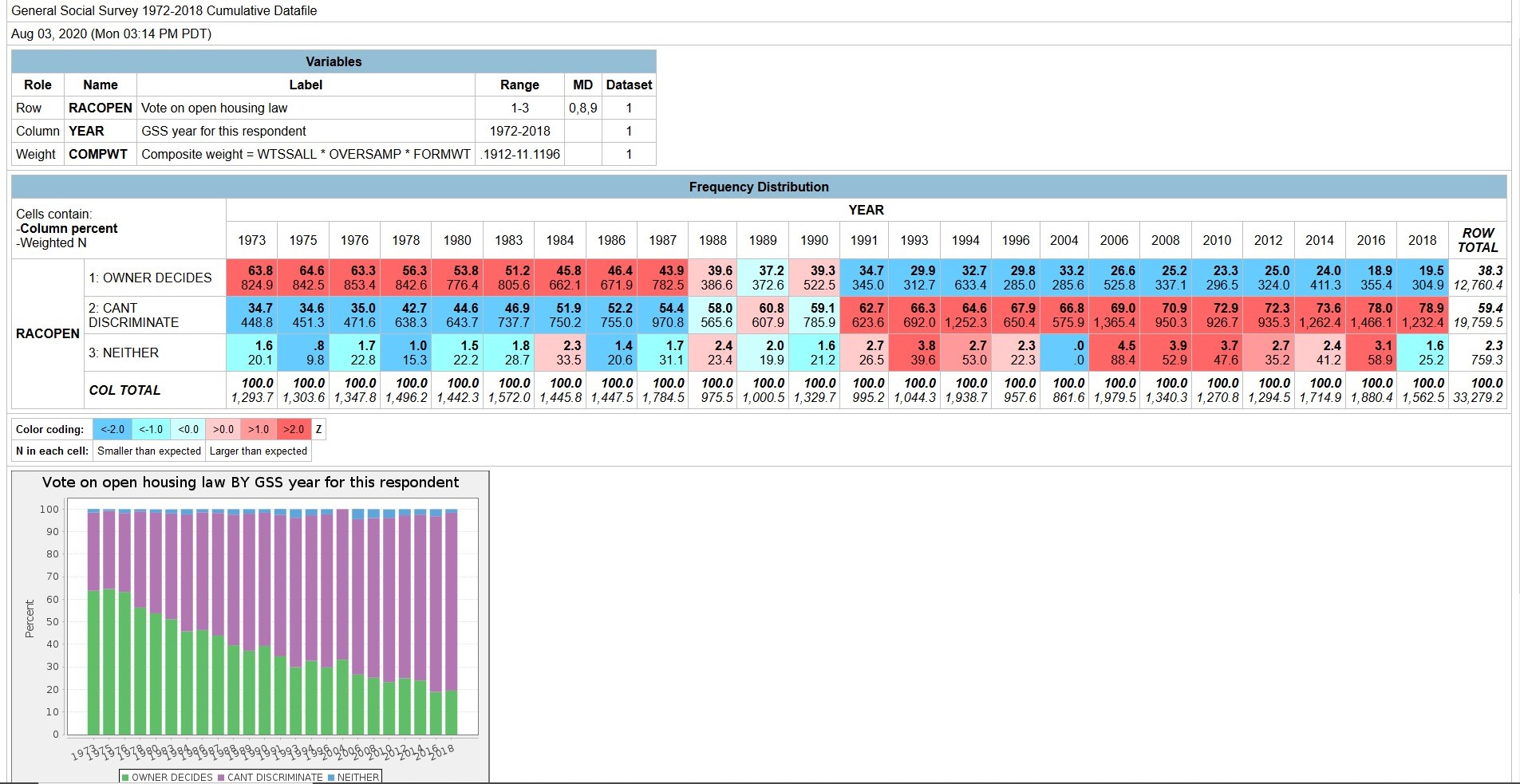
For example, in 1973 the General Social Survey and The Washington Post found that 64% of white Americans said they would vote for a law allowing homeowners to discriminate in selling their house. In 2014, that portion shrunk to only 28% while 70% thought such discrimination should be legally barred.
That the attitudes of Americans has improved on this subject is good. Using GSS data through 2018 (variable racopen), the question about racial discrimination has improved even further: only 19.5% of respondents believe the owner decides regarding discriminating in housing. Indeed, multiple measures of attitudes on race have improved since the early 1970s.
Yet, the data is still disheartening in two ways:
1. Over a quarter of Americans in 2014 thought such discrimination should be legal. That may not seem like much but pockets of such people may continue to practice housing discrimination. Local groups, including in the Chicago suburbs, continue to encounter cases of housing discrimination.
2. Overt housing discrimination does not need to occur to keep people out of housing or communities. Several other methods are utilized. Zoning is where communities set guidelines regarding what can and cannot be built. Communities can make it possible only to build expensive housing or only single-family homes or that lots need to be of a certain size. These guidelines make housing more expensive by limiting the housing supply and encouraging builders to construct more expensive housing to make more profit. Those with fewer resources then cannot rent or purchase properties in a more expensive area. The paucity of cheaper housing can then be explained away by local preferences or the inability of people to have the resources needed to access the community. Zoning can also limit the abilities of religious groups to gather (examples here and here). A second method is to make others feel less welcome. This can happen in more active ways such as through negative interactions with local residents (see examples here from one suburb), arguments about sending which kids to which local schools (suburban examples here and here), or arguments about local policies (such as English-only documents and signs). This can also happen more passively: what groups and ways of life are celebrated? What kind of diversity is welcomed? What kind of language is used regarding the community (a suburban example here)?
All of this hints at a basic sociological point: racism does not need mean, overt racist individuals to exist. The reality of suburbs includes exclusion and both overt and covert means are used to discourage certain residents from living in certain suburbs.
I came to this article through wanting to analyze the connection between religion and place. Having seen at least a few stories of religious zoning conflict in the Chicago area (see an earlier study here), I wondered whether these patterns held across different metropolitan regions (and all the variations that could exist there), a longer time period, and within different communities within metropolitan regions. As the abstract suggests, there are some similarities – for example, locations near residences or requests from Muslim groups receive more attention – and differences – including what religious groups are in each region (with a larger population of Orthodox Jewish residents in the New York City region).More broadly, zoning is a powerful tool communities have. As they set their land use guidelines, they are making decisions about what they envision their community looking like. This applies both to the physical structure or spaces as well as who might reside or work in the community. Americans tend to like local government, in part because it exercises control over what might locate near their homes or residences. But, this impulse to protect homes and property values can come up against other interests a community might have, such as affordable housing or medical facilities.