Sociology of Religion today published online my article referenced in the title to the post:
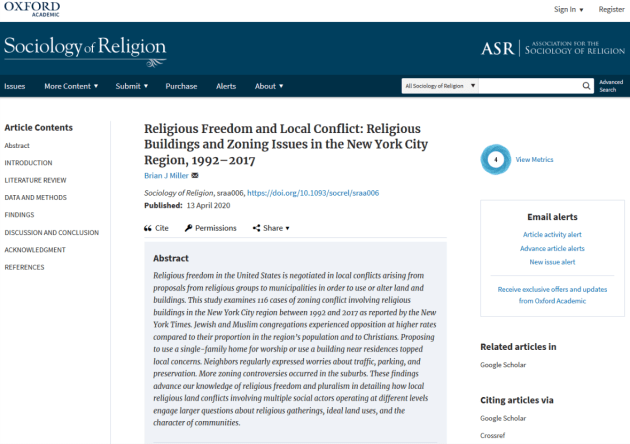

Sociology of Religion today published online my article referenced in the title to the post:
With more people at home during the day, they can hear more of what goes on during a typical day. And they may not like it:
Cities, towns and villages in New York, New Jersey and elsewhere in the country have created bans or sought voluntary cuts in the use of leaf blowers in suburban neighborhoods. Town leaders noted that with everyone sheltering in home, the constant din was an added nuisance…
The municipal actions are a departure in the ongoing saga of leaf blowers, one marked, in many towns, by equal parts irritation and inaction. Everyone hates hearing them down the block, but no one complains about the swift and eye-pleasing work they accomplish on their own lawns. And so a silent majority has carried on, under the whine of the motor.
Some residents have apparently questioned whether the machines could be spreading the coronavirus. The village of Croton-on-Hudson, N.Y. raised the same worry on Twitter this week…
In Westfield, N.J., Mayor Shelley Brindle, in a statement, asked homeowners and landscapers to keep the blowers locked away until at least noon ever day.
This comes amid broader discussions about banning gas leaf blowers and other gas-powered outdoor equipment. Compared to electric or battery-powered equipment, they produce more noise and exhaust. This could be an interesting time to nudge people toward different equipment – in the name of noise, environmental concerns – though asking them to do so in the midst of a crisis will make it more difficult.
I wonder how much the perception of the noise problem is also due to the time of year. I wrote two years ago about common summer noises that can interrupt tranquility: air conditioners, lawnmowers, construction, etc. Once the weather starts warming up, more people are outside and more people are doing work outside. The person in one house who wants to sit on their deck and enjoy some peace and quiet competes with the person next door who enjoys keeping their yard neat and green. And both of them may dislike the municipal road project that reconstructs the next street over and produces noise for weeks. If the COVID-19 induced lockdown started in November, would people have the same noises to complain about?
At the same time, dealing with noise is tricky among neighbors and within a community. People generally know that certain locations are noisier than others and adjust accordingly. Some people even live right under runway paths. Businesses also have a stake in this; as is noted at the end of the article cited above, not using certain yard equipment is possible but raking and pruning by hand will take more time and cost more money. Keeping everyone happy regarding noise is likely to be difficult.
Sociologist Eric Klinenberg follows up his New York Times op-ed with comments in the Chicago Tribune explaining why “physical distancing” is a better term than “social distancing”:
“A lot depends on us making this change,” Klinenberg said when I reached him by phone Friday at his home in New York. “To ask for ‘social distancing’ implies that we should go home and close our doors and turn our back on the people around us. That’s precisely wrong. We need social connections, social solidarity, more than ever before. It’s feeling social solidarity that leads us to lend a hand to the most vulnerable people around us – the elderly, the homeless and those who are doing what we now call essential work, who are at enormous risk.
“Of course we need physical distancing to prevent the virus from spreading,” Klinenberg said. “It’s transmitted through physical contact. It’s not transmitted through social bonds. And it’s social closeness that will help us help each other through this and help us rebuild. So if we stigmatize social life through our terminology, if we praise individualism and just taking care of ourselves, we run the risk of making the problem even worse.”
Perhaps there are two ways to approach this. First, changing the term could indeed matter. Second, with or without a changed term, the appeal to individualism and private action in staying away from others could be a powerful one in a country that celebrates individualism.
At the least, Klinenberg’s call could push some people to pay more attention to their social interactions in a time when typical social interactions are discouraged and dangerous. Klinenberg’s earlier work suggests that social bonds are already tenuous in a number of communities. In normal times, it is relatively easy to engage in patterns that do not require much thought. When that normalcy is disrupted, continuing those regular patterns requires flexibility and new ideas.
And, it remains to be seen how social bonds continue after the time of COVID-19. Will normal social interaction occur? Will there be new precautions (such as no or limited handshakes)? Will some who sheltered in place for a long period continue in those patterns? The length of the new policies, interactions during COVID-19, and hard-to-predict social changes (spanning economics, politics, and social life) could all influence future interactions (including the possibility that social bonds will be strengthened significantly after COVID-19 recedes).
Building on earlier posts on COVID-19 NIMBYism and COVID-19 in suburbs, I return to a particular suburban case: many residents in the Chicago suburb of Itasca opposed a 2019 proposal for a drug rehab facility in an empty hotel. In recent days, concern mounted as the community thought that same hotel could become a facility to treat COVID-19:
The fate of a shuttered hotel in Itasca took another strange turn this week when local officials briefly thought it might be used to quarantine COVID-19 patients suffering mild symptoms or those at heightened risk from the virus.
It turned out to be a false rumor, but its circulation illustrates the opaque process through which government officials are trying to line up buildings for use in the response to the coronavirus pandemic.
The Illinois Emergency Management Agency has asked its county-level counterparts to create “an alternative housing plan” to assist at least 25 people. The federal government would reimburse counties for sheltering those who have been exposed to or tested positive for COVID-19 but don’t require hospitalization, and “asymptomatic high-risk individuals needing social distancing as a precautionary measure.”
Some counties, though, aren’t saying much about their searches. Asked for specifics, a spokesman for the DuPage County Office of Homeland Security and Emergency Management said only that “we are working with our municipal agencies to identify needs as well as identifying potential community partners for potential housing.”
Read on for more details of official letters from the mayor to the medical company and back, bureaucratic vagueness, sharing theories on a local Facebook group, and the official denial.
Given how this played out, is it a wonder that some officials might follow an “opaque process”? If a county or state feels they need a facility as it has particular advantages, opposition from local residents could make it very difficult to move forward.
According to the DuPage County Department of Health COVID-19 Dashboard (as of 4/10/20), Itasca had seven cases of COVID-19. This is where the typical NIMBY concerns – reduced property values, a threat to an existing way of life or the character of the community – makes less sense: COVID-19 is present in Itasca. Granted, it is less present there than in other DuPage County communities. But, a facility in Itasca could be helpful for local residents. The same question arose with the proposed drug treatment facility; is drug rehab an issue in Itasca, surrounding suburbs, and DuPage County or is it only an issue that occurs elsewhere? In both of these cases, the medical conditions can affect people across all sorts of communities.
While much of the COVID-19 attention has been on cities, it is also present in suburban locations. Yesterday, I looked at cases in DuPage County west of Chicago. Today, a little digging around for other suburban locations:
Westchester County, New York
The New York region leads the United States in number of cases and deaths. Westchester County is a wealthy county just north of the city. Early on, an outbreak in New Rochelle received attention. According to figures for the county as of a few days ago, it looks like COVID-19 is in a number of community in sizable numbers.
Nassau and Suffolk Counties, New York
New York Gov. Andrew Cuomo said health officials “watching” Nassau and Suffolk counties as the number of deaths related to novel coronavirus (COVID-19) is on the rise.
There have now been 18,548 confirmed COVID-19 cases in Nassau County – up 1,938 from the day before, while Suffolk County has reached 15,844 cases, an increase of 291…
“We’ve been watching Rockland County, Nassau County, Suffolk County closely,” he said. “We’re looking at the concentric circles around New York City, and the natural spread circles are toward the suburbs. Westchester has already had trouble, now we’re seeing new hotspots on Long Island and the other suburbs.
Seattle area, Washington
King County, Washington is home both to Seattle and over a million suburban residents and two surrounding counties, Snohomish and Pierce, have more suburban residents. An update on the cases and deaths as of last night:
King County has been struck the hardest with Covid-19 with 3,688 cases and 244 deaths. Snohomish County reports 1,695 cases and 63 deaths. Pierce County reports 795 cases and 16 deaths.
From mid-March, a story of how the Seattle suburb of Kirkland responded in early March:
Within hours, Kirkland, an affluent mid-sized suburb that until two weeks ago was best known outside of Washington as the namesake for Costco’s Kirkland Signature brand, became the epicenter of the U.S. coronavirus outbreak.
More than 60 Kirkland residents, including people staying there temporarily, have died from or been hospitalized with the virus. Nearly all of them were associated with Life Care Center. Many patients with symptoms are at EvergreenHealth, a Kirkland hospital, which has seen nearly 100 confirmed cases and 24 deaths.
Kirkland’s response to the crisis is being watched around the country, and other cities are looking to them for guidance as infections spread.
New Orleans area
An update from yesterday shows numerous cases in and around New Orleans:
Orleans and Jefferson parishes continue to lead all other parishes with their coronavirus cases. According to Thursday’s update, New Orleans has 5,242 cases while Jefferson Parish is reporting 4,480 cases…
Other parishes seeing high case numbers include East Baton Rouge, Caddo and St. Tammany. Health officials continue to monitor St. John the Baptist, Ascension and Lafourche parishes where cases are in the 300-400 range.
In sum, numerous suburban counties and communities outside of major cities hit by COVID-19 are also facing significant numbers of cases. Various factors could be at play including race/ethnicity, the locations of jobs and workplaces, and the ability of suburban governments and organizations to respond to the threat.
(And a bonus story from ABC in Australia: how residents of Australian suburbs are coping with isolation.)
As news came out in recent days about disparities in COVID-19 cases and deaths by race in Chicago (and now the AP shows blacks are disproportionately affected in numerous American locations), I wondered how this plays out in DuPage County. The second most populous county in Illinois (after Cook County) has a reputation for wealth, conservative politics, and numerous jobs.

The numbers differ across communities, with some DuPage County municipalities still having no confirmed cases while others have 40+ (and Naperville, the largest community by population in DuPage County, leads the way with 71 cases). But, it would be useful to have rates as the populations differ quite a bit in DuPage County. The Chicago Tribune has an interactive map that shows cases by zip code and also provides rates of COVID-19 cases per 100,000 (but appears to be missing data compared to the DuPage County map). Across the zip codes in DuPage County listed, the rates of cases range from the 50s to the 140s per 100,000. Working with both the absolute numbers and the rates, a few communities stand out: Addison, Lombard, Carol Stream, and West Chicago.

DuPage County has a different population composition than Chicago or Cook County. For DuPage County as a whole, 66.3% are white alone (not Hispanic or Latino), 14.5% are Latino, 12.6% Asian, and 5.3% Black.Of course, these demographics can differ pretty dramatically across different communities (Oak Brook looks different than West Chicago which looks different than Glendale Heights). While the reported data does not have a breakdown across racial/ethnic groups (and without this it is impossible to see who has contracted COVID-19 in these communities), some of the higher rates of cases are in communities that are more diverse (Lombard is an exception): Addison is 40.6% Latino (44.7% white not Latino), Carol Stream is 19.3% Asian and 14.9% Latino (and 57.2% white not Latino), and West Chicago is 52.9% Latino (36.5% white not Latino).
Second, addressing age, there are several stories about COVID-19 cases in DuPage County senior homes. The most notable case was a center in Willowbrook (where as of April 7 eight of the county’s 26 deaths had occurred), it also hit a community in Carol Stream, and eight more deaths in the county were attributed to long term care facilities. As of yesterday afternoon, 17 of the 28 COVID-19 deaths in the county occurred among long term care residents.
People 65 years old or older make up 15.5% of the population in DuPage County. Lombard is right at the county average while the other three communities with higher rates are lower than the county average.
Third, all four of the communities with higher rates of COVID-19 cases are below the county median household income. While Lombard is just below the county poverty rate, the other three communities are higher. For DuPage County, the poverty rate is 6.6% and the median household income is $88,711. (A side note on social class: wealthier communities may have fewer households receiving stimulus checks. For example, “About 30% of Naperville households earn too much to COVID-19 stimulus money, study finds.” I imagine there would be similar results in other DuPage County communities with higher incomes.)
More detailed data would obviously enhance our abilities to examine patterns in COVID-19 cases in suburban settings. And the patterns could look different even in the Chicago region: wealthier DuPage and Lake counties might have different patterns compared to other Chicagoland areas. But, I do hope that data does come eventually; while much attention is now focused on big cities, COVID-19 is widespread throughout numerous metropolitan regions, individual suburban governments have limited resources and abilities to tackle the issue, and the risk of contracting and being harmed by COVID-19 could vary quite a bit across suburban residents and businesses.
People around the world want answers about the spread of COVID-19. Models offer data-driven certainties, right?
The only problem with this bit of relatively good news? It’s almost certainly wrong. All models are wrong. Some are just less wrong than others — and those are the ones that public health officials rely on…
The latest calculations are based on better data on how the virus acts, more information on how people act and more cities as examples. For example, new data from Italy and Spain suggest social distancing is working even better than expected to stop the spread of the virus…
Squeeze all those thousands of data points into incredibly complex mathematical equations and voila, here’s what’s going to happen next with the pandemic. Except, remember, there’s a huge margin of error: For the prediction of U.S. deaths, the range is larger than the population of Wilmington, Delaware.
“No model is perfect, but most models are somewhat useful,” said John Allen Paulos, a professor of math at Temple University and author of several books about math and everyday life. “But we can’t confuse the model with reality.”…
Because of the large fudge factor, it’s smart not to look at one single number — the minimum number of deaths, or the maximum for that matter — but instead at the range of confidence, where there’s a 95% chance reality will fall, mathematician Paulos said. For the University of Washington model, that’s from 50,000 to 136,000 deaths.
Models depend on the data available, the assumptions made by researchers, the equations utilized, and then there is a social component where people (ranging from academics to residents to leaders to the media) interact with the results of the model.
This reminds me of sociologist Joel Best’s argument regarding how people should view statistics and data. One option is to be cynical about all data. The models are rarely right on so why trust any numbers? Better to go with other kinds of evidence. Another option is to naively accept models and numbers. They have the weight of math, science, and research. They are complicated and should simply be trusted. Best proposes a third option between these two extremes: a critical approach. Armed with some good questions (what data are the researchers working with? what assumptions did they make? what do the statistics/model actually say?), a reader of models and data analysis can start to evaluate the results. Models cannot do everything – but they can do something.
(Also see a post last week about models and what they can offer during a pandemic.)
But as each logged in, not everyone’s new reality looked the same.
One student sat at a vacation home on the coast of Maine. Another struggled to keep her mother’s Puerto Rican food truck running while meat vanished from Florida grocery shelves. As one young woman’s father, a private equity executive, urged the family to decamp to a country where infections were falling, another student’s mother in Russia couldn’t afford the plane ticket to bring her daughter home…
She added: “It’s possible to believe that we can bridge inequalities by coming together on the Haverford campus, or that we can at least soften the edges — and then there is this incredible rupture. I’m very worried about what comes next for them.”
I suppose there is an optimistic and pessimistic way to look at this. For the first, perhaps college campuses truly do offer opportunities for students to have a somewhat level playing field. At the least, they have similar accommodations on campus and face similar day-to-day pressures regarding school. For the pessimistic side, on-campus college experiences may simply gloss over stark differences and access to resources while in school (as well as before and after). The campus experience might even make the problem worse by suggesting everyone has similar resources and opportunities.
Going further, there is a possible research study here looking at how students – and others using conferencing software for a variety of groups and organizations – display their surroundings. What are markers in a Zoom tableau or background that indicate relative advantage or disadvantage? How aware are users that they are doing this? Does it get discussed in the class/meeting/session or is it talked about later off-screen? What are the accepted norms in these areas?
From my own areas of research, I wonder what could be found regarding homes and interior spaces. Particularly for college students, where are the best or most common spaces for them to participate? American home activity can tend to center around the kitchen but I assume this is not the optimal space for video conferencing. This creates an interesting contrast: there are parts of homes that are meant to be showpieces for visitors – updated kitchens, big open concept spaces, entryways, the front exterior – but these would rarely show up on video conferences. If extended isolation becomes more common, would this change how people design homes and interior spaces?
In the hours and days after planes hijacked by terrorists slammed into the twin towers, America recalled with a ferocious tenderness how desperately it loved New York. America loved the gritty, multicultural melting pot that was New York; it loved the way New Yorkers pulled together, demonstrating heroic selflessness and service. America loved its burly firefighters and cops and rescue workers. And America loved that New York bustled on, that New York pledged to rebuild. The city and the twin towers became the national locus of grieving, sometimes in ways that elbowed out the Pentagon and Shanksville, Pennsylvania, the other scenes of 9/11 attacks…
Fast forward to the pandemic of 2020, which has, in its earliest days at least, walloped New York harder than anyplace else in the country. As of this writing, New York City has seen more than 1,500 people dead and more than 57,000 cases diagnosed. But this time, New York City has not received an outpouring of national love and support. Instead, it has been shunned and shamed…
It was always a fairy tale, but it was surely a nice one. Columbine’s tragedy was America’s tragedy. Las Vegas happened to all of us. Parkland, Florida, was everyone’s worst national nightmare. Regional differences were downplayed so we could grieve together. But Donald Trump came along to remind us that Puerto Rico is not really America, and Detroit is not really America, and California is definitively not America. It was an easy myth to puncture, and he has deftly and rapidly ensured that no city or state will ever be America’s battered sweetheart again. We are all on our own.
New York almost makes it too easy. The city has long been associated with unbounded greed and wealth, cultural elitism, and ethnic diversity. That encompasses Ted Cruz’s sneering dog whistle about “New York values” in 2016, and Trump’s newfound loathing of the city he called home for his entire life—a city he was maligning long before the coronavirus came along. Despite the country’s love affair with New York in the wake of 9/11 or even Hurricane Sandy in 2012, it’s also always been the case that the city coexists uncomfortably with the fantasy of rugged cowboys, wide-open spaces, and manly white men dominating nature, an American story Trump and his acolytes seem to love above all things.
I would add to this in a few ways:
Michael Sorkin, a fiery champion of social justice and sustainability in architecture and urban planning, who emerged as one of his profession’s most incisive public intellectuals over a multifaceted career as a critic, author, teacher and designer, died March 26 at a hospital in Manhattan. He was 71…
“Civilizations are marked by their priorities,” he wrote, “and ours are too given over to prisons, malls, and McMansions and too little to good housing for all, complete and sustainable communities, green energy, rational mobility, structures of succor. Politics programs our architecture. The emblem of Trump’s agenda is a piece of architecture — that absurd pharaonic wall he bruits for the Mexican border. His whole project trumpets control, and his mantra is shared by many an architect: just leave it to me!”
This would fit well into the fourth dimension of the term “McMansion” I discuss in analyzing hundreds of articles in the New York Times and Dallas Morning News that use the term. Here, McMansions are symbols of larger issues. In this case, Sorkin argues that society has the wrong priorities; instead of McMansions, we should look at “good housing for all.”
In this kind of argument, the McMansion is a symptom of larger issues. Fight against McMansions, as some critics and communities have done, and the larger issues still remain. If McMansions are part of larger issues, addressing the design and construction of McMansions may do relatively little to change conditions or address important social problems. Indeed, addressing architecture and local regulations might be much easier to do that considering systemic concerns. What about building large houses in general, not just McMansions? What about incentivizing or requiring the construction of affordable housing? What about sustainability? What about building communities with fewer private spaces and more attractive public spaces? McMansions might be particularly noteworthy – hence McMansion Hell – but they are products of particular conditions and processes.
Perhaps flipping the question around makes for a more provocative conversation: instead of thinking of how McMansions symbolize larger social problems in American society, we could think of whether a more just or equal or good society would or could have as many McMansions. Are they mutually exclusive? Must the McMansions decrease so that better outcomes would result?

