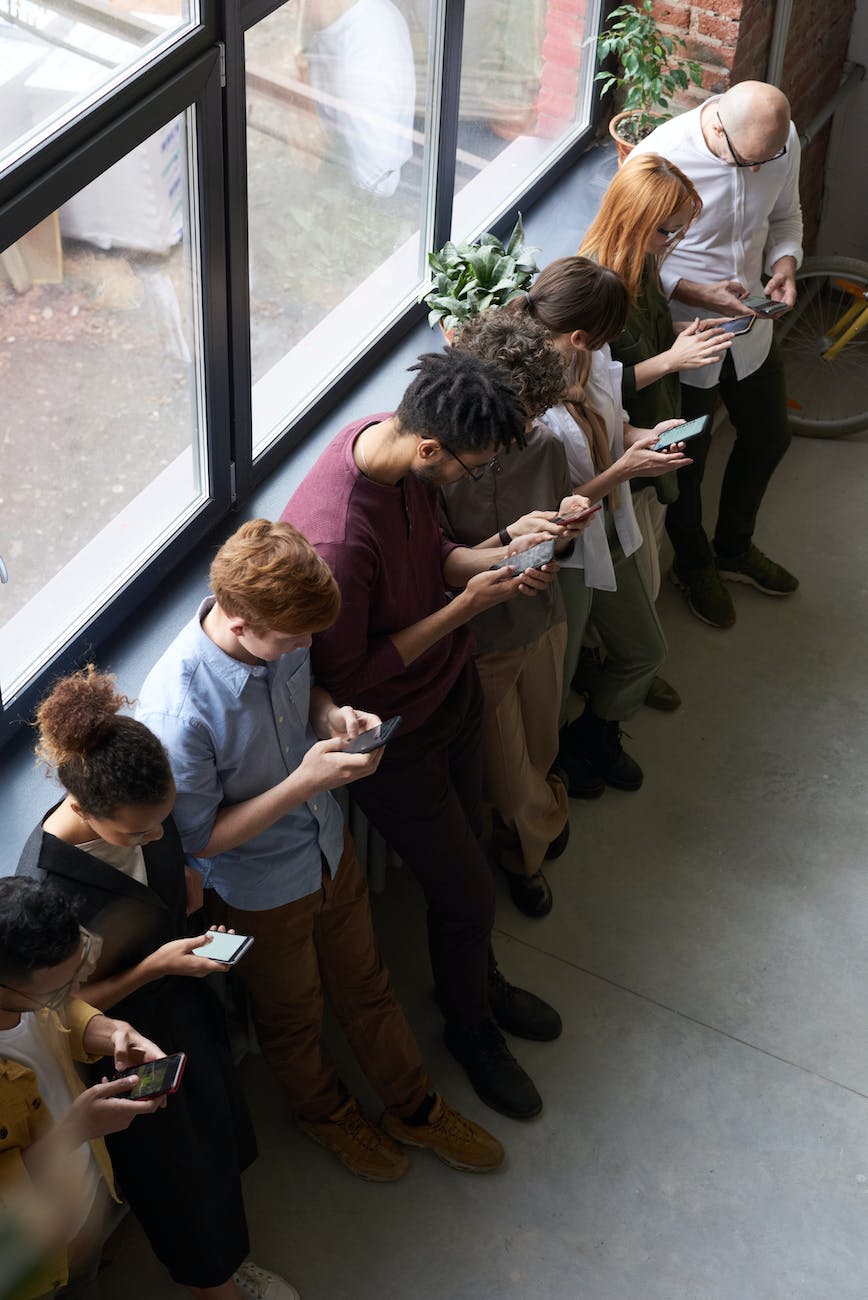
If you’re in your 30s or your 40s, and you’ve already built your clout and you’ve made your place in the world and you’re now being told you’re going to have to go start over somewhere else, you probably find that idea profoundly exhausting. But go talk to a 13-year-old. Are they exhausted by the idea that they’ll have to be online? No. They’re thrilled. Ask an 8-year-old what he wants to be when he grows up; he’s going to tell you he wants to be a YouTuber. Don’t sit here and tell me that the social web is over. The social web is being reborn, and I’m sorry that that makes you tired.
The global town square is dead. Long live 45 different global town squares.
Yes, and no one is brave enough to write that maybe it’s a good thing that now there are 16 different places to post. Weren’t we all supposed to be upset that there were these monolithic platforms and that we were all governed by their rules? We had no recourse if a content moderation decision went against us. Weren’t we supposed to be upset about the concentration of power? Well, now we have what we asked for. There is no longer a concentration of power in social networks. And so, instead of saying social networks have no future, I think the more interesting question to ask is: What is the future of these platforms that are being born?
The idea here is that the social media realm is fracturing into a lot of other smaller spheres. This has happened before in other media forms; television went through a time in the late 1990s and early 2000s where the number of channels and content expanded and audiences fractured or in print when texts were rare and controlled and then exploded with the printing press.
Something or some setting will likely arise for Americans to share their opinions if social media fails to play this role. But, whether it is a long-term space that hosts robust discussion as opposed to simply sharing thoughts is another matter.
Social media platforms are having a field day with microapartments and tiny homes like Mr. Marshall’s, breathing life into the curiosity about that way of living. The small spaces have captivated viewers, whether they are responding to soaring housing prices or to a boundary-pushing alternate lifestyle, as seen on platforms like the Never Too Small YouTube channel. But while there is no precise count on the number of tiny homes and microapartments on the market, the attention on social media has not necessarily made viewers beat a path in droves to move in, perhaps because the spaces sometimes can be a pain to live in…
Viewers of microapartment videos are like visitors to the Alcatraz Federal Penitentiary in San Francisco Bay who “get inside of a cell and have the door closed,” said Karen North, a professor of digital social media at the University of Southern California.
Social media users want to experience what it’s like at the “anomalously small end” of the housing scale, she explained…
Pablo J. Boczkowski, a professor of communications studies at Northwestern University, said that despite the belief that new technologies have a powerful influence, millions of clicks don’t translate into people making a wholesale lifestyle change.
Perhaps it will take a long term social media effort for people to adopt tiny homes? What could be curiosity at the beginning could become normalized as more and more people are exposed to popular images. If such tiny homes are still drawing a lot of views and engagement in a few years, could this add up to something?
Still, I would not be surprised if more tiny or smaller residences attract social media hits in the coming years. If under 100 or 200 square feet is too small, could more housing options at 200-500 feet prove attractive in real life and on smartphones?
In the early years of the new millennium, internet theorists and tech startups were fixated on the long tail, the idea, popularized by a 2004 Wired article and subsequent book, that on-demand manufacturing and digital distribution would disrupt the winner-take-all logic of monopoly capitalism and allow businesses to profit by making a nigh-infinite variety of products available to any audience, no matter how small. You could sell one book to a million people, but you could also sell them a million different books, especially once you were freed from the storage constraints of a brick-and-mortar store. The problem is that this theory, that “the future of business is selling less of more,” turned out to be, at least in some cases, almost exactly wrong. Faced with the internet’s overwhelming range of choices, people retreat to the familiar, or flock to the latest TikTok trend. In a 2018 study, researchers found that increasing the number of available movies by a mere 1,000 titles decreased the market share occupied by the bottom 1 percent of DVDs—the ones the long-tail effect should benefit most—by more than 20 percent. Faced with even more options, people just gave up entirely. “When instead of 20,000 DVDs you can choose from 50,000 or 100,000 or 1 million,” the study’s co-author, Wharton professor Serguei Netessine, explained, “what happens is demand for all movies goes down.”…
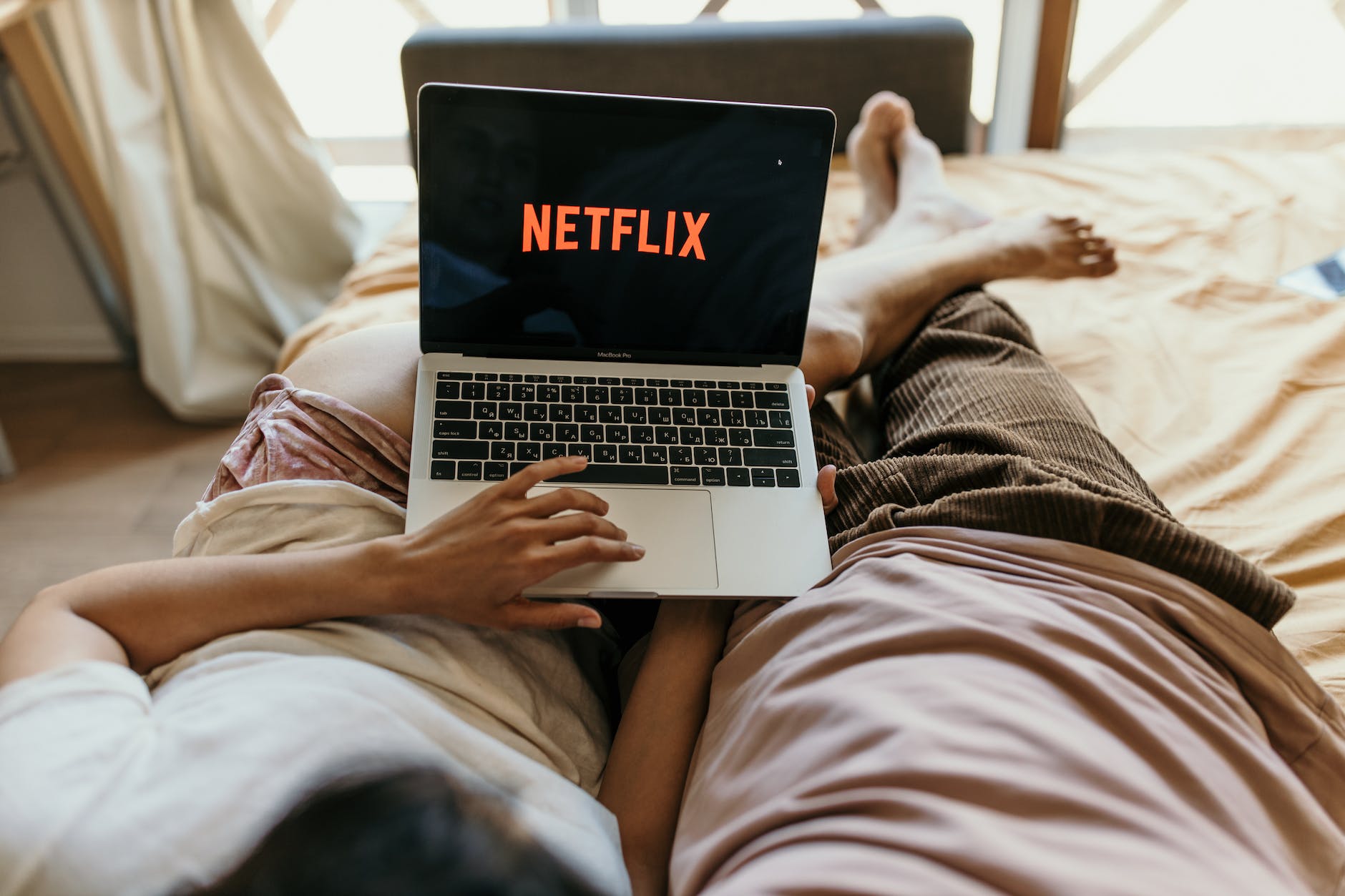
Netflix won’t say how many movies are on the service at any given time, but estimates put it at fewer than 4,000, less than a hundredth of the vast universe it once provided. Where Netflix’s disc-by-mail service promised you could watch anything you wanted, its streaming incarnation merely promises that you’ll always be able to watch something. In the DVD era, Netflix’s queue would not only show you what was available but what wasn’t—if a disc ended up lost or damaged, the title would be grayed out and it would sink to the bottom of the page. But if a title on your list leaves the site, as dozens do every month, it just disappears: off of Netflix, out of mind. I rarely look at my list at all these days, but when I do, I’m vaguely annoyed that it’s full of things I’ve already watched, as if one time through Army of the Dead wasn’t enough. It’s no longer an agenda, something to be meticulously arranged and checked off one item at a time. (The cinephiles have Letterboxd for that now.) It’s just a pile of stuff.
When Hollywood’s legacy conglomerates launched their own streaming services in 2020, they followed Netflix’s initial model: one low price for a mountain of content. For less than $10 a month, you could access every movie Disney ever made, plus all the Marvels and NatGeo specials you could stuff your eyeballs with. Twice that, and HBO Max would serve up a vast trove of Hollywood history, from Batman to Casablanca, not to mention Game of Thrones and Friends. But they followed Netflix’s arc at an accelerated clip. Two and a half years after HBO Max launched, it started pulling down titles by the fistful, and six months later, Disney+ and Hulu followed suit. “This whole idea of warehousing content on Max, on a streaming platform, in retrospect is incomprehensible,” the CFO of HBO’s parent company, Warner Bros. Discovery, recently told investors. “A small percentage of titles really drives the vast majority of viewership and engagement.” Any title outside that small percentage is at risk of being removed, and while a movie or a TV show that went off the air might once have still been available on disc at your local video store, now, not even the people who create the content own their own copies.
The unchecked sluice of streaming can make it seem like you’ll never run out of things to watch, but that doesn’t mean you can watch anything you want to. When the director William Friedkin died last month, many people were unpleasantly surprised to find his cult favorite To Live and Die in L.A. unavailable to stream at any price, even as a digital rental or purchase. The movie is available on Blu-ray, but while Netflix once had a copy in its library of discs, they didn’t in August. (My local library, at least, does.) In the streaming era, we’ve come to accept such artistic lacunae as a way of life, and if To Live and Die in L.A. isn’t available, you can still watch The Exorcist and The French Connection—not to mention Sorcerer and Cruising and Killer Joe. How much William Friedkin does one person need, anyway?
This sounds like the ongoing issue facing the culture industries: how do they know what will be a hit and which products generate the most interest and money? In the world of movies, TV shows, books, music, and similar media, it is hard to know what viewers, readers, and consumers might find worth their time. Thus, these industries produce hundreds and thousands of options each year. A small group will generate a lot of money and help make the rest of the production possible.
Netflix offered a different possibility: the ability to profit from the edges of the catalog. By being the place where movie viewers could find particular options, they could offer a unique product. Other Internet-based companies, such as Amazon, could offer similar opportunities.
But it sounds like Netflix does not think it profits enough from the long tail. The goal is to make a smaller catalog available and focus on finding the big hits. If this is the plan moving forward, the culture industries continue on a long term path: try to crack the code on what becomes a hit and funnel resources to similar products.
-The delayed start from a traffic light. Vehicles at the start of the line may not move for a few seconds after the light turns green, even when the path is clear. This slows down the rest of traffic, particularly when there are a lot of traffic lights in a row.
-The increased distance between vehicles. If drivers think they need more margin because they are not fully paying attention to the road, vehicles will be further spaced out.
-Not paying attention to directions or turns might mean people have to cut across lanes or make alternative paths.
Since traffic can act like waves, then even a slight disruption can have a ripple effect.
If all drivers took the “most efficient” or “fastest” routes according to their apps, would these hits to traffic be cancelled out?
It might also be worth remembering that one of the appeals of self-driving vehicles is that they could better address these issues. They could better safe themselves and adjust to changes in conditions around them.
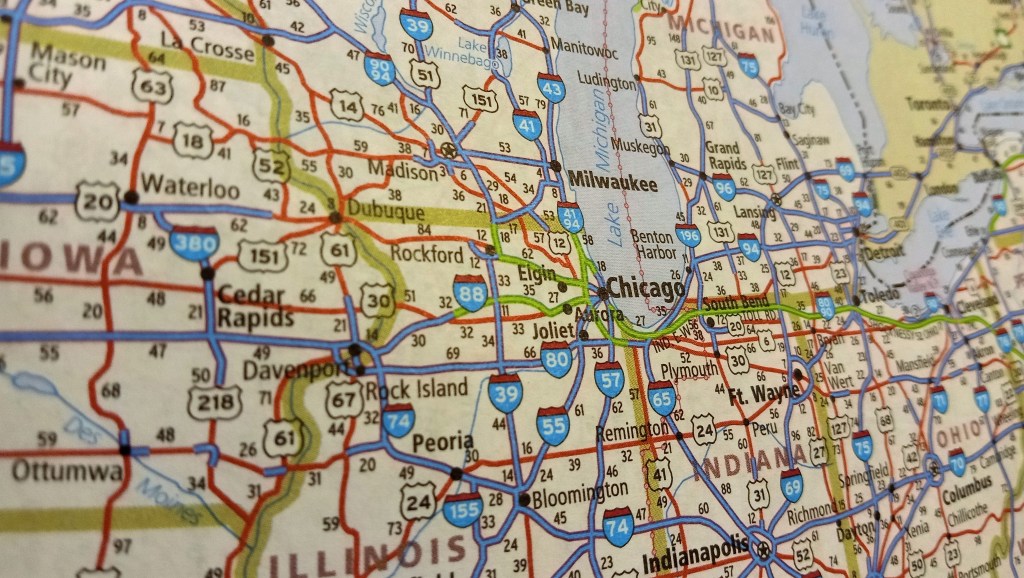
Apps are invaluable when you miss your exit on the interstate or need the quickest route through gridlock. But dispensing directions in 10-mile increments on a tiny screen is not the same as spreading a U.S. map out and visualizing a journey.
Everyone has a “mental map … made up of both factual information about a place and also our own understanding and imagination about the place,” Maitha said. Paper maps help build that mental map and provide spatial awareness, he explained.
All of these options are aids to help humans. With a paper map or Waze, the external object is helping a person make sense of the physical world around them. Our brains could use the help as we get our bearings.
My sense is that the digital devices are very helpful in immediate information – what is the next step I take? – but not so great in providing the big picture. You can see a list of turns or a broad map. But, their primary value is right in front of the vehicle. The paper atlas or road map provides the big picture while not saying as much about what is right outside the vehicle.
Just recently, I spent some time examining a 1718 map of North America made by a French cartographer. In working on some research involving these areas, the paper map provided a sense of how the French viewed this part of the world. It does not provide granular detail but it hints at what they thought was important.
Like some of the people interviewed in this article, I will keep both my atlas and my devices with me while driving. Until the device can unfold a larger image of the full scope of a journey, I want that option and will continue to enjoy maps and atlases.
Specifically, it has everything to do with LKFS, which stands for “Loudness, K-weighted, relative to full scale” and which, for the sake of simplicity, is a unit for measuring loudness. Traditionally it’s been anchored to the dialogue. For years, going back to the golden age of broadcast television and into the pay-cable era, audio engineers had to deliver sound levels within an industry-standard LKFS, or their work would get kicked back to them. That all changed when streaming companies seized control of the industry, a period of time that rather neatly matches Game of Thrones’ run on HBO. According to Blank, Game of Thrones sounded fantastic for years, and she’s got the Emmys to prove it. Then, in 2018, just prior to the show’s final season, AT&T bought HBO’s parent company and overlaid its own uniform loudness spec, which was flatter and simpler to scale across a large library of content. But it was also, crucially, un-anchored to the dialogue.
“So instead of this algorithm analyzing the loudness of the dialogue coming out of people’s mouths,” Blank explained to me, “it analyzes the whole show as loudness. So if you have a loud music cue, that’s gonna be your loud point. And then, when the dialogue comes, you can’t hear it.” Blank remembers noticing the difference from the moment AT&T took the reins at Time Warner; overnight, she said, HBO’s sound went from best-in-class to worst. During the last season of Game of Thrones, she said, “we had to beg [AT&T] to keep our old spec every single time we delivered an episode.” (Because AT&T spun off HBO’s parent company in 2022, a spokesperson for AT&T said they weren’t able to comment on the matter.)
Netflix still uses a dialogue-anchor spec, she said, which is why shows on Netflix sound (to her) noticeably crisper and clearer: “If you watch a Netflix show now and then immediately you turn on an HBO show, you’re gonna have to raise your volume.” Amazon Prime Video’s spec, meanwhile, “is pretty gnarly.” But what really galls her about Amazon is its new “dialogue boost” function, which viewers can select to “increase the volume of dialogue relative to background music and effects.” In other words, she said, it purports to fix a problem of Amazon’s own creation. Instead, she suggested, “why don’t you just air it the way we mixed it?”
This change in how television audio works contributes to needing subtitles to understand what is being said.
I wonder if the bigger question is whether this significantly changes how people consume and are affected by television. If we are reading more dialogue and descriptions, does this focus our attention on certain aspects of shows and not others? Could this be good for reading overall? Does it limit the ability of viewers to multitask if they need to keep up with the words on the screen? Do subtitles help engage the attention of viewers? Do I understand new things I did notice before in the world with fewer subtitles? Does a story or scene stick with me longer because I was reading the dialogue?
Does this also mean that as Americans have been able to buy bigger and bigger TVs for cheaper prices, they are getting a worse audio experience?
This has been possible with Photoshop and similar tools for years but Magic Eraser from Google makes it even easier: we can get rid of strangers in our photos. Should we?
My most Andy Rooney opinion, at least since the latest flare-up of the sleepover debate (I’m pro), is that we should not erase strangers from our family pictures. My original nuclear family’s albums, which my mother maintained in those classic 1980s scrapbooks with self-adhesive pages, annotating each image in her distinctive handwriting, are absolutely, positively chock-full of randos. When I was in elementary school, I loved to look at these pictures, hauling out two albums at a time and paging through them at our kitchen table. It was a time when I was becoming acutely aware of the difference between our family and others—not in a bad way, but in an interested one. We lived in a small town, and our family vacations gave us information about how things were elsewhere. I wasn’t going to pass up analyzing those clues.
The people we are around are also parts of our lives, even if we do not know them. To take pictures in public often means that others are present. We may not interact with them but we do not live in a world where we have our own bubbles and no one else is around.
There may be occasional times where removing strangers makes sense. Perhaps we want to focus on particular people or a particular scene. But, doing this at a larger scale always puts us at the center and makes it appear as other people do not exist.
Is this a continuation of the emphasis on the individual self? Social media, which is linked to the images we take, see, and use today, also encourages emphasizing ourselves. In images and a world where there is no one portrayed around us, we are at the center.
A future world where our pictures only feature us makes me think of Black Mirror or an extended global pandemic where streets and public places are empty. It would be a loss of our collective memories and the ways that we rely on nameless others every day.
I get why. It is indeed tempting. The kids are running around and occupied. Their activity means that parents might have a few moments to themselves. The park often has benches or places to relax. Why not catch up on some texts or social media activity?
Even without kids around, parks feature plenty of phone use. Walk the dog and read the phone along the way. Try biking and phone use together. Lots of walking with earbuds in or headphones on.
However, parks can be inherently interesting places without phones. Kids are learning and developing skills. There are often hints of nature around, birds to spot, bodies of water to observe. There is plenty of people-watching to be done. If the park is a lively one, perhaps one envisioned by Jane Jacobs where people are using it in multiple ways and it is situated among other interesting uses, there is plenty to see and do.
(To be fair, adults are on their phones all over the place. I have just noticed it recently in parks amid my own efforts to use my phone less in this setting.)
Los Angeles-based car YouTuber effspot stumbled across something we’ve heard about but haven’t been able to dig up solid evidence of: dealerships are hiding a ton of new inventory in secret locations. Now you might think these dealers are putting their overstock vehicles in some secure location like a warehouse or locked lot, and some definitely are, but effspot found hundreds of Jeeps, Dodges, Rams, and Chryslers stashed in a public parking garage, all apparently put there by just one dealership.
This is a potentially interesting find. How common is this?
Dealerships have been running this scheme for months and months, but it’s starting to fall apart despite some media outlets trying to claim there may be no return to normal for the car market. Instead, both the new and used markets are going in only one direction: down. Just how quickly and by how much remains to be seen, but don’t believe car dealerships have hardly any vehicles and need to overcharge you big time for the privilege of new car ownership.
So we go from one parking garage is “dealerships have been running this scheme for months and months”? Roughly 51 seconds into the YouTube video, the maker says “these dealerships, or at least this particular dealership” has engaged in these practices. Later, at 5:52, he asks whether this is happening around the country.
This does not necessarily mean the larger argument is not true. But, the evidence presented here shows one parking garage and cars from one dealer. How broad is this practice? We do not know from this video and story.
This might just be the daily story of the Internet and social media. Interesting things are posted. Information is shared. People describe their experiences. But, it is difficult to know how this matches larger patterns or not. An individual reader might be able to make connections across stories. Or, people online could connect the dots for others. For example, others could make videos on YouTube detailing their finds of auto inventory in different locations. Sometimes these connections are made, often they are not. The next day comes and there is more information to process and relatively little that helps fit all the pieces together.
The connection is not just the Internet and social media and the way they connect us to more people and narratives. This is a change in statistics: we think we can see larger patterns and we can access more information.
Whether what we see on social media is a real pattern might not matter. (A reminder: relatively few people are active on Twitter.) We see more online and we can see what people are highlighting. This might appear as a pattern.
Not too long ago, we were more limited in our ability to compare our actions to others. The mass media existed but in more packaged forms (television, radio, music, films, newspapers, etc.) rather than the user-driven content of social media. The comparisons to that mass media still mattered – I remember sociologist Juliet Schor’s argument in The Overspent American of how increased TV watching was related to increased consumption – but people’s ties to their family and friends in geographic proximity were likely stronger. Or, in Robert Putnam’s Bowling Alone world, people spent a lot more time in local organizations and groups rather than in the broad realms of the Internet and social media.
Now, we can easily see how our choices or circumstances compare to others. Even odd situations we find ourselves in quickly be matched across a vast set of platforms for similarities and differences. Whether our tastes are mainstream or unusual, we can see how they stack up. If I am on college campus X on one side of the country, I can easily see what is happening on college campuses around the world.
Even as the Internet and social media is not fully representative of people and society, it does offer a sample regarding what other people are doing. We may care less about what the people directly near us are doing and we can quickly see what broader groups are doing. We can live our everyday lives with a statistical approach: look at the big N sample and adjust accordingly.