Q: Speaking of “SNL,” that famous sketch for Chris Farley you wrote, about him living in a van down by the river — were you writing with Naperville in mind?
A: There is the DuPage River, and when I was writing that I did picture the bridge in Naperville over the DuPage. It was a bridge for stoners when I was a kid. Stoner kids hung out there. So this guy parking his van by a river — yes, that was the image I had.
There are several bridges Odenkirk could be referring to. Could it be this bridge (in a picture from nearly a decade ago)? This is a little removed from the busier downtown area and the more manicured areas of the lively Riverwalk.
Naperville has a reputation as a wealthy and large suburb with a thriving downtown and numerous high-status jobs. Does the image of a guy living in a van down by the river fit this or kids smoking pot by the DuPage River? Probably not and the city in recent years was not interested in marijuana dispensaries.
I cannot imagine a statue of Matt Foley near the DuPage River in downtown Naperville among the suburb’s collection of public art...but perhaps Odenkirk could eventually make the cut?
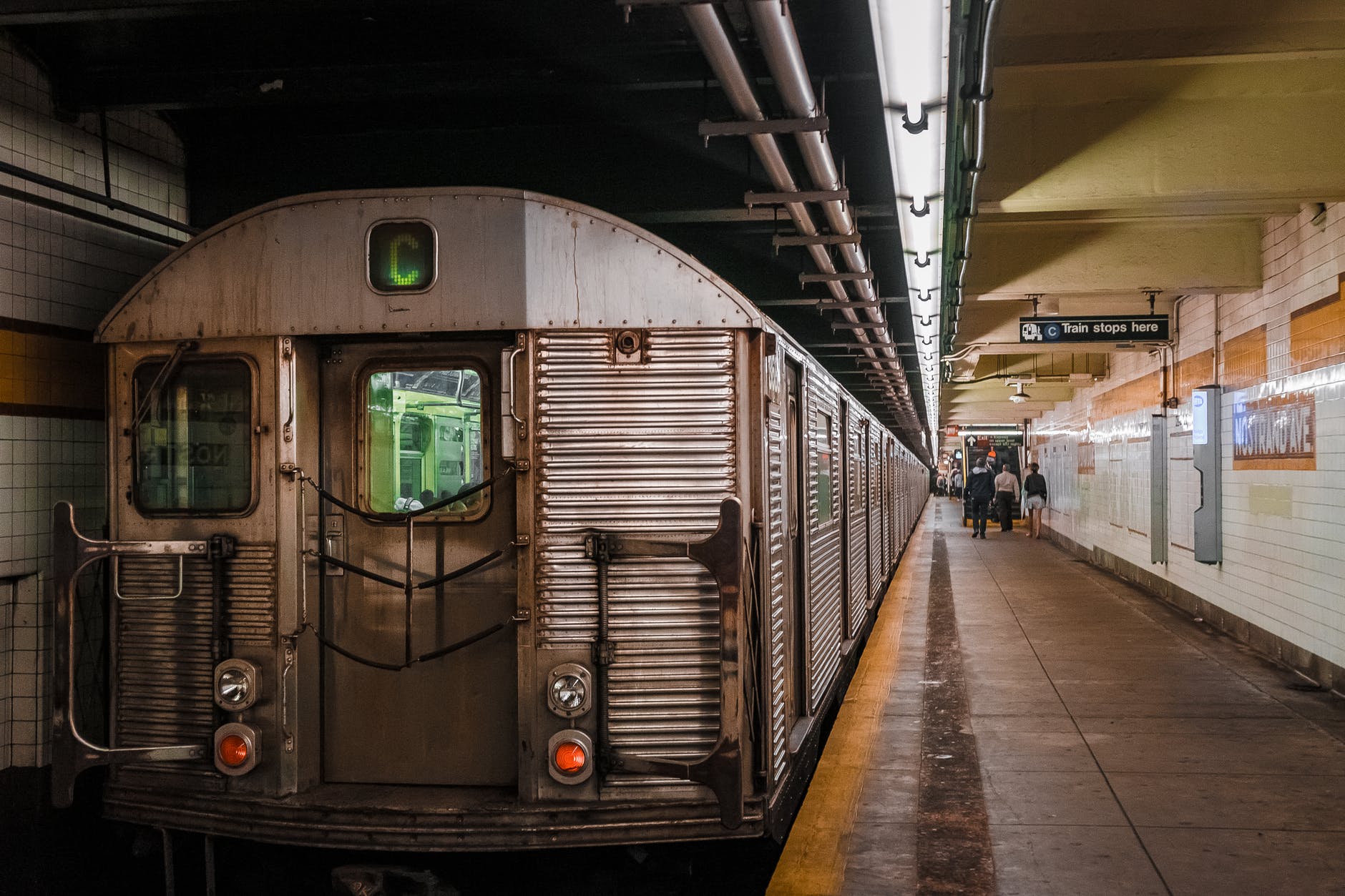
The good news is the city finally has plans to restore 11 blocks of Park Avenue north of Grand Central to a semblance of its former glory, Bloomberg reports, expanding the median from a useless 20 feet to a potentially-rejuvenating 48 feet. That redesigned street could include bike paths, walking paths, and generally more space for things other than cars or pretty things for people in cars to look at as they drive by.
The bad news is many if not most of the people currently living and working in New York will not be around to enjoy it once it’s done. It will take 20 years to redesign these 11 blocks, according to the city’s Department of Transportation. Yes, you read that right. The project to redesign 11 blocks of a Manhattan street will not be completed until 2042.
But there is no mistake, according to both DOT and Kaye Dyja, Powers’s spokesperson. As Dyja explained, “The reason the construction is going to take a long time is because they’re improving the underground railroads leading to Grand Central, as well as redoing the ‘train sheds.’ This entails that they’re digging up the ground, so the construction will have to take place in stages which will end up taking many years to complete.”
The project Dyja is referring to is a massive $2 billion renovation of the Metro North infrastructure underneath Park Avenue from Grand Central to 57th Street. Park Avenue is a bridge over those tracks, and like many of the U.S.’s bridges, this one is falling apart, too. The project will involve ripping up sidewalks and the median of Park Avenue a couple blocks at a time, going section by section, down the stretch of Park Avenue. It is expected to cause more or less permanent disruption to the Midtown East area, to varying degrees, over the next two decades.
As a kid, I remember reading books with cross-sections of underground Manhattan. Seeing all of that infrastructure needed for modern urban life – pilings for skyscrapers, subways, water pipes and sewers, etc. – was fascinating.
The flip side of that is the work it takes to make significant changes to such a system. It takes time (and money) to work around what is there and complete the work.
The time is one factor but I wonder about how the budgets will work over a 20 year period. Large American infrastructure projects can have a tendency to stretch in terms of time and budget as the work is underway.
I would love to say I will check in on this in twenty years but that is a long commitment…
The streetcar system is no more with numerous works discussing how it was dismantled amid a push for cars and highways. But, the video is a reminder that cars and streetcars operated together for at least a while as the city and region grew quickly. Both provided opportunities to travel throughout the area and utilized the same roadways.
It is also interesting how such altered videos – here with color and sound added – have the opportunity to change perceptions of the past. When even relatively recent history is displayed in black and white, it seems less vibrant and real. Throw in approximate sound and such video could help viewers feel as if they are back in Los Angeles nearly a century ago.
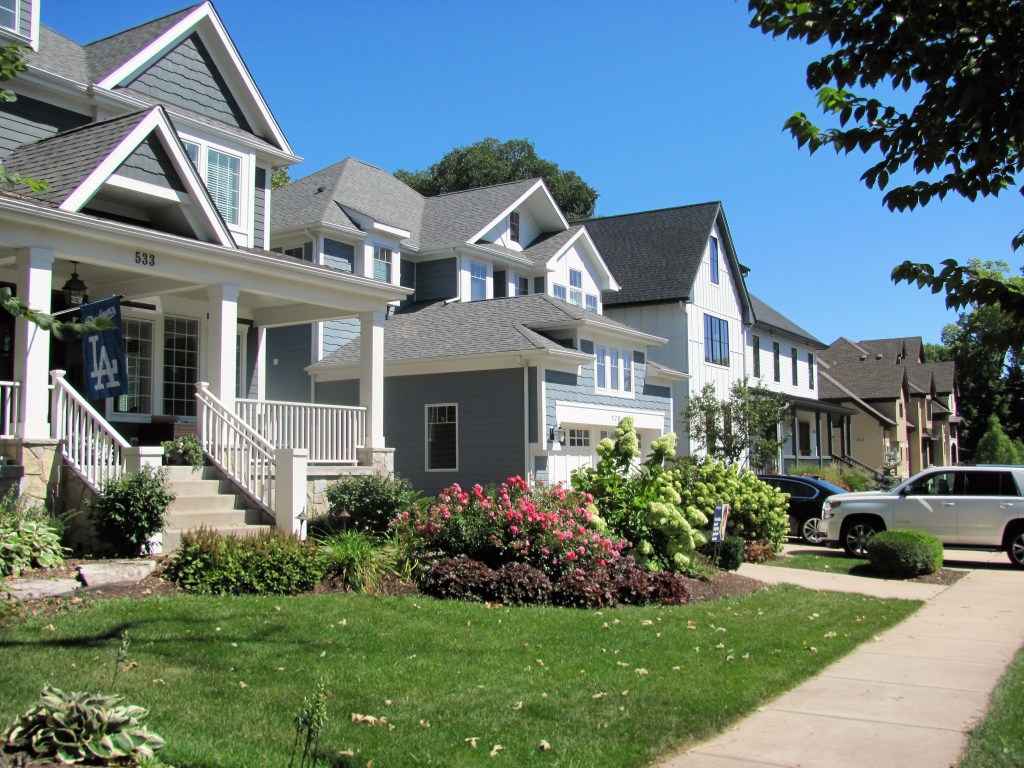
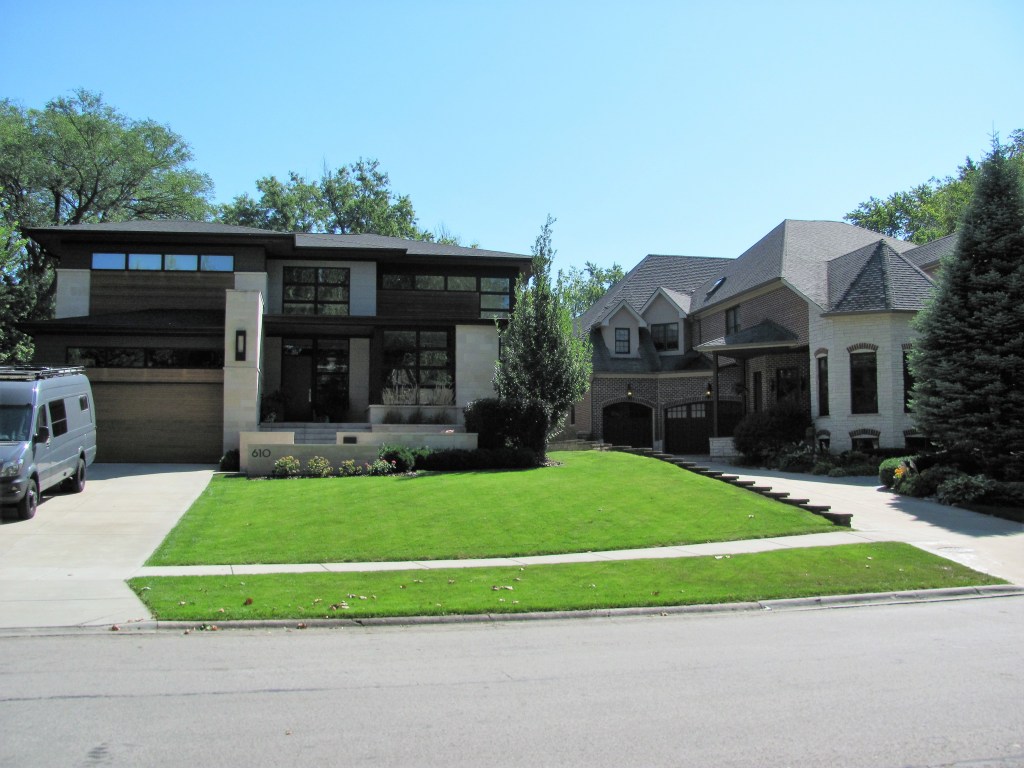
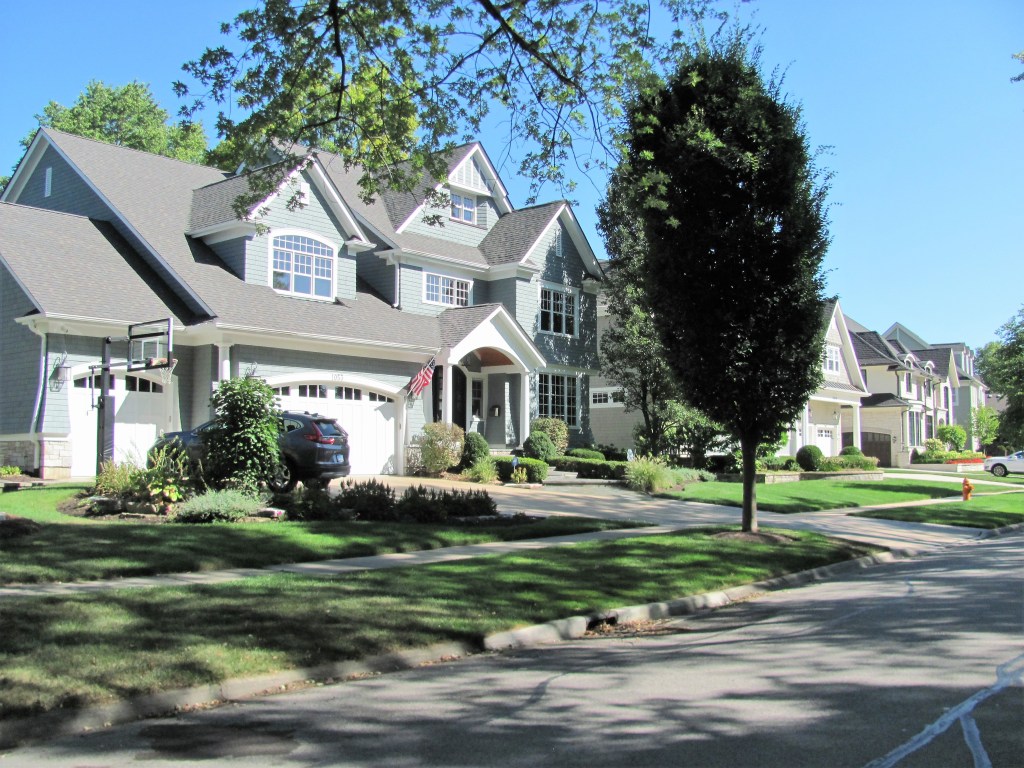
Analyzing before and after images of 349 teardowns between 2008 and 2017 in the wealthy and sprawling suburb of Naperville, Illinois, shows patterns in aesthetic choices and their fit in older neighbourhoods. First, the teardowns are significantly larger and have different features including larger garages and more windows. Second, over 60% of the teardowns feature Victorian styling. Third, the teardowns are often next to other teardowns in desirable neighbourhoods near the suburb’s vibrant downtown. These visual findings show how teardowns that add to the housing stock often imitate common architectural styles yet exhibit disparate features compared to older neighbouring homes.
All three of these streams helped lead to this project. And there is a lot more that could be done in this area as teardowns affect numerous neighborhoods and communities in the United States.
Housing activists and lawyers filed a complaint over aldermanic prerogative with HUD in 2018, alleging that allowing aldermen de facto veto power over most development proposals in their wards promotes housing discrimination by keeping low-income minorities from moving into affluent white neighborhoods.
The complaint against the city alleges that “aldermanic prerogative” helps residents who fear racial change pressure aldermen to block affordable housing projects by publicly raising concerns over school overcrowding, declining property values and other “camouflaged racial expressions.”
HUD officials continue investigating the matter and sent a letter to aldermen Dec. 1 asking them a series of questions about aldermanic prerogative, including how they define the term.
This reminded me of how aldermen helped shape the locations of public housing projects after World War Two. From the Encyclopedia of Chicago:
When Congress passed the Housing Act of 1949, which provided substantial funding for public housing, CHA was ready with a map of proposed sites for projects to be built on open land throughout the city, but the city council rejected this map altogether. White aldermen rejected plans for public housing in their wards. CHA’s policy thereafter was to build family housing only in black residential areas or adjacent to existing projects. This rejection explains the concentration of public housing in the city center on the South and West Sides.
In a city marked by residential segregation, numerous methods for keeping Black residents out of white neighborhoods, and white flight away from the city, the protection of certain areas has been a major emphasis. Affordable housing and public housing are typically viewed as unattractive land uses in whiter and wealthier communities with residents and leaders expressing concerns about property values, safety, and other matters with a sometimes stated and sometimes not underlying factor of race and ethnicity.
A decade ago, Austin, the capital of Texas often deemed a liberal oasis in a staunchly conservative state, was among the most affordable places to live. Now, according to a forecast prepared by Zillow, a real estate company that tracks affordability, the Austin metropolitan area is on track to become by year’s end the least affordable major metro region for homebuyers outside of California. It has already surpassed hot markets in Boston, Miami and New York City…
Home sale prices in the city of Austin skyrocketed to a record median of $536,000 in October, up from about $441,250 a year ago. And they have more than doubled since 2011, when the median sales price was $216,000, according to the Austin Board of REALTORS, a trade group. Rentals, too, have surged, with the average cost of an 864-square-foot apartment now $1,600.
Much of this article addresses the effects on the city and residents. The rapidly rising costs have consequences for many.
Thinking beyond this particular city, I wonder at the convergence of people, business, and real estate in the last decade in one city and region. Particular communities, including cities and suburbs, have experienced this before during boom times. Is Austin’s case unique or is it simply the latest American community to go through such growth? Austin has a unique mix of tech industry, cool culture, it is the capital of an important state and home to the flagship university in the state system, and once had cheaper housing.
At some point, the pace will slow down in Austin. This could happen because of the rising real estate values or other factors. What community and region is next? Based on what made Austin successful, I could venture some guesses. The first places that come to mind are on Richard Florida’s lists of creative class havens in The Rise of the Creative Class. Or, perhaps the tech industry gathers in a new yet unlikely location that offers similar advantages.
“Reaching a new record median sale price at $7,475,000, Atherton’s 94027 remains the #1 most expensive zip code in the U.S. for the fifth consecutive year — nearly $2 million ahead of the runner-up,” the real estate property firm said in a news release. “Not only that, but the billionaire favorite also saw its median rise 7% year-to-year, suggesting that this exclusive enclave may continue to retain its leading position in the future.”…
The list of the ten most expensive zip codes includes several locations in the Bay Area, one in the Boston area, one outside New York City, one in Miami, several in southern California, and one outside Seattle. These are not surprising given the money in such locales plus the high real estate values in these markets.
At the same time, the Atherton zip code stands out. The housing is almost $2 million higher than other desirable locations. This does not necessarily it has the most expensive properties in the United States but it does speak to the uniformity across the zip code. And this has been the most expensive zip code for five years running. There is consistency which could be related to development activity (or a lack thereof), demand for housing in that particular place, and local regulations and zoning.
Even as numerous scholars have studied the concentration of poverty in certain locations or gentrification and changes in particular locations, I have not read as much on the concentration of wealth. How often does top-end wealth change locations? I would guess at least some of the zip codes in the top ten have been significantly wealthy for a long time. However, locations can change, new industries arise, and capital can move and real estate fortunes change. How different would a similar list be several decades ago or a century ago in the United States?
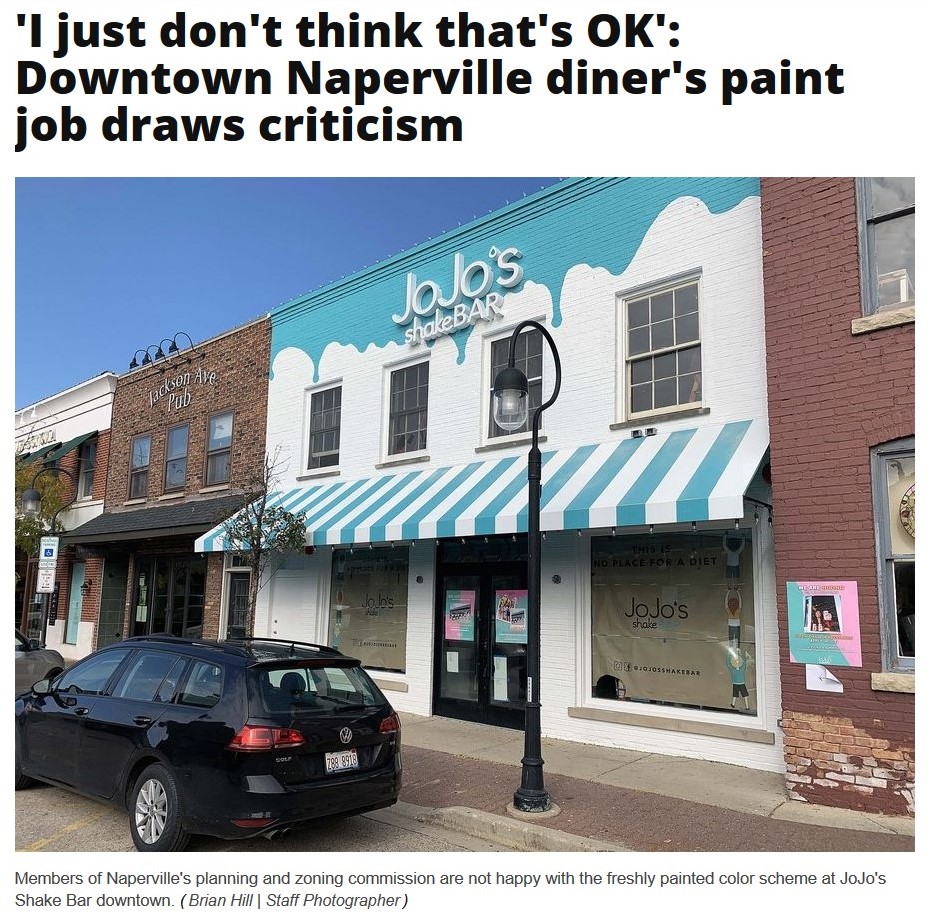
Members of the city’s planning and zoning commission gave a chilly reception to the freshly painted exterior at JoJo’s, a self-described “next generation diner” with milkshakes, milk and cookie flights and diner classics that’s scheduled to open this month at 5 Jackson Ave.
But because JoJo’s adhered to city codes regarding its main color choice and the amount of accent color it used, there’s not much the commission or the city can do except possibly ask JoJo’s to change the facade and create stricter guidelines for the future…
Behind white raised letters reading “JoJo’s Shake Bar” is a turquoise background stretching across the two-story building that looks like dripping ice cream extending down past the top of the second-floor windows.
Commission members said a uniform block of turquoise across the top would have been acceptable. They believe the dripping effect, however, isn’t appropriate for downtown Naperville…
The issue came up at the end of Wednesday’s meeting when Commissioner Anthony Losurdo said he saw the facade while driving by, labeling it a “sore thumb.” Stressing he wouldn’t have approved the look had it been subject to a vote, Losurdo said he has received complaints about the paint scheme from residents.
Many communities have guidelines for signs and facades. This helps create a more uniform look, ensures that no single property sticks out too much from others, and can limit concerns from nearby residents (such as signs that are too bright or too big). The aesthetics help contribute to an overall character the community wants to promote.
Naperville’s downtown is important for the community. With its revival in recent decades, the city is proud of the bustling business and social activity downtown. It wants to both nurture and protect that for the future. The downtown helps the community stand out from other suburbs and generates revenue.
So, protecting the look of downtown buildings makes sense. On the other hand, concerns about this new business could send out other signals. It sounds like JoJo’s followed existing guidelines. The end result may not be what some leaders and residents desire but it was within regulations. This commission is supposed to talk about issues like these; their task is to see how properties align with the city’s guidelines. The regulations can be changed to prevent such outcomes.
Even having an article with a headline like this might contribute to perceptions that Naperville is a snobby place. The appearance of dripping paint is a big problem for the community? Does a negative reaction welcome the new business? Is it helpful to have these conversations through a local newspaper?
It is unclear how many people and leaders in Naperville have concerns with the paint job. Will it soon be changed and/or the regulations updated to avoid a similar case? Or, can one building stand out a little in a successful downtown?
Small U.S. cities dominated The Wall Street Journal/Realtor.com Emerging Housing Markets Index in the third quarter, as high housing costs and remote-work opportunities drive many home buyers to seek out more living and outdoor space…
Elkhart, Ind., which bills itself as the RV capital of the world because its region is the country’s leading manufacturer of recreational vehicles, topped the housing index this quarter, followed by Rapid City, S.D., Topeka, Kan., Raleigh, N.C., and Jefferson City, Mo…
The recreational-vehicle industry is a major player in Elkhart’s economy. The Covid-19 pandemic spurred more RV demand, as households wanted to travel while keeping their distance from others. Wholesale RV shipments in the first eight months of 2021 rose 53.8% from the same period in 2020, according to the RV Industry Association…
The median home-sale price in Elkhart County rose 12.3% in August from a year earlier to $209,900, according to the Indiana Association of Realtors. There were 163 homes for sale that month, down from 220 a year earlier.
I am glad that Elkhart appears to be doing well at the moment. Having lived nearby for five years, the area has a lot to offer and economic development would be welcomed.
At the same time, it was not so long ago that Elkhart faced a difficult time. When the economy is not doing so well, such as in the late 2000s with a burst housing bubble, fewer people had money for RVs. Demand shrunk. Jobs disappeared. Before that, this area and South Bend were home to numerous manufacturers who went out of business or left. The homes have been cheaper here for a long time because few people want to move in.
It is good that this community in the Rust Belt at least has the opportunity to at times benefit from upticks in RV sales. Such industries and jobs could leave completely. But, having so many fates tied to one industry that can go up and down is trying in the long run. Numerous communities in the United States have looked to diversify their economic base – see the recent rush to add tech companies to their portfolios – even as they might have local economies based around a few companies or a few sectors. RVs may sell well one day and then conditions change and demand drops or new technology moves in. May Elkhart take some of this positive momentum and add to lineup of industries and services.
Overall, the city’s population increased by about 50,000 during that decade. But aside from those top 10 communities — which are found mostly on the North Side or near downtown — the rest of the city actually declined in population by more than 40,000 people.
WBEZ conducted an analysis of growth in Chicago community areas within the past decade, examining growth in population, new construction permits, jobs, and licenses issued to new businesses. The analysis showed that majority-white communities, collectively, experienced high growth in all areas: population, jobs, new construction and new businesses. The same was true for areas experiencing significant growth in white population, like the Near West Side and the Near South Side…
When compared with majority-Black and majority-Latino communities, and communities with no majority racial or ethnic group, majority-white communities also had higher rates of job growth, new construction and new businesses…
“Race is a big factor in the growth and development and revitalization in Chicago communities,” said Saunders, who studies Rust Belt cities and urban dynamics. “It’s a big factor that many people do not want to acknowledge.”
Such disparities across Chicago neighborhoods and the role of race are not new. The 77 community areas and how many neighborhoods have had different reputations and resources available. For decades, Chicagoans have celebrated how these different communities can have a common identity while knowing that this did not mean they were treated the same.
And this is not an issue limited to Chicago or just big cities. Uneven or unequal development is a prominent feature of communities in our current system. Within metropolitan regions, some suburbs are wealthy and continue to accrue residents and businesses (see the example of Arlington Heights in the Chicago news) while others struggle. These patterns often follow race-based settlement patterns and residential segregation.
This could be a critically important issue for the twenty-first century: how to encourage development and growth within places that historically have not attracted residents or capital. Without significant interventions, these patterns do not easily change.



 Legally Sociable