Design standards, paint, and appearances in a suburban downtown

A new business in downtown Naperville chose a different paint job compared to nearby establishments and this led to some discussion:

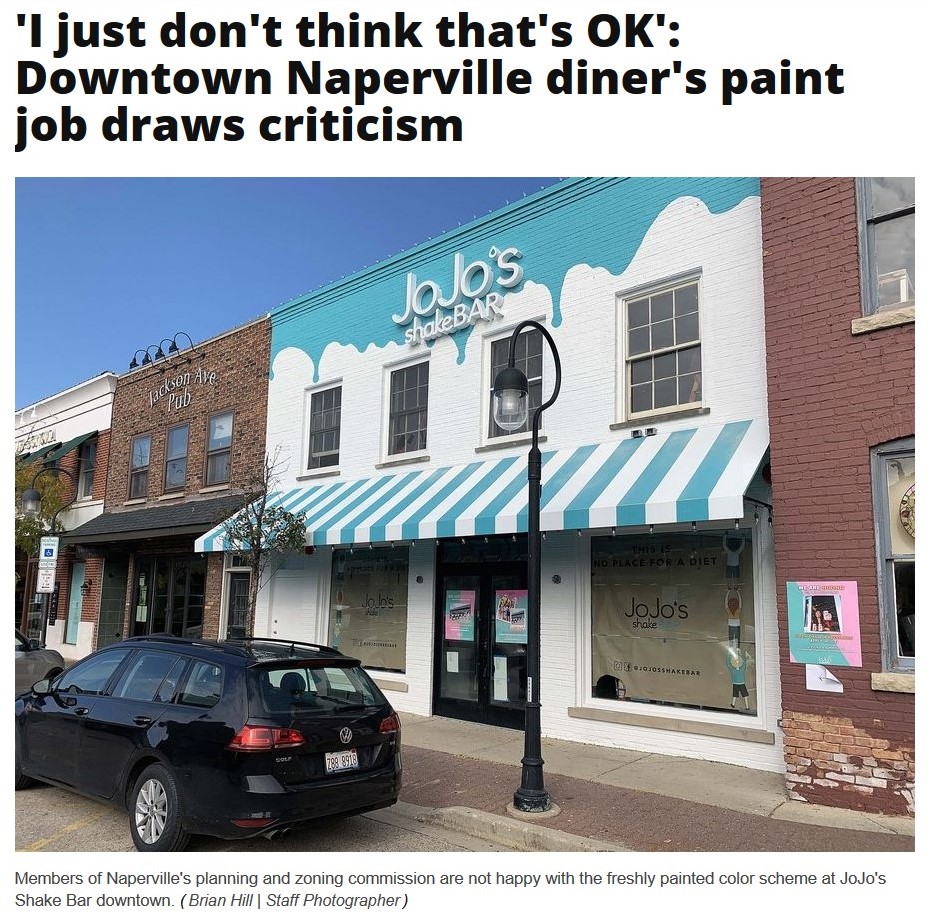
Members of the city’s planning and zoning commission gave a chilly reception to the freshly painted exterior at JoJo’s, a self-described “next generation diner” with milkshakes, milk and cookie flights and diner classics that’s scheduled to open this month at 5 Jackson Ave.

But because JoJo’s adhered to city codes regarding its main color choice and the amount of accent color it used, there’s not much the commission or the city can do except possibly ask JoJo’s to change the facade and create stricter guidelines for the future…

Behind white raised letters reading “JoJo’s Shake Bar” is a turquoise background stretching across the two-story building that looks like dripping ice cream extending down past the top of the second-floor windows.

Commission members said a uniform block of turquoise across the top would have been acceptable. They believe the dripping effect, however, isn’t appropriate for downtown Naperville…

The issue came up at the end of Wednesday’s meeting when Commissioner Anthony Losurdo said he saw the facade while driving by, labeling it a “sore thumb.” Stressing he wouldn’t have approved the look had it been subject to a vote, Losurdo said he has received complaints about the paint scheme from residents.

Many communities have guidelines for signs and facades. This helps create a more uniform look, ensures that no single property sticks out too much from others, and can limit concerns from nearby residents (such as signs that are too bright or too big). The aesthetics help contribute to an overall character the community wants to promote.

Naperville’s downtown is important for the community. With its revival in recent decades, the city is proud of the bustling business and social activity downtown. It wants to both nurture and protect that for the future. The downtown helps the community stand out from other suburbs and generates revenue.

So, protecting the look of downtown buildings makes sense. On the other hand, concerns about this new business could send out other signals. It sounds like JoJo’s followed existing guidelines. The end result may not be what some leaders and residents desire but it was within regulations. This commission is supposed to talk about issues like these; their task is to see how properties align with the city’s guidelines. The regulations can be changed to prevent such outcomes.

Even having an article with a headline like this might contribute to perceptions that Naperville is a snobby place. The appearance of dripping paint is a big problem for the community? Does a negative reaction welcome the new business? Is it helpful to have these conversations through a local newspaper?

It is unclear how many people and leaders in Naperville have concerns with the paint job. Will it soon be changed and/or the regulations updated to avoid a similar case? Or, can one building stand out a little in a successful downtown?

The boom and bust RV cycles of Elkhart

The latest rankings in the Emerging Housing Markets Index has Elkhart, Indiana at the top of the list:

Photo by Kampus Production on Pexels.com

Small U.S. cities dominated The Wall Street Journal/Realtor.com Emerging Housing Markets Index in the third quarter, as high housing costs and remote-work opportunities drive many home buyers to seek out more living and outdoor space…

Elkhart, Ind., which bills itself as the RV capital of the world because its region is the country’s leading manufacturer of recreational vehicles, topped the housing index this quarter, followed by Rapid City, S.D., Topeka, Kan., Raleigh, N.C., and Jefferson City, Mo…

The recreational-vehicle industry is a major player in Elkhart’s economy. The Covid-19 pandemic spurred more RV demand, as households wanted to travel while keeping their distance from others. Wholesale RV shipments in the first eight months of 2021 rose 53.8% from the same period in 2020, according to the RV Industry Association…

The median home-sale price in Elkhart County rose 12.3% in August from a year earlier to $209,900, according to the Indiana Association of Realtors. There were 163 homes for sale that month, down from 220 a year earlier.

I am glad that Elkhart appears to be doing well at the moment. Having lived nearby for five years, the area has a lot to offer and economic development would be welcomed.

At the same time, it was not so long ago that Elkhart faced a difficult time. When the economy is not doing so well, such as in the late 2000s with a burst housing bubble, fewer people had money for RVs. Demand shrunk. Jobs disappeared. Before that, this area and South Bend were home to numerous manufacturers who went out of business or left. The homes have been cheaper here for a long time because few people want to move in.

It is good that this community in the Rust Belt at least has the opportunity to at times benefit from upticks in RV sales. Such industries and jobs could leave completely. But, having so many fates tied to one industry that can go up and down is trying in the long run. Numerous communities in the United States have looked to diversify their economic base – see the recent rush to add tech companies to their portfolios – even as they might have local economies based around a few companies or a few sectors. RVs may sell well one day and then conditions change and demand drops or new technology moves in. May Elkhart take some of this positive momentum and add to lineup of industries and services.

Uneven development by neighborhood continues in Chicago

Examining both population change and development activity across Chicago neighborhoods between 2010 and 2020 reveals stark differences:

Photo by Trace Hudson on Pexels.com

Overall, the city’s population increased by about 50,000 during that decade. But aside from those top 10 communities — which are found mostly on the North Side or near downtown — the rest of the city actually declined in population by more than 40,000 people.

WBEZ conducted an analysis of growth in Chicago community areas within the past decade, examining growth in population, new construction permits, jobs, and licenses issued to new businesses. The analysis showed that majority-white communities, collectively, experienced high growth in all areas: population, jobs, new construction and new businesses. The same was true for areas experiencing significant growth in white population, like the Near West Side and the Near South Side…

When compared with majority-Black and majority-Latino communities, and communities with no majority racial or ethnic group, majority-white communities also had higher rates of job growth, new construction and new businesses…

“Race is a big factor in the growth and development and revitalization in Chicago communities,” said Saunders, who studies Rust Belt cities and urban dynamics. “It’s a big factor that many people do not want to acknowledge.”

Such disparities across Chicago neighborhoods and the role of race are not new. The 77 community areas and how many neighborhoods have had different reputations and resources available. For decades, Chicagoans have celebrated how these different communities can have a common identity while knowing that this did not mean they were treated the same.

What may be newer is that this issue has received more attention in recent years. Former Mayor Rahm Emanuel was criticized for efforts directed at downtown and wealthier areas. He was Chicago’s leader for a good portion of the decade. Chicago remained an important global city, but those benefits did not reach all residents or neighborhoods. Many called for this to change.

And this is not an issue limited to Chicago or just big cities. Uneven or unequal development is a prominent feature of communities in our current system. Within metropolitan regions, some suburbs are wealthy and continue to accrue residents and businesses (see the example of Arlington Heights in the Chicago news) while others struggle. These patterns often follow race-based settlement patterns and residential segregation.

This could be a critically important issue for the twenty-first century: how to encourage development and growth within places that historically have not attracted residents or capital. Without significant interventions, these patterns do not easily change.

Arlington Heights and many other suburbs: looking for downtown redevelopment and independence from the big city

With the possibility of a Chicago Bears stadium in the suburb of Arlington Heights, Illinois, the Chicago Tribune profile of the community highlights changes in the suburb:

More than 150 years ago, the 19th-century farming community’s prosperity was inextricably tied to its proximity to the railroad line, which served as a trading hub bolstering the town’s agrarian economy. By the 1920s, the community would become home to professionals boarding commuter trains headed to and from the city.

Despite many of those residents working at home these days as a result of the pandemic, the Union Pacific Northwest line dissecting the village of 77,000 residents is still viewed as an economic engine. But Arlington Heights is no longer beholden to the fortunes of Chicago, making the prospect of a Bears stadium in town interesting, yet not essential…

Embracing change has been a recipe for success for the revitalization of downtown Arlington Heights, which like central business districts across the U.S., was languishing in the 1970s and ’80s after mom and pop businesses were devastated by shopping malls and big-box stores, said Charles Witherington-Perkins, the village’s director of planning and community development…

To build the Arlington Heights of today, crafting a new downtown master plan was only the first step. In order to execute the vision, officials needed to loosen building height and density restrictions — stringent regulations that were making it impossible to create an economically and aesthetically vibrant downtown, Witherington-Perkins said…

The contingent of new residents arriving in Arlington Heights — many of whom were commuters attracted to the complex’s proximity to the Metra station — ushered in a surge of downtown residential and retail development that has served as a model for neighboring communities along the Metra line.

Take out the name of Arlington Heights and a few other regional details, and this story might be told for dozens of suburbs in the Chicago region as well as dozens more outside of older American big cities. Here are a few of the common features:

  1. A founding before mass suburbanization. Communities were small, farming was a primary industry, and the railroad was very important for the initial mass of people at that spot.
  2. Mass suburbanization of the twentieth century brought many residents and changes.
  3. Revitalizing suburban downtowns became a priority in the last four decades as competition from shopping malls and strip malls moved business activity away.
  4. This revitalization included adding residential units in denser structures.
  5. As noted elsewhere in this article, these choices about downtown redevelopment often involved choosing more expensive housing units rather than affordable housing. Even when cases went to court (as one did in Arlington Heights), relatively few affordable housing units were created in these denser suburban areas. This leaves Arlington Heights as wealthy and whiter.
  6. This theoretically means the community is more independent from Chicago with its own ecosystem of residential and commercial life downtown and in the suburb.

Does all of this add up to a new state-of-the-art stadium with a multi-billion dollar price tag being constructed in the suburb? That may be a separate issue given how few stadiums are in even large metropolitan areas and the sizable available property at play here.

Is Arlington Heights now truly independent of Chicago and self-sufficient? I would prefer to consider metropolitan regions as a whole as the fate of particular suburbs are connected both to the health of the big city and the suburbs. While a Bears stadium in Arlington Heights will be discussed as a win for the suburb (mostly – as the article notes, some residents oppose it) and a loss for the city of Chicago, the team and the benefits that come with it are still in the region.

Yet, it is worth noting that how the changing suburb understands itself is important. No longer a small farming community, Arlington Heights likely views itself as ambitious and making choices today to help secure its future success. A denser downtown provides a different experience than a bedroom suburb strictly made up of single-family homes. A Bears stadium would put them on the map in a way that few other nearby suburbs could equal. What Arlington Heights is and will be depends on choices made and responses from all of the actors involved.

City government funded by cryptocurrency

At least one leader in Miami thinks the city can raise substantial revenue through partnerships with cryptocurriencies:

Photo by David McBee on Pexels.com

The lofty idea is the byproduct of a cooperation with CityCoins, a nonprofit that allows people to hold and trade cryptocurrency representing a stake in a municipality. By running software on their personal computers, CityCoins’ users mint new tokens and earn a percentage of the cryptocurrency they create. A computer program automatically allocates 30 percent of the currency to a select city, while miners keep the other 70 percent.

Since the nonprofit unveiled “MiamiCoin” in August, it has sent about $7.1 million to Miami. (City commissioners agreed to accept the donations on Sept. 13.)

While the program is still in its infancy, Suarez (R) estimates the effort could generate as much as $60 million for Miami over the next year and ultimately “revolutionize” how the city funds programs that address poverty and other societal issues…

Over the past year, several financial and tech firms set up offices in the city, including Goldman Sachs, SoftBank and Blackstone, according to Suarez. In June, the crypto wallet Blockchain.com announced it was moving its headquarters from New York City to Miami, citing the city’s “welcoming regulatory environment serving as a hotbed of crypto innovation,” the company revealed in a news release. That same month, the stock-trading platform eToro announced plans to establish offices in the city.

In many ways, this is a continuation of what cities have tried to do for decades: diversify their tax base and/or become a leader in a certain industry or sector, particularly in a new area. All of this helps bring in new tax revenues, jobs, and provides a certain status for the city.

Because of its growth in recent decades plus expectations that it will continue to grow, many American cities want to attract tech companies and grow the tech sector in their own community. If cryptocurrency is the new hot thing, everyone wants that.

On the other hand, chasing after the new thing does not always work out. Some cities will succeed in becoming cryptocurrency hubs, others will not. In a few years or decades, we can better assess Miami’s efforts. How much does cryptocurrency, or any tech business, need to be anchored in a particular place as opposed to conducting their business online or through a more distributed set of locations?

Additionally, cities are also interested in ways to generate easy revenue. When I read this article, I also thought of tourism. Many cities want to play in this game because there is a lot of money involved and visitors come, spend money, and then go home and do not require the long-term services that come with population growth. But, tourism is also dependent on factors like weather, pandemics, broad economic patterns, and more. Is cryptocurrency the newest easy money?

Chicago starts new round of advertising battle with Texas

Chicago and Illinois have been part of advertising campaigns from other states – Texas, Florida, and Wisconsin – in recent years. Several weeks ago, a Chicago group countered with a full page ad in the Dallas Morning News:

World Business Chicago, the city’s public-private economic development arm, purchased the print ad, which opens with “Dear Texas” before jumping into reasons companies should consider moving north. It cites the Midwest city’s startup ecosystem, attraction of tech and engineering graduates and a top-ranked logistics and transportation sector as strengths.

Then it hones in on what it perceives as Texas’ new weakness.

“In Chicago, we believe in every person’s right to vote, protecting reproductive rights and science to fight COVID-19,″ the ad states.

“We believe that the values of the city you are doing business in matters more than ever before,” World Business Chicago CEO Michael Fassnacht told Bloomberg News Friday.

So goes on the ongoing battle between different cities and states in the United States with sizable differences. Certain locations stand out as outliers for the two sides; places like California, New York City, and Chicago for liberals and Texas, Florida, and other Southern locations for conservatives. Certain places do have sizable differences in culture and character but are they as easy to reduce to stereotype as their opponents often do? Many Americans live in more in between spaces – such as suburbs – compared to the ideal type locations often discussed.

The real question in all of this is whether such marketing campaigns work. Would a business or resident in Texas or Dallas see this ad and then make a move to Chicago? What factors prompt people and organizations to move? Multiple features of Chicago mentioned in the article could matter: human capital, a central location, a particular culture, certain regulations. Texas’ new abortion restrictions seem to have fired up many and some companies have announced plans to help their employees in Texas. At the same time, moving is not an easy task. Texas, like most places, has its own appealing factors.

Ultimately, is such marketing more about dunking on the opponent? I would be interested in checking back in with World Business Chicago to see how the advertising worked out.

Adjusting city infrastructure to meet new challenges

What is underneath the streets of older major cities may not be enough to face new weather patterns and additional challenges cities face today. Here are some of the efforts from recent years in New York City:

Photo by eberhard grossgasteiger on Pexels.com

New York had its first climate-related wake-up call nine years ago, when Hurricane Sandy brought a storm surge that flooded low-lying areas and, yes, subway stations. Since then, the city has spent almost $20 million on climate-proofing the city, according to the Mayor’s Office of Resiliency. But some of that funding went to solving a different problem than the one presented by Ida: water coming from the rivers. This week, all the wet stuff fell from the sky, threatening even areas above sea level…

Now, after years of updates, 60 percent of New York City has a combined sewer system, which uses a single pipe to carry both wastewater and stormwater to treatment plants. During heavy rainstorms, the system can get quickly overwhelmed. The detritus of city living—trash, plants, general gunk—clogs drains, further gumming up the works. “So if you get a really big kahuna like this, I don’t think it really has a shot at draining that out fast enough to avoid flooding,” says Farnham.

The city has worked to separate those combined sewer systems and to clear clogged drains, especially when storms threaten. It has raised and in some cases eliminated subway grates, which were built to allow fresh air to flow down to dank underground spaces but which now look like holes to let more water in. In some places, the MTA constructed flood-proof doors, which can close when the water gets too close.

More generally, cities like New York can create more green infrastructure to help with their water problems—basically, less pavement and more dirt. You might, for instance, create roadside green spaces where water can percolate before moving into stormwater drains, removing trash and pollution in the process. Los Angeles has been doing this to catch rainwater. “This is a long-term thing,” says Horodniceanu. Retrofitting cities to deal with what’s coming, and what’s already come, will take gobs of one of the scarcest resources of all: much more funding.

As cities expand and change, fixing the infrastructure already there to incorporate new technologies and grow the capacity is a difficult task. How disruptive will the efforts be? How much will it cost? It could be much easier in the long run to anticipate these issues way ahead of time and proactively make changes rather than only act after a major issue is exposed.

Water is particularly destructive as much of modern life depends on the fact that water will be excluded from the system. Residences, businesses, mass transit, electronics must be dry to function well. If there is an overwhelming storm or a breach of the water defenses, water can quickly wreak havoc both in the short-term and long-term. Cities require a lot of things to go right to properly go about their business but water can quickly disrupt this operation.

The recent events in New York City and New Orleans also remind me of the planning that can go into highways and parking lots: they can be constructed with peak use in mind. The parking lot needs to be large enough to handle the biggest crowds, hence the shopping mall parking lots that can handle Thanksgiving weekend shopping but are not fully used throughout the rest of the year. Or, the highway that needs more and more lanes to handle rush hour traffic while there are many hours when that capacity is not needed. Sewers need to handle really big storms or events. But, in each case, can the largest need be forecast correctly? Adding lanes to roads can increase the traffic. Right-sizing parking lots can be tricky. And planning for the rare storm is hard, particularly if conditions are changing. Similarly, people will not be happy in these cases if there is not enough capacity and there will be calls to fix the problem afterward.

Lightning strikes one Chicago building each year more than any other in the country

Tall skyscrapers are not just good at defining a skyline and providing status for a city; they attract lightning, some more than others.

Photo by Cameron Casey on Pexels.com

By a wide margin, three skyscrapers in the East stood out for repeated lightning strikes between the years 2015 and 2020. At 1,776 feet tall, the tallest building in the U.S., One World Trade Center in New York City, was struck 189 times between 2015 and 2020, but it wasn’t the most frequently hit building in the nation…

Yet the Big Apple isn’t the U.S. city with the most frequently struck building. That distinction goes to the Willis Tower in Chicago, which ranks third in the U.S. for height, towering at 1,451 feet above the Windy City. That skyscraper was hit with 250 lightning strikes between 2015 and 2020, making it Thor’s favorite target, so to speak.

Why Willis and not World Trade? Lightning strikes vary based on building height, material, and suppression systems. Chris Vagasky, a meteorologist for Vaisala, told AccuWeather that location may be to blame as well.

“Chicago gets more lightning in an average year than New York City,” Vagasky said. “So when you stick a tall building in a place with a higher lightning density, it’s more likely to be struck than a tall building in a place with a lower lightning density. Willis Tower is only slightly shorter than One World Trade, by about 35 feet.”

This is a timely write-up given the number of storms the Chicago area has experienced in the last week or so. With summer heat and humidity in a humid continental climate, big dark clouds and rain have swept over the Chicago region.

The pictures that capture lightning striking the Willis Tower highlight the height of the building above the rest of the (impressive) Chicago skyline. Additionally, they also show the resilience of the structures – explained elsewhere in the article as large Faraday cages – in the midst of a natural phenomena that can be quite destructive.

What does it mean if the suburb of Naperville is the first US community to have two Amazon Fresh locations?

Signs point to a second Amazon Fresh store in Naperville and if it comes to reality, the suburb will be the only community in the country with two locations.

Photo by Sagar Soneji on Pexels.com

All signs point to a second Amazon Fresh grocery store opening soon in Naperville.

While city officials haven’t been notified of definitive plans for the site at 1351 E. Ogden Ave., Naperville Director of Communications Linda LaCloche said Amazon Fresh recently applied for a liquor license at the location. An opening date is unknown, but the building is currently being renovated and looks similar to the city’s other Amazon Fresh location on Route 59.

Naperville would become the first city in the country with two Amazon Fresh grocery stores…

According to Amazon’s website, there are only four Amazon Fresh locations in Illinois. In addition to Naperville, there are stores in Bloomingdale, Oak Lawn and Schaumburg.

Naperville may not be the only two store location for long and being the first means something. What is so attractive about Naperville as a location? Here are a few possible reasons:

-It is a wealthy and large community: over 148,000 residents with a median household income of nearly $126,000 (both 2019 estimates). This adds up to a lot of potential customers. Naperville is known for high white-collar jobs and tech jobs. These could also provide a good customer base.

-Naperville as a community has received many accolades. It has a high quality of life, high performing schools, and a vibrant downtown. It is a high status community and companies like to associate with such communities.

-Naperville is in favor of business and growth. This dates back decades with pro-growth decisions in the postwar era, includes tax incentives for corporations, and a desire to improve the streetscape along Ogden Avenue, a major roadway.

-Naperville is outside Chicago and in the Midwest, “normal America” locations for testing new concepts and ideas.

Put this all together and Amazon finds it worthwhile to go forward with two locations in Naperville.

Fighting the 2020 Census population count in Aurora, Illinois

Leaders in Aurora, Illinois are not happy about the 2020 Census results that suggest the second largest city in Illinois lost 17,000 residents:

Aurora Mayor Richard Irvin said this week the city will continue its fight to get what it considers a more accurate census count…

[The 2020 Census] showed Aurora had lost about 17,000 residents during the past 10 years – about the equivalent of one of the city’s 10 wards – and officials have said they doubted that kind of population loss would have gone unnoticed among other city metrics, such as housing stock, water customers and traffic counts…

The big concern is that the city has estimated the new count could cost Aurora about $31 million a year in lost distributions of motor fuel tax, sales tax, income tax and money from federal programs for housing and education…

He has called for a review of the numbers by the government, and has even said the city could call for a special census down the line.

Another loss for the large suburb: no longer being able to highlight the growth of the community. Looking at the dicennial Census figures on Wikipedia, Aurora has never lost population over a decade until the 2020 count. And the growth has been particularly strong since 1990; the city had 99,581 residents then before growing to 142,990 in 2000 (43.6% increase) and then to 197,899 in 2010 (38.4% increase). In American communities, “growth is good” so a population loss is a sign of something wrong.

A special census could be worth calling for given the money and status at stake. I recall that neighboring Naperville had at least a few special censuses in recent decades as they sought to benefit from a rapidly growing population. The goal would be similar here – acquire more resources – but also different in that the population may have dropped rather than increased.

Given my own knowledge of the area, a drop of 17,000 residents does seem large. This could go against the larger trends of the region – Chicago suburbs and the City of Chicago – which slightly gained population in the 2010s.