Perhaps the only way to turn scholarly attention to the suburbs is to focus on their politics

A long piece comparing the disparate fates of Parma and Shaker Heights outside of Cleveland, Ohio suggests it is politics that makes it worth examining suburbs:

We don’t spend much time thinking about the suburbs. That’s sort of the point — they’re purposely and pleasantly boring, a cul-de-sac monolith of culture. But the suburbs also form the worldviews of 175 million Americans. Whom you live next to, where your parents went to school, what store opens down the street — all these small things shape the politics of Americans before they even know what politics are.

In the past few years, the suburbs have also shown themselves to be the heart of the shifting politics of the nation. According to exit polls, Hillary Clinton lost the suburbs to Donald Trump in 2016, continuing a slump for Democrats — Obama lost the suburban vote in 2012 after nabbing it in 2008. But in the 2018 midterm elections, Democrats took back the House on the strength of their showing in suburban districts.

Lots of theories for the changing political proclivities of suburban Americans have been floated, and white Americans are front and center. (White people are the majority in 90 percent of America’s suburban counties.) Class has something to do with it. Over the past few years, college-educated white people have been increasingly more apt to vote for Democrats, while those without a college education skew Republican.

But what do we mean when we talk about “class” and politics?

Indeed, there is a growing body of research from political scientists and others as well as plenty of media interest (example I am quoted in here) on political changes in suburbia. The general pattern is this: Democrats tend to win in communities closer to the city, Republicans tend to win in the exurbs, and the two parties are now dueling over middle suburbs. While these are broad patterns, there can be communities within metropolitan areas that do not exactly fit the mold (as this article notes).

At the same time, I find it odd that this may be the only reason scholars and commentators may pay attention to the suburbs. If the majority of Americans live there (175 million residents, according to the number above), isn’t this enough reason to focus on them? Or, is everything today about counting votes and political races, to the exclusion of the other important factors in suburban life?

This analysis of two Cleveland suburbs also has the pieces for a more accurate and ultimately interesting look at these two communities. In discussions of social class along with race and community history, the article hints at how two suburbs can come to such unique outcomes in a particular election cycle. Think inertia plus community decisions and outside pressure. But, since the goal is to illustrate the issues Democrats face in the suburbs, we are not allowed to consider these suburbs in their own right. Instead, they serve as fleeting communities that are not worth considering more deeply except for their votes.

A town of over 53,000 residents can elect a mayor with just over 3,600 votes

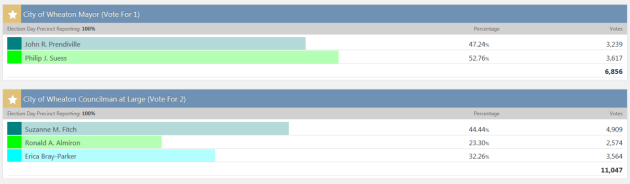
Municipal elections in Illinois took place this past Tuesday. In my suburban community of just over 53,000 residents, here are the results for the two races:

WheatonMunicipalElectionResultsApr19

In races for two important local positions, voter turnout was relatively low. Of the roughly 41,000 adults in the community 18 and older, the mayor was elected by 3,617 voters while his opponent had just over 3,200 votes. In the councilman race, the numbers are a little harder to interpret because voters could select two but the numbers are certainly not much higher. Overall, under 20% of adults voted (hard to know how many are registered) and less than 10% of those adults selected the next mayor.

Perhaps there are a variety of factors at work:

  1. Do residents/voters believe that municipal elections matter? What do local officials do anyways?
  2. Holding municipal elections separately from larger races – state and national races that tend to get more attention – could lessen enthusiasm.
  3. Perhaps the candidates are not that exciting (the two mayoral candidates shared multiple characteristics) or they are unknown to broad swaths of the community.

Low voter turnout is now common and it may not take much to be voted in to local office. But if suburbanites claim to value local government, it is not hard to see the disconnect between choosing local leaders and wanting to maintain local control.


Informing the public about delays in completing large public projects

The reasons for delayed Jane Byrne Interchange project in Chicago are only now trickling out to the public:

In January 2015 — just over a year into construction — university workers noticed the building had been sinking and shifting, leaving cracks in the foundation and making it impossible to shut some doors and windows, according to court records…

Over the next 1½ years, IDOT blamed engineering firms it had hired for missing the poor soil conditions that contributed to the problem. That led to a redesign of a key retaining wall that boosted costs by $12.5 million and dragged out that part of the project at least 18 more months…

IDOT’s Tridgell gave the Tribune a list of other reasons for delays. Among them: The city was leery of shutting down ramps and lanes on many weekends because of festivals and other events. And other local agencies required extra permits and reviews for work…

UIC’s Sriraj said public outreach is challenging on big projects, with no “gold standard” on how much is appropriate.

The public is likely not surprised that such a large project is behind schedule and over budget. This is common on major infrastructure projects. They just want the project done. (And I’m sure some of the cynical ones will note that even when the Byrne project is done, repaving of its surfaces will probably begin again very soon.)

Is this expectation of poor performance what then allows public agencies to not have to explain further delays and costs? Realistically, there is little the public can do whether they know about the delays and cost overruns or not: the construction keeps going until it does not. And the article hints that there is possibly little the state can do to compel contractors to do better work. So, because the news looks bad, is it just better to sit on the information?

I would prefer it work this way: given that such large projects affect many people and involve a lot of taxpayer dollars, the public should have access to clear timelines and explanations for delays. Many people won’t care, not matter how much information is available. But, in general, public life is valuable and information should be widely available and not hidden for fear of angering people or avoiding blame. At the least, knowing about delays and increased costs could theoretically help voters make better choices in the future about leaders who will guide these processes.

Suburban voters less likely to be politically independent

The suburbs are the current political battleground and a recent report provides insights into several suburban political trends:

Fewer suburbanites describe themselves as politically independent than do residents of the nation’s urban and rural areas, according to a survey released Tuesday by the University of Chicago Harris School for Public Policy and The Associated Press-NORC Center for Public Affairs Research. The poll also found that the partisan leanings of suburban residents are closely linked to whether they have previously lived in a city…

Suburbanites who previously lived in a city are about as likely as city-dwellers to call themselves Democrats, the survey found. Similarly, Americans living in suburbs who have never resided in an urban area are about as likely as rural residents to say they are Republican…

That divide extends to the White House: 72 percent of ex-urban suburbanites disapprove of President Donald Trump’s performance in office, as do 77 percent of city residents. That compares with the 57 percent of suburbanites who have not previously lived in a city and 54 percent of rural Americans who say they disapprove of the president.

Suburbs may be more purple but that does not necessarily mean that suburbanites feel compelled to be avoid choosing a political party identification. Perhaps the regular interaction with suburbanites of other political backgrounds helps. Or, stating political independence in the city or rural areas is the more acceptable way of signaling a break from the geographic hegemony without completely going over to the other side.

This may be the hint of the final paragraph of the article with one experience from Jefferson County, Colorado:

“You’re welcome regardless of your political beliefs,” said Stern, a Democrat and volunteer firefighter in a suburban department with a wide range of political views in the station. “It becomes harder to live in rural or urban areas if your political beliefs don’t match those of the majority of the people who live there.”

Alas, this is just one story and it is nice to end a news story on a hopeful note. Are suburbanites really more willing to work across political lines? Local non-partisan elections might appear this way – though they can have their clear divides. Given political polarization in the United States, this may only last so long in any setting.

Local political slates: contrast “values” and “progress”

Local government races in many suburbs and small towns are non-partisan but this does not stop opposing groups of candidates from aligning themselves with particular ideas. See this example from Lake Zurich, Illinois:

The race for three seats on the Lake Zurich village board pits two slates with fairly disparate ideas about where the village should be headed and how to get there against each other. Among the key differences between LZ Values and Lake Zurich Progress is how to spur development in the struggling downtown.

Simple names but complex ideas. Presumably, one group wants to hold on to the best of what Lake Zurich is – the LZ Values slate – while the other has ideas about positive change for the community – Lake Zurich Progress. Local voters who are looking for help in who to vote for can just latch on to these ideas rather than the candidates themselves or particular policy positions. And this might be necessary when local turnout is so low (despite how Americans tend to value local government).

Where are the people oriented suburbs?

The book Market Cities, People Cities by sociologists Michael Emerson and Kevin Smiley examines big cities in light of two ends of a spectrum: market cities follow an economic logic and people cities look out for the well-being of their residents first. In their study, Houston is the model of a market city and Copenhagen is the people city exemplar.

This got me thinking about American suburbs. Given their history and priorities, they appear to be market communities. On the whole, American suburbs emphasize single-family homes, private families, driving, and local control over resources. They are generally known as wealthier communities. Additionally, the suburbs have generated a lot of money for developers, builders, the construction industry, and communities through tax revenues. Most of this is private wealth or money that residents hope can be spent on their own lives.

So, are there suburbs that emphasize the welfare of residents over markets? If so, where might they be located? A few ideas:

  1. Inner-ring suburbs. This could be because they located near big people cities or the sets of issues facing such suburbs – often racial and ethnic diversity and more poverty – could prompt a different approach to local governance and community life.
  2. Suburbs within blue states. If this is the case, suburbs in states like New York, Illinois, California, New Jersey, Connecticut, and Washington are more likely to have people suburbs.
  3. Suburbs that have strains of political liberalism. While suburbs are traditionally associated with more conservative political stances, this has been in flux in the last few decades. With new residents in suburbia as well as new generations, some communities may view suburban life through a different lens.
  4. The rare suburb that has experienced a significant crisis – a major development gone awry, the loss of a major employer, severe budget issues – and tried to forge a new path.

If I had to guess what percent of suburbs could be considered more devoted to well-being than markets, I might venture 20% at most.

A call for the Green New Deal to address sprawl and where people live

Want to pass a Green New Deal to benefit the United States? One commentator suggests it must reckon with the legacy and persistence of sprawl:

The Green New Deal is ostensibly a jobs program, an environmental program, and a redistributive program. If it’s a jobs program, it must wrangle with spatial mismatch. If it’s an environmental program, it must tackle the fact that an all-electric fleet of cars is functionally, at this time, a pipe dream. And if it’s a redistributive program, it must grapple with how roads paved into suburban and exurban greenfield developments deepen, expand, and exacerbate segregation.

A Green New Deal must insist on a new, and better, land-use regime, countering decades of federal sprawl subsidy. The plan already recognizes the need to retrofit and upgrade buildings. Why not address their locations while we’re at it? Suggestions of specific policies that would enable a Green New Deal to address land use have already emerged: We could, simply, measure greenhouse gases from our transportation system or build more housing closer to jobs centers. Reallocating what we spend on building new roads to paying for public transit instead would go a long way toward limiting sprawl.

Where we live is no coincidence of preference. Federal policy has enforced inequities and disparities for both the environment and vulnerable people at a national scale. It’s never too late to address the most fundamental aspect of our carbon footprint: where we live. And building housing near jobs, transit, and other housing—rather than ultra-LEED-certified parking garages—is merely a political choice. No innovation required.

This makes sense: how much can the United States truly address environmental matters if it does not reckon for the actions of roughly the last century that encouraged decentralization?

Here is what I wonder: would it be harder to address sprawl or environmental issues? On one hand, climate change is contentious and partisan. On the other hand, going after sprawl would require taking on deeply ingrained American values. When Americans value single-family homes, driving, and all that the suburban life offers, shifting priorities and funds to denser housing, mass transit, and cities may prove difficult.

The environmental movement in the United States has roots in suburbia. Rachel Carson was inspired by her suburban settings to write Silent Spring. But, truly reforming land use as opposed to making suburbs greener is a tall task. Of course, important decisions made today could address the issue of subsidized sprawl. American suburbs are neither natural or have to last forever. It would likely take decades to see the consequences on the ground.

Kotkin argues both political parties want to destroy single-family home suburbia

The single-family home may be the bedrock of the American suburbs and Joel Kotkin suggests both political parties ignore this at their own peril:

However much they might detest Trump , suburbanites are not likely to rally long-term to a party that seeks to wipe out their way of life. The assault on suburbia, both from the ultra-capitalist right and socialist-minded left, neglects the very reasons—space and privacy—people of all ethnicities move to suburbia. Just as Republicans can ignore the unintended consequences of ultra-free market policies, Democrats ignore the aspirations of their own voters.

More important still, the anti-single-family campaign undermines the foundation of our democracy. The essence of American civilization has been the pursuit of a better life for oneself and one’s family. Take away the ability to own one’s home and we are well on our road to a neo-feudal society where the masses will need to rely on the state not only for housing but, without meaningful assets, to finance their retirement.

The clamor to restrict single-family homes and thus push the American dream further out of many Americans’ reach, represents an assault on what both parties once espoused. An America without widespread homeownership is no longer an aspirational country, but a place where people remain imprisoned by their class and unable to pursue what they perceive as a better quality of life.

Kotkin’s argument seems to go like this:

  1. The suburbs are the way they are because the American people wanted to live in suburbia. Both political parties supported this mission for much of the 20th century through monies and programs.
  2. Unless Democrats and Republicans cater to suburban voters, they will have a difficult future as political parties.

But, this seems to assume that this suburban way of life based around a home and emphasis on family will always continue this way. To some degree, Americans did desire land and privacy from the beginning yet the suburban experience was really made available to the masses first around the turn of the twentieth century and then even more so after World War II. Younger or future Americans could decide they would prefer cities and denser areas or even rural areas and the political parties could help lead them in that direction.

All that to say, I think Kotkin is right in that a majority of Americans continue to profess interest in living in suburbia. At the same time, this could change in the future and one or both of the political parties could start leading in that direction. Not all Americans want to be suburbanites so there is political room to suggest alternatives.

Religiosity of 116th Congress both does and does not reflect changes in American religion

Comparing the religious makeup of the newest Congress to previous Congresses shows several interesting patterns:

http://www.pewforum.org/2019/01/03/faith-on-the-hill-116/

A few patterns to note:

  1. The number of Protestants has dropped dramatically – roughly a loss of 100 from sixty years ago – even as the percent of Protestants in Congress (54%) continues to be higher than the percent of Protestants in the U.S. population (48%).
  2. The number of Catholics in Congress increased from the 1960s into the late 1970s and early 1980s and then has stayed relatively stable. There are more Catholics in Congress (30%) than in the U.S. population as a whole (21%).
  3. The number of religious others is still low and hasn’t changed much over time.
  4. As noted in the summary of the findings:

But by far the largest difference between the U.S. public and Congress is in the share who are unaffiliated with a religious group. In the general public, 23% say they are atheist, agnostic or “nothing in particular.” In Congress, just one person – Sen. Kyrsten Sinema, D-Ariz., who was recently elected to the Senate after three terms in the House – says she is religiously unaffiliated, making the share of “nones” in Congress 0.2%.

When asked about their religious affiliation, a growing number of members of Congress decline to specify (categorized as “don’t know/refused”). This group – all Democrats – numbers 18, or 3% of Congress, up from 10 members (2%) in the 115th Congress. Their reasons for this decision may vary. But one member in this category, Rep. Jared Huffman, D-Calif., announced in 2017 that he identifies as a humanist and says he is not sure God exists. Huffman remains categorized as “don’t know/refused” because he declined to state his religious identity in the CQ Roll Call questionnaire used to collect data for this report.3

In summary, Congress is overwhelmingly religious and Christian. While America as a whole is still solidly majority religious and Christian, Congress is even more so. This seems to suggest Americans still like to elect people who have a faith affiliation even if there is less information on the actual beliefs and practices of the Representatives and Senators (this data “does not attempt to measure their religious beliefs or practices. “).