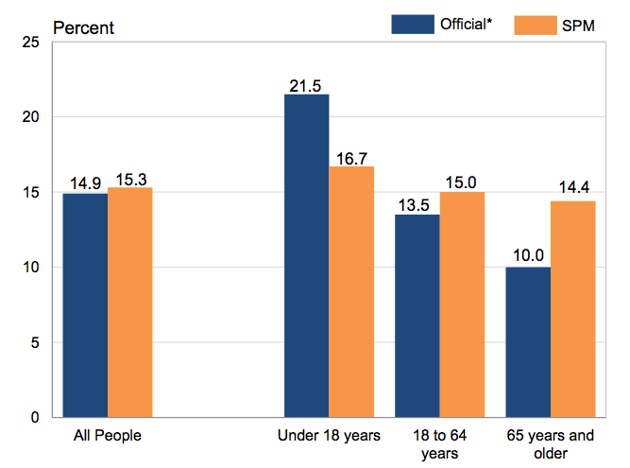
That’s why for the first time, the bureau released a supplemental poverty measure along with its official figures. According to the supplemental data, the poverty rate in the U.S. was about 15.3 percent—0.4 percentage points higher than the report’s official rate. But the additional measure shows differences in age groups. For instance, those under the age of 18 have a poverty rate of 16.7 percent—quite a bit lower than the 21.5 percent reported in the main findings. For older Americans, the tweaked metrics paint a grimmer picture, with the share of seniors living in poverty reported as nearly 5 percentage points higher than the official measure.
Poverty Rates: Official Versus Supplemental
Census
The more inclusive measures might help monitor the effectiveness of programs meant to increase the well-being of specific populations, such as children or the elderly. Still, the use of an official, blanket income level remains a crude means of identifying families that are having a difficult time putting roofs over their heads or food on the table, especially considering the vast differences in cost of living around the country. To better understand the persistent poverty problem requires greater attention to nuanced and localized data that can better illustrate areas where the cost of essentials are outstripping income and benefits, and where families continue to suffer.
An interesting development. Now the vetting of the new measurement tool can begin and I’m guessing that this won’t satisfy too many people.
A political question: would any administration allow the official government definition of poverty to change if it meant that the rate would increase during their time in office? This isn’t just about measurement; there are political considerations as well.
The report features the Social and Behavioral Sciences Team’s first year of projects, which have made government programs easier to access and more user-friendly, and have boosted program efficiency and integrity. As a result of these projects, more Servicemembers are saving for retirement, more students are going to college, more Veterans are accessing their benefits, more farmers are obtaining credit, and more families are gaining healthcare coverage.
The Federal Government administers a wide array of programs on behalf of the American people, such as financial aid to assist with college access and workplace savings plans to promote retirement security. Americans are best served when these programs are easy to access and when program choices and information are presented clearly. When programs are designed without these considerations in mind, Americans can incur real consequences. One behavioral science study found, for example, that a complex application process for college financial aid not only decreased applications for aid, but also led some students to delay or forgo going to college altogether.
Behavioral science insights—research insights about how people make decisions—not only identify aspects of programs that can act as barriers to engagement, but also provide policymakers with insight into how those barriers can be removed through commonsense steps, such as simplifying communications and making choices more clear. That same study on financial aid found that streamlining the process of applying—by providing families with assistance and enabling families to automatically fill parts of the application using information from their tax return—increased the rates of both aid applications and college enrollment.
On one hand, the administration suggests this improves efficiency and helps people make use of the help available to them. On the other hand, there are predictable responses from the other side: “Obama issues Orwellian executive order.”
These are not new ideas. Richard Thaler and Cass Sunstein (who tweeted the news of the executive order) wrote the 2008 book titled Nudgethat makes policy recommendations based on such science. For example, instead of having people opt-in to programs like setting aside matched retirement savings or organ donor programs, change the default to opting out rather than opting in and see participation rates rise.
I imagine both parties might want to use this to their advantage (though it might might rile up the conservative base a bit more if it was made public) when promoting their own policies.
With Illinois Gov. Bruce Rauner threatening to “rip the economic guts out of Indiana” and Indiana Gov. Mike Pence admitting to “a playful penchant to poach business from Illinois,” efforts to forge alliances within the tri-state metro area have been consigned to scholarly conferences and countless committee meetings, with scant tangible results…
In the global competition to attract business and talent, regions that collaborate to establish a brand, develop industry hubs, streamline transportation, foster a cultural scene and revitalize neighborhoods have a competitive edge, experts say…
Formalized regional collaboration is paying off for a number of major metropolitan regions, helping to stoke their economies and lure new residents. Denver-area taxpayers have anted up repeatedly for cultural and transit projects that have revitalized the city. Portland and its suburbs worked together to rev up exports. Metro Minneapolis’ tax-sharing strategy has helped reduce the gap between rich and poor communities. The communities lining the southern coast of Lake Michigan comprise the nation’s third largest economy. They are home to a rich assortment of businesses, an educated workforce, respected universities and a massive, if overloaded, transportation system.
But greater Chicago’s tepid growth rate is outpaced by a number of metropolitan areas with cohesive regional strategies. Denver, for instance, ranked No. 6 in economic performance among the nation’s 100 largest metros since its pre-recession peak, while Chicago was No. 77, according to Brookings Institution data.
This is a good example of how relatively arbitrary political boundaries limit the ability to operate within day-to-day social boundaries. The Chicago region exists as an interdependent whole and it cross state lines into Wisconsin and Indiana as well as includes hundreds of Illinois municipalities. Yet, politicians are elected to represent their particular geographic area and don’t get much credit if nearby areas also do well. Voters don’t have broad views of regions – efforts to support metropolitan institutions and bodies are often voted down across the United States – and prefer to exercise local control. Thus, politicians hunker down and do what they can to boost their particular chances even if what they can do is affected by what these nearby leaders do. For example, see Indiana’s ongoing effort to attract Illinois businesses. In contrast, see what a 2012 OECD report said could be done across the Chicago region.
Given the issues facing the region (from mass transit to stormwater management to poverty to affordable housing to jobs to population decreases and more), one would hope that the various leaders and governmental bodies will start working together before it might be too late to do anything productive.
[T]he most explicit political songs are often pedantic and cringeworthy, while the best political music is generally more sociological in bent, from Springsteen’s best to Kendrick Lamar’s vivid rhymes.
The first two songs that came to mind were these: “Eleanor Rigby” by the Beatles and “Common People” by Pulp. Both songs are sociological commentary with the first considering the lonely life and the second addressing a woman who wants to slum it and experience the life of “common people.” One is sharper in its approach than the other – Paul McCartney has a certain distance from the character while Jarvis Cocker suggests the girl doesn’t really understand what is going on – but neither is overtly political even as they draw attention to important social issues.
Yet, where exactly the line is between the overly political and strongly sociological is difficult to determine. Some of this may be on the political activities of the music artist; if they are known activists, their music may be interpreted in such a way. Some songs have a beat or rhythm that inspires group behavior – maybe a more martial or driving beat? – while a song like “Eleanor Rigby” wouldn’t exactly inspire physical action with its string quartet. Songs can also later become adopted by protest movements or political leaders without the support of the artists. And, most mass media sources don’t do a whole lot with angry music – much pop or rock music is upbeat or is more veiled if it is about negative topics.
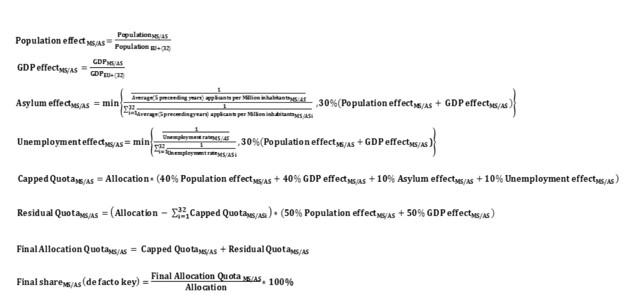
How will refugees be dispersed among European countries? This formula:
On Wednesday, shortly after European Commission President Jean-Claude Juncker announced a new plan to distribute 120,000 asylum-seekers currently in Greece, Hungary, and Italy among the EU’s 28 member states, Duncan Robinson of the Financial Times tweeted a series of grainy equations from the annex of a proposed European regulation, which establishes a mechanism for relocating asylum-seekers during emergency situations beyond today’s acute crisis. Robinson’s message: “So, how do they decide how many refugees each country should receive? ‘Well, it’s very simple…’”
In an FAQ posted on Wednesday, the European Commission expanded on the thinking behind the elaborate math. Under the proposed plan, if the Commission determines at some point in the future that there is a refugee crisis in a given country (as there is today in Greece, Hungary, and Italy, the countries migrants reach first upon arriving in Europe), it will set a number for how many refugees in that country should be relocated throughout the EU. That number will be “not higher than 40% of the number of [asylum] applications made [in that country] in the past six months.”…
What’s most striking to me is the contrast between the sigmas and subscripts in the refugee formula—the inhumanity of technocratic compromise by mathematical equation—and the raw, tragic, heroic humanity on display in recent coverage of the refugees from Syria, Afghanistan, Eritrea, and elsewhere who are pouring into Europe.
The writer hints at the end here that the bureaucratic formula and stories of human lives at stake are incompatible. How could we translate people who need help into cold, impersonal numbers? This is a common claim: statistics take away human stories and dignity. They are unfeeling. They can’t sum the experiences of individuals. One online quote sums this up: “Statistics are human beings with the tears wiped off.”
Yet, we need both the stories and the numbers to truly address the situation. Individual stories are important and interesting. Tragic cases tend to draw people’s attention, particularly if presented in attractive ways. But, it is difficult to convey all the stories of the refugees and migrants. Where would they be told and who would sit through them all? The statistics and formulas help give us the big picture. Just how many refugees are there? (Imagine a situation where there are only 10 refugees but with very compelling stories. Would this compel nations to act.) How can they be slotted into existing countries and systems?
On top of that, you can’t really have the nations of today without bureaucracies. We might not like that they are slow moving or inefficient at times or can be overwhelming. How can you run a major social system without a bureaucratic structure? Would we like to go to a hospital that was not a bureaucracy? How do you keep millions of citizens in a country moving in a similar direction? Decentralization or non-hierarchical systems can only go so far in addressing major tasks.
With that said, the formula looks complicated but the explanation in the text is fairly easy to understand: there are a set of weighted factors that dictate how many refugees will be assigned to each country.
The state of Illinois has been drowning in debt for years due to mismanagement, and their only solution is to keep raising taxes. Sound familiar? Illinois taxpayers have been picking up the tab for longer than anyone cares to remember, but it wasn’t always that way.
Ten years ago Indiana and Illinois had the same AA credit rating, but the unfunded pension debt crisis in Illinois has steadily deteriorated over the years, to the point that their current credit rating of A- is the worst in the nation.
Illinois is borrowing a staggering amount of money to pay for state services and they’re seen as a bad risk to keep making those payments, according to the rating agencies. In fact, the interest alone on Illinois’ unfunded liabilities is about $1.5 billion per year…
Indiana is deliberately making smart financial decisions and defining what a state can do to pass the savings of efficient government on to their taxpayers by eliminating debt, keeping taxes low and continually balancing their budget. It’s a refreshing change from a state like Illinois that has taxpayers picking up the tab for a public debt-management crisis, and it’s what makes Indiana a state that works.
Such efforts have been going on for quite a while yet I haven’t seen evidence that shows a campaign like this works. I’ve long suspected this is more about scoring easy political points than anything else; “look at the good things happening in Indiana while Illinois languishes.” Yet, somehow the Chicago region with its 9+ million people hangs on and the city is continually ranked as one of the top 10 global cities in the world.
One side note: part of northwest Indiana is in the Chicago metropolitan region. According to this campaign, some might get the best of both worlds: the residents and businesses get the lower taxes, less political gridlock, and less debt yet get to take advantage of the jobs and other opportunities the Chicago area offers. In the long run, a significant decline in Illinois or Chicago’s fortunes probably would have some residual negative effects not just on northwest Indiana but also the entire state.
Twin trends in American housing: homeownership is down while housing costs increase. First, on homeownership:
Only about a decade ago, in 2004, 69.2 percent of all homes were occupied by their owners; the home ownership rate has since fallen to 63.4 percent, the lowest in almost fifty years despite some of the most attractive mortgage interest rates on record. In part this is due to the difficulty young couples have in qualifying for a mortgage, as once-burned, twice-fined and increasingly risk-averse banks, looking over their shoulders at their regulators, raise their lending standards.
But even a further loosening of credit standards that have already been relaxed for “jumbo” loans (in excess of $417,000 and $625,500, depending on the region) is unlikely to change the trend towards renting rather than owning, last month’s increase in construction of single-family homes notwithstanding. Jordan Rappaport and Daniel Molling, economists at the Federal Reserve Bank of Kansas, find that adults in their 20s and early 30s, so called millennials, are not alone in preferring to rent rather than buy. Ageing baby boomers, now in their 50s and 60s, have tired of mowing, hunting for plumbers, fixing leaky roofs and coping with the nightmares that accompany realization of the one-time American dream of home ownership. They have accounted for the bulk of new renters, and are likely to continue to “be the main drivers of multifamily [apartment] construction as they age through their senior years,” conclude the Bank’s economists.
Consumer prices rose modestly in July, and according to the U.S. Labor Department those gains were largely due to a 0.4 percent increase in the cost of shelter—the government’s measure of housing costs. This was the largest increase in the shelter index since 2007.
While inflation for other Consumer Price Index (CPI) basket items has been decelerating, the inflation of shelter has only been going up since 2010. Compared with July of last year, shelter prices are up by 3.1 percent. In the coming months, shelter inflation is expected to continue…
Rising housing costs, paired with stagnant wages, are a big concern for most Americans because not only is rent often already the largest part of monthly expenses—it is increasingly becoming more expensive. One study found that half of all renters spend more than 30 percent of their income on rent and utilities.
Interestingly, this is getting very little attention from politicians. Let’s say a politician wanted to appeal to the masses in the United States. One traditional way of doing this has been to push homeownership, a strategy pursued from Presidents since the 1920s. Owning a home might be the modern equivalent of a chicken in every pot for Americans. Since owning a home has been viewed as an essential part of the American Dream, most politicians want to be viewed as in favor of expanding this opportunity. (Of course, there are other reasons for pushing homeownership including boosting the economy and fighting communism.)
Perhaps other issues are more pressing at the moment. Or, I suspect few leaders really know what to do about reviving housing given the efforts in the early 2000s to expand homeownership that contributed to a big economic bust. Yet, since most major politicians today want to appeal to the middle class (and they don’t pay much attention to the poor – another story for another day), this would be one easy way to go if they could just figure some sort of plan.
The culture wars may have changed, but that doesn’t mean they’re over. Nowhere is this more clear than on the internet. Hartman’s culture wars were fought in national magazines, peer-reviewed journals, cable news shows, and in the halls of Congress: all venues with some degree of gatekeeping. Today, a broader swath of self-proclaimed culture warriors can engage in comment sections, on blogs, and on Twitter, where the #tcot hashtag is filled with echoes of earlier flashpoints. Whether the internet is simply a new, more broadly accessible forum for old debates about the meaning of America, or whether it is facilitating a new kind of culture war altogether, is not entirely clear. Nor are online spaces any less susceptible to the imperatives of capitalism than any other part of American culture. But if the culture wars are over, no one told their most energetic partisans: on this new frontier, the battle rages on.
If this is the case, it has altered the culture war landscape in multiple ways:
1. Increased the speed of battle. Now, new issues can pop up all over the place through text and videos on multiple platforms. Who can keep up with it all?
2. The old gatekeepers – traditional media like television, newspapers, and radio as well as politicians – have to scramble to keep up. This means they may race to the bottom or endlessly cycle through everything to stay relevant.
3. The culture wars don’t have to be about big issues but rather can be a larger series of micro battles. There may be no big “culture war” but rather an endless number of skirmishes involving small numbers of participants.
4. Anyone can participate with the possibility of being part of a larger conversation behind their smaller sphere. However, it is hard to know which of these skirmishes might blow up.
To see how that works in practice, de Blasio should spend a week commuting on the subway from various points in the city: taking the No. 7 train from Flushing, the L train from Greenpoint, the F train from Fort Hamilton Parkway.
Such an exercise may remind de Blasio that while a few rich people can bail out of mass transit by taking ever-cheaper black cars, most New Yorkers are stuck on a subway system that is creaking under record ridership.
The mayor should do some weekend, night and borough-to-borough commutes, too, so he can see how hard it is for lower-paid, off-hours workers to get around when the MTA cuts its service.
Then, the mayor should agree to Gov. Andrew Cuomo’s request to put $3 billion into investments in subways and buses over the next five years, helping to pay for the next few stops on the Second Avenue Subway, plus better technology on existing subway lines.
The mayor should think seriously, too, about funding his own transit project. He mentioned a subway on Utica Avenue, and then never talked about it again. With China’s economy cratering, it’s a good time to build — steel and concrete are cheaper.
Former Mayor Michael Bloomberg’s extension of the 7 train to Manhattan’s Far West Side will open soon — and New Yorkers will remember that Bloomberg did it.
What will they remember about de Blasio?
Powerful politicians often like to enhance their legacy through the construction of massive buildings or public works projects. And mass transit can easily become an issue tied up with social class and race as mass transit in theory is supposed to be more democratic. But, how many would like their legacy to be underground subways in a city that already has an extensive system? Such projects often take billions of dollars, cause all sorts of disruptions, and can be lengthy. This might only work in New York City, a place so dependent on daily subway usage (particularly compared to other large American cities).
If pushed by the mayor, can a new line be called the de Blasio line? I can’t help but think of the “Rod Blagojevich, Governor” signs every time I pass through the open road tolling facilities on Chicago area tollways…
Assuming time travel is off the table, let’s learn from our mistakes. First, let’s get the federal government completely out of the business of maintaining the interstate highways crisscrossing our big metropolitan areas. Hand these roads over to state governments as soon as possible, and free state governments to finance these roads in any way they see fit, from higher state gas taxes to variable tolls they could use to reduce traffic congestion. Second, for interstate highways that connect cities across deserts and cornfields, let’s replace the federal gasoline tax with per-mile tolls. One of the many problems with the gas tax is that as gas mileage improves, and as a small but growing number of drivers turn to electric vehicles, gas tax revenue is not keeping up with the needs of the highway system. Per-mile tolls can solve that problem by charging drivers according to how much they actually use the highway system, regardless of the kind of vehicle they’re driving. And as Robert W. Poole Jr. explains, they can be pegged to the cost of each road and bridge, which will help ensure that roads and bridges are adequately financed.
After adopting this approach, we will see states investing in the infrastructure projects that best meet their needs, with some states, like California and New York, choosing to invest more heavily in urban mass transit while others, like Texas and Utah, build bigger and better highways. What remains of the federal highway system, meanwhile, will evolve over time, as the routes that attract the most traffic will grow in line with their per-mile toll revenue while those that attract the least will stay the same size, or perhaps even shrink. We’ll have an infrastructure worthy of a bigger, denser, more decentralized America—the kind of infrastructure that Ike, in his infinite wisdom, would be proud of.
An interesting argument that might have appeal for both liberals and conservatives. For conservatives, having more local control is generally good and states could innovate in a way that a larger bureaucracy might not. (At the same time, corporate interests cross state and national lines and they might not like a decentralized highway network.) For liberals, highways have often been used in redevelopment projects harming poorer neighborhoods and state control would theoretically give neighborhoods and communities more say over the fate of highways. Additionally, interstates encourage sprawl and liberals might want to reign in highway building and maintenance in many places.
I could also imagine several objections to this argument:
1. How many states would be willing to take this on right now given budget issues? This would have to be phased in over time. Which government officials want to take responsibility for raising tolls for driving?
2. Uniformity in the system could be a good thing ranging from common road signs to expectations regarding levels of maintenance and service across states.