One approach to the broken dreams of the American suburbs: realistic expectations

After reading Jonathan Franzen’s latest novel Crossroads, I have a not-original answer to the problem of the brokenness lurking behind the promise of the American Dream in the American suburbs: realistic expectations about what life in the suburbs is like.

Photo by Lara Jameson on Pexels.com

Much is expected of the American suburbs and Americans love them for multiple reasons. They are the land of opportunity. Home to the middle-class and the hard-working. A symbol of success. A setting meant to guarantee success to future generations. The land of private single-family homes where owners can control their own destiny.

What if the suburbs could never deliver on all of these promises? What if it was only available to some? What if the humans who tried to pursue these goals still faced difficulties and heartbreak? What if the suburbs covered up a whole host of issues in American society?

Numerous novels, films, songs, and creative works have addressed these questions over the last century. They have clearly showed the cracks in the suburban facade, the tragedies masked by the suburban sprawl.

But, these works often struggle to propose a solution. Get rid of the suburbs? Do not move to them in the first place? Stop promoting them?

If anything, these works serve as a cautionary tale: the suburbs may not be as impressive as they are made out to be. They are home to the problems all humans face as well as have their own particular issues due to their histories and current realities.

At the same time, through policy and ideology, millions of Americans have moved to the suburbs. Balancing the dire stories told of life falling apart in the suburbs alongside the narratives of success and comfort in the suburbs, is there a more realistic narrative available about what suburban life is?


Suburb of Elk Grove Village now turns to NASCAR race car ad

Elk Grove Village has sponsored a college football bowl game. Now, it is sponsoring a NASCAR car:

Photo by Pixabay on Pexels.com

The Northwest suburban municipality — of Makers Wanted Bahamas Bowl fame — has inked a two-year marketing partnership with the Roush Fenway Keselowski Racing team that will enable it to affix its business marketing tagline, logo and brand to the No. 6 Ford Mustang stock car during the NASCAR Chicago Street race events next year.

The announcement was made during the ninth Made in Elk Grove Manufacturing & Technology Expo at the high school. The daylong exhibition, awards and networking event highlights businesses within the village’s sprawling industrial park — which the village has sought to promote through several unconventional marketing sponsorships. The town sponsored the college football bowl game in 2018 and 2019, plus three USA Olympic teams last year.

“Elk Grove Village is home to the largest industrial park in North America. We’re surrounded by incredible transportation options and our town works hard to make this a destination for businesses,” Johnson said in a statement. “Partnering with RFK for a marquee race allows us to reach a huge audience with a partner that shares a passion in American business and manufacturing.”

Suburbs continue to market themselves in order to stand out from the hundreds of other suburban communities with which they might be competing. Lots of suburbs could say they have industrial space, nearby transportation options, and are business friendly. Fewer might be able to say they have “the largest industrial park,” sit near O’Hare Airport, within such a busy region for railroad traffic, and right next to major highways, and offer exactly what Elk Grove Village can offer businesses. This branding effort will help highlight these distinctive features.

But, the big question is whether this broader exposure translates into increased business and development activity in the community. Will those watching Brad Keselowski zoom around a track visit makerswanted.org in large numbers or relocate their firms to the suburb? Is it enough that the suburb might have an increased status but no change in activity?

Putting together statistical data and experiences, Right Turn on Red edition

A discussion of Red Turn on Red (ROTR) pits statistical evidence and experiential data:

Photo by Jack Gittoes on Pexels.com

Critics of the D.C. bill have pointed out the lack of data showing the dangers of RTOR, but many people who don’t use cars know instinctively how dangerous turning vehicles can be. “Our current safety studies fail to capture the reality of the constant near misses and confrontations that result between these motorists and pedestrians, which can be observed daily just by observing a typical busy intersection with RTOR,” Schultheiss says.

When teaching a research methods class, I can often come back to this observation about how sociologists approach data and evidence: we want both “facts” and “interpretations” to get the complete story of what is going on. In this particular situation, here is what that might mean: even if the statistical data suggests ROTR is not very dangerous, it matters that people still fear cars turning right on red. The experiences of pedestrians, bicyclists, and others on sidewalks and streets is part of the larger picture of understanding turning right on red. This would go alongside the data and experiences of vehicles and drivers.

Once this full set of data is collected, making policy decisions is another matter. If leaders want to prioritize vehicles, that is one choice. Or, as the piece suggests, some cities want to rethink streets and transportation, and they can end ROTR. But, it would be advisable to have all of the evidence before acting.

Creation care, “practical love,” and the American suburbs

One evangelical leader is asked about caring for the environment as a Christian imperative and they connect the issue to the American suburbs:

Photo by Pixabay on Pexels.com

If you play the visionary, what must the church or mission agency do now to prepare for the coming changes? How will they take the gospel message to the world?

Much of what we will have to do is practical love, not just suburban evangelism. I don’t know how leaders of World Vision, SIL, Compassion International, or TEAM should change their strategies—but they must be talking about this. Do the analysis, and anticipate the threats.

Will “practical love” be necessary also in the suburbs?

As environmental impacts ramp up, more and more people will discover they are vulnerable. On the West Coast, the Colorado River is running dry. An entire swath of the country is or may soon be on water rationing, and I don’t know how to deal with that. We are not as protected from environmental impacts as we think we are.

Supply chain issues are affecting cellphones and new cars, but what happens when it hits the grocery stores? Trace it back, and you will discover that there were no apples, because the pollinators were absent. This brings it home, but by then, it will be too late.

I see two connections to suburbs in this discussion:

  1. There is “suburban evangelism” and this contrasts with “practical love.” To address changes in the environment, “suburban evangelism” may not be enough.
  2. The environmental issues will eventually come to the suburbs. Suburbanites might feel like they are protected by a certain level of wealth and distance from immediate dangers, but environmental change will find them.

In other words, there is a particular way of Christian faith that aligns with suburban life. Right now, that faith does not regularly intersect with climate change or environmental issues.

A much larger, and related, question: what about suburban faith does not line up with addressing climate change and other important social issues? (I have some thoughts about this: I have an analysis titled “Faith in the Suburbs: Evangelical Christian Books about Suburban Life” in this book.)

Can anything be more horrifying than small town “Everytown, USA” set in Illinois?

The fictional Haddonfield, Illinois has a grim past:

Photo by Toni Cuenca on Pexels.com

As far as I can count, for a town of only 40,000 or so (I think; no census data for the place exists), it has seen more than 150 murders since 1978, nearly all during October.

As the setting for the “Halloween” horror films, the town has an accumulated history:

What makes Haddonfield important, though, is what made Sherwood Anderson’s Winesburg, Ohio, and Hawkins, Indiana, of “Stranger Things,” and many other fictional Midwest small towns, so indelible. These are places that retain the allure of an America we’re promised, full of kindness and nurturing, alongside the hypocrisy we’ve always known. Like Spoon River, Bedford Falls, Grover’s Corners, Brigadoon, Lake Wobegon and Springfield in “The Simpsons” — some Midwestern, all too good to be true — Haddonfield will be defined not as One of the Best Places in America to Live but One of the Best Places to Remind Yourself That Small Town America was Never a Vacuum…

If you take all the “Halloween” films as reference: There are also low-slung elementary schools surrounded by chain-link fencing. Boulevards lined with Victorian and Cape Cod-style homes with welcoming porches and big lawns. There are farms just outside town, and two newspapers and two hospitals inside. The University of Illinois is mentioned but there’s also a community college there and a strip club, tavern and small police force. It’s middle to upper-middle class, but with pockets of inbred poverty. No one mows the cemetery, and despite the violent history, there are more shadows than streetlights…

The real Haddonfield, of course, is South Pasadena, in California. That explains the lack of foliage (and mountains in the background). According to the Los Angeles Times, the 130-year-old home used for the Meyers house has since been made a historic landmark.

But if Haddonfield existed in Illinois, it would most likely be around the Bloomington-Normal area, said Jim Hansen, a professor of English and critical theory at the University of Illinois at Urbana-Champaign who also teaches classes on horror. It seems to sit off I-55. That said, Bloomington-Normal is south of Livingston County, the (real) county referenced in the series. On the other hand, isn’t it scarier if we don’t know?

I have multiple thoughts in response to this:

  1. Are horror films more effective in supposedly idyllic small towns or suburbs? The contrast between normal everyday life and the activity of horror films is high. If the Midwest is a home to American virtue, is it also home to its repudiation?
  2. Put 13 films together and a devoted fan base and this fictional place becomes a known one. Certain sites are familiar, the logic of daily life is known. Relatively few places depicted on television or in movies can become so familiar.
  3. The filming location is very interesting. If you know the filming took place in South Pasadena, does this ruin the image – visual and conceptual – of small town Midwestern life?
  4. This small town needs the services of Encyclopedia Brown, or perhaps an older detective; someone who could put an end to the horror business.

Trying to make suburban mass transit more attractive by offering private rides and vans to reserve

Pace has tried for decades to increase bus ridership in the Chicago suburbs. Here are two new strategies:

Photo by Vlad Cheu021ban on Pexels.com

Commuters can reserve a $2 ride in a small bus that typically stops at train stations and travels on major roads…

On-Demand service runs from early morning to evening with zones in Aurora, Batavia, Hoffman Estates, Naperville, Round Lake, St. Charles/Geneva, Vernon Hills/Mundelein, West Joliet and Wheaton/Winfield. Rides need to be booked at least an hour in advance.

Another experiment is the VanGo program that lets people reserve a Pace van at the Lake Forest or Lake-Cook Metra stations and drive to employment centers such as Baxter International. An expansion to Palatine is under consideration.

“We give you a code for the vehicle, it unlocks the door, it unlocks the key, you can take it to work and back at night to the train station” along with co-workers, Metzger said.

VanGo drivers must have a credit card and a good driving record, plus meet other requirements. A round trip is $5.

These are mass transit options – still mass transit because the vehicles are operated by a transportation entity and because they are hoping there are multiple riders in the vehicle – that try to adapt to suburban sprawl. A lack of density in the suburbs means that traditional railroad and bus lines cannot reach enough people and the ease of traveling by car means that many people will choose driving. These options offer more flexibility to individual users and specific locations.

Will it work? Can Pace compete with ride shares companies or companies that offer access to vehicles? I am skeptical that it will be effective in the long run given the current nature of suburbia.

Like Wakanda, drop the suburbs so cities and rural areas are closer

Why do we need suburbs between city and rural life? Perhaps the fictional Wakanda offers an answer:

Photo by Pixabay on Pexels.com

“One of the things I love about Wakanda, if you notice, if you watch ‘Black Panther’ carefully, there’s the city, the city’s got all this mass transit and all this housing parks and all this stuff,” explained Chakrabarti, who wrote a book called “A Country of Cities: A Manifesto for an Urban America.” “And the moment you leave the city, you’re in farmland. And there’s this connection between rural life and urban life.”

He added: “I just think that is a really interesting paradigm to think about people, either living in super dense circumstances or really living in true rural hinterland and doing the things that we need everyone to do in farmland, which is grow our food and all of that stuff. And it would mean you would use a lot less land on this planet at the end of the day.”…

Whether major American cities ever transform from where we are today — heavily suburbanized and car-dependent — remains to be seen. But all we have to do is look to Wakanda for an idea of how our cities of the future could work.

I would argue that the American suburbs are popular, in part, because they appear to offer both features of city and rural life. Suburbanites like access to housing, jobs, and cultural amenities but they also want smaller communities and proximity to nature. With cars, they can on their own schedule access these features.

I remember the first time I saw in person this cleaner break between a city and rural areas. I had a chance to spend several days in Tokyo while in college. On one day, we took a train out of the city. As we moved at a high speed away from the city center, we suddenly moved from the denser city to fields. The same break could be seen from the air when flying in and out of the city.

This is not typically the case in the United States where suburbs might stretch for dozens of miles from the city limits before finally dwindling out. Moving more people into denser locations would indeed free up land or freezing development in metropolitan regions within an established boundary would do the same.

I enjoy maps in the ground – and cite three examples

It is one thing to hold a paper map or look at a map in a book; it is another to encounter a map in the ground. In a recent trip to Holland, Michigan, I enjoyed seeing this map in the ground of a park overlooking Lake Michigan:

While the installation highlights the location of Holland, it also shows the size of Lake Michigan, one of the biggest freshwater lakes in the world.

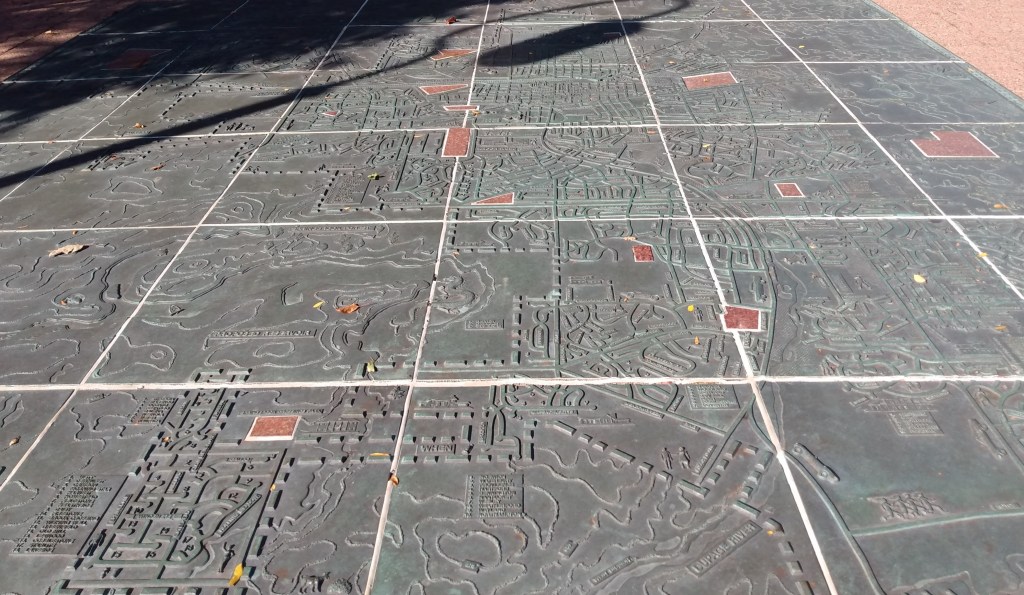
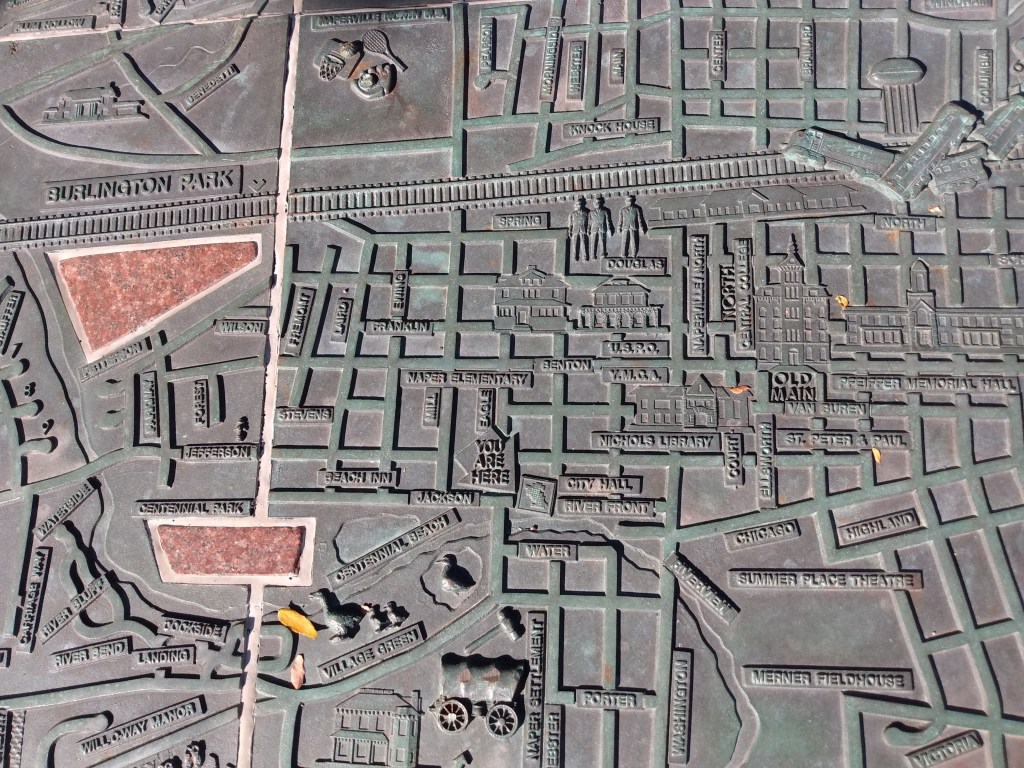
Here is another in-ground map, this time just southwest of the main library in downtown Naperville, Illinois:

The large map hints at the sprawling nature of the suburb while you can also see some of the details the community feels are important (see some of them in the close-up image of the downtown).

A third in-ground map that made a memorable impression of me as a kid was the Mississippi River installation on Mud Island in Memphis, Tennessee. To walk the vast length of the river, see important points along the way, and even play in the water was much fun.

To make the abstract map more concrete provides an opportunity to share places with a broad range of people passing by and help them better visualize the whole and its parts.

A marker of a certain kind of community: lots of Teslas on suburban roads

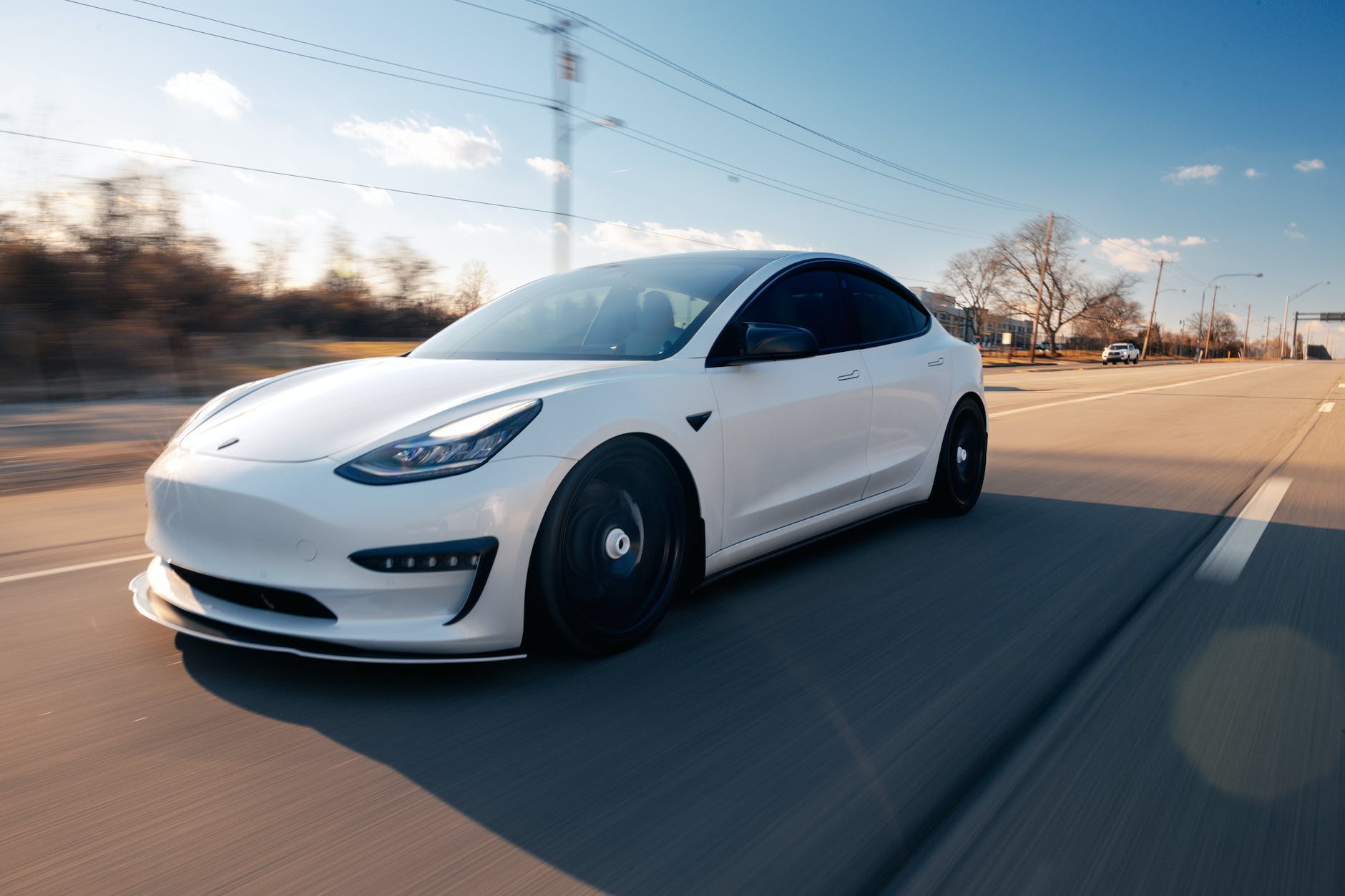
I believe I have seen a growing number of Teslas on local suburban roads. How much is this tied to the kind of community I live in plus the character and demographics of nearby communities? A few thoughts:

Photo by Matt Weissinger on Pexels.com
  1. Teslas are not cheap. There is not a big used market. People need money to purchase Teslas. (New cars are not cheap in the US overall.)
  2. Teslas are electric and electric car owners may have particular political and social patterns. This area has leaned slightly Democratic in recent national elections. As a company, Tesla itself may be more aligned with libertarian or conservative causes, but I do not see large numbers of other electric vehicles. (There are plenty of Prii.)
  3. Teslas are a particular status symbol. They are cool. Some have a cool matte finish or special trim levels. Particular suburbanites want to have one. (Particularly compare them to other “cool” suburban driving options, whether the latest SUV or a sports car.)
  4. The people here take a lot of shorter trips and/or have access to electric chargers. Even the vacation destinations of many in this area – whether Wisconsin or southwest Michigan – are within a single charge.
  5. They are available at local showrooms and dealers. One can go to a nearby suburban shopping mall and check out a Tesla.

If it is true that you can tell something about a community by looking at what cars are in parking lots or driveways, all of these Teslas say something.

Can a successful suburb have a thriving downtown and a stadium-driven mixed-use district?

With the Chicago Bears considering building in Arlington Heights, one village trustee expressed concerns that a sizable project would compete with the suburb’s successful downtown:

Photo by Philipp Silbernagl on Pexels.com

But, he said, “I’m going to tell you right now I’m not a fan of the site plan. And I hope this doesn’t blow up and ruin things for you in any way because I’m just one person sitting up here. But I have to be true to myself and true to my thoughts.”

Tinaglia, who founded his Tinaglia Architects firm in Arlington Heights in 1991, blasted the mixed-use transit-oriented development aspect of the Bears’ proposal, arguing the plans for restaurants, stores, offices, hotels, homes and more on 206 acres of the 326-acre property would detract from what is in downtown Arlington Heights.

“For a community that doesn’t have a downtown — that doesn’t have what Arlington Heights already has — that community would die to have this,” Tinaglia said. But he said he didn’t believe Arlington Heights’ current business owners could survive the competition from the kind of development being proposed.

Just how many entertainment centers can exist in the suburbs, let alone in one community?

Many suburbs would like to have a thriving downtown. Arlington Heights has one. It boosts the status of the community with its older buildings, current businesses bringing in residents and visitors, and possibly residents living downtown and also visiting local businesses and restaurants. Not all suburbs have downtowns; some never had them due to consisting of multiple suburban subdivisions joined together while others may have had a downtown that is now struggling or non-existent. The suburban downtown has had numerous challenges over the years – strip malls, shopping malls, driving and parking, big box stores, and more – so having a successful one is not something a suburb would lightly give up.

On the other hand, not every suburb has an opportunity to be home to a major sports stadium and all of the development around it. This is a new opportunity that could be worth a lot in terms of business activity and tax revenue, population growth, and status tied to being the home of an important football franchise.

It will be interesting to see if there is a compromise to be had here where both a downtown and a new mixed-use development coexist. Do they have to be in competition or can they serve different audiences?