When America’s unofficial third place closes 400 locations

If Starbucks is an important third place for Americans to gather and interact, what happens when the company closes 400 stores because of COVID-19 and to focus more on drive-through and carry-out business?

business cafe coffee dark

Photo by Abhinav Goswami on Pexels.com

Starbucks announced on Wednesday that it will close 400 of its roughly 10,000 locations in the U.S. and Canada over the next 18 months as the company projects to lose up to $3.2 billion in sales this quarter due to the ongoing coronavirus pandemic. It’s not exactly a retrenchment. The company plans to end this year with 300 more stores than when it started, even accounting for the closures—but that’s half of what the chain had originally been planning. About 40 to 50 of the new locations will only offer pickup or drive-through.

Starbucks typically closes about 100 stores every year due to leases expiring and market conditions. The decision to up that number signals that Starbucks expects the recovery from the current recession to extend far into the new year. The company did not list which locations it plans to shutter, though it did say that they would be in “high-social gathering locations” like campuses and malls. Shares for the company fell by 4 percent in midday trading as the news broke. “As we navigate through the COVID-19 crisis, we are accelerating our store transformation plans to address the realities of the current situation, while still providing a safe, familiar and convenient experience for our customers,” Starbucks CEO Kevin Johnson said in a press release.

While nearly all of the company’s cafés have reopened in limited capacities without in-store seating, the twin health and economic crises continue to discourage consumers from spending and venturing out to public spaces. The shock to Starbuck’s business model has reportedly accelerated its shift to focusing on takeaway service, which it had already been planning to do before the pandemic. In November, the company opened its first Starbucks Pickup store at Penn Plaza in New York City, where customers order and pay through their phones. While Starbucks locations have long served as a “third place” where people could meet and relax, customers in recent years have been placing more and more orders for takeout, perhaps due to the company’s recent focus on mobile ordering. The company estimates that 80 percent of its orders at company-owned stores in the U.S. are to-go. Now that the virus has made people even less likely to dawdle at cafés for an extended period of time, Starbucks expects that percentage to rise.

The new stores will emphasize the use of Starbucks’ ordering app, Uber Eats, walk-up windows, and curbside pickup to facilitate social distancing. Some store layouts will also begin including pickup counters that exclusively cater to mobile orders and food delivery services. The company hopes that large U.S. cities will eventually host a mix of cafés and pickup locations that are located within walking distance of one another in order to reduce crowding.

For a long time, the presence of a Starbucks has denoted a particular status for an area or community. Will the loss of a Starbucks or even the shift from a place one can sit and gather to one that sends food and drinks out the doors and windows harm communities?

Even without COVID-19, this hints at the limited public realm Americans have where fast-food places are some of the popular places people can or will gather. Starbucks presented this possibility though as a private business they still aim to make money and will restrict certain behavior. As the article notes, this shift may have already been underway; I noted the busy Starbucks drive-through early this year on a rare work session at a local store.

Suburban police and promoting a better future for youth

On Instagram, Congresswomen Alexandria Ocasio-Cortez connected defunding the police to what suburbs do instead:

AOCPoliceandSuburbs

A few thoughts:

1. According to sociologists and other scholars who have studied American suburbs over the last century, an overriding concern in suburbs is to protect families and let children flourish. The assumption is that suburban life – with its lower density, single-family homes, more space, better schools, lower crime – will benefit children in the long run.

2. At the same time, suburbs are also based on exclusion. For decades, only white people – and certain ones at that – were allowed in many suburbs. While this is officially off-limits today, it can be accomplished in other ways such as through exclusionary zoning, drawing school district boundaries, and through police.

3. Police can and have reinforced the race and class based exclusion in suburbs. This could range from sundown towns to watching fire bombings in Cicero, Illinois to harassing motorists, residents, and protestors in Ferguson, Missouri. Wealthier suburban residents generally do not want to involve the police in their conflicts but they can and do at times.

4. Many suburbs offer limited social services. The expectation is that residents will have the resources to provide for themselves or that corporations and local charities will provide.

5. Many suburbs like having their own police department. This allows them to retain local control, important for #2 and #3 above.

6. For an academic study of how this works in wealthier suburbia, I recommend America’s Safest City: Delinquency and Modernity in Suburbia. From the book description:

Adolescents, parents, teachers, coaches and officials, he concludes, are able in this suburban setting to recognize teens’ need for ongoing sources of trust, empathy, and identity in a multitude of social settings, allowing them to become what Singer terms ‘relationally modern’ individuals better equipped to deal with the trials and tribulations of modern life

Losing population in other Illinois cities

Chicago gets a lot of attention for losing population but it is not the only Illinois city facing that issue:

RockfordCityWebsiteJune1120

Rockford, Illinois website – https://rockfordil.gov/

Decatur, in central Illinois about 40 miles east of Springfield, has lost 7.1% of its population since the 2010 census, according to the recently released 2019 population estimates. That drop is the third-largest percentage loss in the U.S. among cities with a population of 50,000 or more. Rockford comes in at No. 15 on that list. The northern Illinois city, the fifth-largest in the state with an estimated 145,609 residents, has lost 5% of its population during that nine-year period.

Rockford’s total population loss of 7,676 people over the last decade places it ninth nationwide among large cities, according to the U.S. Census Bureau, with Decatur (-5,385) at No. 15. Four of the five cities that have lost the most people since the last census are in the Midwest. Detroit has lost the most people, about 43,000, since 2010, followed by Baltimore, St. Louis, Cleveland and Toledo, Ohio…

“I think those cities are very susceptible to having populations hurt by the new service economy or the new postindustrial economy, and that’s because they have such a historical reliance, and a current reliance, on manufacturing and heavy-duty industry,” Wilson said. “And for those city economies that have not diversified, they really get hurt, they get pummeled. And what does that mean to get pummeled? People have a very difficult time living there and earning a living wage. They simply can’t make ends meet. And they become primed for thinking about leaving and trying to find something better.”…

“It’s going to create a further divide between the haves and the have-nots in places like Joliet, Aurora, Rockford,” Wilson said. “And people are going to want to leave.”

Three quick thoughts:

1. The population growth of the Sun Belt is a major force in American change in recent decades. Americans obsess over population growth and it is not in the Midwest so status and attention goes elsewhere.

2. This reminds me of Jennifer Egan’s book Look at Me where one of the main characters dreams of restoring Rockford to flourishing and growth. Yet, it is hard to imagine cities like Rockford or Decatur recapturing their past glory or entering a significant revival.

3. The narrative around population loss in Chicago often revolves around problems specific to Chicago. But, this article hints that it is a state-wide issue or a regional issue. If true, this would require a more coordinated effort across communities and groups that sometimes spend more time sniping at each other than working together (for example, feuds Illinois has with Indiana and Wisconsin rather than regional cooperation).


Bringing the Texas U-turn to Chicago

An innovation is coming to a particularly difficult Chicago road construction site: a Texas U-turn will be in place for drivers hoping to get on the northbound Kennedy from the eastbound Eisenhower.

Google Maps image of Meachem Road and Illinois Route 390

Kennedy-bound traffic will be detoured onto the far-right Eisenhower lane and steered to the outbound Dan Ryan Expressway. From there, motorists will take a “Texas U-turn” at the Taylor Street interchange and go from there to the westbound Kennedy…

“The detour will be a dedicated lane separated by a barrier wall to restrict merging into the regular Dan Ryan lanes and requiring drivers to use the Taylor Street interchange,” IDOT engineers said.

What’s a Texas U-turn? It “refers to a roadway that allows vehicles to make a 180-degree maneuver to go in the opposite direction, usually without traffic signals,” IDOT spokeswoman Maria Castaneda said. “They were first widely used in Texas on one-way frontage roads that paralleled expressways.

“The free flow U-turn improves traffic flow and reduces congestion in certain situations because it keeps the U-turning traffic out of the cross road intersections. An example of this is at the Meacham Road interchange on Route 390.”

According to Wikipedia, the Texas U-turn is present in a number of states.

Two additional thoughts:

1. A precondition for the Texas U-turn seems to be having frontage roads along highways. There are some areas in the Chicago region where this is common – such as long the Dan Ryan Expressway – but many other areas where frontage roads are not present and properties back up to the highway. In Chicago, I wonder if the frontage roads are the result of fitting highways into the existing street grid (such as the Congress Street Expressway, later the Eisenhower).

2. It would be interesting to see how different road innovations spread across states. How do highway innovations diffuse across the United States? They may arise because of particular local conditions but then engineers and planners elsewhere see how they are applicable. At some point, there is federal intervention regarding safety and regulations. Having driven on highways across the United States, there is both familiarity with the system – similar signage, the roadways themselves look similar – as well as local peculiarities – exits on different sides, the size of on and off-ramps as well as the space between them, HOV lanes, etc.

Related post: the coming of the diamond interchange to the Chicago area.

More on the wealthy leaving cities, San Francisco edition

The flight of some out of New York City amid COVID-19 has attracted attention. This may also be happening in San Francisco:

city skyline during golden hour

Photo by Kehn Hermano on Pexels.com

Amid the depths of a global pandemic and financial downturn, the demand for real estate is unexpectedly rocketing in wealthy regions outside San Francisco, reports Bloomberg. Agents say that demand is soaring in affluent areas around the Bay Area such as Napa, Marin and further afield in Carmel, as people who have the means look to get away from the city. Meanwhile, the market in San Francisco and Alameda County is still well below where it was last year.

Elsewhere, Lake Tahoe has also seen a surge in real estate interest. The prospect of living out of the city on an alpine lake while maintaining a career is appealing for a new generation of young buyers, as many tech companies have signaled that remote work may be the new norm for a long time…

Meanwhile, the rental market in San Francisco has dropped significantly, with rates for one-bedroom apartments in the city dropping by 9.2% since June 2019, and hitting a three-year low.

However, buying a new home in an isolated haven in a nearby bucolic county is not an option for lower-income San Francisco residents, and some believe the trend is only exacerbating the wealth divide.

And, as noted in the final paragraph of the story, it is hard to know whether this is a long-term trend. But, this is one of the advantage of wealth and resources: residential options during times when many others are limited in where they can live. And this is not just limited to where they can live; it includes being able to travel back and forth easily, owning or renting multiple properties at the same time, and having all the resources for working from home.

More broadly, the evidence cited above is interesting in that people moving out of the city are not said to be moving very far. They are still within a drive of San Francisco/the Bay Area/Silicon Valley. Are people in the Bay Area more willing to stay close by or do they have to due to work (a need for at least some in the tech industry to be at meetings, see people and products, etc.)? Does this differ from New York City where many of those moving ended up in the suburbs while others left the metro region all together? Staying in driving distance changes the moving experience.

I am also imagining the possibility of a more significant migration than some wealthy people heading for the suburbs or other cool metro areas. What if Facebook said they want to get out of the petri dish of Silicon Valley, be a different kind of tech company that really wants to connect people, and picks up for Omaha or St. Louis or another smaller big city in the middle of the country? Clusters of organizations have particular synergies and efficiencies but if more workers are going to be at home, is there still the same need to locate near everyone else?

Related earlier post: the evidence for this happening in Washington D.C. may not be as strong.

Trying to figure out whether tiny houses are actually affordable

I ran across a story of a self-sustaining time home made in Australia and retailing for roughly $61,000:

In total, this Urban Tiny home on wheels is 8.2 feet wide, 14.1 feet tall, and 24.3 feet long, including its drawbar. The drawbar, which is 4.6 feet long, allows the 7,363-pound tiny home to be towed by several vehicle types, including pickup trucks and SUVs…

The home’s self sufficiency title comes from its power systems, which includes solar panels, a battery system, and a 240-volt inverter…

The inside of the home looks no different than a typical loft apartment…

The bathroom and kitchen source its water from the drinking and grey water tanks. But for those who want a more consistent stream of water and power, there are water and generator power connection points in the tiny home.

The home looks appealing and the built-in electricity and water units provide more flexibility and sustainability. But, here is why I wonder if such houses could truly be affordable housing:

1. The price on one unit is cheaper than most single-family homes in the United States. This does not necessarily mean it is affordable. It is almost double the cost of the average new car in the United States. Would lenders be willing to extend longer mortgages for these small housing units?

2. The owner of the tiny house still needs land. This would require buying a lot, renting a lot, or finding a free lot. The first two options could add significant costs while the third requires a personal connection.

3. It is unclear what the operating costs are for tiny houses: what does maintenance cost? How much are utilities? How long do these units last? What is their resale value after five or ten years?

4. Moving the unit is an attractive option (particularly given #2). But, this requires renting or owning a large enough vehicle to tow the unit.

5. This is not a large unit at roughly 200-250 square feet (including the loft space). In terms of price per square foot, this is not necessarily cheap (particularly if the costs for #2 are added in). If people have a lot of stuff, would they need to rent a storage unit or have a storage building/garage on their property? There is not a lot of private space in these units; would this require living near a community that provides pleasant public and private spaces (think coffeeshops, libraries, parks, etc.) and would this drive up the price of parking the unit?

Putting this all together, I’m not sure this is within the reach of many people (perhaps it is more in the ballpark for a retreat or second home for people with more resources).

Addressing race without addressing residential segregation?

Residential segregation is a long-standing problem in American society. Through legal and illegal means, formal and informal practices, whites often sought and still seek to keep others, particularly blacks, out of their communities and neighborhoods. While residential segregation has lessened in recent years, it is still persistent and numerous communities disadvantaged decades ago are still struggling because of this.

The ability of people of different races and ethnicities to live near each other is not just about proximity to work and access to jobs (though this is helpful too); there are numerous consequences.

-local schools

-access to local governments, and social services

-interaction with neighbors and people in the community

-political representation at higher levels such as state officials or Congress

-nearby cultural opportunities

-health as well as recreational opportunities

-could provide more options for housing and building wealth

-the chance to address local or community problems together

And the list could go on.

As one example, more minorities living in the American suburbs does not necessarily a guarantee them a better life. When many suburbs were built on and operate on the logic of exclusion, suburban residential segregation subverts the idea of the suburban single-family home representing the American Dream.

Tackling residential segregation is a difficult task. Whiter, wealthier communities are not likely to be on board (see how this plays out with affordable housing conversations). Addressing housing at a national level is hard. But, that does not mean it is not worth addressing.

A long history of violence in American society

From the beginning, the story of the United States of America is a violent one. From violence against indigenous people to slavery to armed rebellion to colonial conquests to the Civil War to vigilante violence to violence-enforced residential segregation military intervention around the Western Hemisphere and then the globe to police brutality to gun violence to celebrating the military to assassinations.

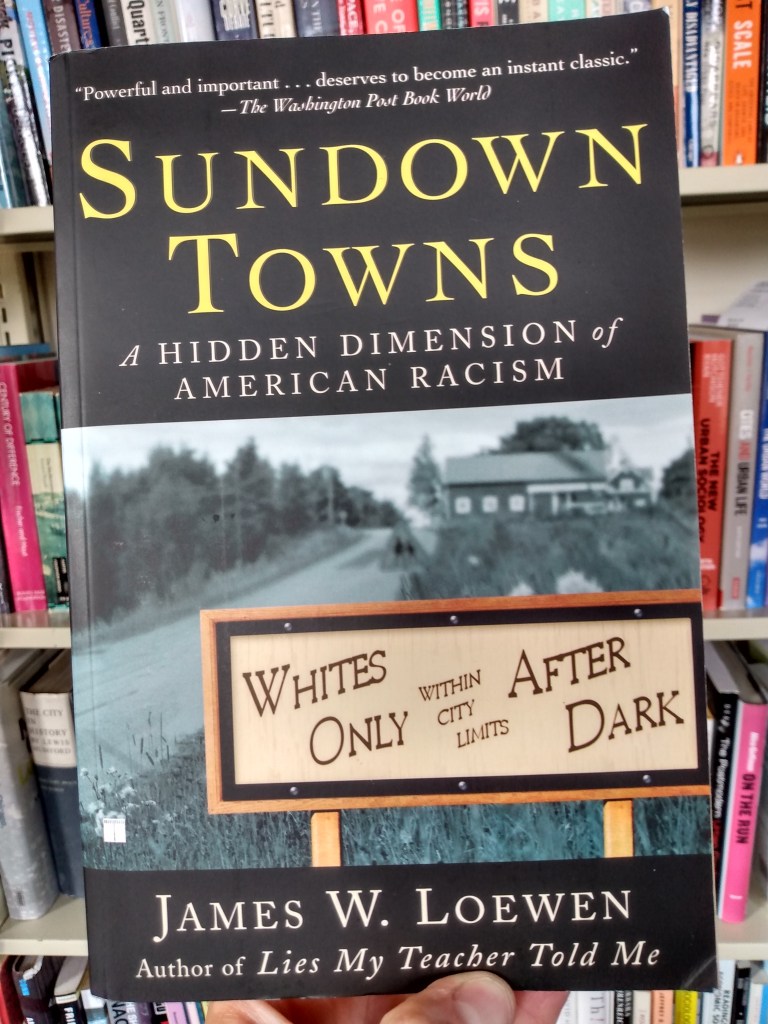
Take vigilante violence as an example. I read Sundown Towns: A Hidden Dimension of American Racism at the recommendation of a colleague and having read multiple works by sociologist James Loewen. He argues that a significant number of Northern towns and cities had informal sundown laws that prohibited minorities from being in the community after dark with violence implied if the norms were not followed.

Or, take the example of the role of violence in residential segregation. After violence at a South Shore beach set off moreviolence in Chicago in 1919, residential segregation was enforced not just with restrictive covenants and blockbusting and redlining: actions involved bombings and attacks. Historian Stephen Grant Meyer detailed some of this in his book As Long As They Don’t Move Next Door: Segregation and Racial Conflict in American Neighborhoods, a book I read for a class paper. In places like Cicero, Illinois and Levittown, Pennsylvania, violence accompanied attempts of blacks to move to the suburbs.

CiceroRiot1951ChicagoTribune

Photo by Chicago Tribune, July 13, 1951

Or, take the last in the list as an example. The book that really brought this to my attention as a student was Philip Agee’s Inside the Company: CIA Diary. This led me to read a lot about the Church Committee’s work in 1975-1976 as well as assassinations in the United States and ones in which the United States played a role abroad. In several papers, I worked with the idea of assassinations, discovered databases of political violence in countries around the world that political scientists have collected for decades, and found that the political violence rates in the United States are high.

All together, the United States is awash in violence. It is part of American history, it is regularly promoted, and it is often excused or justified. Thinking about some of the examples I noted above, I found out about these through reading and research because these stories are widely taught, known, or experienced by significant segments of the population. Yet, violence is antithetical to numerous aspects of American society and ideals, including the religious beliefs of many Americans, particularly when harnessed alongside other destructive ideologies such as white supremacy or colonialism.

Divided By Faith, race, and religion

When I teach Introduction to Sociology, one of the texts I use is Michael Emerson and Christian Smith’s 2000 book Divided By Faith: Evangelical Religion and the Problem of Race in America. Here are parts of Chapter Four (“Color Blind: Evangelicals Speak on the “Race Problem””) that seem very pertinent:

The racially important cultural tools in the white evangelical tool kit are “accountable freewill individualism,” “relationalism” (attaching central importance to interpersonal relationships), and antistructuralism (inability to perceive or unwillingness to accept social structural influences). (76)

But, these perspectives are not just tied to race:

Unlike progressives, for them individuals exist independent of structures and institutions, have freewill, and are individually accountable for their own actions. This view is directed rooted in theological understanding… (76-77)

A summary later in the chapter:

On careful reflection, we can see that it is a necessity for evangelicals to interpret the problem at the individual level. To do otherwise would challenge the very basis of their world, both their faith and the American way of life. They accept and support individualism, relationalism, and anti-structuralism. Suggesting social causes of the race problem challenges the cultural elements with which they construct their lives. This is the radical limitation of the white evangelical tool kit. This is why anyone, any group, or any program that challenges their accountable freewill individualist perspectives comes itself to be seen as a cause of the race problem. (89)

And back to race:

But white evangelicals’ cultural tools and racial isolation curtail their ability to fully assess why people of different races do not get along, the lack of equal opportunity, and the extent to which race matters in America. Although honest and well intentioned, their perspective is a powerful means to reproduce contemporary racialization…

This perspective misses the racialized patterns that transcend and encompass individuals, and are therefore often institutional and systemic. It misses that whites can move to most any neighborhood, eat at most any restaurant, walk down most any street, or shop at most any store without having to worry or find out that they are not wanted, whereas African Americans often cannot. This perspective misses that white Americans can be almost certain that when stopped by the police it has nothing to do with race, whereas African Americans cannot… (89-90)

The book is twenty years old and has led to productive listening, conversations, action, and scholarship. Yet, the intersection of race and religion, the deeply embedded assumptions in faith and other spheres of life, still matters today.

(See this 2016 post titled “How white evangelicals define themselves – and what is missing” for an earlier discussion involving Divided By Faith.)

When protests make it to the wealthier suburbs, this means…

With protests spreading across the United States, including wealthy suburbs like Naperville, Illinois and Dunwoody, Georgia, this could hint at several forces at play:

NapervilleCorner

-Americans dislike or disapprove of blatant injustice. (Whether that extends to making significant changes or sacrifices is another story. The suburbs are built in part on race and exclusion.)

-The population composition of suburbs has changed in recent decades. As William Frey of Brookings Institution details in Diversity Explosion, minority populations have grown across suburbs.

-The image of primarily conservative voters in wealthy suburbs may not be as valid as it was in the past. The outcome of the 2020 election depends in part on suburban voters with suburbanites closer to big cities leaning toward Democrats and suburbanites on the metropolitan edges leaning toward Republicans. And appealing to suburban women are important for candidates.

-Certain upscale suburban locations have become important sites for attracting attention because of their status. For example, Occupy Naperville occurred in 2012 and Naperville attracts other protestors as the largest community in DuPage County, its walkable downtown with lively stores, restaurants, and recreational options, and its status.