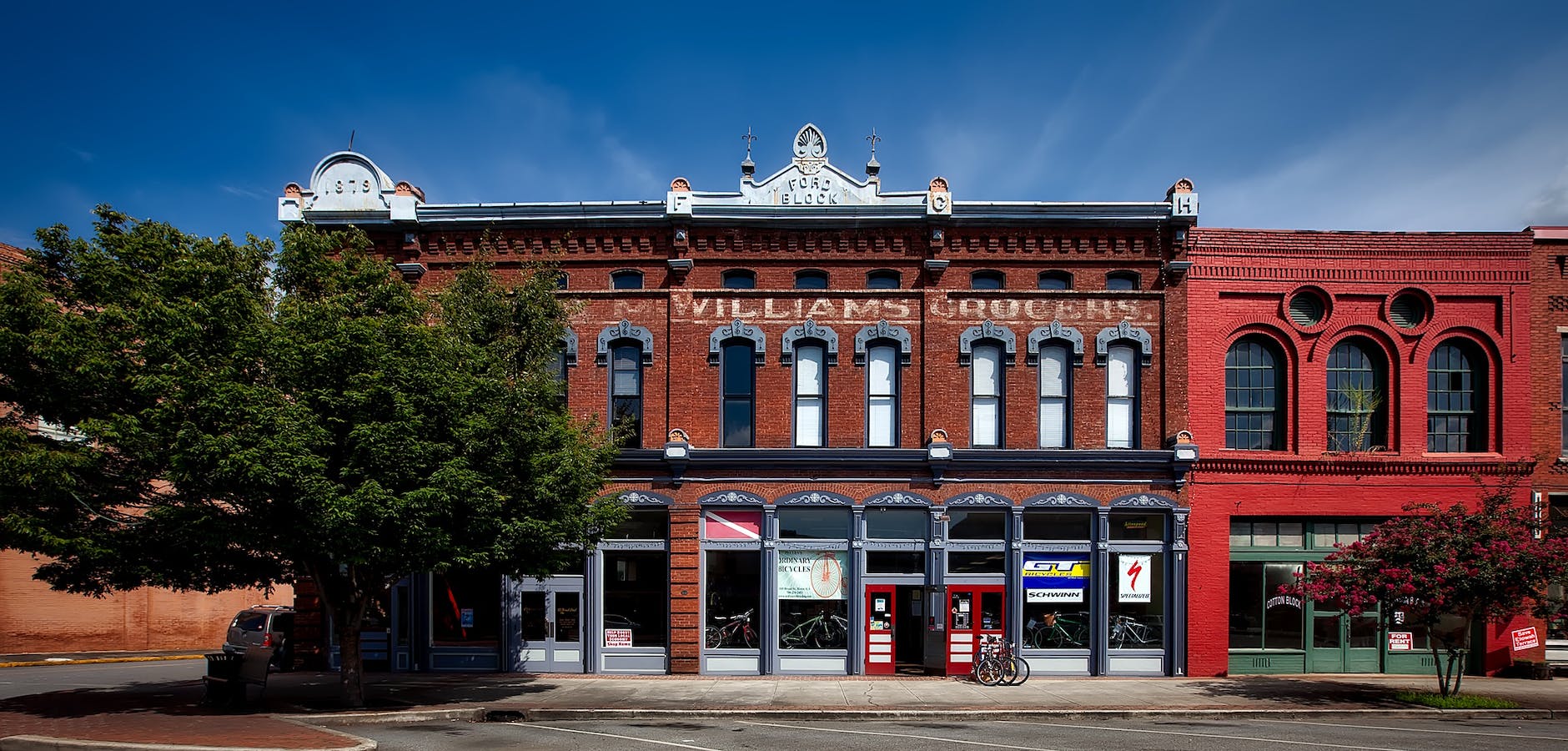
With talk of empty urban office buildings leading to a decline in property values, how might this affect tax revenues collected by cities? Here is one estimate:
Municipal governments have even more to worry about. Property taxes underpin city budgets. In New York City, such taxes generate approximately 40 percent of revenue. Commercial property—mostly offices—contributes about 40 percent of these taxes, or 16 percent of the city’s total tax revenue. In San Francisco, property taxes contribute a lower share, but offices and retail appear to be in an even worse state.
These are not huge numbers but they do contribute to the overall local budget picture. Office or commercial buildings in cities that are not being used or are being turned over to lenders or are prospects for building conversions will not generate as much tax revenue as they might when demand for such properties is higher.
How will cities address this? It will be interesting to see different approaches that could be affected by local real estate markets, housing needs, and budget specifics. If there are a few cities that are able to limit the revenue damage, they might serve as models for others.
(This is also a problem for suburbs with large amounts of office and commercial space.)
Specifically, it has everything to do with LKFS, which stands for “Loudness, K-weighted, relative to full scale” and which, for the sake of simplicity, is a unit for measuring loudness. Traditionally it’s been anchored to the dialogue. For years, going back to the golden age of broadcast television and into the pay-cable era, audio engineers had to deliver sound levels within an industry-standard LKFS, or their work would get kicked back to them. That all changed when streaming companies seized control of the industry, a period of time that rather neatly matches Game of Thrones’ run on HBO. According to Blank, Game of Thrones sounded fantastic for years, and she’s got the Emmys to prove it. Then, in 2018, just prior to the show’s final season, AT&T bought HBO’s parent company and overlaid its own uniform loudness spec, which was flatter and simpler to scale across a large library of content. But it was also, crucially, un-anchored to the dialogue.
“So instead of this algorithm analyzing the loudness of the dialogue coming out of people’s mouths,” Blank explained to me, “it analyzes the whole show as loudness. So if you have a loud music cue, that’s gonna be your loud point. And then, when the dialogue comes, you can’t hear it.” Blank remembers noticing the difference from the moment AT&T took the reins at Time Warner; overnight, she said, HBO’s sound went from best-in-class to worst. During the last season of Game of Thrones, she said, “we had to beg [AT&T] to keep our old spec every single time we delivered an episode.” (Because AT&T spun off HBO’s parent company in 2022, a spokesperson for AT&T said they weren’t able to comment on the matter.)
Netflix still uses a dialogue-anchor spec, she said, which is why shows on Netflix sound (to her) noticeably crisper and clearer: “If you watch a Netflix show now and then immediately you turn on an HBO show, you’re gonna have to raise your volume.” Amazon Prime Video’s spec, meanwhile, “is pretty gnarly.” But what really galls her about Amazon is its new “dialogue boost” function, which viewers can select to “increase the volume of dialogue relative to background music and effects.” In other words, she said, it purports to fix a problem of Amazon’s own creation. Instead, she suggested, “why don’t you just air it the way we mixed it?”
This change in how television audio works contributes to needing subtitles to understand what is being said.
I wonder if the bigger question is whether this significantly changes how people consume and are affected by television. If we are reading more dialogue and descriptions, does this focus our attention on certain aspects of shows and not others? Could this be good for reading overall? Does it limit the ability of viewers to multitask if they need to keep up with the words on the screen? Do subtitles help engage the attention of viewers? Do I understand new things I did notice before in the world with fewer subtitles? Does a story or scene stick with me longer because I was reading the dialogue?
Does this also mean that as Americans have been able to buy bigger and bigger TVs for cheaper prices, they are getting a worse audio experience?
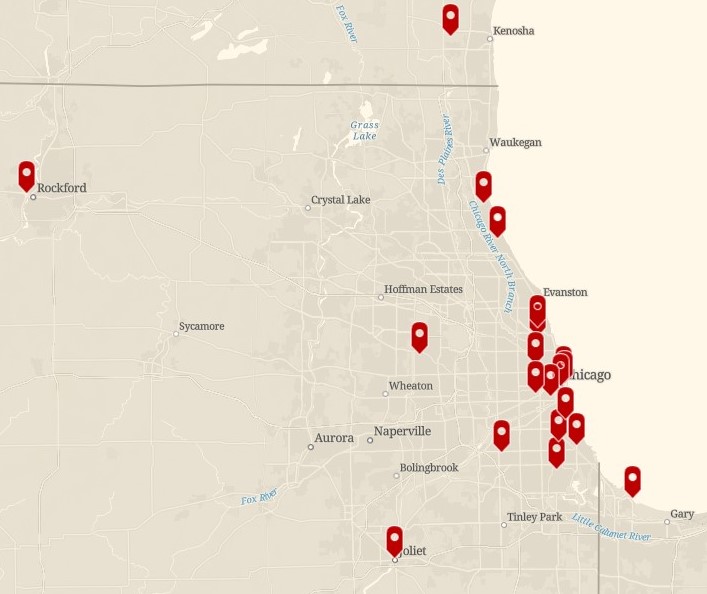
I do not know enough literature to know how well this map might reflect the totality of fiction written about and/or set in Chicago. However, the map above has relatively little from the suburbs. Here are the suburban works listed (a few others have markers in the suburbs but the descriptions say they are set in Chicago):
-Joliet – A Martyr for Suzy Kosasovich (2008)
-Salt County, Illinois – Water Marked (2000) [this is the one with a marker in northeast DuPage County on the map above]
-Prairie Park, Illinois – Neon Green (2016) [this is the one with a marker in northwest Indiana]
More broadly, is there any consensus on the best suburban novel of the last few decades? Academic treatments of the literature set in suburbs often cite novels like The Crack in the PictureWindow or Revolutionary Road from the early years of postwar suburbia.
There are more than 2,000 active adult communities from Florida to California, and all along the Sunbelt in between. Click on websites such as PrivateCommunities.com or 55Places.com, and the results can be overwhelming. Florida has 673 to choose from. California has 220. Arizona has 151. There are 217 more in the Carolinas. Pennsylvania has 215.
“Over the past decade, the housing market has been driven, in part, by the 73 million Baby Boomers who have been buying homes as they retire and adopt new lifestyles,’’ says Rob Parahus, president and chief operating officer for Toll Brothers, one of the leading home builders in the U.S.
Multiple forces helped bring this together: developers and builders seeing an opportunity, a growing number of aging Americans, people with money wanting to have communities with particular amenities and protections against what they might find elsewhere, and an ongoing interest in homeownership.
I imagine there are things missing from these communities. If a group of people with means have come together in an age-restricted community, they will not encounter all the same people and/or neighbors they might elsewhere.
What happens to these communities in a future when there are fewer older Americans who want to live in such places? How easy might it be to convert communities back to the general housing stock?
What is the modal experience in these communities or does it vary quite a bit? Some of these places get more media attention than others. Take, for example, The Villages in Florida is well known. But, it is hard to know from the occasional news story about whether this is a “typical” adult active community or not.
The context for this quote is a dispute between local governments in the region about obtaining water. Hundreds of millions of dollars, perhaps billions, are on the line. People need water. For now, it is there and it probably will be there for a long time…but it is not guaranteed to be there.
“We will continue the ongoing demolition activity and work toward a path forward in Arlington Heights, but it is no longer our singular focus,” Scott Hagel, the Bears senior vice president of marketing and communications said in a statement. “It is our responsibility to listen to other municipalities in Chicagoland about potential locations that can deliver on this transformational opportunity for our fans, our club and the state of Illinois.”…
This isn’t the first time there’s been hopes of a Bears move to the suburbs. Through the years, the Bears have considered sites in Hanover Park, Hoffman Estates, Aurora, Elk Grove Village and Waukegan. And once before in Arlington Heights.
Wehrli’s letter touts Naperville as accessible through major highways, such as the east-west Interstate 88 and the north-south Interstate 355, as well the city’s downtown Metra train station. There are also Metra stops in nearby Lisle and on Route 59 in Aurora.
The meeting is a major splash for Wehrli, who was elected in April and has been mayor for only a month. A lifelong Naperville resident with family roots in the community dating back to the 1840s, his letter to Warren stresses the impact an NFL stadium would have on the city.
This strategy works for the Bears because they can seek out a community that will give them a good deal on land, permits, taxes, and more. Their goal is to make money off the stadium and nearby development.
This strategy might work for individual suburbs beyond Arlington Heights. If the Bears do not come to Naperville, does the new mayor lose anything by reaching out? Even a short conversation keeps his community in the news. If the Bears come, it could be touted as a big deal. (On the other hand, just as some residents and taxing bodies in and near Arlington Heights are not thrilled about the Bears locating there, I imagine there would be some resistance in Naperville.)
Arizona officials announced Thursday the state will no longer grant certifications for new developments within the Phoenix area, as groundwater rapidly disappears amid years of water overuse and climate change-driven drought.
A new study showed that the groundwater supporting the Phoenix area likely can’t meet additional development demand in the coming century, officials said at a news conference. Gov. Katie Hobbs and the state’s top water officials outlined the results of the study looking at groundwater demand within the Phoenix metro area, which is regulated by a state law that tries to ensure Arizona’s housing developments, businesses and farms are not using more groundwater than is being replaced.
The study found that around 4% of the area’s demand for groundwater, close to 4.9 million acre-feet, cannot be met over the next 100 years under current conditions – a huge shortage that will have significant implications for housing developments in the coming years in the booming Phoenix metro area, which has led the nation in population growth.
State officials said the announcement wouldn’t impact developments that have already been approved. However, developers that are seeking to build new construction will have to demonstrate they can provide an “assured water supply” for 100 years using water from a source that is not local groundwater.
The sprawl of the United States depends on cheap and abundant water available for the new properties. Phoenix is not alone in pursuing sprawl or in not having to think much about water for a long time.
However, the immediate and long-term future in at least a few metro areas involves a lack of water. This is certainly an issue in the West and Southwest. It could be in play in other regions as well.
This has been possible with Photoshop and similar tools for years but Magic Eraser from Google makes it even easier: we can get rid of strangers in our photos. Should we?
My most Andy Rooney opinion, at least since the latest flare-up of the sleepover debate (I’m pro), is that we should not erase strangers from our family pictures. My original nuclear family’s albums, which my mother maintained in those classic 1980s scrapbooks with self-adhesive pages, annotating each image in her distinctive handwriting, are absolutely, positively chock-full of randos. When I was in elementary school, I loved to look at these pictures, hauling out two albums at a time and paging through them at our kitchen table. It was a time when I was becoming acutely aware of the difference between our family and others—not in a bad way, but in an interested one. We lived in a small town, and our family vacations gave us information about how things were elsewhere. I wasn’t going to pass up analyzing those clues.
The people we are around are also parts of our lives, even if we do not know them. To take pictures in public often means that others are present. We may not interact with them but we do not live in a world where we have our own bubbles and no one else is around.
There may be occasional times where removing strangers makes sense. Perhaps we want to focus on particular people or a particular scene. But, doing this at a larger scale always puts us at the center and makes it appear as other people do not exist.
Is this a continuation of the emphasis on the individual self? Social media, which is linked to the images we take, see, and use today, also encourages emphasizing ourselves. In images and a world where there is no one portrayed around us, we are at the center.
A future world where our pictures only feature us makes me think of Black Mirror or an extended global pandemic where streets and public places are empty. It would be a loss of our collective memories and the ways that we rely on nameless others every day.
The University of Illinois Extension earlier this year held a seriesof webinars to arm leaders of rural communities with positive data, such as fully occupied homes and anchored schools, while suggesting language those leaders should use to recruit people to move to rural towns, which are often coping with negative stereotypes…
Indeed, residents and leaders in Cullom and Wenona, a town of 1,000 an hour’s drive away and about 25 miles south of the LaSalle-Peru area, say their towns are very much in demand. Cullom Mayor Barbara Hahn said that people — mostly from larger cities around the state — call her “all the time” to see if there are any houses for sale and she mostly has to tell them that the housing stock is at capacity…
But Neste said that the lack of population increase is not because rural life is undesirable…
The circumstances lead to one inescapable, albeit morbid, conclusion, experts say. Prospective rural dwellers are left waiting for seniors occupying single-family homes to die.
What is lurking behind this discussion is an assumption in the United States about communities: they are considered healthiest if they are growing. Communities whose populations are stagnant or declining are often viewed as not doing well. There needs to be construction, population growth, and new businesses in a community for outsiders to suggest that it is doing well. The end of this story above tells of one downstate small town that implemented a TIF district and took on risk in order to build some new housing.
But, not all communities in the United States grow decade after decade. Some are growing now, particularly in the Sunbelt. A number of cities, suburbs, and small towns reached their population peak in the past. Some of these examples are regularly discussed, such as Detroit or Chicago or rural small towns.
The measures suggested above offer some different ways of discussing the vitality of a community. In-demand housing is something Americans understand; if there are few housing units available, this suggests people like the community. Having thriving schools is another aspect Americans like as good schools suggest a community has plenty of children and the community rallies around an institution that can help the next generation succeed.
Other measures that might also be helpful:
-The number of active community groups. This suggests people want to participate.
-The number of local jobs available per resident. Are there economic opportunities in the community?
-The number of local businesses owned by residents or nearby residents. This highlights local business activity compared to national firms (like dollar stores or fast food restaurants).
More broadly, a more open conversation among Americans about what marks a healthy or good or desirable community could provide more measures than just population growth.
The sounds of summer fun ripple up from ads for Swimply, an app that allows homeowners to rent out private pools to strangers looking to enjoy cool water under the hot sun. But that seasonal chorus has sharply divided suburban residents of Montgomery County as the local government considers formally regulating the short-term amenity rentals — potentially becoming the first in the nation to do so…
It is only mid-spring, but already dozens of pools in and around Maryland’s most populous county have been listed for rent on Swimply, which launched in 2020 as people sought alternatives to public pools that shut down because of the pandemic on the heels of the wild success of apps like Airbnb and Uber. Hosts set hourly rates anywhere between $25 to $100 an hour to access private backyard pools that bypass lines and crowds.
Unlike long-established home rental and ride sharing apps, newer apps that let people rent out their pools, home gyms and backyards have largely been unregulated across the United States so far. In fact, several jurisdictions, from the city of San Jose to towns across New Jersey to the state of Wisconsin, have tried over the past three years to ban the rentals or set up strict rules that require private pools to meet the same standards as a public pool…
A like-minded group of 36 county residents from Chevy Chase, Rockville, Montgomery Village, Kensington and Rosemary Hills, wrote a letter opposing the bill and asking the county instead to outlaw the amenity rentals altogether. The group argued that the rentals turn quiet residential neighborhoods into bustling business districts, without the infrastructure to support commercial activity. They raised dozens of concerns, largely over the added nuisance of strangers pouring into their neighborhoods because of the apps, congested roads, scarce parking, and noise and safety.
Should the property rights of homeowners reign supreme – they can do what they want with their property – or is this too much activity within residential neighborhoods where people expect quiet and do not want neighboring activities that they perceive will affect their property values?
If Montgomery County does not regulate this, someone will. I can imagine an alternative line of reasoning from a suburban government: this is a possible revenue stream.