Americans fight for the right to have cheap or free parking

One columnist uses a story of obtaining a parking ticket on vacation to argue Americans like cheap parking:

I finally paid my parking ticket last week, but only because my wife reminded me. The ticket arrived unbidden on my windshield while we were on vacation. I parked too long in what I should have recalled but didn’t was a one-hour zone. I had no defense and sought none. As one who tries to be a good citizen, I stuck the small manila envelope above the visor on the driver’s side of the car, planning to pay up as soon as possible … and immediately forgot its existence. We arrived home from vacation with the ticket still hidden above the visor…

Indeed, the fact that the city increased the fines by only $5 helps illustrate the uneasy relationship between drivers and urban planners. Planners hate cars; drivers love them. Drivers have more votes than planners, so parking stays cheap…

Which brings us back to my parking ticket. Nobody has more status and power than the state, so why didn’t I pay my ticket at once? Because the state’s status and power are not strongly signaled. The face value of the ticket was relatively low — $20 — and paying late increased the fine only by $5. Now imagine increasing both by a factor of 100. Were the fine $2,000 and the late fee $500, most of us would pay on time. As a matter of fact, we’d go out of our way never to be ticketed. We might even forego our beloved cars and turn to public transportation.

Except that we wouldn’t. We’d rise in revolt instead, demanding a return to cheap parking. We’d be wrong, but we’d win.

For many urbanists, the car is the antithesis of urban life. To have thriving street life, the sort of streetscape described by Jane Jacobs in The Death and Life of Great American Cities, people need to be walking rather than seeing places go by at 30 mph and above. Perhaps cars should be banned all together in some places. Reliance on the car ends up shifting resources to having wide and efficient roads rather than the traditional style and walkable neighborhoods New Urbanists tout. The sprawl of the suburbs is only possible because cars enable wealthier residents to leave the city and its residents behind for the night.

On the flip side, American love cars. Arguably, the suburbs are the prime illustration of a life built around and enabled by personal vehicles. The federal government largely funded interstates, allowing more workers to move to the suburbs. The new shopping malls of the postwar era included many indoor stores at once but also free parking. Communities, both suburban and urban, fought over whether to compete with the shopping malls with free street parking or continue to use parking meters. If owning a car is expensive enough, does the average user want to also have to pay for parking?

Outside of the densest areas in the United States, such as Manhattan where parking can go for a premium, parking will likely remain rather cheap. It would be interesting to see one or two cities really try to go after cheaper parking to push mass transit or other transportation options. Could places like Seattle or Austin get away with it? Maybe but even there many people in the region need a car. Perhaps significantly raising parking prices would have to go hand in hand with constructing and pushing transit options to truly change behaviors.
Argument: mass transit service comes before demand

A history of the decline of mass transit in the United States concludes with this claim: there must be transit service in order to generate demand.

The story of American transit didn’t have to turn out this way. Look again at Toronto. It’s much like American cities, with sprawling suburbs and a newer postwar subway system. But instead of relying on park-and-ride, Toronto chose to also provide frequent bus service to all of its new suburbs. (It also is nearly alone in North America in maintaining a well-used legacy streetcar network.) Even Toronto’s suburbanites are heavy transit users, thanks to the good service they enjoy.

Likewise, in Europe, even as urban areas expanded dramatically with the construction of suburbs and new towns, planners designed these communities in ways that made transit use still feasible, building many of them around train stations. When cities like Paris, London, and Berlin eliminated their streetcar networks, they replaced them with comparable bus service.

Service drives demand. When riders started to switch to the car in the early postwar years, American transit systems almost universally cut service to restore their financial viability. But this drove more people away, producing a vicious cycle until just about everybody who could drive, drove. In the fastest-growing areas, little or no transit was provided at all, because it was deemed to be not economically viable. Therefore, new suburbs had to be entirely auto-oriented. As poverty suburbanizes, and as more jobs are located in suburban areas, the inaccessibility of transit on a regional scale is becoming a crisis.

The only way to reverse the vicious cycle in the U.S. is by providing better service up front. The riders might not come on day one, but numerous examples, from cities like Phoenix and Seattle, have shown that better service will attract more riders. This can, in turn, produce a virtuous cycle where more riders justify further improved service—as well as providing a stronger political base of support.

I wonder how much infrastructure – largely paid for by taxpayers and serving the public – differs from other kinds of innovation. Sometimes, new products meet a clear demand. At other times, a new product generates new demand that people did not even know existed.

Furthermore, let’s say for the sake of argument that this claim is true: building more mass transit lines and options would eventually increase demand. Municipalities and governments would still be left with a tricky issue: is there enough will or enough resources to pay what can be massive costs up front with a promised payoff in the future? Long-term thinking is not necessary something Americans have done well in recent decades. (And this does not even include the possibility that the big investment might not pay off.)

Finally, another way to approach this is to start with smaller-scale projects, show people that they work, and then build up to a larger structure. In many American communities, this would mean starting with bus service since plenty of roads already exist. But, many Americans do not like buses. They may be more likely to take trains but these require a lot more work and money.

Speeding occurs when a road feels like a highway but has low speed limits

An analysis of high-speed tickets issued in Chicago highlights a fundamental contradiction with Lake Shore Drive:

The number of tickets issued on Lake Shore Drive points to a long-standing problem — with four lanes in each direction along most of the road, the drive looks and feels like a highway, though it was intended as a scenic boulevard and in some places has no guard rails or emergency shoulders. The maximum speed limit is 40 mph on the North Side and 45 mph on the South, but up to 95 percent of drivers exceed the limit when the road is not congested, according to an Illinois Department of Transportation study.

The majority of motorists getting nabbed for speeding on the drive were going at least 75 to 80 mph.

“I observe some people driving extremely fast,” said Joseph Schofer, a professor of civil and environmental engineering at Northwestern University. “The roadway kind of invites that. When there’s not much traffic, it’s a pleasant drive; there are not many sharp curves. It feels like the Edens Expressway.”…

While drivers speed both north and south of Madison, there are more tickets on the South Side. It is both easier to go at high speeds and easier to catch speeders south of the Museum Campus.

The current solution to the contradiction seems to be more enforcement of speed limits on Lake Shore Drive. More tickets and public knowledge of more tickets issued should theoretically help drivers think twice before going fast.

But, this ignores the underlying issue: the road is built and designed in such a way that fast driving can appear safe. Even if the road is not actually built for those speeds, having all those lanes plus a large number of drivers going fast can overrule a rational approach to the speed limit. Additionally, this is a major north-south artery in Chicago. There are a limited number of these, particularly those without many traffic stops. Outside of a crowded Kennedy and Dan Ryan Expressways (consistently rated as some of the worst spots for traffic in the United States), Lake Shore Drive is it. Even with its traffic lights around Grant Park, it offers unparalleled ease of travel.

It would be interesting to see what the City of Chicago could dream up to slow down drivers. The other complication is the road is intended to be a scenic one as it often travels through parks and offers numerous great views on one side of Lake Michigan and on the other a thriving global city. Speed bumps? Giant signs about traffic? A road diet to limit the width of the road? More guard rails and visible safety symbols? If the true goal is to improve safety, just handing out tickets is not enough.

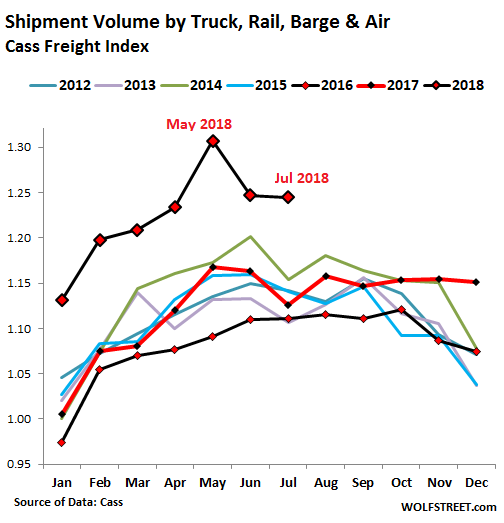
Shipping via truck and railroad in a strong economy

If the economy is going well, the trucking and railroad industries have plenty of work to do:

The dynamics in the transportation sector are “clearly signaling that the US economy, at least for now, is ignoring all of the angst coming out of Washington D.C. about the trade wars,” the report by Cass said.

The Cass Shipments Index does not include shipments of bulk commodities, such as grains or chemicals. But shipments of commodities were strong too, according to the Association of American Railroads. Excluding the carload category of coal, which is facing a structural decline in the US, carloads rose by 6.7% year-over-year, including grain, up 14.7%; petroleum & petroleum products, up 27%; and chemicals, up 4.6%. Of the 20 commodity carload categories, only five showed declines, including nonmetallic minerals, metallic ores, and the biggie, coal.

And intermodal traffic – shipments of containers and trailers via a combination of rail and truck – surged 6.9% in July compared to July last year, the AAR reported.

At the least, this is just a reminder of how goods make their way to stores and eventually buyer’s residences. Those trucks and trains may be a nuisance when you want to get where you want to go but this is how it works in our society.

A few other thoughts:

  1. It is hard to imagine drones could make up for all or even many of the goods shipped by trucks and trains. Or, imagine drones like swarms of locusts.
  2. The shipping industry is another one highly affected by economic swings. Like the construction and housing industries, when times are good, there is a lot of need for goods to be moved around. When a recession hits, all that equipment and all those employees are not needed.
  3. Of course, there is an international component to all of this where goods have to enter or leave countries. That all happens on a consistent even with all the rhetoric regarding trade wars and trade agreements. I remember going past some of the shipping yards in Hong Kong and being amazed at the size of the facilities: cargo containers in huge piles for as far as one could see.

CREATE plan slowly moves to address Chicago area railroad congestion

An expensive and sizable project aims to solve the train congestion in the Chicago region:

CREATE takes an incremental approach to fixing rail gridlock in the suburbs and Chicago, the nation’s busiest rail hub.

One overpass here, two extra tracks there, and eventually freight trains will be chugging along instead of noisily idling in your neighborhood while emitting diesel fumes.

The downside is the cost — a staggering $4.4 billion to fix the region’s outdated rail infrastructure.

Despite funding challenges, 29 out of 70 CREATE projects in the region have been completed with $1 billion spent, Association of American Railroads Chief Engineer for CREATE William Thompson explained during a recent tour…

The Chicago region handles a whopping 25 percent of freight traffic in the U.S. That means almost 500 freight trains and 760 Metra and Amtrak trains pass through the region daily. Completing the Chicago Region Environmental and Transportation Efficiency Program that builds bridges and new track will mean the metro area can host 50,000 more freight trains a year by 2051.

The Chicago area is a critical railroad hub for the entire nation. Yet, given the amount of development in the region, making significant changes is difficult. For example, construction at O’Hare Airport is held up by a dispute over railroad land adjacent to the busy facility. Or, suburban residents and communities do not like it when freight traffic is increased near them even if benefits the region as a whole. Or, getting rid of the many at-grade crossings is a slow process. This is another good illustration of how foresight – addressing these issues decades ago as the region was growing at a face pace – could have cut off numerous later issues.

Also, I am intrigued by the last line from the article quoted above. I assume most of the region’s residents would assume that the amount of time and money poured into this project would eventually mean that they would encounter fewer trains. And this might be the case if more bridges, underpasses, and routes around the outskirts of the region limit the vehicular contact with trains. Yet, increasing the number of freight trains by 50,000 means more noise and possibly more traffic issues at the points in the transportation grid where trains and vehicles still come in contact. Would the majority of residents want 50,000 new trains? I would guess no even if it is essential to their day-to-day lives (delivering goods and food, etc.).


Why Americans love suburbs #5: cars and driving

If the single-family home offers private space in suburbia, the car offers private mobile space. The home offers a base to which the owner can retreat, the car offers the chance to travel elsewhere. Even if the single-family home is the ultimate focus of suburbia, these homes are hard to imagine without cars in the garage or driveways (usually front-facing, sometimes in the rear) or without traveling to the suburban in something other than a car. Cars and homes are intimately connected in American society.

Americans love driving (and need convincing to instead use mass transit). The suburbs require driving. The sprawling nature of suburban communities are often ill-suited for mass transit. On one hand, driving offers freedom to go where you want when you want. It is a symbol of American individualism. On a global scale, Americans have one of the highest rates of car ownership. On the other hand, owning a car has numerous costs. It is not just the obvious costs of gas, insurance, and car maintenance (and even these add up for the average owner). Additionally, critics would argue cars are a drain on community life as people can build relationships and spend money wherever their car can take them, commuting via car can take a lot of time and can limit economic mobility, road networks are costly to maintain, have negative effects on the environment, contribute to health issues through limited walking and biking, and are a menace to pedestrians and bicyclists who want to be part of the streetscape as well as are a safety threat to drivers and passengers themselves. Even with these costs, Americans persist in driving. For example, rather than push back against highways and driving in the auto-dependent Los Angeles area, officials instead focused their efforts on getting more efficient cars. The thought of major highways closing for a few days in a sprawling region creates near panic and highways can become effective sites for protests because of the number of inconvenienced drivers.

Numerous aspects of suburbia emphasize the love of cars. The single-family home would be incomplete without a garage. As homes increased in size over the decades, so did garages. The pattern of driving out of the garage at the beginning of the day and back in at the end with minimal neighborhood interaction may not characterize every home but is common enough. Many suburban single-family home are located along residential streets that are plenty wide and can handle cars traveling at decent speeds. The fast food restaurant would not be possible without cars. What is more American than going through the McDonald’s drive-thru in the midst of another suburban trip? Think of the many commercial strips all around America with fast food restaurants and strip malls (they may even not be considered aesthetically appealing by some suburbs). Similarly, the big box store – Walmart, Costco, Ikea – and shopping malls would not be possible without cars. In these spaces, hundreds of separate drivers can congregate in massive parking lots for unparalleled choice and prices. Numerous industries, let alone the automobile industry, depend on cars, vehicles, and roads.

The suburban car is part status symbol, part lifeline to the outside world. What vehicle you have matters and judging from the vehicles around me, the suburban family life is impossible without an SUV or minivan. Not being able to drive is a huge problem (sorry teenagers and some seniors). The largest category of trips involves drives between suburbs, particularly for work as jobs are spread throughout suburban regions. Additionally, the image of soccer moms persists as kids need to get to all of their activities.

It is difficult to predict how exactly cars fit into the future of suburbs. Driverless cars may mean fewer people need to own their own vehicle (those garages can then be used to store more stuff!) but being able to relax or do work rather than drive may mean people could live even further from cities. Millennials have less interested in car ownership and driving. Numerous suburbs are pursuing denser developments, particularly along railroad or transit lines, and this could limit car use in those areas and create more walkable spaces. Yet, it is hard to imagine the American suburbs without many cars and the ability to travel from a single-family home to all sorts of places.

Suburban traffic trapped by train, Barrington edition

Combining the issues posed by numerous at-grade crossings in the Chicago area plus the purchase of the EJ&E tracks by Canadian National, an afternoon rush hour situation arose June 12 in the suburb of Barrington because of a stopped freight train:

Among the thousands of vehicles caught in the jam were ambulances headed to Good Shepherd Hospital with two patients from a DUI crash at Ela Road and Northwest Highway…

As first-responders quickly found out, all four CN crossings — at Main Street, Hough Street (Route 59), Northwest Highway and Lake Zurich Road — were inaccessible, and trains on an intersecting rail line also backed up…

While traffic gridlock spiraled, Barrington police who had coalesced south of the tracks to handle the DUI crash reached out to neighboring departments. “Can you please let Lake Zurich PD, Lake County and Barrington Hills know on our northwest side we have no officers on right now. So if we need assistance we’ll be calling them,” a dispatcher asked.

As she idled in traffic, Barrington resident Erika Olivares tried to troubleshoot how to reach her 8-month-old son, Leo, before day care closed. “Basically I was panicking,” she recalled Thursday.

Some desperate commuters ducked under train cars to reach the opposite side. “There are numerous people who are actually crawling over the train that’s stopped here,” a 911 caller reported. “It’s getting more and more dangerous — there are kids doing it as well.”

Several quick thoughts:

  1. I would guess the winning issue on which to focus to solve this problem are the safety concerns. If people cannot make it to the hospital or police and fire units cannot make it to scenes, lives in the community may be endangered. Even though it would be interesting to look at how many safety cases are involved on an annual basis, the argument that even one endangered life is too many would likely convince many suburbanites.
  2. The traffic caused by such an incident is experienced by numerous Chicago area suburbs. Lots of at-grade crossings add up to the potential for outraged drivers. Even if rail lines move tremendous amounts of goods, the backups may leave the average suburbanite with the impression that the trains are foremost a nuisance.
  3. The fallout of the Canadian National purchase of the EJ&E tracks continues. What is potentially lost in stories like this from Barrington about changes in communities are the effects on the entire region. One of the outcomes of the purchase was to be that more freight traffic would be rerouted around the region rather than to areas closer to the city with further inconveniences to those communities. The Chicago area has long had problems with too many trains yet it is a vital part of the local and national economy.

Two dead suburban transportation projects: the Metra STAR Line and the Prairie Parkway

A large metropolitan area of over 9 million residents could benefit from more transportation options for residents and visitors. Here are quick summaries about two projects that never got off the ground:

The STAR Line

The suburb-to-suburb STAR Line rail system was intended to loop from O’Hare to Hoffman Estates to Joliet along tracks formerly owned by the EJ & E railroad, providing an alternative to the suburb-to-city commuter lines.

But Canadian National Railroad bought the EJ & E in 2008 and moved freight traffic onto those tracks, effectively putting the STAR Line on ice. In 2011 Schaumburg pulled the plug on a special taxing district meant to spur development around the convention center, which had been envisioned as a STAR Line hub.

Prairie Parkway

The Prairie Parkway would have circled Chicago’s outer suburbs, linking I-88 near Elburn to I-80 near Minooka. The Illinois Department of Transportation began studies in 2003, and in 2005 President George W. Bush came to Montgomery to sign a highway funding bill and call the Prairie Parkway “crucial for economic progress for Kane and Kendall counties.”

Opponents organized and sued. The highway’s patron, former U.S. House Speaker Dennis Hastert of Plano, was accused of profiting from land buys near the proposed highway. And in 2012, the Federal Highway Administration rescinded its approval of the right of way. It was only in March that IDOT canceled the corridor.

I have always thought the STAR Line was a clever idea in multiple ways:

  1. It would provide needed railroad links throughout the region so that not all riders have to go into Chicago before making transfers. The spoke model in the Chicago region is good for getting to downtown but the biggest number of trips these days are suburb to suburb.
  2. It made use of existing tracks. Although they likely needed more capacity to run regular passenger service and new tracks would be needed along I-90, some of the infrastructure was already there. This is not something to look past in an era when acquiring land can be expensive and time-consuming.
  3. It had the potential to spur transit-oriented suburban development in a number of communities. This is a hot topic in many suburban downtowns and it could have opened up new commuting, residential, and business opportunities.

Yet, the plan was scuttled by several factors:

  1. A lack of money. This project has been around since the 1990s but it was unclear who would fund it.
  2. Control of the EJ&E tracks.
  3. Likely concerns from neighbors to these tracks. When CN purchased these tracks and added freight trains, multiple communities pushed back.

The Prairie Parkway may have not offered as much opportunity to remove cars from roads but could have spurred development on some of the edges of the Chicago region and offered a shorter drive time in these areas. Building belt-line highways like this require some foresight: if they are constructed after too much development has occurred, they can be much more expensive to build. Also, neighbors can object to the plans, such as with the Illiana Expressway which also has not gotten off the ground.

Adding more context to Americans spending 7% of income on gas

AAA reports on how much Americans spend on gasoline:

Analysts say Americans are now spending 7% of their income on gas, a statistic that is up 1.5% from last year.

If you make $45,000 per year, you’re shelling out over $3,000 just to put gas in your vehicle.

The 7% figure may be interesting in itself but this is a statistic that begs for more background information. Is 7% a lot or a little? Should people be alarmed?

The story already includes two pieces of context:

  1. This is an increase from last year. Generally, people do not want to be paying significantly higher prices year after year. While 1.5% is a low number, drivers would probably not want this number to keep going up.
  2. A slightly lower than average income person or family – the median household income is a bit higher than this – spends over $3,000 on gas. People could read this figure and then think where else that $3,000 could be used.

But, there is more information that could be useful here.

  1. Historically, how much do Americans spend on gasoline? The article includes a one-year trend but how does this look over decades? Are gas prices going up the same way medical costs are going up?
  2. How does this 7% compare to other essential categories of spending such as food (and the groceries vs. eating out breakdown could be interesting) or housing?
  3. What are the total costs of car ownership? Gasoline adds up but vehicle owners also have to factor in maintenance and insurance.
  4. These are average figures for gasoline consumption: how much different will gas costs be for SUV and truck owners (and these are driving the car market) versus small car owners?
  5. How does this compare to gasoline costs in other countries? The rise to 7% may seem like a lot but gasoline costs more in some other industrialized countries and people in other countries drive less than Americans.

While this may be too much to ask for a short news story, gas costs, as well as most other social and economic statistics, are complicated. The numbers do not necessarily interpret themselves. Something going up or down or staying the same is as meaningful as its context and what we make of it.

Jane Jacobs, self-driving cars, and smartphone walking lanes

Fining distracted pedestrians who are paying attention to their smartphones is one option for communities. Here is another: a Chinese shopping center in Xi’an has a clearly marked lane for smartphone-using walkers.

Colorfully painted paths outside the Bairui Plaza shopping mall have been designated for walkers who cannot be bothered to look up from their devices…

Instead, messages painted along the lane cajole walkers to look up and pay attention.

“Please don’t look down for the rest of your life,” one message reads. “Path for the special use of the heads-down tribe,” another says…

Xi’an is not the first city to experiment with special areas for mobile phone use. In 2014, a street in the southwestern city of Chongqing was divided into two sections. On one side, phone use was prohibited, and on the other walkers were allowed to use their phones “at your own risk.”

The German city of Augsburg in 2016 embedded traffic lights on the surface of the street to prevent texting pedestrians from walking into traffic.

This will be a difficult issue to tackle for many communities. Here are two more additional ideas that may (or may not) help address these concerns:

  1. In reading multiple stories about distracted pedestrians on sidewalks, I am reminded of Jane Jacobs’ thoughts on lively sidewalk life. She argued that a lively street scene full of mixed uses will promote a thriving social scene. Could it be that sidewalks need to be more lively to keep the attention of pedestrians? If someone is walking down a bland block or through a shopping mall that does not really look any different than other shopping malls, it can be easier to pull out a smartphone. Of course, users might be so familiar with the walking area or their thoughts are elsewhere such that no level of liveliness would keep them from their smartphone.
  2. Perhaps some of the technology already being rolled out in cars and destined for significant use in driverless cars that helps cars sense other objects and respond accordingly could be implemented in cell phones. Imagine using your smartphone while walking and all of the sudden a radar screen pops up that indicates you are about to run into something. Or, perhaps it could have lights on different edges that could provide indications that objects are on that side. This is where Google Glass could be very useful: a display of nearby objects could always be within a user’s vision. Maybe technology will soon advance to a point where we have “bubbles” around us displaying information and nearby pedestrians or other objects could trigger some sort of alarm.

Separate walking lanes as well as punishments may not be enough. Given our reliance on technology to solve problems, I would not be surprised if new technology ends up as a substantial part of the solution proposed for problems posed by earlier technology. At the same time, this may be less about technology and more about the changing nature of public life.