Village trustees Monday voted 4-2 to approve the 5% entertainment tax as part of its upcoming budget. The tax would take effect July 1.
Village officials budgeted $25,000 in revenue from the new tax, which would tack 77 cents onto a standard monthly Netflix subscription costing $15.49 or 15 cents to an Amazon video rental costing $2.99.
“This is a modern version of the original telecommunication tax,” Village Administrator Erika Storlie said, adding that the village has seen a decrease in taxes collected from cable subscribers as more people drop cable television in favor or streaming services…
Chicago adopted an entertainment tax charging 9% on streaming services in 2015. In March, a judge dismissed a lawsuit filed by Apple Inc. challenging the tax. Though Apple’s complaint was dismissed, the judge left the door open for Apple to file an amended complaint.
Evanston, where Storlie served as city manager before coming to East Dundee, has charged a 5% entertainment tax on streaming services since October 2020.
Several thoughts about this:
-This is a relatively small tax in this community: the story above suggest its will generate $25k in revenue. Even in a small suburb, the money this generates will only do so much?
-I could imagine the argument that infrastructure is required to provide streaming services and taxes like these would help communities cover these costs. (I could also imagine – very faintly – the logic of a vice tax to limit the hours upon hours that Americans spend in front of televisions and screens…but limiting television watching via taxation seems somehow un-American. )
-I do not recall seeing much about public discussions of such taxes within communities. Is the tax so small that it does not attract much attention? Do residents not have a compelling argument against a streaming tax?
-Entertainment taxes are sometimes used for visitors or more public activities such as tickets for sporting events or theater shows. A streaming tax is aimed more at residents than visitors.
Many municipalities need consistent tax revenue streams as they look to provide services and balance budgets. This is one way to help achieve that goal.
The fact that Secret Service, NCIS, and even DHS personnel were apparently fooled about the authenticity of Taherzadeh and Ali doesn’t actually surprise experts in the field. There’s a human tendency to accept people are who they say they are.
A cynic might say that this makes people an easy mark. Some people will take advantage of the willingness of others to trust them. This is part of the reason spam and scams work: people might not be the most discerning, particularly when the pitch looks viable.
Yet, this giving people the benefit of the doubt increases sociability, cooperation, and trust in the long run. Not everyone will take advantage of you. Humans like to be liked and work with others. Humans are social creatures whose social relationships and networks enable them to do things far beyond what the might accomplish as individuals (read more about this in Connected).
Directly confronting someone about suspicions we may have of them also is a risk. It introduces conflict and an opportunity for both the questioner and the other to be uncomfortable. As we practice impression management, we generally want to avoid losing face. Ignoring a text or email is relatively easy to do; the stakes are higher when the other person is in front of you.
This does not necessarily mean that security agencies should not have structures and/or actors who try to counter these human tendencies. But, the task may be very difficult in light of how humans want to behave.
The average American received roughly 42 spam texts just in the month of March, according to new data from RoboKiller, an app that blocks spam calls and texts…
There were more spam calls last month than in any of the previous six months, per YouMail’s Robocall Index…
Spam emails rose by 30% from 2020 to 2021, according to a January report from the Washington Post…
There was an unprecedented increase in social media scams last year, according to data from the Federal Trade Commission. Many scams were related to bogus cryptocurrency investments.
As the article notes, it keeps going in part because the spammers are successful enough. Yet, it would be worth also seeing the bigger picture: how much time and mental effort is expended fighting off spam efforts? Even if the majority of people relatively quickly discard the emails and texts or even just glance quickly at them and then ignore them, what does this all add up to?
The glut of information we all face, some positive and some negative, requires time and mental space. Just to push it aside requires a choice. We may think it does not affect us – I have heard many people say the equivalent of “advertising does not affect me” – but it does.
Could we envision a future world where we only get the firehose of information that we truly want and discard all the rest? Imagine the echo chambers or media bubbles possible today plus the technical means or financial means to only get all that we want to handle? I am not sure how advertising or alternative viewpoints might fit into all of this but I would guess there would be at least a few people willing to pay a lot to achieve this state.
Glenview officials indicated the Allstate campus is described as Territory D within the Milwaukee Road and Sanders Road Corridor Agreement between the two communities, which specifies that Glenview alone has the right to its annexation and that Prospect Heights shall not object to Glenview’s annexation.
But David Just, community engagement manager for Glenview, said Prospect Heights notified his village in late March that it intends to seek annexation of the former Allstate campus itself…
“We are disappointed to learn that Prospect Heights is now attempting to annex the former Allstate campus,” Jenny said. “This violates our long-standing agreement and partnership with Prospect Heights, and our community intends to take any and all actions necessary to enforce the terms of the agreement that governs annexation and development of this property.”
The statement added that Glenview strongly encourages Prospect Heights to respect the communities’ long-standing partnership and continue to abide by the promises made when the agreement was negotiated and approved.
Based on what I read, this strikes me as having two dimensions. There could be a legal dimension involving boundary agreements and annexations. How might the law and courts look at land between communities that could be claimed by both community or either community?
The second area involves interactions between communities in the long-term. Will Glenview and Prospect Heights see each other differently for years because of this? Will one community do something in response?
Suburban land is valuable, particularly if developers have plans for a land use that will generate additional revenues. Suburban communities are in competition for business and revenues so an opportunity like this might be too good to pass up, even if it ruffles the feathers of other actors. Given a good chance to secure a new development, how many municipalities would abide by agreements?
In a pair of radio interviews last week, Lightfoot poo-pooed a potential move, saying Arlington Heights can’t match the offer Chicago will make — or its tourist trade…
While the prospect of reelection is much more imminent for Lightfoot than where the Bears end up, any signs that she is relenting to Arlington Heights would be the death of her political career.
It was just a few months ago that Lightfoot was overtly dismissive of the Bears’ purchase agreement for the 326 acres at Arlington Park Racecourse — enough land for a world-class stadium plus all manner of ancillary entertainment businesses from which the team could profit…
If Lightfoot thinks she can keep the Bears at Soldier Field — even with a dome — she’s nuts. The constraints of the NFL’s smallest and oldest stadium won’t allow Soldier Field to host a Super Bowl or, as is important to the team, to allow the Bears to do what has become commonplace around the league: develop the stadium as an entertainment complex that generates more cash…
The only sure winner in this tug of war will be the football team.
The research consistently finds that team owners are the biggest winners in the battle to provide tax breaks, monies, and other benefits for sports teams who consider relocation. Yes, it would be a PR and status blow to Chicago to lose the Chicago Bears to a suburb – even a denser Arlington Heights – but people will still spend money in the city and the team will still be in the region. Do not go into taxpayer debt just to enrich a private football team.
It will be very interesting what kind of “best offer” Chicago will provide. And how public will this all get as the city tries to avoid losing the team?
“They are not going to sacrifice,” Spaniak said. “They don’t have the time to rehab. And they want something newer, with quality, that expresses who they are.”
That’s a tall order that often isn’t in line with the split-levels and Colonial Revival houses common in higher-end Chicago suburbs. The scarcity of polished, modern houses in established suburbs further drives up the prices of the few houses that do meet that narrow criteria, Spaniak said.
This is an issue facing many suburban communities and potential homebuyers:
Many existing homes do not have the features, finishes, or architecture preferred by homebuyers now.
More mature suburbs have a limited number of newer homes as new construction is limited to small developments or teardowns.
The housing prices in more expensive and mature suburbs are not that low that it will attract people drawn by fixer-uppers. The people who can buy and rehab homes in the wealthier suburbs have enough capital to buy in and fix or teardown the homes for a tidy profit.
Roughly five years ago, we were in a similar position looking for a larger home. Homes within our price range often needed updating or had disagreeable and unchangeable traits. The style of homes available fit into what is described above: split-levels, raised ranches, ranches, Colonials, and a few older structures. We had time and flexibility so it all worked out but I could see how the available options and at the particular prices available would frustrate some homebuyers.
The stakes are high: California grows more than a third of the vegetables and two-thirds of the fruits and nuts eaten in the United States, dominating production of artichokes, avocados, broccoli, cauliflower, carrots, celery, dates, grapes, garlic, olives, plums, peaches, walnuts, pistachios, lemons, sweet rice, and lettuce. The Central Valley is America’s agricultural heartland, crucially important to the state’s economy and the groceries of the nation. More wine grapes are grown there than in California’s wine country, more almonds than anywhere else on earth. There are more than a quarter of a million acres devoted to tomatoes, which when plucked, weighed, canned, and shipped add up to around a third of all the processed tomato stuff eaten worldwide. And that’s not to mention all the region’s livestock—chickens, pigs, cows.
When I go to the grocery store, I am not thinking about what goes into all of the food there and instead just enjoy the many options I have within and across stores. When I have a little more time to consider the process, two thoughts come to mind:
The amazing ability for humans to produce this amount of food from this amount of land. I know California is a big state and a lot of people live there and it is still astounding how much food is produced.
The complexity to pull this all off plus the burden on the natural systems that make this all possible. If one piece gets out of whack or the climate changes or human patterns change, the whole system needs to adjust.
It will take significant work to keep the system going and the food growing. While many dystopian works hint at the trouble that would come when normal food systems are disrupted, there would be serious problems if California cannot produce food in the way it does now.
“We’re still here,” says Kent Griswold, 63, who lives in Bend, Ore., and is the founder of the Tiny House Blog, which is believed to be one of the first blogs about tiny houses. “The movement hasn’t stopped growing, it’s just not in the public eye as much anymore.”…
Laubach says due to the pandemic, which has made people re-evaluate what is important, retirees, mature widows and single women are driving much of the demand today…
Griswold agrees, but says instead of just the novelty of people looking for tiny homes on wheels, which really drove the movement during the 2007-09 recession, people are looking at other ways to live small…
“Tiny homes on wheels or park models are thought of as RVs, but many jurisdictions are starting to think of them as Accessory Dwelling Units (ADUs). Still, the code problems can get frustrating for people,” says Laubach.
COVID-19 and the housing affordability issues in many metropolitan regions would seem to be the conditions under which tiny houses would thrive. People want to get away from typical locations and they need cheaper spaces.
At the same time, more uncertain economic conditions might mean that people are less likely than ever to be lenient about zoning and codes. This limits where tiny houses are possible. This is, of course, a much broader issue: many communities want to protect single-family homes at all costs.
Does this mean something has to give in the future? Can people have really high property values, complain about the lack of affordable housing or housing options, and continue to restrict other housing options like tiny houses?
The tiny house movement might be small and it might work steadily but its ongoing presence is at least a reminder that other housing options are possible.
By 2020, the A’s were the only team left. But they made it clear they were prepared to leave, too. Last May, majority owner John Fisher and team president Dave Kaval—resident cartoon villains of what remains of the Oakland sports scene—began threatening to follow in the Raiders’ footsteps and relocate Oakland’s last pro team to Las Vegas … unless the Oakland City Council voted to help them build a $12 billion stadium “district”—replete with condos, hotels, and apartment buildings—on a wedge of waterfront property operated by the Port of Oakland just west of Jack London Square. If approved, the project would constitute one of the largest and most transformative development deals in California state history. It would likewise require hundreds of millions of dollars in public funding to complete. Fisher, who is heir to the Gap Inc. fortune and has a net worth north of $2 billion, has committed to privately finance the construction of the stadium itself, but the project isn’t viable without a suite of infrastructure improvements to the surrounding area. These improvements are what the A’s asked the city to find ways to pay for.
It was a familiar ploy. As journalists Neil deMause and Joanna Cagan write in Field of Schemes: How the Great Stadium Swindle Turns Public Money Into Private Profit, since roughly 1984, when the Colts left Baltimore for Indianapolis, team owners across the country have worked systematically to “supplement profits by extorting money from their hometowns,” usually “under threat of moving.” Starting around last summer, Fisher and Kaval began to expand upon their means of municipal extortion. In the run-up to a series of contentious City Council meetings, Kaval took to posting videos of himself on Twitter jubilantly attending Las Vegas Knights games, as if to spur the city into supporting his proposal out of jealous insecurity. Fisher, meanwhile, enlisted MLB commissioner Rob Manfred to act as muscle. “Thinking about this as a bluff is a mistake,” Manfred told the BWAA in July 2021. “This is the decision point for Oakland as to whether they want Major League Baseball going forward.”
Oakland has been struggling to make that decision ever since. Some, like Marcus Thompson, an East Oakland native, 2021 California Sportswriter of the Year, and author of Golden: The Miraculous Rise of Steph Curry,resent Fisher and Kaval’s tactics, and say that Oakland’s political leaders “should not be caving to an owner” worth over $2 billion who has “shown zero desire to be a meaningful member of our community unless it is profitable.” Certain Oakland political leaders, such as Councilmember Carroll Fife, who represents the district in West Oakland where the A’s stadium would be built, agree. “There are so many dire issues in Oakland right now,” Fife told me in February—citing, among other things, Oakland’s crises of gentrification, affordability, and homelessness, which the United Nations has singled out as “cruel.” Fife said she doesn’t believe “a sports team is going to address” any of them. “We should use public resources toward addressing residents’ immediate needs.”
Others believe the economic benefits of a new stadium are worth pursuing in and of themselves. “Building the new A’s ballpark would be a blessing,” Mitchell Schwarzer, historian, professor, and author of Hella Town: Oakland’s History of Development and Disruption, told me in an email. It would “bring crowds to adjacent Jack London Square,” and fill “its vacant spaces with places to eat, drink and shop.” Oakland’s mayor, Libby Schaaf, agrees, calling the A’s stadium project “a world-class waterfront ballpark district” with the potential to “benefit Bay Area residents for generations to come.”
No major city or leader wants to lose a major sports team. And the Oakland case is unique with multiple teams leaving in recent years.
However, the price that is often paid to keep a team is not worth it. The costs are too big, taxpayers lose other opportunities, the money would be spent elsewhere in the city if not at sporting events, and the owners are the ones who truly win with the increasing value of their team.
The Oakland case is also different because of the way the Athletics are run. The team has a Billy Beane approach that suggests an excellent team can be created with a limited payroll and an ability to exploit market inefficiencies. The A’s have done this a few times in the last two decades…and then they sell off all of their good players and start again. They just did this going into the 2022 season and have a minimal payroll of just under $50 million, second-lowest in baseball and roughly one-fifth of the biggest spenders in the sport. In addition to the economic case for taxpayers, is this a team worth supporting?
The wildland urban interface often leads to stories about suburbanites encountering animals they might not expect. Recently in the Chicago region: a bison free in the northern suburbs.
One resident in Hawthorn Woods recently captured footage of a buffalo out and about, just walking around. Believe it or not, this isn’t the first time one has been spotted roaming the region.
Vince Clemens noticed the giant animal outside his home Friday, and his daughter, Michelle, captured video of the buffalo just minding its own business.
“I looked outside and saw the buffalo walking down the street,” Vince Clemens told NBC 5. “[She] broke free from a farm months ago, and is no stranger to people in the Northwest Suburbs…”
The wayward animal’s identity hasn’t been confirmed, but some wonder if its “Tyson the Bison.” Tyson escaped last September while being unloaded at her new home at a farm in unincorporated Wauconda.
More Americans may be much more familiar with seeing bison in captivity, such as in the zoo as in the picture above. They do not expect them to wander through suburban yards.
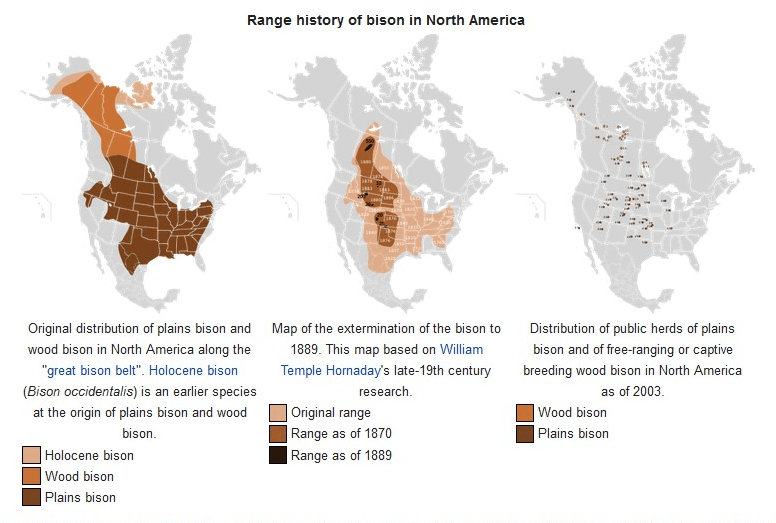
However, bison were regulars in the Chicago region prior to settlement by white Europeans. See these maps from Wikipedia (and the zoo has a similar map):
While bison will not be roaming the suburbs in large numbers anytime soon, suburbanites seem consistently surprised by coyotes and other animals that do not fit their suburban experiences or images. Yet, as the suburbs continue to mature – the Chicago area suburbs are over 150 years old – and nature continues to adapt, the suburban flora and fauna will change.









 Legally Sociable