Where are the heights, mounts, hills, and ridges referenced in the names of Chicago suburbs?

WBEZs’s Curious City looks into the elevation implied by the name of multiple Chicago suburbs:

Mount Hoy offers views of Chicago thirty miles to the east.

For real: Highland Park, Park Ridge, Arlington Heights, Mount Prospect, Prospect Heights, Palos Heights, Chicago Heights, Ford Heights, Barrington Hills, Palos Hills, Rolling Meadows.

And before you say: “But wait! There is some elevation out in the ‘burbs!” Let’s make something clear: You’re not wrong. Chicago’s Loop is at about 570 feet above sea level, and the high point of Cook County is near Barrington Hills at 950 feet. That height difference is just under 400 feet, and that’s spread over 40 miles. If we were talking about any other state in the country (besides Florida) you’d barely notice the difference. In other words, in Illinois, the default standards are low for what’s considered high…

Chicago suburbs end up with names that imply elevation in these two ways: crowd-sourced rebranding and straight-up marketing…

One-hundred years ago we named places very differently, Callary says. Places were named after a town founder, or family member, or after something that indicated the place’s actual, physical presence in the world. Today, it’s more common to name a place after what you want it to be, rather than what’s actually there.

Real estate development is a powerful driver. How could developers and communities differentiate themselves from the hundreds of other suburbs in the Chicago region? Pick an idyllic name and hopefully the moniker plus the new development brings in people and businesses. The image of a mountain or hill would be an attractive one; they are both pleasant to look at and offer vistas from the top.

While none of the communities near me are named after a higher elevation, this story did remind me of the highest height around (see the picture above): a small hill made out of a landfill. Because the area is so flat, on a clear day you can see the tallest buildings in downtown Chicago thirty miles to the east. All this from an artificial 150 foot hill:

Starting in 1965 trash collection agencies and community members were invited to drop off junk and other discarded garbage items. At the end of each day county workers spread the clay, which they had excavated, onto the growing pile of garbage named Mount Hoy after the pioneering family.

Mount Hoy quickly earned its nickname of Mount Trashmore. As the Chicago Tribune article in 1973 announcing the competition of the project read, the hope was to create a popular ski destination by literally “turning garbage to ski slopes.” Although the idea seems a bit farfetched, the City of Evanston was undertaking a similar project and many were trying to convince the City of Chicago to do the same thing.

Overall three millions cubic yards of garbage and clay went into Mount Hoy, becoming a 150 foot hill. By 1974 Mount Trashmore was supposed to host four ski slopes, a snow machine and a chair lift along with two toboggan slides, however a less elaborate setup welcomed skiers and tubers to the area.     

Ignore the venting for the gasses in the landfill and it is almost like a real hill…if we know what those are in northeastern Illinois.


The one HGTV show that leans into the idea of community – but does so through the context of single-family homes

Home Town is one of the big shows on HGTV and it has a premise somewhat different from the other headliners: all of the renovations take place in or near Laurel, Mississippi. The couple in the show, Ben and Erin Napier, say they enjoy contributing to a town that they love:

Photo by Bearded Texan Travels on Pexels.com

The town of Laurel (population 18,338) itself is a starring character in “Home Town,” and it’s a huge part of what keeps the Napiers grounded. “Everybody here knows us,” says Ben. “When we’re in places like New York, Atlanta, Nashville or (Los Angeles) and people stop us on the streets …” Finishing his thought, Erin says, “It’s very surprising.”

Laurel, located about 90 miles southeast of Jackson, was founded in 1882 and flourished thanks to the timber industry (the region is known as the state’s Pine Belt). Mills and factories followed, bringing economic prosperity. Even now, the town boasts the state’s largest collection of early 1900s residential architecture. But as companies moved their operations offshore seeking a cheaper bottom line, the town languished. When the Napiers planted roots in 2008, there was virtually nothing to draw visitors or locals, with vacant storefronts lining the brick streets. Still, they saw its potential and looked for ways to support it, with Ben volunteering with economic and preservation organization Laurel Main Street.

Now, thanks in no small part to the success of the show, “People come to visit Laurel every day, and that’s amazing. It’s incredible. It’s why we agreed to do the show,” says Ben. 

Even with the community focus and the history they provide for each property, the show still takes a classic HGTV approach to the bulk of the episode: it is all about the single-family home under renovation. There are limited shots of the street. There are limited views of the rest of the community. There are no neighbors in view. Most of what we see if of the interior rooms, the facade, and sometimes the rear yard. The new owners move in and presumably live a private happy life ever after.

Slowly rehabbing the housing stock of a community plus bringing visitors is a laudable thing. Many small towns in the United States need attention. Many HGTV shows focus on wealthier suburbs or urban neighborhoods where housing prices are already good and people have money to make the homes even better. The housing in Laurel is not what many would want in growing communities but it represents the housing that is found in many American communities.

Can a show truly be about community when the primary focus are interior private spaces? Home Town offers a variation of HGTV’s relatively anonymous single-family homes but it might only be a veneer of community and not a true transformation.

The home of the brave and the (electric F-150) pickup truck

With all of the talk of the electric Ford F-150, I ran into this statistic about sales of the current F-150:

Photo by Brett Sayles on Pexels.com

Still, if you’re going to pick an electric ambassador to the gas-loving masses, it would be hard to do better than the F-150. The truck has been the best-selling vehicle in the country for decades; more than 2,450 Americans buy a new one every day.

This is a hard number to understand. Roughly 2,500 a day? Some context might help. Americans like driving. They purchase millions of vehicles each year. According to Statista, they purchased over 11 million in 2020. Back in the early 1980s, the number was just over 2 million but there was a steady rise from the early 1990s to the late 2000s and then again in the last decade.

The anecdotal evidence I have matches these numbers. Having spent much of my life in the suburbs, I do not recall seeing many pickup trucks when I was younger. They were more of an occasional sighting, Now, there are pickups all over the place in all different sizes. The F-150 is indeed popular as are numerous other makes and models. The pickup is now a normal suburban vehicle.

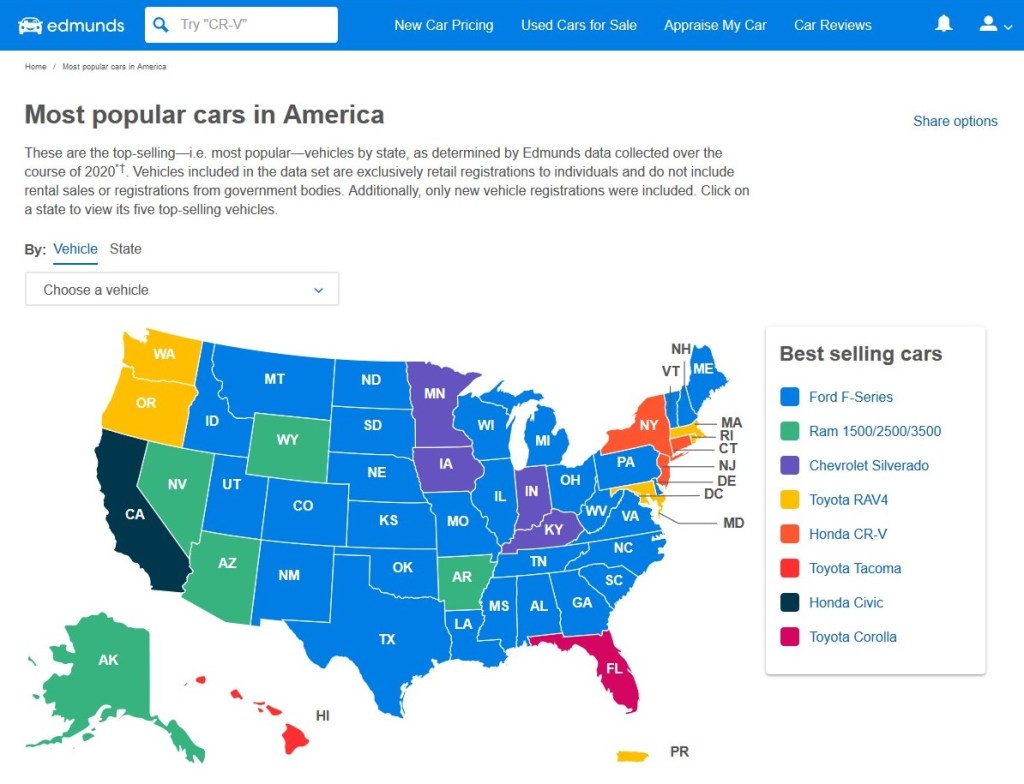
According to Edumunds, the F-150 dominates car sales across the United States (and some other vehicles, including pickups, lead in a small number of states).

This reminds me of a magazine advertisement I used for years in my Intro to Sociology course. The ad was two pages and showed a parked pick-up truck within a swampy area. Sitting by the truck were roughly 15 dogs and standing nearby was the solitary man with his gun and camo. All of it screamed individualism and male vehicle. And this message is repeated over and over in television ads for trucks during sporting events and in many other places.

The electric pickup has the chance to keep Americans driving for decades in the big vehicles there are used to. There might still be a range issue for longer trips. But, imagine pickups that can accelerate even faster and just need to be plugged in at night.

If automated vehicles lead to more miles driven, does this mean cars will continue to dominate American society?

A new analysis suggests drivers who have vehicles that drive themselves put more miles on the road:

In a 2020 paper, Hardman interviewed 35 people who owned Teslas with Autopilot, and he found that most thought the feature made driving less terrible. “The perception by drivers is that it takes away a large portion of the task of driving, so they feel more relaxed, less tired, less stressed,” Hardman says. “It lowers the cognitive burden of driving.”

In new research released this month, Hardman and postdoctoral researcher Debapriya Chakraborty suggest that making driving less terrible leads to a natural conclusion: more driving. Using data from a survey of 630 Tesla owners, with and without Autopilot, the researchers found that motorists with partial automation drive on average 4,888 more miles per year than similar owners without the feature. The analysis accounted for income and commute, along with the type of community the car owners live in.

Extrapolate that result to the wider population, and it may be that partially automated vehicles are already influencing how people travel, live, consume resources, and affect the climate. For governments, which have to anticipate future infrastructure demands, understanding those changes are critical. Shifting commute patterns could affect public transportation budgets and road maintenance schedules. More miles traveled means infrastructure gets more of a pounding. If electric vehicles are doing the traveling, governments still haven’t quite figured out how to charge them for it. And though electric vehicles like Teslas rely on cleaner energy than those guzzling gas, the electricity still has to come from somewhere, and that somewhere is not always a renewable source. A country made up of increasingly sprawling communities, where people blithely travel hundreds of miles via autonomous or sort-of-autonomous vehicles to get to work or play, isn’t an efficient or sustainable one.

The new research suggests that partial automation could have upsides too. The bulk of the extra thousands of miles that Autopilot drivers traveled each year happened on long weekend trips, Hardman and Chakraborty found. Prior to Autopilot, those drivers might have opted to fly, which would have generated more greenhouse gas emissions. In the end, their decision to stick to the road was likely the more climate-friendly choice.

As noted here, there are a lot of possible consequences. I would add a big question asked for decades in the United States: would this continue the dominance of cars in American society? Much critique in the postwar era emerged around planning cities and suburbs around cars as opposed to around people and community needs. All the driving and the infrastructure for it helped give rise to white flight, fast food, big box stores, and even more sprawl within metropolitan regions. Efforts to limit car use have done little to reduce reliance on personal vehicles. Do self-driving cars make cars even more prevalent in American society?

Going further, would electric powered autonomous vehicles mean even more miles driven? If gasoline is out of the equation and the electricity (and car batteries) can be produced with fewer emissions, Americans might feel even more free to drive, commute, and travel.

If a major concern in society is driving itself, no matter how enjoyable it may be, new kinds of vehicles may not be welcome.

Change how album sales are measured, change perceptions of popular music

The music industry changed in 1991 when how album sales were measured changed:

Photo by Maor Attias on Pexels.com

On May 25, 1991—30 years ago Tuesday—Billboard started using Nielsen SoundScan data to build its album chart, with all of its charts, including singles hub The Hot 100, eventually following suit. Meaning, the magazine started counting album sales with scanners and computers and whatnot, and not just calling up record stores one at a time and asking them for their individual counts, often a manual and semi-accurate and flagrantly corrupt process. This is the record industry’s Moneyball moment, its Eureka moment, its B.C.-to-A.D. moment. A light bulb flipping on. The sun rising. We still call this the SoundScan Era because by comparison the previous era might as well have been the Dark Ages.

First SoundScan revelation: Albums opened like movies, so for anything with an established fan base, that first week is usually, by far, the biggest. First beneficiary: Skid Row. And why not? “Is Skid Row at the height of their imperial period?” Molanphy asks of this ’91 moment. “For Skid Row, yes. But Skid Row is not Michael Jackson, Whitney Houston, Bruce Springsteen, or Stevie Wonder. Skid Row is a middle-of-the-road hair-metal band at the peak of their powers, relatively speaking. So it’s not as if they are commanding the field. It’s just the fans all showed up in week no. 1, and it debuts at no. 1. And then we discover, ‘Oh, this is going to happen every week. This is not special anymore.’”

Next SoundScan revelation: Hard rock and heavy metal were way more popular than anybody thought. Same deal with alternative rock, R&B, and most vitally, rap and country. In June 1991, N.W.A’s second album, Efil4zaggin, hit no. 1 after debuting at no. 2 the previous week. That September, Garth Brooks’s third album, the eventually 14-times-platinum Ropin’ the Wind, debuted at no. 1, the week after Metallica’s eventually 16-times-platinum self-titled Black Album debuted there. In early January 1992, Nirvana’s Nevermind, released in September ’91, replaced MJ’s Dangerous in the no. 1 spot, a generational bellwether described at the time by Billboard itself as an “astonishing palace coup.”

Virtually overnight, SoundScan changed the rules on who got to be a mega, mega superstar, and the domino effect—in terms of magazine covers, TV bookings, arena tours, and the other spoils of media attention and music-industry adulation—was tremendous, if sometimes maddeningly slow in coming. Garth, Metallica, N.W.A, Nirvana, and Skid Row were already hugely popular, of course. But SoundScan revealed exactly how popular, which of course made all those imperial artists exponentially more popular.

This is all about measurement – boring measurement! – but it is a fascinating story. Thinking from a cultural production perspective, here are three things that stand out to me:

  1. This was prompted in part by a technology change involving computers, scanners, and inventory systems. The prior system of calling some record sales and getting their sales clearly has problems. But, how to get to all music being sold? This requires some coordination and technology across many settings.
  2. The change in measurement led to changes in how people understood the music industry. What genres are popular? What artists are hot? How often do artists have debut #1 albums as opposed to getting discovered by the public and climbing the charts? Better data changed how people perceived music.
  3. The change in measurement not only changed perceptions; it had cascading effects. The Matthew Effect suggests small initial differences can lead to widening outcomes when actors are treated differently in those early stages. When the new measurement system highlighted different artists, they got more attention.

Summary: some might say that good music is good music but how we obtain data and information about music and then act upon that information influences what we music we promote and listen to.

Bringing S.R.O.s to the suburbs in the form of extended stay hotels

Where can people with no other housing options stay? An extended stay hotel can work:

Photo by Pixabay on Pexels.com

The company’s resilience suggests the S.R.O. housing model never really disappeared. It was reinvented for the suburbs, where, since the mid-2000s, more poor people have been living than in cities, according to research by Elizabeth Kneebone and Alan Berube, the authors of the 2013 book “Confronting Suburban Poverty in America.” And it morphed in accord with broader economic trends — captured, above all, by two statistics: One in five adults who “wanted more work” were doing without full-time work in late 2019, according to the Federal Reserve; and 53 million people have low-wage jobs, research from the Brookings Institution shows. An expanding industry built on informal and impermanent housing is a reflection of the precariousness that increasingly defines daily life for millions of Americans.

And one company sees it as a business opportunity:

The Siegels see no end to demand and seized on the pandemic as an opportunity to expand beyond Nevada. Last July, the Siegel Group announced the purchase of two Budgetel hotels, 15 miles from downtown Birmingham, Ala.; in November, the company said it was buying a HomeTowne Studios with 130 units in Baton Rouge. The most recent purchase, announced in early May, is an Amerihome Inn & Suites in Houston, five miles north of the beltway in the city’s outer suburbs. That brought the chain to 60 sites nationwide, which now also include Toledo; Memphis; Jackson, Miss.; and Shreveport, La. As Stephen Siegel put it to me, “Our business model is great in a good and a bad economy.”

As the article notes, there are much bigger problems here masked by the opportunity or reliance on extended stay hotels: there are limited housing options for people with limited income, evictions on their record, and poor credit. Government assistance can be lacking or very slow. Landlords have their own worries. Suburban safety nets are thin or do not reach very far. Non-profits and religious groups are not as involved in housing. As sociologist Matthew Desmond showed in Evicted, the housing issue is a big one.

What suburban community would want to address this? Many suburbs want to be a higher-status community and this generally means avoiding having cheaper housing. Depending on the suburb, cheaper housing might be everything from smaller single-family homes to apartments to trailer homes. Hotels might be more acceptable because they could be used by a wide variety of people, including business visitors and potential tourists. If there are problems at such hotels, this could lead to issues.

This also connects to another issue facing suburbs and other American communities: the need for housing for single people and changing family structures. SROs offered housing for single people but were primarily located in cities. The largest number of households in the United States are people living alone and this does not work well in suburbs are usually organized around family housing with multiple bedrooms. Could extended stay hotels have different room configurations that could cater to different needs?

The answer Canada may not want: lean in completely to American-style sprawl to get more housing

There is not enough developed land around Canadian cities for what Canadian buyers want:

The world’s second biggest country by landmass is effectively running out of space, and that has Canada on course for a reckoning. The dream of a detached home and a piece of land, which generations of Canadians have taken for granted, and which continues to entice new immigrants, may soon be out of reach in the places where people want to live. That could force an expansion of the idea of home to include condos and rentals, potentially transforming how the middle class does everything from raising families to saving for retirement…

In Canada, buying a home has long been seen as the surest path to middle class security. Canadians on average live in some of the biggest houses in the world, and post higher rates of homeownership than in the U.K., or France, or even the U.S. The pandemic has put an even bigger premium on backyards and extra space…

Still, developers don’t seem to be responding. Though construction started on a record number of new homes in Canada’s metro areas in March, the percentage that were single family-detached actually fell to 19% from 24% the previous year, according to government data. While this ratio improved in April, new home starts slowed that month overall…

It comes down to land. While Canada boasts a total area of about 10 million square kilometers (3.9 million square miles), roughly 40 times the area of the U.K., most Canadians are clustered in a handful of major cities not far from the U.S. border. That’s where the jobs are. And while the work-from-home era has expanded that radius for some, turning quiet farming communities and weekend-getaway spots into the hottest real estate markets in the country, the possibility of returning to the office even a few days a week has kept most workers from striking out too far afield.

The proposed solution in the article is more condos, apartments, and townhouses. These would have provide denser populations and expand the housing options. But, this is not what all Canadians want: like in the United States, the idea of a single-family home is both popular as an ideal and investment.

Here is a different answer from Canada’s southern neighbor: sprawl. More and more sprawl. The article says Canada is out of land; this is not quite true. Keep building suburban areas out from cities. Take advantage of the work from home days of COVID-19. Build on the interest of some Canadians to have their own home and land. Give in more to car culture. Go thirty, forty, fifty miles out like the biggest American cities. There will still be plenty of land in the middle of the country for farms and up north for open space.

Photo by PNW Production on Pexels.com

This may not be a welcomed answer. This all leads to more driving, more dependence on roads. It means less energy efficiency, perhaps particularly during cold winters. It might introduce the same problems that plague sprawling American metropolitan areas.

But, if Canadians do not adjust to living in smaller units in closer proximity, sprawl is one option. The emphasis on homeownership and vehicles is already there. It could be a different kind of sprawl, maybe denser than the American version or more community oriented. Perhaps some lessons could be learned from the mistakes made in the United States. At the least, it could relieve some housing pressure, provide jobs for builders and developers, and set up new subdivisions and future communities for decades to come.

Misplaced nostalgia in Cars for the pre-Interstate days

On a recent rewatching of the Pixar film Cars, I was reminded of something that bothered me at my first viewing soon after the movie came out in theaters. Here is the issue: one of the key points of the plot is that the small town of Radiator Springs suffered when Interstate 40 opened nearby. But, the film makes clear that the issue is the interstate, not driving in general.

This movie celebrates driving. The main character, Lighting McQueen, is an ascendent race car and he needs to rediscover his love of the road. He does this after getting stuck in Radiator Springs. The combination of relationships, the lanscape, and a reorganizing of priorities helps him see that driving should be fun and relaxed, not just about winning and being brash.

The Interstate represents all that is bad. McQueen gets into trouble when he is accidentally dumped off on the side of the Interstate and gets lost. Radiator Springs is just a shell of itself because all the traffic that used to come through town now just whizzes by on the Interstate. Route 66, the road of quirky local establishments, small towns, and vistas, gives way to the straight and multi-lane highway where people just want to go as fast as they can to get to the real destinations.

The movie says everything went wrong with the Interstate. Its emphasis on efficiency came at the cost of communities. It left places behind; not just urban neighborhoods where new highways bulldozed homes and establishments but also small towns in the middle of the desert. McQueen would have left it behind too if he wasn’t forced to stay.

Is the real problem the Interstate or an American way of life built around driving? Sure, the Interstate promotes faster driving but cars themselves promote a different kind of life, one lived at faster speeds. Small towns can force people to look a little more closely with reduced speed limits and speed traps. But, they cannot force them to stop or to care or not just stop at a fast food joint and filling station and get back to the road quickly.

Once Americans had cars in large numbers, they wanted to go places. The open road offered opportunities. Some will want to drive and take their time. Some will want to get places as quickly as possible. Others just need to get from Point A and Point B to do what they need to do on a daily basis. Some of the car commercials I see today make me laugh as they try to say that a sportier exterior or 50 more horsepower transform the daily commute; how many people today really love driving?

Or, how many Americans really like small towns? They may hold it out as an ideal but the population shifts in the last century – both shaped and echoed by the Interstates – have been to metropolitan areas, particularly suburbs. Radiator Springs might be nostalgic and an interesting place to visit. But, it is not the place many would choose as they prefer other amenities including the jobs present across metropolitan regions.

All together, Radiator Springs and its ilk would not likely spring back to life just because the Interstate disappears. Indeed, it is revived in part by the end of the movie because people can get to it via the Interstate and they are drawn initially by the celebrity of Lightning McQueen. Now, Radiator Springs can be a tourist destination and some residents may even rue the day when new residents want to move in and new development threatens what the community once was. Here, cars are both the problem and the answer and without a broader discussion about cars and driving, Americans may just be stuck between wanting places like Radiator Springs to survive and the need to drive quickly to the next opportunity in life.

Publication in Planning Theory & Practice: “Planning and Religious Pluralism, Community by Community”

It was an honor to be invited to contribute to a symposium titled “Rethinking Religion and Secularism in Urban Planning” in the journal Planning Theory & Practice. See all of the contributions here.

My small piece worked with two articles I have published in the last few years: the 2019 article “‘Would Prefer a Trailer Park to a Large [Religious] Structure’: Suburban Responses to Proposals for Religious Buildings” and the 2020 article “Religious Freedom and Local Conflict: Religious Buildings and Zoning Issues in the New York City region, 1992-2017.” I argue the aggregate of religion in the United States – interesting in itself given the particular history, legal structures, and social changes of the United States – and the community level religious experience are both important to reckon with because local officials and residents can respond to the wishes of local religious groups and residents.

For this particular symposium, all of the authors considered the role of urban planners amidst religion and secularism. Building on my findings, I suggest urban planners can play an important role in helping communities plan for future religious uses and, once a proposal is made, focus on welcoming groups and working with them and the community rather than allow the community to emphasize threats.

This will continue to be an issue in communities across the United States as both secularism and religion continue and change. For example, a recent survey suggesting 43% of millennials do not believe in God received a lot of attention in some quarters. But, it would be a mistake to focus on such a find just at the broader, abstract nation-state level; this has implications for communities.

Investors buying about 20% of homes in the United States

A story about rising home prices in small town America highlights the role of investors buying property:

Photo by Lukas on Pexels.com

Local buyers bid against one another as well as against investors who now comprise about a fifth of annual home sales nationally. Online platforms such as BiggerPockets and Fundrise make it easier for out-of-town investors to buy real estate in smaller cities across the U.S., said John Burns of California-based John Burns Real Estate Consulting.

Often, Mr. Burns said, “the cash flows are better in the Tulsas and Allentowns of the world” for those seeking to rent out properties. In the fourth quarter of 2020, nearly a fifth of homes sold in the Allentown area were bought by investors, according to Mr. Burns’s data.

While much attention is directed to hot real estate markets in major metro areas – with a lot of attention for the most expensive like Manhattan, San Francisco, Los Angeles, and others – this hints at a different dynamic. In smaller town, there is not a big supply of new housing. Thus, investors can purchase homes and turn them into rental properties. Without large influxes of new residences, these rental units can bring in good money as buyers look to move up within an unchanging local supply.

If there is such demand and limited supplies of new homes in places like Bethlehem, Pennsylvania, the focus of this article, one possible future is a business opportunity for local or national builders who could come in and provide new apartments or single-family homes. While the community may not be growing much in terms of population, housing stocks do need replenishing and what people desire over time changes. Could building in Bethlehem generate the kinds of profits builders are looking or are more of them chasing even better profit opportunities in hotter markets with faster-growing populations?

If investors are making a significant number of these purchases, could communities respond in ways that help retain opportunities for local residents as opposed to far-off companies? Could they form local investment funds or cooperatives that then only sell or rent the homes at reasonable rates to local residents? This could be an affordable housing issue in many communities and even if local actors generated little profit in the transactions, they could help insure a supply of human capital.