“There’s a lot of talk about a universal voucher program in housing and entitlements, which would be a game changer for family homelessness, but you still have the problem of there not being enough places for people to rent,” Popkin said. “So we need to push both on the supply side and on the increased assistance side.
”Funding could go toward replacing tens of thousands of public housing residences lost between the ’80s and now, whether it be with new construction or renovating older buildings, she said.
“I’d like to see them built in a thoughtful way that doesn’t repeat the mistakes of the past,” she said.
The demolition of public housing high-rises in Chicago and numerous other big American cities had multiple effects. One of the stated goals was to help deconcentrate poverty. By moving public housing residents into other neighborhoods, it was hoped this would help their life chances.
But, this has not worked as well as might have been hoped. If the goal was simply to remove an eyesore in the city and push problems with housing and poverty out of the public eye, mission accomplished. The stigma of such projects disappeared with their demolition. Some of the land, when it was in desirable locations, was redeveloped. If the goal was to help people find good housing and attain more opportunities, this would involve a more robust approach to building and making available good housing. In Chicago, there were promises to provide for better lives andbuild more units…and it did not happen.
Just because the public housing high-rises are not visible in many locations does mean there is not need for cheaper yet quality housing. Americans do not have much stomach for public housing but the need is there to be addressed.
And yet, there was something else that struck me about that scene in New York. For all its feeling of novelty, just about every one of those ways that people were getting around were technologies that dated back to the 19th century. The subway? It officially opened in 1904, but its basic technology was first demonstrated in 1869—the year Jesse James robbed his first bank. The car? Karl Benz sold his first in 1885. The bicycle? 1860. Ferries have gotten a revival in New York City in the past decade, but they have been around since the Dutch. Even e-scooters, which could be read as some Millennials-led plot on boomer NIMBYs, were piloting New York City streets—albeit powered by gas—more than a century ago…
It raises the question: Why hasn’t there been more innovation in transportation? Why is the 21st-century street still being trod by 19th-century vehicles? The pandemic gave the world a pause, the sort capable of disrupting entrenched habits—Zoom changed our notions of social connectivity almost overnight. Had a similar glitch in the matrix allowed us the temporary means to envision better—safer, cleaner, quieter, more efficient—ways to move around?
Transportation tends to resist rapid innovation. There’s the simple physical bounds of being human; as of yet, we can’t be zapped through the ether. The form of cities, built up over centuries, also makes wholesale change difficult. Transportation, too, must account for the way people actually want to move around: It needs to go to where people want to go and get them there reasonably quickly; it needs to be stored and then be available when you want it. Proposed innovations like Personal Rapid Transit (little pods that run on elevated rails), or the “Travelator” (moving sidewalks) have largely failed, outside of places like airports, either because there’s no room (or money) to build them or because they don’t carry enough passengers to where they actually want to go. The Hyperloop, for all its promise, can’t get around the idea it might take longer to get to a terminal in either San Francisco or Los Angeles than it would to travel between them…
But, he argues, we don’t challenge the image’s key assumption: “Why, in this coming world of wonder, are we still getting around in cars?” The passenger car so dominates our thinking that we find it neither desirable, nor possible, to easily imagine alternatives. “Even in our wildest dreams,” Townsend writes, “we can’t free ourselves from the status quo.”
Three quick thoughts:
One way to look at this would be that the cities of today are still addressing the problems of the past few centuries. With the rapid urbanization of many major cities within the last century or two, how could any city coherently address transportation? The growth – often celebrated –
Transportation is not community destiny. And yet, changes in transportation technologies shaped numerous communities at key moments. The stretch from roughly the 1820s to the 1950s brought trains, streetcars, subways, bicycles, and automobiles/trucks (and not including airplanes and changes in ships that enabled more and faster travel between cities). This brought unprecedented speed to humans. It enabled commuting. As prices dropped, the modes became accessible to millions.
I wonder if the true innovation with transportation technology in the future would involve new communities or cities developing around new technologies. Retrofitting the cities of today to new technologies limits options, is costly, and will require lots of time. If we are locked into streets and transportation grids once designed for cars, we can only do so much. But, if whole new places can arise, more opportunities might emerge.
It’s just an arbitrary number, and it doesn’t mean things are much better than when the Dow was at 29,999. What’s more impactful is that the Dow has finally clawed back all its losses from the pandemic and is once again reaching new heights. It is up 61.5% since dropping below 18,600 on March 23.
It took just over nine months for the Dow to surpass the record it had set in February, before panic about the coronavirus triggered the market’s breathtaking sell-off.
I like this explanation for two reasons. First, it downplays hitting 30,000 just because it is a large round number. Why should 30,000 be more important than 29,000 or 29,852? Because round numbers seem more meaningful to us, especially one that is a change from the 20,000s to the 30,000s. Second, it provides a longer context for the rise to 30,000. That particular number is meaningful in part because of the record in February, the drop in March, and then the steady rise. Arguably, this rise since March is much more important than getting past a particular number.
In addition to these steps, a few more could help people interpret the 30,000 figure. Instead of focusing on a particular number, how about discussing the percentage change? This is done regularly with other financial figures. Such a story is ripe for a visual showing the change over time. And a final option would be to downplay such milestone numbers in this story and in future reporting and instead focus on other markers of financial patterns rather than emphasizing outliers (peaks and valleys).
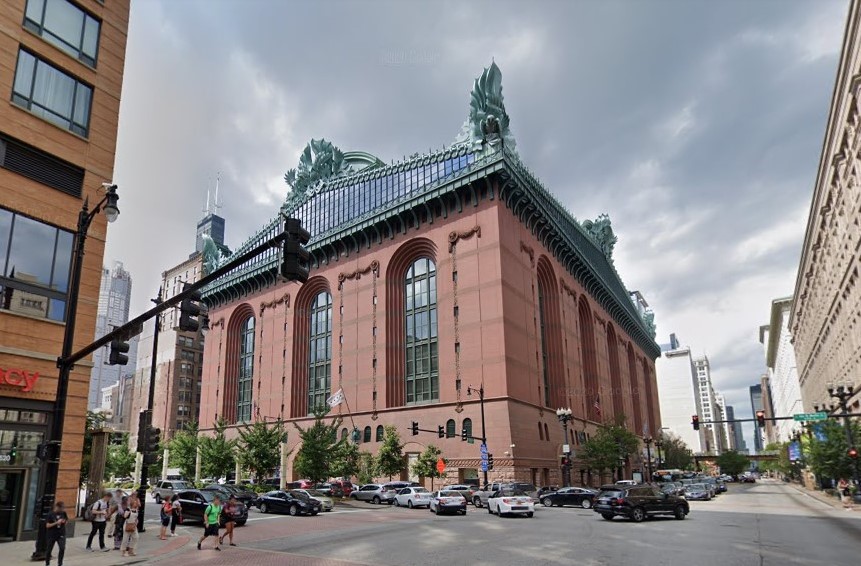
Harold Washington Library Center, Chicago – Google Street View
Libraries, especially during times of crisis, have long been far more than just places where people can check out books and DVDs. With their high-speed internet connections, meeting rooms and massive depositories of information, print and otherwise, they are a beacon to those needing assistance or companionship.
That has changed during the pandemic. Libraries across the state closed for months after Gov. J.B. Pritzker issued his stay-at-home order in March, and though many reopened during the summer, some services remain diminished or unavailable for fear of transmitting the virus.
But libraries have made creative adjustments in these strange times, boosting their Wi-Fi signals so patrons can use the internet in their cars, expanding their curbside pickup services and offering all manner of virtual programming…
The libraries that are staying open typically have large buildings and relatively few patrons coming inside, leaving plenty of social distance. But as winter approaches, they must decide whether they can accommodate those who depend on the buildings as warming centers.
During COVID-19, spaces cannot accommodate the same amount of people or any people at all. They cannot be public spaces in the typical sense of the phrase: the public cannot congregate there.
And after COVID-19, will libraries and other public spaces be the same? Will they garner more public support or less? Even as some will want just to return to a typical library trip, the public library present in many communities and neighborhoods can continue to provide for the good of many people.
The great thing about rowhouses — that is, narrow, long, tall houses built connected to one another, sometimes called townhomes — is that they have most of the stuff Americans say they want in a home in a dense, efficient format. Typically they are single-family homes between two and four stories (though they can be built or split into apartments easily enough), with a front and back yard. The yards are small, but big enough for most purposes — you don’t need a McMansion-style soccer field to have some friends over for drinks and burgers, or let the dog run around, or simply get some fresh air and sunshine.
Then because the houses are connected to each other and on tiny lots, they are vastly more efficient. Instead of construction crews working on separate detached projects one after the other, they can build an entire block all at once. Shared walls means smaller bills for heating and cooling. Perhaps most importantly, the high density they enable allows for walkable neighborhoods with lots of shops and workable public transit. South Philly, which is almost entirely rowhouses, has about 24,000 people per square mile — which is not as dense as Brooklyn, but more than five times as dense as Phoenix and easily enough to support a subway line.
Rowhouses do have somewhat less privacy, of course. (I occasionally hear my neighbors even through the foot-thick brick walls, and I’m sure they hear me on occasion.) But even this has its upside — most obviously in a more vibrant neighborhood culture. When the sun is shining the folks on my block like to sit on the porch, chat with each other, smoke some meat, keep an eye on the neighborhood kids playing on the sidewalk, and so on. It feels like a friendly, alive place much more than the silent suburban cul-de-sacs I have visited in my life. And besides, who really wants to mow a three-acre yard all summer? Occasional weeding is more than enough work for me…
But rowhouses make a perfect middling addition to the American urban housing toolkit. Wherever a location is near to an urban center but not quite suitable for high-rises, slapping down a quick set of rowhouses ought to be the default option whenever land is freed up. By the same token, many American cities are also desperately short of moderately large apartment buildings, in the 3-8 story range, at somewhat more valuable locations like directly adjacent to transit stops.
The advantages and disadvantages to single-family homes amid American sprawl are clearly laid out here. The advantages include a lower price, efficiency in construction and heating and cooling, a smaller yard to maintain, and a lively, denser street. The disadvantages mirror these advantages: less space, less privacy. At the least, rowhouses in cities and denser suburbs provides opportunities for homeowners.
I have three further questions about rowhouses. First, what about rowhouses constructed for wealthier homeowners? In this piece, part of the appeal of rowhouses is a cheaper price point. Yet, rowhouses can be constructed with plenty of space and a lot of features for wealthier buyers. These homes might even give the appearance of being denser but are then trapped in small spots in cities or in suburban subdivisions far from anything walkable. Zoning is indeed an issue in certain places but I am guessing that is matters less in wealthier neighborhoods or communities or rowhouses are not viewed as a threat but rather as an intriguing change of pace.
Second, the importance of privacy may be understated. Americans like suburban single-family homes in part because they want to be separate from others (for privacy, because of race and class, to have their own property). Some homeowners want density and vibrant neighborhood life; others do not. If given the choice between a single-family home, a rowhouse, a condo, a townhouse, and an apartment (and controlling for particular neighborhood characteristics), what would most Americans choose?
Third, how much of these chooses about development depend on regional approaches to housing? As noted in the story, rowhouses are common in some places like Brooklyn and Philadelphia. They are not common in many other places. Having lived in one such development in the suburbs of the Midwest, it was an unusual choice among the typical options. And when that community and other nearby ones have been given choices about what to build since, they have largely eschewed rowhouses (except for more expensive ones). Getting communities to change up these options, particularly if there are worries about property values, is not an easy task.
To help pay for its vast expansion, the company and its developers have won at least $741 million in taxpayer-funded incentives in northeast Illinois alone, according to a Better Government Association/WBEZ investigation…
Amazon collected less than $100 million in public incentives for the 15 warehouses it built in predominantly white communities but won more than $640 million in taxpayer incentives for the 21 projects built in communities with larger nonwhite populations, the examination found. Many of those communities are either mostly Black, mostly Latinx or have higher concentrations of low-income residents, and with municipal budgets already short on cash.
Records show the three largest incentive packages Amazon received — totaling $512 million — all came from predominantly Black suburbs. By contrast, the company built warehouses in at least seven mostly white communities that reported offering no public incentives at all…
While many of the communities may get more jobs, experts interviewed say the lost revenue from taxpayer incentives will strain public resources to rebuild crumbling roads from the truck traffic, mitigate pollution from the exhaust fumes and noise and to pay for other services such as police protection and fire prevention.
But, this illustrates one of the problems with tax breaks in general: it is a race to the bottom. Companies look for communities that will have a hard time saying no. What mayor or local official wants to turn down local jobs? Or, turn away a big company with the status like Amazon? Once they have such a company in town, communities often build on this when marketing land and facilities to other firms by saying they are home to Amazon.
The system could be improved in multiple ways. All the communities in a region could stop competing in this way; that Amazon locates within one municipality could also have spillover benefits for other communities. One community’s gain is not necessarily one community’s loss; the region operates as a whole. If revenue was shared across a region, then tax breaks in a particular community would matter less. Or, communities could just commit not to offer tax breaks at all. If companies cannot play the game, they would have to locate places for other reasons.
These possible solutions do not solve the underlying issues: jobs and capital in a metropolitan region are not evenly distributed. Patterns by race and class continue for decades as companies, residents, and other seek out particular locations and not others. That some communities have to pay more for Amazon to locate there just compounds the problem.
The DuPage County Board has approved a doubling of the 4-cents-per-gallon gas tax in response to revenue losses amid the coronavirus pandemic.
The new rate goes into effect July 1. The existing rate has been in place since 1989.
According to county transportation officials, gas tax proceeds have fallen nearly 25% since April as more people have been staying home and working remotely. The gas tax increase is expected to raise $16 million more a year for an aging system of roads and bridges.
A multimillion-dollar streetscape project in the heart of downtown Naperville is being postponed to mitigate the burden on businesses already struggling under COVID-19 restrictions.
Initially slated for completion last spring, the $3.2 million in proposed improvements — plus an additional $2.2 million in related utility work — were delayed a year due to the challenges and uncertainties of the pandemic, officials said.
These illustrate two different strategies for tackling a budget shortfall. The first tries to raise more revenue. The gas tax is a relatively small increase for each purchase but it adds up since so many suburban lives are dependent on driving. That this tax from the county has not increased for over thirty years is likely to be a small comfort for many as other costs have increased as well. But, raising a number of taxes and fees without huge jumps in any one of them can help local governments close the budget gap.
The second example pushes off planned costs to the next year. Each year, local governments consider improvements and capital projects that will improve the infrastructure of their community. Even in a good year, a number of projects may be dependent on funding from outside sources such as state governments or the federal government. This year, when money is scarce all around, some projects will be pushed into the future. This may not be a big problem for now – unless a lot of projects get pushed back, future budgets cannot handle everything, and infrastructure slowly falls apart. If this year’s budget is bad and next year’s is also affected, when will these local projects get done?
More communities will be making similar decisions in the weeks ahead. How much each community is affected may differ as might their strategies for addressing the budget issues.
Americans like shopping. And this year, even amid COVID-19, the shopping will go on. But, it will take a different form for many as the busy stores and shopping malls will be replaced by online shopping and shopping trips intended to avoid contact with people.
There are two components to shopping at Christmas time. First, Americans generally favor consumerism and can make commodities out of lots of things. Second, shopping can involve being around other people. In a large society where private lives are the norm, shopping near people in an excited holiday atmosphere feels like being part of something bigger. Even if you have no interactions with anyone else outside of your shopping group, simply being in the same time and place can be exciting.
Just as religious rituals can produce collective effervescence according to sociologist Emile Durkheim, so too can Christmas shopping. It may be based on consumerism, have no touch of the transcendent, and involve no direct social interaction with other people. Yet, shopping at Christmas is a different kind of experience than shopping for different kinds of items at different times of the year.
Shopping online produces no such collective effervescence. A person and a screen. The social energy is limited. Of course, one could head to social media to share their online shopping exploits. But, it is not the same as being physically near to other people in a space designed to push you toward Christmas cheer and more spending.
Yet, I would guess that many of the features of modern life that people enjoy are the result of these complex systems. Streaming Netflix to a screen. The availability of modern health care. Being able to get fast food. Modern transportation systems. Widespread social change. All of these require the working together of numerous systems, organizations, and people. All might have been hard to imagine even just a century ago.
Additionally, this complexity is a boon for social scientists and researchers trying to get a handle on it all. The discipline of sociology arose in the nineteenth century as numerous changes – urbanization, industrialization, migration, modern nation-states, ways of thinking based on rationality and science, and more – came together. The modern university also developed relatively recently. The complexity of society plus the speed of social change begs for analysis, looking at patterns, trying to understand what we have helped create.
For now, we can give thanks for what complex society does bring – and work to address its many ills.
Among other interesting tidbits about how data was collected for the 2020 census, here is why it is helpful for census takers to be from the community in which they collect data:
As it turns out, the mass mobilization of out-of-state enumerators is not just uncommon, but generally seen as a violation of the spirit of the census. “One of the foundational concepts of a successful door-knocking operation is that census takers will be knowledgeable about the community in which they’re working,” Lowenthal explained. “This is both so they can do a good job, because they’ll have to understand local culture and hopefully the language, but also so that the people who have to open their doors and talk to them have some confidence in them.”
Going door to door is a difficult task. Some connection to the community could help convince people to cooperate. And when cooperation equals higher response rates and more accurate data, local knowledge is good.
As the piece goes on to note, this does not mean that outside census takers could not help. Having more people going to every address could help boost response rates even if the census takers were from a different part of the country.
I wonder how much local knowledge influences the response rates from proxies, other people who can provide basic demographic information when people at the address do not respond:
According to Terri Ann Lowenthal, a former staff director for the House census oversight subcommittee, 22 percent of cases completed by census takers in 2010 were done so using data taken from proxies. And of those cases, roughly a quarter were deemed useless by the Census Bureau. As a result, millions of people get missed while others get counted twice. These inaccuracies tend to be more frequent in urban centers and tribal areas, but also, as I eventually learned, in rural sections of the country.
It is one thing to have the imprimatur of the Census when talking with a proxy; it would seem to be a bonus to also be a local.
More broadly, this is a reminder of how an important data collection process depends in part on local workers. With a little bit of inside knowledge and awareness, the Census can get better data and then that information can effectively serve many.









 Legally Sociable