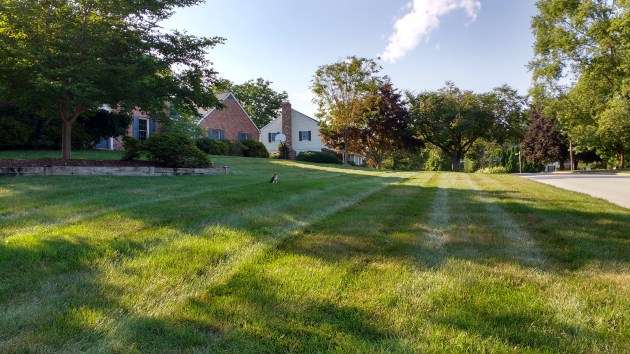
Comparing “Trickle-Down America” (urban) and “Stagnant America” (rural)

Recent comments from Hillary Clinton praising American “places that are optimistic, diverse, dynamic, moving forward” leads to this comparison between “trickle-down” and “stagnant” Americas:

Over the past 40 or so years, the U.S. has been fragmenting into two parallel societies, which I’ll call Trickle-Down America and Stagnant America. Each one looks upon the other with suspicion and hostility. Trickle-Down America is the America of our biggest metropolitan areas, and it is defined by comparatively high levels of density, diversity, and economic inequality. Importantly, the richest people in Trickle-Down America are typically white, while the service-sector workers who enable them to work longer hours are disproportionately brown and black. Stagnant America can be found in rural regions, small cities and towns, and outer suburbs across the country. This America is largely white and relatively equal, though it too is scarred by poverty, particularly among Hispanics and blacks. America’s most and least educated workers are concentrated in Trickle-Down America, while Stagnant America is home to most of America’s working- and middle-class white voters.

Is Trickle-Down America morally superior to Stagnant America? A good starting point is to reflect on the sources of Trickle-Down America’s wealth. In New York City, my hometown, the local economy has long been dominated by the financial-services sector, which has grown mightily in recent decades. Has the financialization of the U.S. economy been an unadulterated good for the country as a whole? There are many thoughtful people who’d argue otherwise. Indeed, some argue that rents flowing to the financial sector have badly distorted the U.S. economy, and have contributed to the devastation of tradeable sector employment in Stagnant America. Corporations headquartered in America’s cosmopolitan cities have profited immensely from the emergence of a globalized division of labor. Yet many of these same multinationals have pioneered tax-avoidance strategies that have made it harder for the federal government to compensate those who’ve lost out with globalization, all while deploying their considerable influence to get the U.S. government to pressure other countries to adopt intellectual-property protections that serve their interests. And then there is the federal government itself, and its vast, growing army of private administrative proxies—contractors, non-profits dependent on public subsidies, and the like—that has helped make Washington, D.C., and its environs one of the country’s most affluent and educated regions. It’s hard to disentangle exactly how much of Trickle-Down America’s success relative to Stagnant America is a product of straightforward rent-seeking. I certainly doubt that it accounts for all of it, or even most. But surely it accounts for some, and that should give Trickle-Down America’s champions pause.

One important thing to keep in mind is that Trickle-Down America is, overall, characterized by more stringent land-use limits than Stagnant America. These limits have raised housing costs in affluent coastal regions, which has redounded to the benefit of incumbent homeowners. Yet high housing costs have deterred inward domestic migration while driving out large numbers of working-and middle-class residents…

For now, though, Trickle-Down America’s affluent professionals find themselves in a sweet spot, which surely accounts for some of Clinton’s triumphalism. The food is better. Beautiful old houses are being renovated everywhere you turn. An abundance of low-wage immigrant labor adds diversity and dynamism to cosmopolitan cities, yet the noncitizen working class isn’t in a position to press for a more egalitarian social order—one that could prove discomfiting for local elites. Best of all, opposition to Trump is helping to obscure simmering discontent over Trickle-Down America’s business model.

This is a different way of categorizing the stark urban and rural political divides of recent years. Yet, it also highlights a key issue simmering within the leading cities and metropolitan areas that are so important to American life: who really benefits in the major cities? Are the high levels of innovation, growth, development, and cultural excitement accessible to all urban residents or do the spoils disproportionately go to the top?Inequality cuts across multiple strata of society. Certainly there are stark differences within cities as well as between urban and rural areas. I’ll add a third area that complicates the story above (though these are likely lumped in with the Trickle-Down America segment): the inequality present in American suburbs. Even as the majority of Americans live in suburbs and seem to have achieved the American Dream of suburban life, life outcomes can differ dramatically across suburban communities.

What makes this suburban inequality more interesting for the realm of politics is how is affects voting: areas generally closer to the big city or with demographics more like the big city vote Democrat and wealthier communities and areas further out in regions vote Republicans. Will these same sort of voting cleavages arise in rural areas in cities as various inequalities receive more attention?

26% of adult Americans online “almost constantly,” 43% “several times a day”

New data from Pew reveal how often Americans are online:

Not surprisingly, more use was related to more use of mobile devices, youth, more education, and more money.

Two additional thoughts:

  1. The difference between “almost constantly” and “several times a day” is worth considering. I would be a good example of someone who works in an office for much of the day and is online there but also has significant amounts of time when I am not online (at home as well as longer periods at work). I would say more than “several times a day” but “almost constantly” isn’t quite true either. This is where some observational data or tracking people through their device use would be particularly helpful.
  2. Only 11% of Americans say they are online less than daily. This means that those who are online – the vast majority of American adults (89%) – are online quite a lot. The Internet truly is part of everyday life.

Now, we will see how long before the majority of Americans fall into the “almost constantly” category. It may not be very long at all.

Tastefully painting the large interior of a McMansion

Decorating the cavernous interior of a McMansion could require some special advice:

Q: I’d like to do some interior painting and I’m not sure about colors. I live in what would be described as a “McMansion” about 20 years old, and the rooms are all very large with cathedral or high ceilings. All of the rooms, including the kitchen, have some form of white/beige/tan coloring, but I would like to paint the living and dining rooms an actual color. But is this appropriate for a contemporary home? Both rooms sit on either side of a cathedral foyer, which we would like to keep in the beige family. Will this look strange to have color, and should it only be lighter shades? Should the inner archways be beige like the foyer or the color of the room you are entering?

A: Homes like yours offer a lot of challenges but some fun creative opportunities as well. Balancing the flow between rooms is important, along with finding ways to make each space interesting, distinct and comfortable. As you noticed, it can be hard to figure out where to start and stop a color on the walls when all the rooms flow together!

One idea is to keep the foyer, its ceilings and the archways light in color to emphasize the big, airy and dramatic entryway. I like your idea of neutral, consider a warm white or light sand color. Painting the adjacent rooms in slightly darker, warmer versions of the foyer color will help make them feel inviting. Since the basic color is the same, you’ll achieve continuity.

Throughout the foyer and other rooms, accent with more colors at eye level and below. The furniture upholstery can be darker versions of the wall colors or coordinating neutrals. Throw pillows, art and accessories can be bolder, so you can change them out more often. And tie the draperies and window treatments in with the wall color of that room.

It is unusual for a homeowner to publicly admit to owning a McMansion but it does help convey information about this home. It sounds like the common two-story, large foyer. Additionally, the colors sound like they could be straight out of a standard set of builder colors intended to provide a neutral palette to attract potential buyers.

Typically, the critique of garish McMansions emphasizes the outside as this is what is easily viewed by the public. Less attention is devoted to the interior. (This is aside from McMansion Hell which also dissects McMansion interiors.) Can a well-done interior offset bad exterior architecture? Can tasteful paint and furnishings provide a stylish and comfortable interior that is hidden from the outside world? For the typical McMansion owner, they must not see the interior as a waste of resources or unnecessary space but rather something desirable and maybe even exciting. McMansions are certainly big – meaning they can hold lots of things – but they also have to be homes on the interior for people to live there for years.

Ongoing Illinois debates about abolishing townships

Illinois is known as the state with the most taxing bodies and one way to reduce that figure would be to eliminate townships:

It’s prompted dueling Republican proposals for new state laws, one to make it easier to get rid of townships, the other to require a study to show financial savings before any township unit could be dissolved.

Illinois has 1,428 townships, helping to account for more units of government than any other state. It’s a layer of bureaucracy formed primarily to serve rural communities, but most states do without them…

“The real issue, and the reason property taxes are so high in Illinois, is because we have 7,000 units of government,” said state Rep. David McSweeney, a Barrington Hills Republican who’s sponsoring the bill to make it easier to mount township abolition campaigns in McHenry County. “The only way we’re going to reduce property taxes is to consolidate local governments. Townships are just a start.”…

Townships have three basic functions: maintaining roads that aren’t handled by other units of government, assessing property for real estate taxes, and helping the poor through food banks and emergency aid. Townships also often provide transportation for people with disabilities, as well as programs for senior citizens and youths….

Advocates of townships argue that they provide the most local, responsive service for the lowest price. In addition, several studies have found that expected expense reductions from government consolidation never materialized. A Rutgers University study concluded that “cost savings are not assured,” and that “most consolidations fail.”

Americans tend to prefer lower levels of government that they feel is more responsive to their daily needs. Taking the duties that townships do and pushing them up to a larger and more abstract county or state government can feel like ceding control to officials who do not know local conditions.

The article also makes it sound as if the research findings do not support claims that fewer bodies of local government would lead to cost savings. If that is not guaranteed, could a successful effort to abolish townships provide hope to some that government can be rolled back or reduced to some degree?

All said, efforts in Illinois in recent years to eliminate or consolidate units of government has been slow. The state legislature banned the formation of new government bodies and DuPage County slowly is reducing the number.

Could governments ever stick to “nonaggression pacts” involving companies?

As companies like Amazon look for good deals from local communities, one economist suggests non-aggression pacts:

It’s hard to draw conclusions about how much local economies gain from fulfillment centers and whether incentives are warranted from the experience of individual towns or counties, said Tim Bartik, senior economist at the Michigan-based W.E. Upjohn Institute for Employment Research.

Fulfillment centers likely do benefit the surrounding community, but the gains may be modest compared with other types of economic development projects that could generate more business for local companies, Bartik said. The jobs have modest wages, limiting the amount workers would potentially spend at local retailers, and warehouses generally don’t patronize local suppliers, he said…

He advocates states form “nonaggression pacts” to contain costs of incentives that simply shift jobs from one part of the country to another, though he acknowledges those pledges are unlikely to stick.

“The next company comes along, and they decide it’s an exception,” Bartik said. “We haven’t seen one that’s really survived.”

Here are at least four arguments I could imagine people making against such pacts:

  1. Competition is central to the American economic system. Why shouldn’t local communities be able to offer whatever they want to attract a company or development? Having and sticking to such pacts is collusion by communities.
  2. If companies cannot get good deals from communities, they will leave the country. This would not make much sense to me as the American market is a pretty lucrative one but it could apply more for certain companies or industries.
  3. Local officials need to be able to show local results, not that they are cooperating with other places. They want to be able to say that they brought specific jobs or benefits to their community, not that the whole region is benefiting (though this may be true).
  4. What is good for companies is good for communities and America. This is a tricky argument all around: thriving companies are important yet it is much harder to figure out whether firms are helping communities in the ways they should. (This is an open question these days involving Walmart, Amazon, and tech companies.)

Perhaps the best argument that could be made for such pacts is that the general public – in the abstract – wins if companies are unable to obtain massive tax breaks or incentives for certain actions.

For better or worse, the decision Amazon makes about where to locate its second headquarter will keep this issue in the spotlight for a long time.

Back to the SUV and McMansion comparisons

With a stronger economy, it may be time now again to link McMansions and SUVs. Here is one review of “gargantuan SUVs” or “extra-large luxury SUVs”:

But when you drive one like the new 2018 Lincoln Navigator (starting at $73,250), you start to understand why these whales of the highway are a rare yet growing subgenome of the SUV originally created in the heady days of the late ’90s. (Sales were up 5 percent in 2017.) They have become less McMansion, less family trucksters gussied up in questionable leather and wood veneers, and more bespoke luxury condo—the mobile living room for sophisticates with a growing brood that they always tried to be.

Space is a luxury, sure. But the stretch-your-legs-out room and cushy rear-seat experience that would normally require a first-class Emirates ticket? That’s a rare kind of decadence on the road that the Navigator handles with surprising grace. The interior is a treat for grown-ups (copious soundproofing, massage seats) and their kids (it can take up to ten WiFi connections).

Three quick thoughts:

  1. There is still an emphasis on space in these comparisons. SUVs and McMansions both provide significant amounts of room compared to the typical vehicle or home.
  2. Both are luxury goods that are a step up from the normal experience. Yet, the line that these newer SUVs are less McMansion and more luxury condo suggests their opulence is more acceptable. Indeed, it is okay to spend a lot of money for a flashy urban condo while the suburban McMansion is still looked down upon.
  3. Are we sure that the SUV and McMansion are the mass consumer goods that mark this era (roughly late 1990s to now) of American life? To critics, they represent wasted resources as well as American conspicuous consumption. The cell phone becomes popular over this time period but not until the smartphone of the late 2000s does it reach its peak.

I will keep looking for the comparisons of SUVs and McMansions. At the least, they suggest the economy is back to the point where more Americans are making or considering these purchases.

Why suburban governments should consider merging

While Lisle, Naperville, Warrenville, and Woodridge appeared to have little interest in merging, the long saga does raise a possibility: should more suburban governments consider merging?

The primary reason not to is that many suburbs and their local officials want to maintain control over what happens in their community and near their homes. Larger communities may make decisions for the good of the larger community that do not necessarily benefit certain members of the community. A smaller government provides closer oversight as the individual votes of residents count more.

A second reason for not merging is that suburbs often see themselves as distinct communities. Even though an outsider might see it all as one amorphous blob of suburbanism, many suburbs have long histories and distinct characters. In this particular case, these suburbs may define themselves partly as not Naperville: we are still a small community with a distinct feel.

On the other side, there may be multiple reasons to merge: financial economies of scale through combining particular city services (for example, having one police department rather than four), increased visibility and status with a larger size (controlling more land as well as having a larger population), broadening a tax base, and some communities may have mutual interests due to similar demographics, locations, or like-minded leaders. Imagine an even larger Naperville that controls a lot of land along major highways (I-88 and I-355), has a diverse tax base (particularly due to a lot of office jobs), thas efficient city services over a broad area, and is clearly the largest suburb of Chicago (Aurora currently holds that distinction). In the long run, is it feasible to keep so many suburban governments going when budgets are ever tighter? Is it worth protecting local control and distinct characters at a higher cost?

The only way I could see suburbs seriously consider merging would involve difficult financial times looming on the horizon. Even then, many suburbs may not want to take on the communities that have a weaker financial standing or a lower status.

The unclear plot to merge Lisle, Naperville, Warrenville, and Woodridge

The Daily Herald reveals details behind an odd 2017 suburban annexation push but there are still numerous unanswered questions:

Court records released this week in Will County show Dave Nelson, a former candidate for Lisle village clerk who ran on a slate with the current mayor and two trustees, was the key proponent of a plan to place referendum questions concerning the proposed mergers on spring 2017 ballots.

Court records show Nelson was working on behalf of his minor child.

The revelation is sparking questions about whether Nelson’s political allies were involved in the merger push, which long was shrouded in mystery. Some village board members also are raising questions about why some of Nelson’s allies who were elected to village posts are considering replacing the village’s legal counsel, suggesting it may be retribution for the firm’s work in uncovering Nelson’s secret…

The courts rejected the petitions in Warrenville and Woodridge because they didn’t have enough signatures and the petitions in Lisle because of procedural problems.

While we now know who started the efforts to annex these communities, there are still more questions:

  1. The article says “Nelson was working on behalf of his minor child.” Was this a school project? Something the minor child really wanted to see happen? Does it have anything to do at all with school districts?
  2. There are some issues with the Lisle local elections and the particular slate of candidates known as “Prosperity for Lisle.” In this article, they deny knowledge of what one of their candidates – Nelson – was doing. Did anyone in Lisle know what was going on?
  3. Was there any additional interaction with the other communities beyond Lisle? Nelson had earlier admitted to talking to the Naperville mayor. Was anyone else in on this?

There is more to uncover.

Tomorrow, I will discuss why suburban governments should consider merging and the reasons why it does not often happen, let alone even reach the stage of a public discussion.

Fighting harder against gentrification

Activists in Los Angeles and a few other cities are ramping up their efforts to fend off gentrification:

That’s because it was organized by Defend Boyle Heights, a coalition of scorched-earth young activists from the surrounding neighborhood — the heart of Mexican-American L.A. — who have rejected the old, peaceful forms of resistance (discussion, dialogue, policy proposals) and decided that the only sensible response is to attack and hopefully frighten off the sorts of art galleries, craft breweries and single-origin coffee shops that tend to pave the way for more powerful invaders: the real estate agents, developers and bankers whose arrival typically mark a neighborhood’s point of no return…

By “making s*** crack” — by boycotting, protesting, disrupting, threatening and shouting in the streets — Defend Boyle Heights and its allies have notched a series of surprising victories over the past two and a half years, even as the forces of gentrification continue to make inroads in the neighborhood. A gallery closed its doors after its “staff and artists were routinely trolled online and harassed in person.” An experimental street opera was shut down after members of the Roosevelt High School band — egged on by a group of activists — used saxophones, trombones and trumpets to drown it out. A real estate bike tour promising clients access to a “charming, historic, walkable and bikeable neighborhood” was scrapped after the agent reported threats of violence. “I can’t help but hope that your 60-minute bike ride is a total disaster and that everyone who eats your artisanal treats pukes immediately,” said one message. The national (and international) media descended, with many outlets flocking to Weird Wave Coffee, a hip new shop that was immediately targeted by activists after opening last summer….

These harsh realities aren’t lost on millennials of color — especially young men and women from gentrifying neighborhoods, where such inequities tend to be on vivid, daily display. To that end, a 2016 Harvard Institute of Politics poll found that only 42 percent of 18-to-29-year-olds now support capitalism; a third now identify as socialists. Among those who backed Hillary Clinton’s presidential candidacy, the number was even higher — a full 54 percent — and minorities and people without a college degree were more likely to support socialism as well…

“We are devoting our time to building a national movement against gentrification,” they wrote in a February blog post titled “Defending Boyle Heights and f***ing s*** up: A 2017 summation and report back from our Hood Solidarity tour.” “Boyle Heights has … become a beacon of hope for other communities facing similar threats. … We are hopeful that in the coming years, with the effort necessary to sustain a movement, poor and working-class people can escalate the class war against gentrification and actually hinder and possibly reverse its effects.”

As the article notes, gentrification is not new but reactions to it have changed over time. Most major cities are beholden to development and have been for decades: development and growth is good, particularly when it is taking place in neighborhoods that have seen better days (think of older urban renewal programs), and politicians and developers can have a symbiotic relationship. Yet, this development often does not help poorer residents who even if they are not pushed out of the neighborhood do benefit in the same ways as developers and politicians.

A few ongoing questions about these efforts:

  1. Do more strident responses to gentrification then allow more negotiation to take place about the future of neighborhoods?
  2. At what point do cities, developers, and business owners push back harder against such protests?
  3. Can protests like these slow or stop gentrification? Can they prompt a larger spirit against gentrification in the community?

Something to keep watching.

The first federal government document to mention “racism”

The Kerner Commission Report of 1968 is notable for a number of reasons. But, I had never heard this claim before:

Did the report change anything?

“I think so,” he said. “Using the word racism was important. That was the first time it had ever been in any government document. Black kids internalize this discrimination they’re feeling: ‘Maybe there’s something wrong with me.’ It was really essential to say you’re not crazy.”

I do not know whether this claim is entirely true. On the face of it, this sounds like the federal government was resistant to using a word that could easily describe decades and centuries of experiences.

But, on the hand, perhaps racism was not a commonly used term. A quick search of Google Ngram suggests the use of racism picked up steam in the 1960s:

GoogleNgramRacism

Still, even if it was relatively ahead of its time, every time I see the Kerner Commission Report I’m reminded of the applicability of its conclusions for the last fifty years.