How do suburbs know if their mass market radio ads are successful?

In the span of a few minutes the other day, I heard radio commercials for two suburbs. One was aimed more at businesses and residents moving to the community, the second was about visiting and enjoying the amenities there. Do these advertisements work?

Photo by Jean Balzan on Pexels.com

There are multiple ways organizations could measure this. The most common one I have seen in today’s age is the online or email survey question: “how did you hear about us/this?” Then the respondent can select among many options, including radio ads.

But if someone were moving to a suburb, starting a business in a suburb, or visiting a suburb, how likely would it be that they would receive such a survey? What would trigger this survey?

There are, of course, other techniques. We could rely on anecdotes and the occasional story people tell. Perhaps focus groups of recent movers or visitors could explore this. Maybe someone contacts the community directly and describes hearing the advertisement. Maybe seeing an uptick in population or visitors or business activity in the community after airing the ad could lead to people saying the ad worked.

None of these are likely great options. Getting people to participate in research studies is hard. The commercial is one out of many people will hear or encounter each day.

It is hard to brand a suburb when there are many – over 300 – in the Chicago area and in a media saturated landscape. What can reflect the community well and stand out to people (and then hopefully prompt them to act)?
Political ad season has been most intense in Pittsburgh

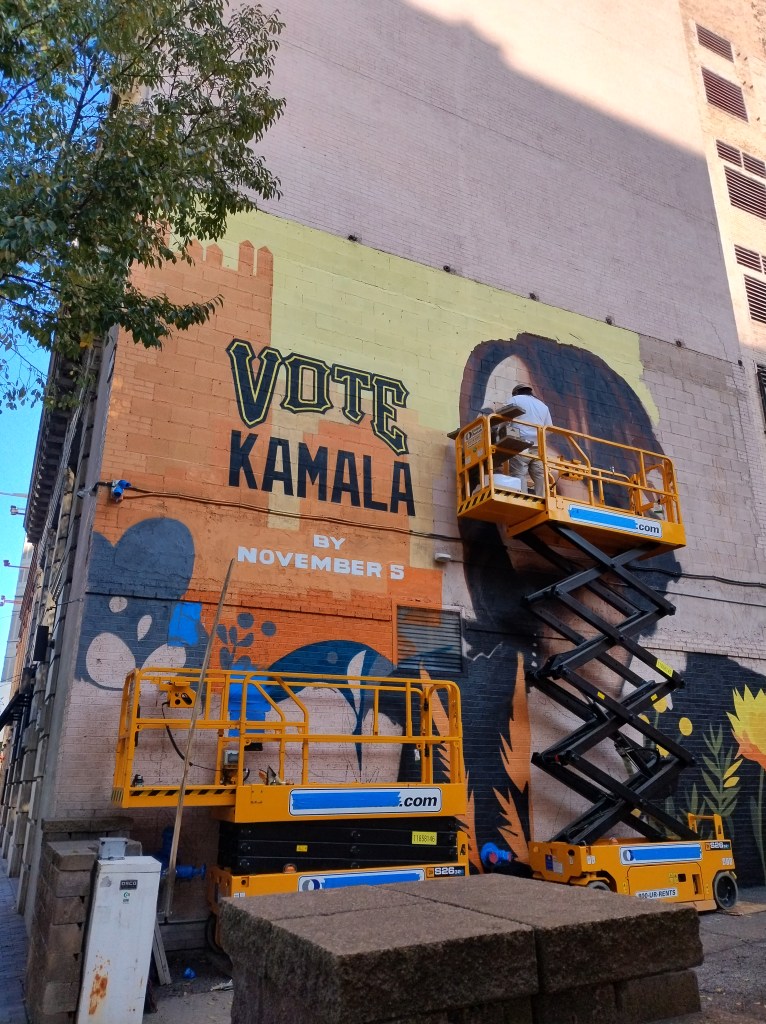
Political ad season 2024 been the most intense in this city:

Pittsburgh viewers tuning into Monday Night Football this week watched their Steelers beat the New York Giants — and 26 political ads.

That’s just a small slice of the roughly 2,300 political ads the typical Pittsburgh household has seen on television this year, according to AdImpact, more than any other market in the country. 

The nonstop political onslaught for viewers, however, means a windfall for the stations. The local ABC affiliate broadcasting Monday’s game charged as much $150,000 for a single 30-second ad, an astronomical sum for the market.

Pittsburgh is the most extreme example of a phenomenon happening in swing states across the country: Campaigns and their allies are buying so many political ads that local businesses — the personal injury lawyers, car dealers and furniture stores that are usually staples of local news commercial breaks — often can’t reserve any airtime even if they could afford the inflated rates. 

While political ads are likely airing almost everywhere due to local and state races, the presidential race depends on a few select states and big markets within them. Which party can turn out the most voters in the key suburban districts?

It would be interesting to see data after the election about how Pittsburgh area residents responded to these ads. How many people did they convince? What did it cost roughly to pickup each vote? How did these big ad buys perform compared to social media campaigns that can target specific individuals? Money was spent…but how effective was it.

Similarly, how might these ad seasons boost local media organizations? Is this like Christmas season for media where the money that comes in during political ad season covers budgets for a much longer time? If political ad season was reduced in length or in spending, how might these media organizations do with less money?

Waiting for the realtor to advertise that they get the buyer the best price

I recently received a glossy mailing from a real estate agent describing their recent efforts on behalf of a property owner. A few excerpts from the advertisement:

Photo by Kindel Media on Pexels.com

***Multiple Offers in 24 hours***

My strategic marketing plan generated over 40 groups of potential buyers, igniting considerable excitement from the moment the property hit the market. By Saturday, we had received multiple offers, ultimately securing a contract that surpassed my client’s wildest expectations!

This sounds good for a homeowner looking to sell. They had multiple offers to consider. They got more money that they might have. This agent helped them move to the next stage with more money.

I do not recall getting an advertisement for a realtor that goes the other direction: I found the home buyer a great deal. I negotiated the price down. I helped point out features of the property that led to price reductions. I got the buyer a great deal.

There certainly is a market for getting sellers the most money they can. Americans value their homes for the money they can provide upon sale. They want to see a big jump in the value compared to the price at which they purchased the home.

Buyers also want good financial deals. If you wanted had a tight budget or wanted to buy investment properties, wouldn’t buyers rather have someone who keeps the price lower? I assume there are realtors who do this well and want to find clients.

Making the sacred profane and the profane sacred at the Super Bowl

The Super Bowl itself may qualify as a religious event given all of its pageantry and symbolism. But, yesterday’s game included at least a few more explicit mentions of religion beyond the patriotism, American consumerism, and big audience already there.

Photo by Shelagh Murphy on Pexels.com

The Super Bowl advertisements from “He Gets Us.”

The ad for prayer app Hallow.

The ad from the Church of Scientology. And see their past ads here.

From Super Bowl MVP Patrick Mahomes: “I give God the glory. He challenged us to make us better. I am proud of my guys. They did awesome. Legendary.”

In early sociological work, theorists discussed the boundaries between sacred and profane. In the Super Bowl, these lines can get very blurry. Is this just an athletic event or is it about our collective lives together and supernatural forces? Can advertising for religious groups and beliefs break through the noise of food and football? Should all of these forces be mixed or is there a time and place for each?

This is not new but it does highlight the ongoing interactions in American society between religion and other spheres. Similar things can and have been said about politics. A football game is not just a football game; it is an opportunity for numerous actors to put their own stamp on what we are doing together.

What you see when you drive in American cities: signs

After seeing plenty of vehicles and buildings while driving recently through cities, I also observed a lot of signs. When driving at fast speeds, large signs are necessary so that drivers can read them and so that they catch people’s attention.

Photo by Charles Parker on Pexels.com

What can be learned from these signs? Here are a few of the domains:

-Information about roadways. From street signs to exit signs, there is a uniformity to information drivers need to navigate. These signs can help a driver navigate a complicated city full of other vehicles and buildings.

-Information about goods and services. Advertising signs are all over the place. They might be for a particular brand, a product, a store or restaurant, or an experience. While road signs are bland and to the point, advertisements tend use more images and text to deliver a particular message.

-Information about local attractions. These could be simple notes on highway signs for a stadium or park or more elaborate advertisement for specific local institutions.

In other words, there are a lot of signs vying for a driver’s attention. If there is time to read even most of the signs (such as being stuck in traffic or at an intersection), they can reveal much about the location and the city. But, add all these signs to the buildings and vehicles and it can be hard to take it all in.

Are McMansions Australian or un-Australian?

A recent ad for “Share the Lamb” includes McMansions as part of its easter eggs:

Screenshot from the end of the “Share the Lamb” advertisement.

Whether these discussions are taking place between patrons in the local pub or constituents in the local council chambers, being dubbed ‘Un-Australian’ has become the ultimate insult to throw in somebody’s face. Generally used as a dig, the term describes something that goes against traditional Australian ideals, thus calling into question aspects of the culture typically associated with national pride. While clearly a country-specific remark, these nationalistic and ethnocentrist themes have become widely recognisable, as cultural identities around the world continue to merge. 

This year, Meat and Livestock Australia’s (MLA) annual summer ‘Share the Lamb’ campaign decided to hone in on the absurdity of this very phrase. Advertising agency The Monkeys, part of Accenture Song, recruited talented director, Yianni Warnock. Known for his ability to draw out the paradoxical humour of a subject, Yianni was tasked with directing this tongue in cheek campaign that pokes fun at the unreasonable – and entirely subjective – specifications of what constitutes ‘Un-Australian.’

Working with Yianni, we worked out that if the characters left a little something behind as they disappeared it would really help sell the effect, and amplify the comedy. The timing of the disappearance also became part of the comedic timing. The big wide-end scene was stitched together from lots of sources. We had a lot of fun putting some Easter eggs in there of various things that might be considered Un-Australian, from ‘McMansions’ to jet skis.  

There are lots of questions of national identity to explore. What makes an Australian? If everyone thinks they are un-Australian, does this make them all Australian?

But, I am most intrigued by the reference to McMansions in the scene captured above. There are a lot of depictions and ideas embedded in this one image. I believe the McMansion is just under the bridge the rises in the top center of the scene. When I zoomed in on this dwelling, it is not as egregious as it might be. The home appears large with an imposing entrance, lots of windows, and a unique architectural style (sort of Mediterranean but some weird angles). I do not know if the impression it makes or better or worse without any other homes around it.

I suppose this means that McMansions are then Australian by being un-Australian? In a country with some of the biggest houses in the world, perhaps McMansions are just extreme or extra-large versions of the homes that mark Australian life.

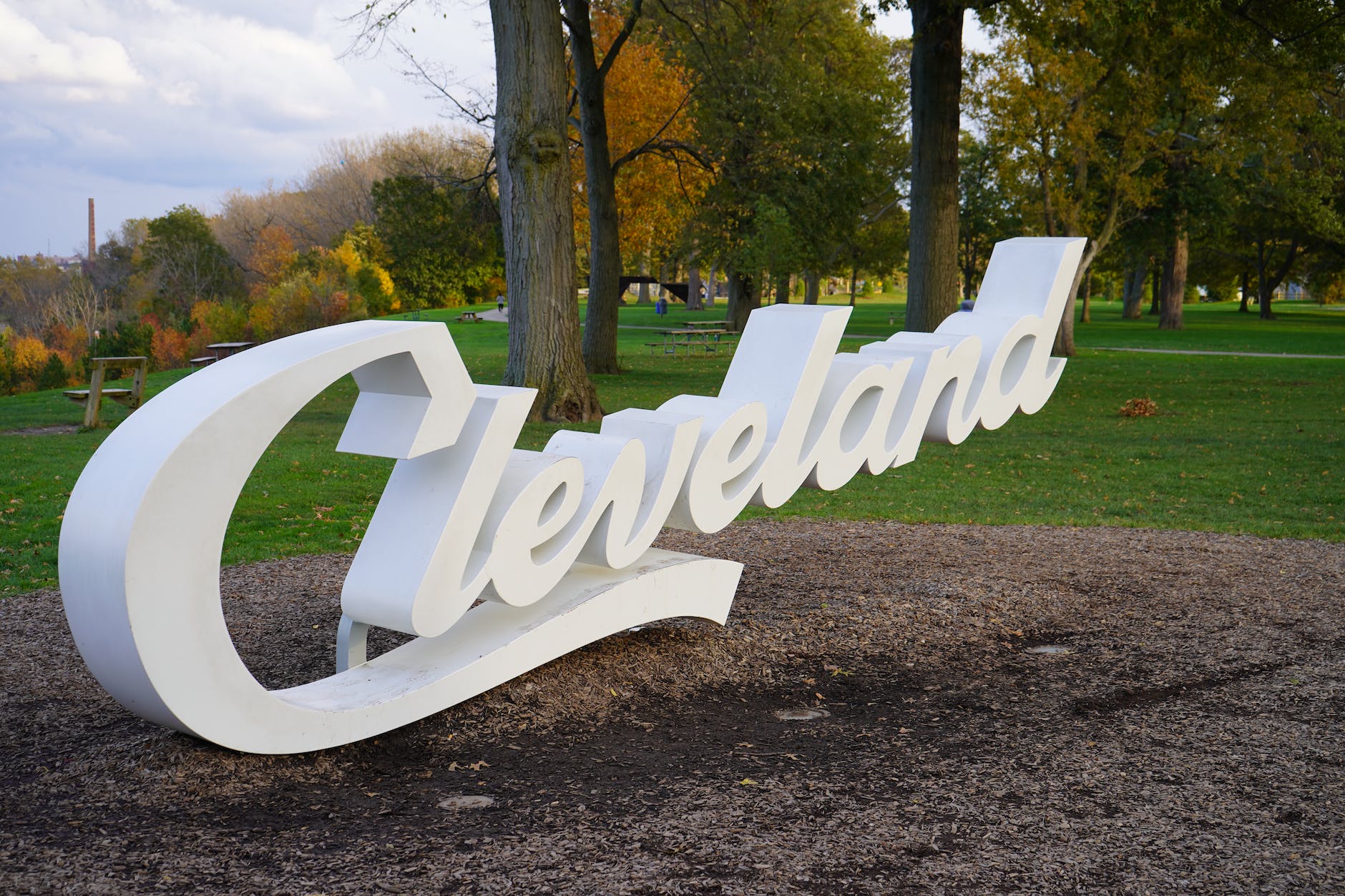
Leaning into “Everywhere else is Cleveland”

A recent ad from the New Orleans Police Department tried to set their city apart from other cities, namely, Cleveland:

Photo by DAVID Mercado on Pexels.com

The NOPD posted the commercial—”Everywhere Else Is Cleveland”—to its social media accounts at 9 a.m. Wednesday…

“Everywhere Else Is Cleveland”—which features women, people of color and members of the local LGBTQ community—was commissioned by the foundation as part of a broader recruitment push to help fortify the city’s shrinking police force. To broaden their applicant pool, the department recently relaxed restrictions around past marijuana use, credit scores and physical appearance—including tattoos, facial hair and nail polish.

The commercial’s title is a play on the famous Tennessee Williams quote: “America has only three cities: New York, San Francisco, and New Orleans. Everywhere else is Cleveland.”

See an earlier post about this quote.

This quote referenced above hints at a larger issue for those who study American cities. When is it helpful to lump cities together as similar enough or helpful to put them in different categories because they have unique traits? All big cities share some common characteristics but they are also different in certain ways. Is size, the time of settlement or rapid population growth, density, political system, cultural opportunities, or something else the factor we should use to analyze cities?

The quote above suggests there are four categories of cities: three that stand on their own then a much larger category represented by Cleveland. Cleveland is the stand-in here for all nondescript cities compared to three American cities that have unique personalities and settings. The ad suggests New Orleans is a very different kind of place.

Is this objectively true? As far as I know, there is no New Orleans School of urban thought, but this does not mean there should not be. Urban sociologists and theorists tend to squabble more about the biggest cities and whether New York, Chicago, or Los Angeles are the best models for understanding urban processes.

If every life event was sponsored, baseball edition

I enjoy listening to baseball games on the radio. The pace of the game, the voices of the announcers, and the ability to do other things while listening add up to an enjoyable experience.

Photo by Anthony on Pexels.com

Except for one growing trend: the number of commercial reads throughout the game. At this point, it seems like almost every baseball event has a sponsor. Strikeouts, walks, doubles, home runs, the fifth inning, the seventh inning…you get the idea. Baseball has a lot of small events and apparently they can be attached to an advertiser for the right price.

I am aware of multiple factors behind this. Radio is a dying business. Live sports is one of the few shining spots where there are certain to be listeners (or viewers). Commercialization is alive and well. There is money to be made here.

But, I can only imagine how this might spread to all areas of life. Go beyond the Internet and social media ads tied to your browsing and shopping habits. You tie your shoes; brought to you by [blank]. You run the dishwasher; brought to you by [blank]. You read a book; brought to you by [blank].

At this point, there do not seem to be any officials guardrails against more and more of this happening. People can push back but this has consequences. If I do not like the baseball ads, I can stop listening. But, if we move to more immersive devices – Google Glass, virtual reality headsets, a house full of Internet equipped objects – this will be very hard to push against or escape.

If Schaumburg is advertising business opportunities and a central location, this means…

I heard again a radio ad recently from the suburb of Schaumburg extolling the benefits for businesses, including a central location, if they relocate there. I thought about this in January 2021 and I wonder now if this ad hints at three patterns:

Photo by Nicholas Githiri on Pexels.com
  1. Schaumburg is an edge city with a lot of office and retail space. The suburb grew rapidly between 1960 and 1980, going from under 1,000 residents to over 50,000 residents. It is home to Woodfield Mall and numerous sizable office buildings. It is featured in Joel Garreau’s book Edge City. If Schaumburg has a lot of vacant space and is struggling to find businesses to sell goods and services or to set up operations, what hope is there for other suburbs that do not have these concentrations that were successful in the past? Brick and mortar operations are declining and COVID-19 has encouraged working from home and this has particular effects on communities highly dependent on both.
  2. This may be less about the troubles of Schaumburg and more about the game that suburbs have to play today. Suburbs market themselves and attempt to differentiate themselves from other suburban communities. The Chicago area has a number of these, including Elk Grove Village hoping to attract makers and Bedford Park touting its industrial space and resources. It is less clear how successful these efforts are but more communities seem to think they need a media presence.
  3. Is there something preferable in advertising a place on the radio? Are people listening in the car more likely to be mobile and/or move? Communities have other options but I do not how attractive they might be. Television is a very broad audience. Targeted Internet or social media ads could be worthwhile if particular categories could be identified. Print may only work in certain outlets. Would billboards catch people’s attention? This may be an emerging branding landscape for which I have not yet found an overview.

If these trends continue, I can imagine a media landscape where ads for suburbs and cities play back to back or near each other, directly juxtaposing their different perceived advantages and trying to chase the elusive businesses and residents who might move.

“Welcome to the Metroburb” in the NW Chicago suburbs

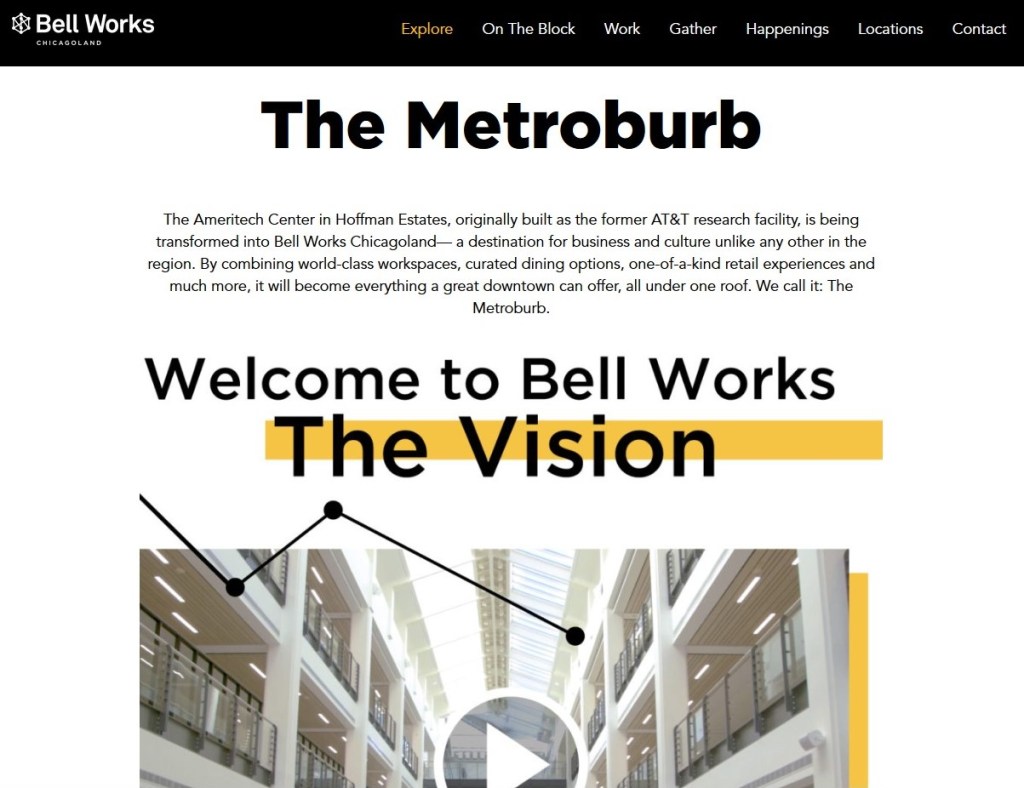
This week I heard a radio ad saying “Welcome to the Metroburb.” Here is more on this new development outside of Chicago:

Chicago area suburbs advertising their communities is not unusual; see examples here and here. Far less common are new suburban developments making broad appeals in mass media. This project has been in the works for a while now – see an earlier post – and it is on an intriguing site as Bell Labs was important for the Chicago region (read more about the effects on local development of their Naperville facility) and the country as a whole.

If you ran a business or were searching for a residence or wanted to be part of an interesting scene, would this ad or website persuade you? This is a unique development and a large one. Suburbs around the United States are looking to fill empty suburban headquarters, denser suburban areas are popular, and standing out in a crowded suburban landscape can be difficult.

Interestingly, there is also a partner project involving the former Bell Labs facility in Holmdel, New Jersey.