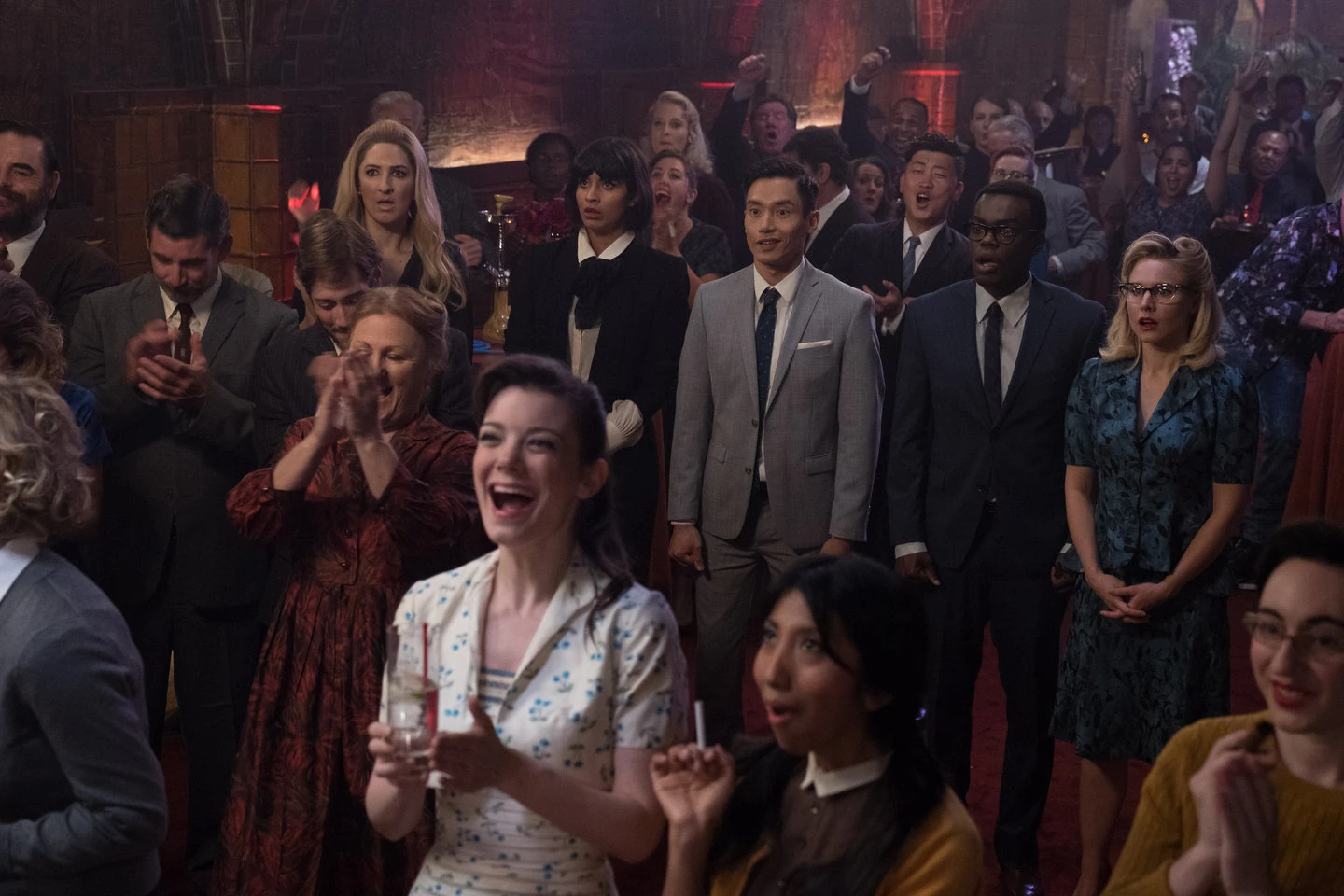
Depicting heaven, hell, and in between through mid-century modern, the 1980s, and the Getty Center

The creators of The Good Place aimed to create a specific aesthetic for the locations on the show:

Rowe: There’s a signature that is heavily inspired by mid-century modern. Not just because it looks cool and clean, but because [the creative team] made a very deliberate dedication to a certain style per world. So the ’80s were the Medium Place. The Mad Men era was the Bad Place. The heightened, more European, I would say, version of that influenced the backlot. Dan Bishop created that cute, charming, endearing vibe from European villages. Those ice-cream colors and those colorful pops in our flowers—those defined what the rest of the world would look like.

It’s very important to point out that [Ted Danson’s character] Michael was an architect, and that was a character choice from Mike Schur that influenced everything from there. What architect going to school, at any stage doesn’t love mid-century modern? Plus the age of the actor—he’s all dressed up. If he was designing kooky ’80s architecture or ’70s skyscrapers, I don’t know if those would fit.

The focus on European villages gets at some features of desirable places: existing at a human scale, full of street-level activity including food and shopping alongside people talking and walking, and a relatively small set of people. (One feature of these some villages that might be missing on the TV show: the homes seem to be set apart from the village area, separating home and work.) While the village streetscape could be part of a larger city (perhaps each neighborhood or district has a village area like this), it hints at more small-town life. Residing in smaller-scale villages might fit better with human history than the substantial urbanization of the last two centuries. At the same time, we view big cities as centers of progress and human achievement. Perhaps the choice of villages hints at human desires for social connections and a human scale rather than big cities. (But Michael’s depiction is not what it seems – so is this commentary about European villages?)

As for heaven itself:

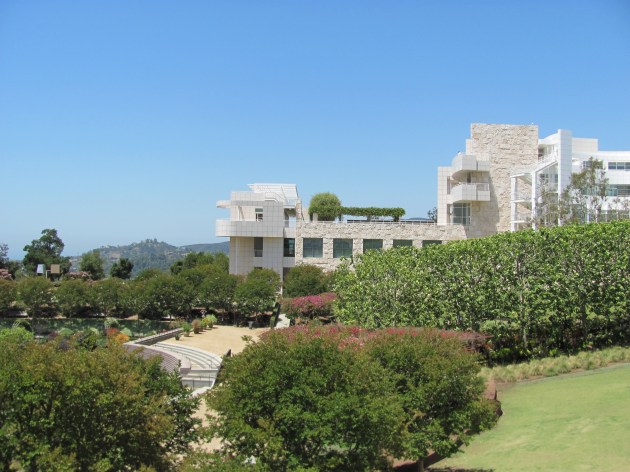
Rowe: When heaven showed up, it was pretty much unanimous right away that they wanted to shoot at the Getty [Center, an art museum in Los Angeles]. There was a lot of discussion that happened to help the Getty get on board, because obviously they have a brand they want to protect. The location manager went and said, “It’s a show about heaven, and we’re showing the Getty as a place of paradise.”

We actually didn’t do that many things there, because the architecture speaks for itself. People breeze through that museum, and you can ask them, “Oh, did you see any paintings?” And they’re like, “Yeah, I kinda saw the modern stuff upstairs, but I was basically outside the whole time.”

The Getty Center is indeed a unique building and it connects modern architecture, gardens, and a view overlooking Los Angeles. As an oasis set apart from the Los Angeles bustle, I could see how it would be compared to heaven:
Getty2

Comparing depictions of heaven across time and cultures could prove to be a fun exercise. How much do the depictions reflect contemporary tastes or standards? If the architects of today or those with architectural knowledge generally like mid-century modern, this is what they might prefer heaven to look like. Would Christians throughout the United States agree? There have been too many depictions of clouds for that not to show up somewhere and ancient Greek architecture – familiar to Americans in a number of important buildings including government structures – might be popular. Would heaven look more like the nondescript suburban megachurches of today or more like a Gothic cathedral? Or, would Americans prefer heaven to look like mansions in a well-kept suburb or prefer it to be more about nature? And global depictions would likely differ significantly from these options.

Six suburbs for Generation Z

Homes.com surveyed Generation Z, found their preferences for where they want to live, and then matched those preferences with six suburbs:

In deciding where to buy a first home, each generation has likes and dislikes that reflect its values and priorities. Recently Homes.com surveyed more than 1,000 members of Generation Z to find out more about their home-buying plans, including what kind of neighborhood they prefer.

The survey found preferences centered around four characteristics:

Diversity. More than half prefer neighborhoods and communities that are racially and ethnically diverse;

Accessibility. Three out of four want a location that is accessible to work as well as to friends and family;

Safety. This is a priority when Generation Z-ers evaluate neighborhoods

Affordability. Generation Z is very aware of rising home prices that have kept millions of millennials from becoming homeowner.

And the six suburbs:

-Lilburn, Georgia (outside Atlanta)

-Florin, California (outside Sacramento)

-Shaker Heights, Ohio (outside Cleveland)

-Glendale Heights, Illinois (outside Chicago)

-Valley Stream, New York (outside New York City)

-Stafford, Texas (outside Houston)

Given these four traits and these six suburbs, there is limited representation from some notable big coastal cities including Los Angeles, San Francisco and the Bay Area, Seattle, Boston, and Washington, D.C. Presumably, these metropolitan are too pricey to meet the priority of affordability.

Additionally, it is interesting to not see on the list cultural opportunities or an exciting location. All big cities have hip locations or neighborhoods that might fit the bill or some of this could be rolled into other factors above. Yet, the list also does not include places like Austin and Denver which have a reputation for being cool.

Finally, I do not know the longer histories of these suburbs. Right now, they are quite diverse (at least in comparison to the image of white and wealthy suburbs) but they might not always have been that way and may not have the same composition in the future. If a lot of Generation Z buyers move to these communities, how would they shape the demographics and character of each suburb?

Cities standing in for other cities in films and TV shows

A longer discussion of how holiday films treat big cities includes information on where these films are made:

The irony, of course, is that these movies that portray the cruel hustle of big cities and the virtues of small-town life are filmed in big cities that get high marks for livability. Christmas Town, like many products of the holiday rom-com industrial complex, was shot in the made-for-cable Christmas movie wonderland of Vancouver, British Columbia, which boasts an abundance of studios and proximity to a variety of urban and rural shooting locations. Vancouver is also a perennial high-scorer in urban happiness and well-being rankings, a place that Canadian journalist Charles Montgomery singles out for praise in his book Happy City. (As this first-hand report from the Christmas Town shoot reveals, conditions on set were somewhat less magical: Filmed on a suburban backlot during a heat wave, the movie used leftover ice from Vancouver’s fish markets as a stand-in for snow.)

Other films rely on Toronto, another Canadian metro with enviable livability scores, to play the urban heavy; while certain landmarks may stand out to local viewers, the mostly American Christmas-movie audience is none the wiser. They’re too busy inhaling the on-screen, small-town romance that Hallmark and its kin have carefully crafted to make us believe miracles happen—just not in the big city.

Many films are made in these locations given the cost of filming in Canada versus the United States as well as the ability of these Canadian cities to stand in for many American cities.

Instead of looking at just holiday films, how many American viewers notice anything amiss when they are actually looking at Vancouver and Toronto on the screen? Would they even notice? Between the use of different cities plus the use of backlots, a good number of television shows and films may include very few to no shots from the location depicted on-screen.

Does this matter in the long run for viewers? On one hand, not at all. Relatively few on-screen depictions of places actually involve much unique material from those places. Think of the average television show: the activity largely takes place within buildings – homes, offices, restaurants/coffee shops, and the like – and involves a limited set of characters. The show may be set in a prominent location yet it could take place in any large city (outside of some establishing shots or an occasional reference to local culture). On the other hand, seeing deplaced places – generic cities and neighborhoods – suggests every place is similar. Does it matter that Full House took place in San Francisco or How I Met Your Mother took place in New York City? Not really. An on-screen big city is largely like any other on-screen big city.

If holiday films need generic cities and neighborhoods, Vancouver and Toronto can work. If they truly wanted unique locations and let those locations help drive the plot – such that a story from Omaha would differ from one in Phoenix or Charleston – then the movies themselves would be richer and more complex.

Designing your own Peytonville, Part 5

In a new iteration of the Peytonville commercials from Nationwide, Peyton is in the big city that loomed at the edge of his region:

peytonville5.jpg

This is one broad avenue with at least four lanes of traffic and it looks like there are bike lanes on each side. There are plenty of trees on wide sidewalks. The buildings are not that tall and are setback a ways. They primarily look like newer structures – glass facades – with some older buildings (or at least structures clad with bricks).

Is this a typical American big city? This view looks like either a sprawling city found in the Sunbelt or a smaller big city in the Midwest.

Is this meant to be an inviting image? My first thought is that this is a city built for cars and not people or pedestrians. With such wide streets, the scale is slightly off (even though the sizes of the buildings showed here do not overwhelm the streetscape). For example, crossing the street at this traffic light would take some time.

I wonder what kind of urbanism Peyton Manning prefers. Would he prefer a college town? A mid-sized big city like he played in during his NFL career?

Claim: “The physical environment feels depressingly finished”

As Derek Thompson of The Atlantic considers innovation and Silicon Valley, he includes this paragraph regarding innovation in the physical and urban realm:

And if you look up from your smartphone, progress becomes harder to see. The physical world of the city—the glow of electric-powered lights, the rumble of automobiles, the roar of airplanes overhead and subways below—is a product of late-19th-century and early-20th-century invention. The physical environment feels depressingly finished. The bulk of innovation has been shunted into the invisible realm of bytes and code.

There are several pieces that can be pulled out of this an examined:

1. Has innovation in cities and urban areas slowed? Many of the major changes may have already happened – think the modern skyscraper, the car and all the roads to go with them – but I’m guessing there are some lesser-known changes in the last few decades that have made a major difference. (For better or worst, one would be the global shift toward and innovations in capitalism, neoliberalism, and the finance industry that has had large effects on numerous cities and neighborhoods.)

2. If “the physical environment feels depressingly finished,” does this mean a change in aesthetics or style could alter this? Science-fiction films and shows tend to depict cities as white, gleaming, and move curved than they are today. Think Her which merges city life and technological change. Or, find images of cities from researchers, activists, and architects who imagine much greener cities full of plants and life rather than hard surfaces and cars. Perhaps the problem is not innovation as it is described in this article; one issue is that the look of big cities has not changed much in the fifty years or so (even as some individual buildings or projects might stand out).

3. If the look and feel of cities has not changed as much recently, could “the invisible realm of bytes and code” bring significant changes to the physical environment in the next few decades? In contrast to #2, perhaps future innovation in spaces will be less about collective experiences and aesthetics and more about changed private experiences. Imagine Virtual Reality in cities that allows pedestrians to see or overlay different information over their immediate surroundings. Or, easier access to Big Data in urban settings that will help individuals/consumers make choices.

Celebrating new development – and recognizing what is lost

Looking at a few 2010s retrospectives at Curbed, I enjoyed looking at one detailing some of the buildings and spaces lost in Chicago in the last ten years:

The losses in Chicago’s built environment go far beyond the buildings and their architectural features. These places are symbols of greater failures: vacant lots represent a dearth of affordable housing, church-condo conversions signal the absence of community spaces, and closed schools call attention to the city’s disinvestment in its neighborhoods.

This only covers a sliver of the demolitions and conversions that have occurred in the past decade. These spaces are still mourned today, and as we reach the end of a decade, let’s take a look back at what Chicago has lost.

This is an interesting collection. And it does not even address the significant changes that may have come to neighborhoods or smaller areas through new development. Addressing how a place changes in atmosphere and feel goes beyond just buildings.

What is the proper or best way to mark these losses? Growth is often seen as an inarguable good. Don’t residents and leaders want new buildings, new options, updated spaces? Here are a few ways buildings and spaces could be memorialized:

  1. Articles, books, and websites can help keep memories alive. A retrospective like the one above makes sense but such pieces need to keep coming, particularly as the years pass and new residents do not even know what used to be there.
  2. Some sort of public marker or display in certain locations. This would be hard to do for every structure that changes but imagine having both a new building or space and a public marker with an image and some text that records what also stood on that land. This would help future visitors visualize what used to stand there.
  3. How about a museum for a lost Chicago? I could envision exciting displays with pictures, videos, interviews, text, and immersive recreations (whether parts of buildings that are reconstructed or using virtual reality displays) that celebrate what used to be in Chicago. A history museum can do some of this as could a celebration of architecture but really focusing on buildings and spaces could be really interesting and worthwhile for a city that wants to celebrate its past.
  4. Of course, ongoing historic preservation efforts can help keep this in the public eye. While it may be difficult at times to agree on a balance between saving key structures and allowing for change and innovation, at least having public discussions about important structures helps provide reminders of how something can be lost even as something new looks promising.

National political leaders’ connections to cities, urban areas, and population centers

In thinking over the (dwindling) 2020 Democratic field for president, I wondered whether national politicians on the whole come from big cities and metropolitan regions. Some (somewhat incoherent) thoughts on the possible connection:

1. The United States is an urbanized country with a little over 80% of residents living in metropolitan areas. Most people live in these places, more politicians come from these places.

2. Politicians need to connect to large pools of voters before they hit the national stage. They can do that in sizable regions/cities and build a base before seeking a larger presence.

3. If national politicians do not necessarily connect with cities, it still seems to help to come from a more populous state where they have appealed to more voters and can make a stronger case about facing complexity before addressing a national stage. I’m thinking of George W. Bush who had numerous connections to Dallas, came from Texas, yet seemed to prefer more rural life in Crawford. He may not have been an urbanite but he had enough connections and experience in one of the most populous cities and states. In contrast, politicians like Bill Clinton or Nikki Haley might have to work harder to reach the national scene coming from less populous states or communities or those operating in second tier cities or regions like Jay Inslee in Washington state or Amy Klobuchar in Minnesota.

4. Does social media help candidates breakthrough an urban/rural divide? If the ultimate outcomes still come to votes, probably not.

5. Is there a major candidate or figure in any party who truly exemplifies a suburban lifestyle? I can think off the top of my head of numerous figures from big cities and others from more rural areas but who is a suburbanite in an era when political elections are decided by suburban voters?

Palaces for the People, Part 2: place-based rather than people-based interventions

I recently read Eric Klinenberg’s 2018 book Palaces for the People. For a few days, I am highlighting a few short passages from the book that make some interesting connections regarding physical places.

In a discussion of policing, crime, and spaces, Klinenberg highlights research showing resources put into improving places can improve social relations:

The Philadelphia studies suggest that place-based interventions are far more likely to succeed than people-based projects. “Tens of millions of vacant and abandoned properties exist in the United States,” write Branas and his team. Remediation programs “make structural improvements to the very context within which city residents are exposed on a daily basis.” They are simple, cheap, and easily reproducible, so they can be implemented on a larger scale. What’s more, they impose few demands on local residents, and the programs appear to pay for themselves. “Simple treatments of abandoned buildings and vacant lots returned conservative estimates of between $5.00 and $26.000 in net benefits to taxpayers and between $79.00 and $333.00 to society at large, for every dollar invested,” their paper in the American Journal of Public health reports. It’s not only more dangerous to leave the properties untended; it’s also more expensive. (70)

Imagine vacant properties in many American cities, particularly in the Rust Belt, transformed. Keeping up the property over time could help show local conditions will not be allowed to decline. Even as residents may come and go, the community is committed to the lot.

But, I wonder how much push back there would be from the public. A typical approach to struggling communities is to argue for more job and educational opportunities. If this works, it gives people options and skills they can then use anywhere over time. Such investments are viewed as showing residents that the community cares about their lives. Would putting resources into places be perceived in the same way?

Generally, infrastructure is pretty invisible in American life. Focusing on vacant properties, very noticeable to both people in the community as well as visitors, might help reverse that.

Building a town for training foreign agents

A new training center gives US foreign service agents an opportunity to learn how to move and operate in an urban setting:

Take the 19 miles of intertwined roads that replicate virtually every type of automotive interchange, intersection, and interstate likely to carry the federal agents tasked with protecting US diplomats and citizens around the world. They include traffic-free driving circles, twisties, and long highway sections where agents learn to evade ambushes and intercept suspects. The tree-lined labyrinth is both a tempting playground and a post-apocalyptic vision of suburban emptiness.

The nearby off-road course includes a simulated rocky riverbed, a real sand pit, a craggy hill, and cement staircases. Agents weave Jeep Wrangler Rubicons through a field of moguls. Elsewhere on the 1,300-acre compound you’ll find a rappelling wall, an explosives range, and live fire “shoot house.” In the “smokehouse,” agents learn to escape burning buildings. In the tactical maze—a warehouse holding dozens of interconnected rooms—teams of agents practice security missions. They bust down doors and stalk their enemies, while instructors observe from catwalks.

All wild stuff, but nothing compared to the centerpiece of this new training center: the “military operations in urban terrain” simulator. Also known as the MOUT, this is a proper town, complete with back alleys, main drags, and a life-size US embassy compound. The multistory buildings sport rooms, stairs, balconies, and rooftops, all of which can serve as stages for faux bad guys or the agents securing the structure while managing a search, evacuation, or watching over a motorcade. The only thing missing is a Starbucks on every corner—or any other permanent set dressing. The town is a blank, reusable canvas that can be modded to play a global capital or developing nation’s unkempt urban center. Actors interact with agents; networked speakers replicate rumbling tanks, bleating goats, midtown Manhattan traffic, and more…

So much for having fun. A pronounced aura of menace colors exploration of even the empty facility, as I discovered during a visit the day before it officially opened. As I went from door to door and floor to floor at twilight, it was easy to sense what agents will face: uncertainty and unfamiliarity, speckled with chaotic radio chatter, aggressive crowds, small arms fire, even pyrotechnics. “It’s designed to make it as realistic as possible, in order for the brain to really make the synapses kick together and go ‘Yeah, this is real life,’” said facility director Bob Weitzel.

Having a training ground seems to make sense: executing maneuvers in a stressful moment could be easier if someone has tried something similar before. At the same time…

1. How much can a training ground like this really replicate complex communities around the world? Having the physical space is one thing but then adding the layers of people and meaning would be really hard to achieve. The article hints at the ways they get at simulating an experience but I would wonder how much it matches reality.

2. It would be interesting to know how much more successful agents are after training in a facility like this versus learning through other means. How much difference does having a tangible training ground make? How many hours does an agent need in the simulated settings to feel comfortable?

3. I wonder how this setup differs from a Hollywood backlot. Did the creators of the training ground borrow from what movie and television producers regularly do?

Move to the big city to live in a capsule

Difficulty in finding cheaper housing means Americans moving to a big city might consider living in a capsule:

Each room contains up to six capsules, which Wilson describes as “cozy.” They contain a single bed, a bar for hanging clothes, a few compartments for storing shoes and other items and an air vent.

By most standards, the accommodation is still not cheap — $750 per month plus taxes. That works out at around $800, which is slightly more than the 26-year-old was paying in Bethlehem, around 70 miles outside Philadelphia…

Cheaper options exist, but UP(st)ART offers a good, central location and modern buildings equipped with a gym, dance classes, recording studio, art workshop and free cleaning and laundry services…

Still, the capsule-living concept is also catching on in other expensive US cities including New York.

The key redeeming feature to these capsule in Los Angeles appears to be that it is located within an artistic community. Capsule inhabitants may not get much in terms of space but they are plugged into a set of like-minded people and have attached facilities they can use.

On the other side, imagine capsules with no community. Would people be willing to rent/occupy those and at what price point? Would it be worth it to have a roughly 31 square foot area for $800 a month in Manhattan? Would the price drop significantly if the capsule was in one of the other boroughs of New York? Or, imagine capsule for people who are not so free to simply pick up and move. Where would you go if you had a spouse? A child?

Both of these could be true:

  1. There is a needed for cheaper housing in many American cities so that young people can get their feet on the ground and start down a path toward adult success.
  2. There might be relatively cheap housing available in many locations, either in smaller cities or neighborhoods beyond the most attractive ones in cities. But, a good number of young adults want to go to the most exciting places such as New York, Los Angeles, Seattle, neighborhoods with lots of millennials such as in Chicago, etc..