How watching the TV show “Cribs” affected what viewers expected from their own homes

What did Cribs teach viewers about homes?

Photo by Hongyue Stone-Jon Lee on Pexels.com

The show’s audience of Millennials, coming of age in an era defined by consumption, learned to take their cues from celebrities. These role models accumulated traditional markers of wealth while also having fun subverting them: In their respective episodes of Cribs, the That ’70s Show actor Wilmer Valderrama highlighted red Solo cups and paper plates on display in a china cabinet, and Missy Elliott gestured to her decorative, seminude Greek statues, remarking, “Naked a-s-s all around the house.” The show featured nouveau riche celebrities who proudly referred to themselves as outsiders; the rapper Juelz Santana was still a “hood dude,” and the record producer Master P claimed that he’d come “from the ghetto.”

These scenes were designed for the average young viewer to enjoy, yet their appeal was offset by their unattainability. Even the celebrities themselves hadn’t always attained Cribs’ vision of the so-called good life. On occasion, the show constructed complete fantasies: Bow Wow and 50 Cent supplemented their car collections with luxury rental vehicles, and the singer JoJo presented her uncle’s lake house as her own. On camera, T-Pain and Missy Elliott admitted to staging their homes—with a frosted cake and a colony of goldfish, respectively—several hours before filming. These contrivances became so well known that, in 2009, the All-American Rejects guitarist Nick Wheeler spent much of his appearance mocking them. “I went down to Enterprise and picked up what they had,” he said, standing beside his Mitsubishi and Mazda sedans, before flaunting his notably sparse kitchen. “I didn’t just do this for Cribs,” he said, evoking an earlier episode in which Kim Kardashian insisted that the cookies on display in her kitchen were homemade, despite their striking resemblance to a popular prepackaged variety…

The secret of Cribs, though, was that even amid its less relatable moments, the show found a way for viewers to feel included in the fantasy: It taught the audience what to consume as well as why they should, by demonstrating how a person’s property—both its literal value and its aesthetic qualities—could define them. Viewers could seek to understand a celebrity’s personality by studying their domestic environment. “The subject of house furnishing is more important than is often realized,” said the Cribs companion book, explicitly articulating this connection:

Everyone is free to change his surroundings. Hence the furniture and the decorations of a house, and the condition of the house and grounds, are properly considered as index to the character of its occupants.

It sounds like one lesson is that the ways someone inhabits a space says a lot about them. Sure, some people have more resources to work with but decorating a home is about self-expression. The homeowner gets to narrate their choices and what they are trying to say about themselves. (Now I am wondering how often this happens when someone provides a house tour to someone visiting; is the focus on the residence or what the house says about the people living there?)

At the same time, I wonder if the size of the dwellings depicted and the amount of things within those spacious spaces affects viewers. I first read sociologist Juliet Schor’s book The Overspent American in graduate school. She argues that watching television shows helped shape what Americans expected from homes. If you watch a typical drama or sitcom, you tend to see people living in large residences with nice furnishings. With Americans watching a lot of television in the postwar era, they could consider the characters on television as a reference group. Rather than just looking at family or neighbors for what is normal or possible regarding housing and consumption, they could now turn to TV depictions of regular life. For example, how did those young adults on Friends afford those apartments and lifestyles? Did regular viewers of Cribs then envision larger homes for themselves?

I have not read any studies that look specifically at that question: did watching specific television shows directly affect choices about where to live? Broader data can look at the possible relationship between how many hours of TV people watched and their consumer choices. Did watching Cribs or HGTV or any number of shows that prominently feature well-appointed spaces change real behavior, and if so, how?

Starbucks moved away from being a third place, emphasized drive thru and mobile orders

Is Starbucks no longer a gathering place?

Photo by Josh Sorenson on Pexels.com

The idea of Starbucks as a third place became part of its corporate mythology. Starbucks aimed to create a welcoming environment for coffee drinkers and employees with comfortable seating, jazz music and the aroma of freshly-brewed coffee. Employees who brewed and served Starbucks coffee, whom Starbucks called baristas, handwrote customers’ names on their drink orders…

Mobile app and drive-thru orders make up more than 70% of Starbucks’ sales at its approximately 9,500 company-operated stores in the United States. In some stores, customers complained online that Starbucks pulled out comfortable chairs and replaced them with hard wooden stools. Starbucks has also built pickup-only stores without seating. Machines that print customers’ names have replaced baristas’ handwriting on cups.

“Third place is a broader definition,” current Starbucks CEO Laxman Narasimhan said last year. The “classic definition of third place — it’s a box where I go to meet someone — it’s frankly not relevant anymore in this context.”…

Starbucks’ changes to its sit-down business model came in response to several trends — demand from customers for ordering coffee from their cars in drive-thru lanes or on their smartphones. The shift from a business serving hot coffee to one in which cold coffees, teas and lemonades make up more than half of sales. The Covid-19 pandemic, which forced cafes to shut indoor seating.

Starbucks shifted to meet Wall Street’s demands, too. Starbucks found it could reduce labor costs and increase order volume by running a mostly drive-thru and take-away coffee business. Starbucks also found difficulties with being America’s third place and did not want to become the public space and bathroom for everyone, including people coming into stores who were homeless or struggling with mental health challenges on city streets. Starbucks has closed some stores and restricted bathroom access over safety concerns.

The shifts make sense: more consumers want quick service and coffee to go, the company and shareholders want to make more money, and serving the public can be difficult.

But this is a different approach to coffee, food, and places more generally. Getting coffee to consumers as cheaply and quickly as possible and when and where they desire it treats place differently. Arguably, you might not even need a location any longer. Can we get Starbucks via drones or by drivers within ten minutes of an order? Why bother going to a location at all? Why not have a huge centralized Starbucks that sends out drinks at light speed in all directions?

The purpose of third places is less about consumption and more about social interaction and conversation. Yes, third places like cafes and pubs have food. But the food helps people talk and relax. All humans need to eat – and they also need social connections. Having a refresher in the car while driving – often a solo experience – is a different experience than sitting with friends for half an hour near other people.

Starbucks is not alone in this. McDonald’s is a gathering place for some. But if coffee and fast food places limit seating and primarily want to serve people who do not stay, where can or will people go? Maybe nowhere else. Perhaps this helps give momentum to sociologist Eric Klinenberg’s argument that public schools and libraries should be designed in ways that encourage social interaction.

Housing, the holidays, and the economy

Just before Christmas, President Joe Biden touted the economic strength of the United States:

Photo by Jamie Lee on Pexels.com

Americans have been through a tough few years, but I am optimistic about our country’s economic prospects. Americans’ resilience has helped us recover from the economic crisis created by the COVID-19 pandemic, families are finally getting more breathing room, and my economic plan is making the United States a powerhouse for innovation and manufacturing once again.

In the list of economic accomplishments, I could find no mention of housing. None. Zero. There could be a few reasons for this:

  1. There is little good news on the housing front.
  2. The new about housing is less good or clear than the areas Biden cites.
  3. Housing is not viewed as a winning political topic.

What could political leaders do to help deliver a Christmas housing present for Americans? How can they talk about jobs, incomes, taxes, and opportunities without mentioning one of the most basic pieces of the good life in the United States: a pleasant home or residence in a decent location?

I keep thinking about the car commercials that have run for years featuring people getting new cars, SUVs, or trucks as Christmas gifts (sometimes with a bow). This might be the ultimate in Christmas consumption: a true big ticket purchase on the biggest consumer day. At the same time, Americans like cars and driving and are willing to shell out for it. Americans also like single-family homes; could someone develop a Christmas housing share gift program? Or, “give a mortgage”?

Even George Bailey, who realizes life is worth living, has a home to come back to at the end of the classic film. How many Americans want a storybook ending that includes such a home this Christmas?

How Americans arrived at converting rooms into closets

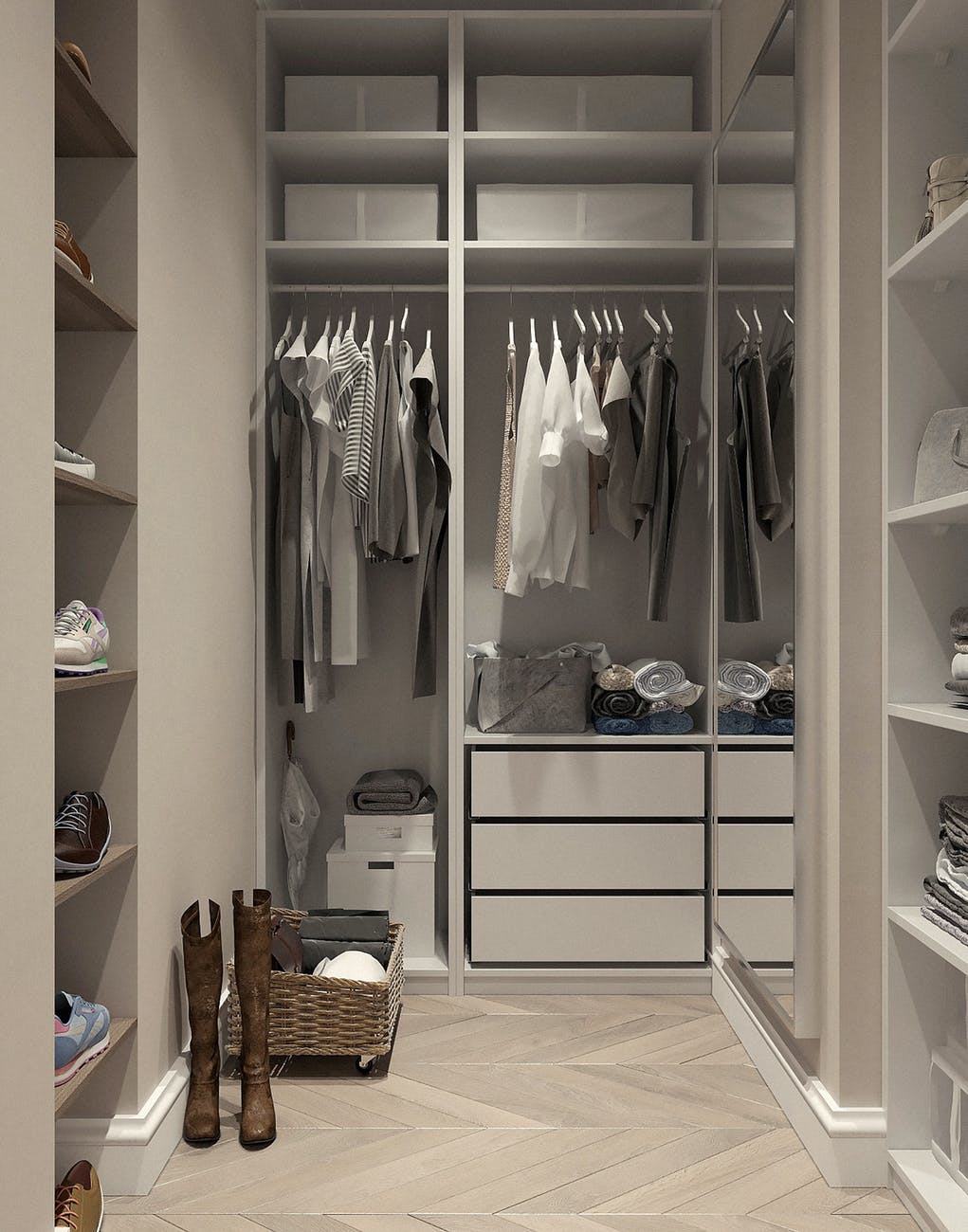
Is it as simple as Americans own a lot of stuff so they then need giant closets?

Photo by Victoria Borodinova on Pexels.com

That model held for the next century or so, until the postwar American economy lurched into motion, setting the country on the conveyor belt that would eventually deliver it to Kylie Jenner’s mirrored hall of designer handbags, a tour of which has been viewed more than 15 million times on YouTube. Prosperity settled in the suburbs, where millions of families moved into progressively bigger homes. Today, the average new single-family home is more than 1,000 square feet larger than it was in the early 1970s, even though new homes have, on average, fewer people living in them. (Regardless of Americans’ lack of need for giant houses, our zoning laws create them; many local governments have made building apartments or condos effectively illegal, and they are supported in this by homeowners, many of whom fear attracting less wealthy neighbors but welcome anything that pumps up property values, such as bigger houses down the street. Developers are happy to comply.)…

American homes not only have more space and fewer people than they once did; they also have a lot more stuff. “We’re conditioned that we need the right thing for the right activity,” Jill LaRue-Rieser, the senior vice president and chief merchandising officer for the custom-storage company California Closets, told me. As clothing in particular has gotten less expensive and more bountiful, big closets have become a selling point unto themselves. “The builders really figured it out,” she said. “If they could hook women with enough space for their shoes, they could sell the whole house.” Which is why, for decades, the country’s closets have had no reason to do anything but grow, fueling the perpetual-motion machine of the modern wardrobe—you have more space, so you don’t hesitate to buy more stuff, but eventually your big new closets seem cramped and small. At that point, maybe it’s time for a new place with even bigger closets…

Bradford said that converting a spare room to a closet has become particularly popular in recent years because it accommodates various internet home-design fantasies: natural lighting, room for a center island, seating areas, and space to show off particularly beloved collections of sunglasses or handbags or sneakers. “If people have something they value a lot, they want to create a perfect space for it, to highlight it,” she told me…

In other words, extreme closets may be starting to resemble those of, say, 16th-century Europe: a collection of prized things on loving display, a comfortable seating area in the innermost sanctum of one’s home, maybe a little desk area to work in solitude. “It’s about being proud of your space, feeling really good and calm in your space,” Adams said. Just like the Renaissance-era closet enthusiasts—though they probably lacked a wine or coffee station.

Jay Pritchett was ahead of his time: what America really needs are closets, closets, closets.

As the article notes elsewhere, if HGTV is to be trusted in this matter, a lot of bedrooms have been turned into large closets. This is a formal statement: a homeowner wants a large closet with particular features. But, this is a formal declaration of what has been happening for decades as Americans used spare rooms, attics, basements, and garages to store all of their items. As a person with a fair amount of stuff myself, I was intrigued by the first neighborhood we lived in as homeowners where all of the units had one car garages. Very few people parked in those garages. Instead, they held various items that did not fit in the relatively-small-by-today’s-standards 1,450 square foot residents.

I do think the curating and display of one’s possessions is worth noting. Today, it is not just about owning items but also about having ways to organize and show these items. Traditionally, closets are not something a homeowner might show to visitors. But, convert a room into a closet, put in an island and custom shelving plus a dazzling light fixture and this is now part of the home and possessions tour. How much time people actually spend in the expanded closet does not matter; this is a luxury item for the homeowner and the visitor.

I wonder if the reduced size of American households plays a large role here. If households have three-plus bedrooms but only a few members living in the home, there is now a free room. This could become an office; this has also picked up in recent years, even before working from home due to COVID-19, due to an interest in a clearly-defined and purposeful space. But, it could also become a closet or a theater room or a workout space.

How searching for houses online became sexy

With SNL poking fun at the ways people in their late 30s use Zillow to look at housing, what makes online home shopping such a current phenomena? I thought of the numerous factors that had to come together – here is an incomplete list:

SNL “Zillow”
  1. The rise of online real estate sites and apps. These have been around for years but between Zillow.com, Redfin.com. Realtor.com, Trulia.com, and more, potential sellers and buyers have a lot of easily accessible platforms. These options are now ubiquitous: people can search at any time from any location for any length of time. And now that some online listings have video tours and/or 3D models, viewers can get a good sense of what a property is like without ever getting near it.
  2. COVID-19 adds much to existing patterns. With some people interested in moving out of cities and health risks making it more difficult to see homes, online viewing may be the primary option.
  3. The SNL spoof targeted a particular age group – people in their late-30s – who might be in the middle of a housing dilemma. By this age, those interested in settling down somewhere may or may not have the resources (think school loans, unstable employment during COVID-19 and the last economic crisis in the late 2000s) to buy in the places they want. But, the browsing is free and all sorts of homes in all sorts of locations are available.
  4. The single-family home has always been an important part of the American Dream. Today, this is true and in new ways. The home is a respite away from COVID-19 and political polarization. It is an important investment as buying the right home is not just about enjoying day-to-day life; it should pay off in the future when the homeowner wants to sell and housing values have continued to rise.
  5. Americans also like to consume and compare their social status or possessions to others. With homes occupying such an important part of American mythology, these larger patterns carry over to these sectors. Browsing homes online allows for window shopping and comparisons on one of the most expensive investments. And homes are not just dwellings; they offer windows into lifestyles and neighborhoods.

Put all of these together and you get an SNL reflection on how home searching and purchasing happens today.

Basic sociology in the story of a fancy burger from cattle breeding to plate

The story of a $20 hamburger in Washington, D.C. reminded me of several basic sociology concepts from Introduction to Sociology:

ham burger with vegetables

Photo by Valeria Boltneva on Pexels.com

But for months, the burger had been traveling through a complex supply chain crippled by the novel coronavirus. Now it was about to end up in a takeout box…

On the burger’s journey from a Kansas farm to the engineer’s dinner plate, every person had a story like Solano’s. A rancher with five children who lost thousands every week. A factory worker who brought the virus home to her son. A courier who calculated the true cost of every delivery not in profit, but in the risk it required her to take.

To follow the burger is to glimpse the lasting toll of this pandemic: on the beef supply chain, on the restaurant industry, on the people who were struggling before this catastrophe began, kept going to work throughout it and are still waiting to see what their lives will become when it ends.

A few of the sociological concepts in the story:

  1. The miracle of modern systems. The number of people involved, the travel, and the meanings and social policy it play all hint at the complexity and ability of rationalized processes to bring a burger to the home of city residents. Reminds me of Durkheim’s organic solidarity and division of labor as well as Ritzer’s McDonaldization.
  2. The human involvement and costs all along the way. Producers and workers struggling, consumers eating the product with little idea of how it all happened, and an economic and social system that tried to make it as profitable as possible. Furthermore, many of the people are faceless and their personal and collective circumstances – whether race, class, or gender – are obscured or ignored. Reminds me of Marx and alienated workers as well as consumption patterns within modern capitalism.
  3. I am struck by two additional factors that perhaps could be hinted at during Intro to Sociology: does this story illustrate urban-rural divides? The city residents, young 30-somethings order fancy burgers after a week of white-collar work, ranchers raise cattle in the middle of the country, and faceless workers in between facilitate the exchange. And does this illustrate how broad social change is within the United States over the last century? Some aspects of this story could fit 100 years ago – the shipment of beef and other agricultural commodities helped make Chicago and other places – while other aspects would be unheard of. People need to eat and make money but how this happens evolves over time.

What if Americans stop buying things they do not need?

COVID-19 has helped slow retail sales and one writer suggests this could be a tipping point toward a society where fewer Americans feel the compulsion to consume:

We’re trained to buy often, buy cheap, and buy a lot. And I’m not just talking about food, which everyone has to acquire in some capacity, or clothes. I mean all the other small purchases of daily life: a new face lotion, a houseplant holder, a wine glass name trinket, an office supply organizer, a vegetable spiralizer, a cute set of hand towels, a pair of nicer sunglasses, a pair of sports sunglasses, a pair of throwaway sunglasses. The stuff, in other words, that you don’t even know that you want until it somehow finds its way to your cart at Target or T.J. Maxx.

In post–World War II America, the vast majority of things we buy are often not what we actually need. But they’re indisputably things we want: manifestations of personal and collective abundance. We buy because we’re bored, or because planned obsolescence forces us to replace items we can’t fix. We buy to accumulate objects meant to communicate our class and what sort of person we are. We buy because we want to feel something or change something, and purchasing something is the quickest way to do so. When that doesn’t work, we buy “an experience,” whether it’s a night at Color Me Mine or a weekend bachelorette trip to Nashville. We buy because, from the Great Depression onward, how we consume has become deeply intertwined with how we think of ourselves as citizens…

And yet we keep spending: As of 2018, the average household expenditure was $61,224. That’s rent and groceries, but also nonessential items: entertainment, vacation, clothes, plus all that other random stuff that ends up in your shopping cart.

That kind of spending is what our current economic model is based on: Americans of all class levels buying things and always wanting to buy more, regardless of their actual means. But when a society-throttling, economy-decimating pandemic comes along, what happens when that ability — and, just importantly, that desire — goes away? In April, retail sales fell an astonishing 16.4%, far more than the 12.3% economists had predicted. Clothing store purchases went down by 78.8%; furniture and home furnishings plummeted 58.7%. If you feel like you’re buying far less than at any point in recent history, you’re very much not alone. But will American identities and habits actually change, or will we just figure out a new and COVID-19–compatible way to consume at the same rate as before?

The argument makes some sense: many people in the United States have now had a few months where they could not consume in the same ways. And there have been plenty of people in recent decades asking Americans to slow their consumption or change their habits, ranging from sociologist Juliet Schor discussing downsizing or tiny houses or the popularity of Marie Kondo.

Yet, here are a few obstacles to a slow down in consumerism:

  1. As noted in the article, decades of messaging from politicians, advertisers, companies, and residents that consumption is good and acquiring items is a key marker of living the good life. The American Dream is partly about having a lot of stuff.
  2. The interest Americans still have in buying houses. And since the supply is not great, prices may stay high.
  3. The ever-increasing prices of new vehicles and the Americans who want to endlessly purchase pickup trucks and SUVs.
  4. New technology items will continue to emerge, particularly smartphones. But also think about new video game consoles, virtual reality units, home camera systems, electric cars, and so on.
  5. The large houses Americans have compared to the rest of the world. They need to fill all that space with something!
  6. Online ordering makes it very convenient to consume items without much effort. If retailers disappear in large numbers or shopping malls fade away (except for the wealthiest ones),

Absent many more months of staying at home or a large collapse of the American economy, it will be hard to transition away from consumption as Americans have known it to another system.

Trying to kick the consumption habit while living in a tiny house

One scholar studying people who lived in tiny houses found that a smaller space did not necessarily mean to having less stuff:

Tiny houses are often put forward as a more sustainable housing option. They are certainly a potential check on the continued pursuit of bigger houses and greater consumption of energy, building materials and so forth. Yet reducing your environmental impact by going tiny is not as simple as some have claimed.

I came across several tiny households that were using external storage spaces for items that wouldn’t fit in the home, for example. Referred to as a “dirty secret” by one interviewee, another explained her desire to keep items from her previous home in case she changed her mind about tiny living.

Over half of my interviewees had a “one in, one out” mentality, where they would throw away or donate one item to make space for something new. As one dweller in her late 30s, who lives in a state-of-the-art home in a caravan park in rural New Hampshire, said, “I have a TJ Maxx addiction. I still go out every couple months and buy a bunch of stuff then come home and decide which things to get rid of.”

Regardless of how tiny living is marketed by the enthusiasts, sustainability was not a major driver for most of the participants in my study. Instead it was almost an afterthought. It seemingly takes more than changing the size of a home to change the mentality of the people who live inside.

One reason (among many) that Americans live in large houses is in order to store all their stuff. Having a smaller dwelling does not necessarily mean that the resident will get rid of all their stuff or reduce their consumption. Because there are so many options for storing stuff, it can be easy to keep all that stuff. (Side note: I could imagine future communities of tiny houses or tiny house living quarters surrounding larger community facilities like kitchens and entertaining spaces that include storage facilities or warehouses on site.)

Furthermore, the American economy needs people to buy things and American culture celebrates buying more (and buying bigger things). There are occasional calls to curb consumption – or at least pare down the number of things one has – yet they put limited dents in the overall patterns

Perhaps the bigger change will come over time. Imagine someone who has lived in a tiny house for a decade or more. Will they still keep their stuff in a storage unit wondering if they will move to a larger dwelling? Will they learn to live without all that stuff and get rid of it? Or, imagine a kid who grows up in a tiny house. Maybe they will be less inclined to have a lot of items around given their familiarity with smaller spaces and the reduced availability of items.

Modernization, smaller homes, and social class

I wanted to come back to a post from earlier this year where an economist argues that modern conveniences mean people can save money by living in smaller houses:

DR. SHILLER: Big houses are a waste. People are still in a mode of thinking about houses that is kind of 19th century. As we modernize, we don’t need all this space. For example, we don’t need elaborate kitchens, because we have all kinds of delivery services for food. And maybe you don’t need a workshop in your basement, either. You used to have a filing cabinet for your tax information, but now it’s all electronic, so you don’t need that, either. And bookshelves, for people who read a lot. We have electronic books now, so we don’t need bookshelves anymore…

DR. SHILLER: Having a big house is a symbol of success, and people want to look successful. People have to know about your achievements. How do you know, really? Who knows what people are doing in their day job? But you do see their house…

DR. SHILLER: When it comes to housing, there are books about this in the last 20 years—including “The New Small House”—that talk about designing houses to look impressive as well as function with a smaller scale.

Just like we’re developing Uber and Lyft and Airbnb using existing resources more efficiently, we can also build houses that are better at serving people’s needs without being big.

All of this could indeed be true. Many of the items people purchased just a few years ago may not be necessary. However: some of the services mentioned above seem to be tied to social class and age. Which people in society are getting all of their food delivered? How many people are doing all their taxes and bill paying online? Who needs space to store books, clothes, toys, electronics, gym equipment, etc.? Imagine a few scenarios of who might trade stuff for a smaller home:

  1. A downsizing well-off couple who wants to move to the big city now that they are empty-nesters.
  2. A recent college graduate who cannot afford a large residence but wants to spend money on cultural options and food.
  3. A professional who works long hours and does not want to care for a large residence.
  4. People who live the majority of their life through the Internet and their smartphone.

On the flip side, imagine people who might still want a larger home:

  1. A suburban couple with a child on the way who want more space for their kids.
  2. A young worker who has saved a little money, wants to put down roots in a community, and invest in something that will probably rise in value over the decades.
  3. People who like to have friends and family visit or who want to gain some extra income through hosting people.
  4. Numerous Americans who think a larger home is a better deal given that they can use the space, they like to buy stuff, and/or think that their home will appreciate in value.

In sum, I could imagine those who choose to buy smaller homes might be doing it for class/education/taste based reasons rather than just because they want a more efficient home. Those with more education might value a big home less. I would guess it will take time for many American residents to come around to the way of thinking that a smaller home is more efficient. In the meantime, there are still many forces still pushing people to buy larger homes.

Downsizing, Marie Kondo, and all the stuff Americans own

Many older Americans want to downsize (and cash out on their homes), Marie Kondo’s approach is popular, but where will all that stuff owned by older homeowners go?

Auctioneers and appraisers, junk haulers and moving companies all seem to be echoing the same thing: The market is flooded with baby boomer rejects. And they cite a number of reasons our kids are turning down the possessions we so generously offer to them. They rent rather than own, live in smaller spaces, collect more digital than physical items and tend to put their money toward experiences rather than things…

Her kids also rejected three sets of formal dinnerware, including Haviland China; vast collections of Lladro figurines and Department 56 Christmas villages; as well as 3,000 Beanie Babies and boxes of soccer awards she and her husband, who both coached for many years, earned with their children.

The only offer she got on any of her treasures? One son wants her Hallmark Frosty Friends ornaments she’s collected over 37 years “because he knows how much they are worth.”

Two scenarios could develop:

1. There will be a growing market in stuff that older Americans no longer want. Perhaps many millennials or Gen Z do not want stuff from their parents but some other American will want it. It does not just have to go to resale shops; enterprising individuals and firms could shop all these items online to find buyers interested in particular niches. Perhaps this could even expand to international markets and be shipped in bulk around the globe.

2. Much of the stuff will simply be thrown away, particularly items that are more sentimental in nature. Some lucky owners will find people to take or buy their unneeded items but much of the rest will simply find its way into landfills. Decades of consumption will end in the garbage can.

I have not seen any estimates either way of how much money all of these goods could generate or how much waste could be involved (or a combination of both).

Also, consider the implications of such a change: younger generations do not take material objects from their parents and grandparents, creating a bit of a gap in a material timeline. Perhaps the shifting of wealth from generation to generation more often takes the form of helping to pay for housing or student loans rather than tangible goods. How does this change memories and collective understandings of the past?