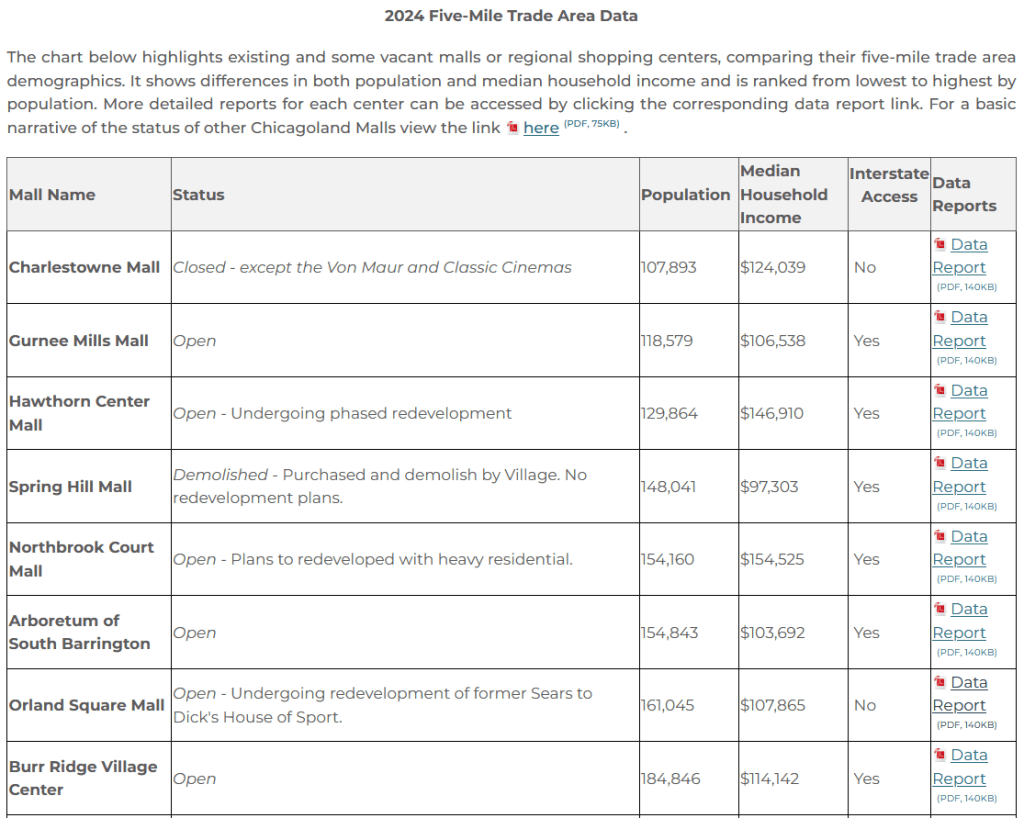
Commercial businesses such as retail stores, restaurants, and entertainment venues depend on a strong local population to generate steady sales and foot traffic. The more households that surround a shopping center, the greater the built-in customer base to support those businesses and the more attractive the redevelopment is for a developer. For Charlestowne Mall, the surrounding area has relatively low population density compared to other successful shopping corridors in the region. With fewer nearby residents, there is less day-to-day demand to sustain large-scale retail, making it harder to attract and retain major tenants. The graphic below provides the basic demographic and market data within a five-mile radius of the Charlestowne Mall site. Developers and businesses rely on this data to evaluate the market feasibility of proposed commercial uses and to understand the strength of the local customer base.
From this analysis (which continues for about 10 more malls in addition to the chart above), several features of Charlestowne stand out: the nearby population is relatively small and the mall has no interstate access. It does have a higher median household income than some malls, including the two others on the list that were demolished (but had more residents nearby with one having interstate access and another not).
So is the real story about this property about mall overdevelopment? As the number of shopping malls expanded in the growing suburbs of the end of the twentieth century, how many were doomed from the beginning? Or perhaps developers and communities were too optimistic about how many people malls might draw or projected more nearby residents than ended up living nearby. Did anyone foresee the rise of online shopping or the shifts in consumption habits?
The trend in recent years is to try to save malls with new features that will continue to pull people to the property. But the malls that are already closed – such as Charlestowne – can struggle to replace them with something local residents and leaders want. This property still has fewer people nearby and no interstate. Even if the mall building is closed, it is hard to lose the dream of the mall and all that went with it including local revenue and a local gathering spot.
Metro Chicago’s Asian population is growing faster than any other racial or ethnic group, Census Bureau estimates show. Of the estimated 9.4 million people in the Chicago metropolitan statistical area in 2024, roughly 764,000 are Asian — almost 80,000 more than in 2020, data show. During that span, the Hispanic population also grew from about 2.22 million to more than 2.32 million. Meanwhile, the metro area’s white and Black populations both declined. White population fell from 4.83 million to 4.64 million, and the Black population declined from about 1.56 million to 1.50 million.
If these patterns continue, what significant changes could come to communities and the region? How does this affect residential segregation in the region (thinking back to the high levels of white-Black segregation documented in American Apartheid)? Or political representation and policies? Or day to day lives of residents? Looking at the regional level could obscure important differences at other levels.
I am also reminded how the city of Chicago has had roughly similar sized populations of white, Black, and Latino residents in recent years. Do the patterns above suggest that the city might be headed toward four groups being roughly evenly sized at some point?
The U.S. immigrant population grew by 1.6 million between 2022 and 2023 to 47.8 million, according to the MPI analysis, with immigrants now representing a 14.3 percent share of the overall population—the highest ever.
Three quick thoughts:
Population growth is good in the United States. To have flat population growth or decline in population would be viewed with concern. This is a perception issue.
The country has never experienced a decline in population between decennial censuses. It did not have growth under 7% in any decade (just over this during the 1930s and 2010s).
How many systems and sectors in the country would be harmed if population growth and/or immigration slowed or stopped? What would keep going and what would not?
Back in 1990, 78 percent of White people lived in predominantly White neighborhoods, where at least 4 of every 5 people were also White. In the 2020 Census, that’s plunged to 44 percent.
Large pockets of segregation remain, but as America’s White population shrinks for the first time and Hispanic, Asian, Black and Native Americans fuel the nation’s growth, diverse neighborhoods have expanded from urban cores into suburbs that once were colored by a steady stream of White flight from inner cities…
More broadly, a new majority of all Americans, 56 percent, now live in mixed neighborhoods where neither White people nor non-Whites predominate – double the figure that lived in mixed neighborhoods in 1990, according to a Washington Post analysis of census data. By racial group, 56 percent of White Americans live in mixed neighborhoods, as do 55 percent of Hispanic Americans, 57 percent of Black people and 70 percent of Asian people…
Racially mixed neighborhoods continue to be less common in small towns and rural areas, and are increasing the most in the suburbs. Across large metro suburbs and medium metros, the share of people in racially mixed neighborhoods jumped by double digits over the past decade to 59 percent.
This is part of the emergence of complex suburbia where racial and ethnic populations have changed in recent decades. There still are predominantly-white neighborhoods but there are also more neighborhoods with different mixes of residents.
If people are now more likely to live near people of different racial and ethnic groups, what might this lead to? The analysis mentions backlash toward immigration. Could it also lead to positive change? How exactly is life playing out in different kinds of neighborhoods? How much does social class and the particular character and histories of a place shape outcomes in addition to these racial and ethnic changes?
In adding suburbia to the Democratic base, it turned out, Madigan also created a party that would no longer tolerate his Chicago ward boss style of leadership.
“Suburbanites tend to be less enamored of machine politics,” said Christopher Z. Mooney, a professor of political science at the University of Illinois-Chicago. “Machine politics is about one thing: getting jobs. Suburban voters tend to be more concerned about corruption. They’re a little better off,” and thus don’t need the government jobs political bosses can dole out…
While many suburban representatives had benefited from Madigan’s operation, the ComEd scandal marked the moment that “a limit had been reached,” Mooney said. “They felt that his usefulness was over. The fact that they were from the suburbs allowed them to have some cover. Madigan’s political tentacles are more effective in the city of Chicago or Cook County.”…
Suburbanites haven’t just changed the way politics is conducted within the Democratic Party, they’ve also made certain issues more important to the party. Abortion, for instance. In the 1980s, the Catholic Madigan declared himself “100% pro-life.” In 2019, he supported the Reproductive Health Act, which ensured that abortion will be legal in Illinois if Roe v. Wade is overturned, and declares that a “fetus does not have independent rights under the laws of this state.”
The explanations here suggest the changes in suburbs have had significant consequences for politics. As noted above, corruption turns off suburban voters – who often like the idea of more virtuous smaller local government – and there are more pro-choice suburban voters.
I could imagine several other factors involving suburbia that have influenced this change:
The suburbs have changed in demographic composition. There are now different kinds of suburban residents, including more racial and ethnic minorities and more lower-income residents. The whiter and wealthier suburbs still exist in places but so does more complex suburbia. The suburban voters today are not just more educated whites.
While the comparison above is between Chicago style politics and suburban politics, I wonder how suburbanites view the big city more broadly as compared to the past. Are more suburbanites interested in life in denser communities with more cultural opportunities (even if they are in the suburbs)? How essential is Chicago to the region and state compared to all of the activity – business, cultural, civically – in the suburbs?
The new data shows that, by 2019, the white population share declined nearly nine more percentage points, to 60.1%. The Latino or Hispanic and Asian American population shares showed the most marked gains, at 18.5% and nearly 6%, respectively. While these groups fluctuated over the past 40 years, either upward (for Latinos or Hispanics and Asian Americans) or downward (for whites), the Black share of the population remained relatively constant.
The declining white population share is pervasive across the nation. Since 2010, the white population share declined in all 50 states (though not Washington, D.C.) (download table A), and in 358 of the nation’s 364 metropolitan areas and 3,012 of its 3,141 counties. Moreover, as of 2019, 27 of the 100 largest metropolitan areas have minority-white populations, including the major metropolises of New York, Los Angeles, Washington, D.C., and Miami—as well as Dallas, Atlanta, and Orlando, Fla., which reached this status by 2010 (download Table B).
Most noteworthy is the increased diversity in the younger portion of the population. In 2019, for the first time, more than half of the nation’s population under age 16 identified as a racial or ethnic minority. Among this group, Latino or Hispanic and Black residents together comprise nearly 40% of the population. Given the greater projected growth of all nonwhite racial minority groups compared to whites—along with their younger age structure—the racial diversity of the nation that was already forecasted to flow upward from the younger to older age groups looks to be accelerating…
The unanticipated decline in the country’s white population means that other racial and ethnic groups are responsible for generating overall growth. Nationally, the U.S. grew by 19.5 million people between 2010 and 2019—a growth rate of 6.3%. While the white population declined by a fraction of a percent, Latino or Hispanic, Asian American, and Black populations grew by rates of 20%, 29%, and 8.5%, respectively. The relatively small population of residents identifying as two or more races grew by a healthy 30%, and the smaller Native American population grew by 7.6%.
This is important data to have regardless of what people make of this data. Having an organization that collects and reports important data is valuable to residents, scholars, and policy makers. With good data, people can now examine and use the patterns and trends.
At the same time, it is interesting to see how the Census is trying to market participation in the 2020 Census:
The emphasis here is more on what residents might get out of the process – federal funds, political representation – with a final reminder of the government mandate since 1790.
Together, this suggests having good data is critical for understanding and responding to social change. Without such data, we are left with triangulated data or anecdotes that do not inspire confidence. The United States is a large country with many interest groups. While other organizations might be able to collect similar data, having it done by the government offers some advantages (though the Census process has long been politicized).
This has been a Republican district since the early 1970s. Before that, the District was represented by a Democrat since the late 1920s and dominated by Republicans between the Civil War and 1911. Long-time representative Henry Hyde passing the seat to Peter Roskam may be the recent history but the district has more variation over the years.
The demographics of these suburban areas has changed quite a bit. Like many American suburbs, the Chicago suburbs have become increasingly non-white and more diverse in terms of social class. The area covered by the district today is not the same white, middle-class swath that it may have once appeared to be.
Roskam replaced conservative icon U.S. Rep. Henry Hyde in Congress, but much of his old territory in eastern DuPage County is now represented by U.S. Reps. Mike Quigley of Chicago and Raja Krishnamoorthi of Schaumburg, both Democrats.
4. The patterns of voting in the Chicago area suburbs mirror larger trends about suburban voters. The 6th district as well as several other House districts are comprised of the middle ground between Democratic voters in the big city and close suburbs and Republican voters in more rural areas and outer suburbs. These are the battleground areas and this will likely continue in future election cycles.
All this said, there are no guarantees in this district. Multiple factors could sway voters in this district in the near and far future including changes in what the national parties stand for (and what presidential candidates are leading the way), increasing diversity in the suburbs, possible redistricting, and particular concerns and issues that may resonate voters in the middle suburbs. As the suburbs continue to be important areas for both parties to try to pick up seats, expect this district to continue to be contested for at least a few elections to come.
Abstract: The United States spends more than $250 million each year on the American Community Survey (ACS), a labor-intensive door-to-door study that measures statistics relating to race, gender, education, occupation, unemployment, and other demographic factors. Although a comprehensive source of data, the lag between demographic changes and their appearance in the ACS can exceed several years. As digital imagery becomes ubiquitous and machine vision techniques improve, automated data analysis may become an increasingly practical supplement to the ACS. Here, we present a method that estimates socioeconomic characteristics of regions spanning 200 US cities by using 50 million images of street scenes gathered with Google Street View cars. Using deep learning-based computer vision techniques, we determined the make, model, and year of all motor vehicles encountered in particular neighborhoods. Data from this census of motor vehicles, which enumerated 22 million automobiles in total (8% of all automobiles in the United States), were used to accurately estimate income, race, education, and voting patterns at the zip code and precinct level. (The average US precinct contains ∼1,000 people.) The resulting associations are surprisingly simple and powerful. For instance, if the number of sedans encountered during a drive through a city is higher than the number of pickup trucks, the city is likely to vote for a Democrat during the next presidential election (88% chance); otherwise, it is likely to vote Republican (82%). Our results suggest that automated systems for monitoring demographics may effectively complement labor-intensive approaches, with the potential to measure demographics with fine spatial resolution, in close to real time.
The researchers created an algorithm to identify the brand, model and year of every car sold in the US since 1990.
The types of cars also provided information about the race, income and education levels of a neighborhood, the study said.
Volkswagens and Aston Martins were associated with white neighborhoods while Chryslers, Buicks and Oldsmobiles tended to appear in African-American neighborhoods, the study found.
This study seems to do two things that get at different areas of research:
Linking lifestyle choices to voting behavior as well as other social traits. Researchers and marketers have done this for decades. For example, see this earlier post about media consumption and voting behavior. This hints at the work Bourdieu who suggested class status is defined by cultural tastes and lifestyles in addition to access to resources and power.
Connecting different publicly available big data sets to find connections. Google Street View is available to all and election outcomes are also accessible. All it takes is a method to put these two things together. Here, it was a machine learning algorithm by which different kinds of vehicles could be identified. It would take humans a long time to connect these pieces of data but algorithms, once they correctly are identifying vehicles, can do this very quickly.
Of course, this still leaves us with questions about what to do with it all. The authors seem interested in helping facilitate more efficient national data-gathering efforts. The American Community Survey and the Dicennial Census are both costly efforts. Could machine learning help reduce the effort needed while providing accurate results? At the same time, it is less clear regarding the causal mechanisms behind these findings: do people buy pick-up trucks because they are Republican? How does this choice of a vehicle fit with a larger constellation of behaviors and beliefs? If someone wanted to change voting patterns, could encouraging the purchase of more pick-up trucks or sedans actually change voting patterns (or are these more of correlations)?
The Democratic Party of DuPage got a sudden influx of young foot soldiers, like organizer Alex Franklin, who campaigned for charismatic Democrat Bernie Sanders until the Vermont senator conceded to Clinton in July, then went to work for Clinton. Clinton won DuPage County by 14 percentage points on Tuesday.
“If you look at the holes right now, even where Democrats lost in DuPage there were absurdly high numbers, which are a direct result of the Sanders people and what we were doing out here,” said Franklin, of Glen Ellyn. He sees the merger of Clinton and Sanders supporters as the beginning of a beautiful friendship that will spill over into spring municipal elections…
This year, support for local candidates by minorities down ballot helped Clinton at the top of the ticket, experts said…
Shunning the New York billionaire might have cost Illinois Republicans down ballot, said Mark Fratella, a Trump delegate and Addison Township GOP organizer.
A variety of explanations. Yet, one is ignored here: the Chicago suburbs have experienced a lot of demographic change in recent decades: more non-white residents, more immigrants moving directly to the suburbs (rather than to neighborhoods of Chicago first), more lower and working-class residents. In other words, the images of Lake County and the North Shore or DuPage County as looking like Lake Forest, Highland Park, Hinsdale, Elmhurst, and Wheaton (all white and wealthy) simply do not hold.
A great graphic shows the change over time in recent elections:
The trends are clearly away from Republicans in the collar counties.
See earlier posts about presidential candidates fighting over the suburban vote here and here.
In 370 counties across 36 states and the District of Columbia, non-Hispanic whites accounted for less than half the population as of July 2015. That includes 31 additional counties since 2010, such as those encompassing Fort Worth and Austin in Texas; Charlotte, N.C.; Savannah, Ga.; and parts of suburban Atlanta and Sacramento, Calif.
Of the nation’s 3,142 counties, the so-called minority majority ones—12% of the total—represent an outsize chunk of the U.S. population since they are home to almost one-third of Americans…
In Texas, Latinos are the main group driving the shift, primarily because they are younger and have more children than whites, said Texas State Demographer Lloyd Potter. Whites are also moving out of the urban cores of Fort Worth and Austin.
A notable uptick in Asian immigrants is also diversifying these cities, Mr. Potter said. Immigration from Mexico has slowed so much that the percentage of immigrants coming to Texas from Asia is almost as high as the share coming from Latin America. “That’s a very dramatic shift in a relatively short period of time,” he said.
In other words, there are two processes going on:
The spread of minorities – particularly new groups since the 1965 Immigration Act – throughout all parts of the United States, including rural areas.
Continued concentration of non-whites in large urban centers.
There is enough demographic change taking place across the country that many communities have new populations even as minority majority counties are still limited. All of this probably contributes to some of the geographic divides of today such as competing interests between urban, suburban, and rural groups as well as Democrats having city votes, Republicans having rural votes, and the parties fighting over suburban votes.






 Legally Sociable