The new residential skyscrapers in Chicago continue to highlight capital flows and disparities

While reading reporting about skyscrapers going up in Chicago even during COVID-19, I continue to wonder: who is purchasing all of the residential units in times like these? Here is one example involving Chicago’s new third-tallest building.
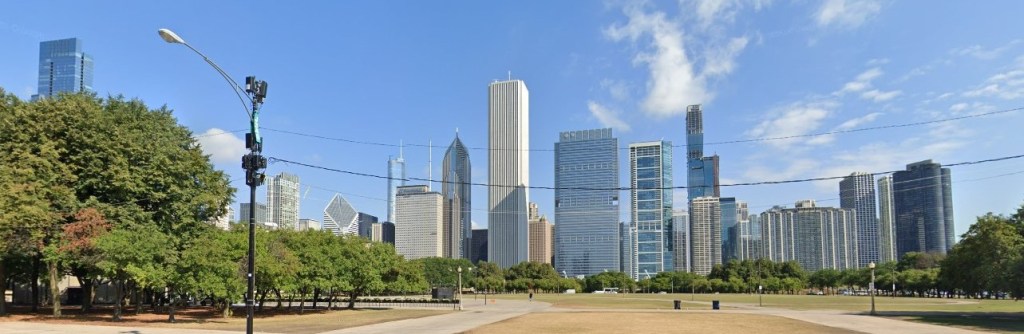
Part of the Chicago skyline from East Jackson Drive – Google Maps

Located on a multilevel riverfront site at 363 E. Wacker Drive that belongs to the same Lakeshore East development as Aqua, Vista will house a 191-room hotel and 393 condominiums once it’s complete in the third quarter of next year.

For now, as COVID-19 rages and office cubicles remain empty, the tower sends the upbeat message that downtown has a future, and it’s not just for the 1%. Vista’s ground-level amenities will benefit ordinary citizens as well as those who can afford the tower’s condos, which start at around $1 million.

The entry point of $1 million means that the clientele for such a building is pretty restricted. The Chicago area is not a superheated real estate market like San Francisco or Manhattan or several other coastal cities yet tall residential buildings are meant for a select few.

On the other hand, another skyscraper project in Chicago might move to make their residential units available for rent rather than purchase:

The biggest Chicago skyscraper to have construction halted by the coronavirus pandemic could be revived in 2021 — as apartments instead of condos.

Unit layouts are being redesigned at 1000M, the Helmut Jahn-designed condo tower on South Michigan Avenue, in an effort to refinance the project and resume construction next year, “primarily as a rental project.”…

It was the largest condo development by unit count, at 421 units, launched in Chicago since the Great Recession all but shut down construction of condos in the city for several years. At 832 feet, it also would be the tallest Jahn-designed building in Chicago, where the German-born architect is based.

With rentals being in demand, this makes some sense in order to help get the project started again. At the same time, these rental units will not come cheap.

All of this residential construction suggests there is a lot of capital continuing to flow for prestigious building projects in desirable locations. COVID-19 might be a bit of a speed bump – whose impact will continue to be determined by its length – but big lenders, developers, and buyers still have an appetite for these prestigious residential units.

Focusing on the construction of these units can both help the public pay attention to where the money is really going as well as continue to highlight the disparities in development money by location. It is hard not to report on these new tall structures; they require a lot of effort and resources and will be part of a celebrated skyline for decades. Yet, within Chicago, as the skyscrapers continue to rise for the corporations and residents with plenty of resources, needs for housing and other development are very present elsewhere.

Finding the “unstandard McDonald’s”

A Twitter account titled “unstandard mcdonald’s” features unusual McDonald’s buildings.

Recently discovering this account reminded me of some earlier posts about unusual McDonald’s (see here and here). There might be some things worth researching here…

  1. How often are fast food companies – or any large corporations with many locations – willing to compromise their architectural identity to either meet (a) local standards or to (b) be located in a potentially profitable location? In the first case, different communities might want a fast food restaurant to look a certain way. Some might consider a typical McDonald’s tacky or vulgar but the business might be more acceptable if it fits with local architecture. In the second case, McDonald’s might prefer to have a drive-thru and huge identifiable arches but can you pass up a location in a heavily trafficked location like an urban street corner or a museum?
  2. What makes the cases featured on this Twitter account stand out is that they are deviations from what McDonald’s typically looks like. Fast food – and other industries – value recognizability, especially when drivers are going by at a high rate of speed. McDonald’s helped standardize all sorts of things (hence McDonaldization), including architecture and design. Of course, that look can change over time but it typically takes place within a corporate-defined time period to refresh locations or project a new image.
  3. Can fast food have local variation? Different regions have different chains while other businesses are all across the country. Perhaps the most famous example in a similar space to McDonald’s is In-N-Out Burger. As the chain expands (and the recent opening of locations in Colorado drew lots of customers), does it lose some of its cachet and quality as it becomes just another national chain? Fast food is part of the American lifestyle but it also draws much critique.

Utilizing the front porch during COVID-19

With social life changed to COVID-19, front porches offer a unique opportunities for social interaction:

Photo by Thgusstavo Santana on Pexels.com

Thanks to the pandemic, the front porch is enjoying a new golden age. Like their near cousins, stoops, steps, even fire escapes, porches offer a semipublic setting where we can meet friends and neighbors face-to-face—even if those faces are masked. In the words of Claude Stephens, founder of a tongue-in-cheek group called Professional Porch Sitters Union Local 1339, a porch is “the only place where you can feel like you are outside and inside at the same time; out with all of the neighbors and alone reading a book.”…

“The front porch was an escape from the heat of the wood-burning kitchen stove,” explains historian Donald Empson, the author of “The Street Where You Live,” an architectural guide to St. Paul, Minn. “On the porch, in the cool of the evening, the family could gather to discuss the day’s events and exchange the latest news with neighbors strolling by.” Porches offered neighbors a place to exchange gossip, to spin sagas and sing songs, to flirt and court and air political views. The front porch at the turn of the century was Starbucks, flash mob, church social and Facebook rolled into one…

We no longer need front porches to broadcast our political agendas or to keep cool, as our grandparents once did. But we still need them, perhaps now more than ever. Porches give us a physical space to safely host friends, neighbors and passersby for the small talk and deep conversations otherwise difficult to foster in the middle of a pandemic.

If you’re yearning to add a porch, a 300-square-foot version will set you back an average of $21,000. One study shows you can recoup 90% or more of that investment at resale. But you can’t place a dollar value on the intangible elements of a porch—a social lubricant, a casual meeting place, an eye on the world, a place that’s a little bit yours and a little bit theirs.

Architects, urban planners, and others have argued for decades that front porches and the social life associated with them would help improve community. By spending time in a zone connected to the single-family home yet open to people passing by, residents open themselves up to interactions in a way that is not possible with the common holing up inside to watch TV or driving in and out of the garage at the beginning and end of each day.

It would be interesting to see how exactly front porches are being used right now. There is a time period of home construction lasting at least a few decades in the postwar era when front porches were not common. Older homes may have home as might some newer homes, though these newer porches can be fairly small or more cosmetic than usable. Do people in neighborhoods where front porches are more common report higher levels of social interaction during COVID-19?

In addition to the new opportunities for social interaction during COVID, the front porch can also function as a work or social space separate from inside life yet still connected to the home. With many working from home or students going to school remotely, the front porch offers a covered yet open-to-nature space. Just make sure the Wifi works well…

Trying to define the “average American home”

One writer/realtor describes the features of today’s typical American home:

Photo by Scott Webb on Pexels.com

Homebuyers now realize that although space is important, it’s not necessarily the most important feature to have. To have enough space to be comfortable, today’s average American home measures about 2,400 square feet. This is definitely up from the 1973 average of about 1,500 square feet for a single-family home, but it’s down quite a bit from the 4,000-plus-square-foot McMansion…

People like finished basements, a home office, a large master bedroom, a big (we’re talking the size of a child’s bedroom), customized walk-in closet with organizer features, and a tricked-out ensuite master bathroom — think of one with spa-like amenities, such as a linen closet, a separate shower stall and tub, a double vanity, and a private toilet room…

Even when you adjust for inflation, you’ll find today’s median home price has increased 900% from 1973, but incomes have increased only 600%. Americans have become used to spending more of their paychecks to get the American dream of homeownership…

“Live, work, play” became the motto of the day as people grew weary of being car-dependent. Being able to walk to shops, restaurants, bars, and entertainment has become just as important as the home itself to many homebuyers.

This description appears to draw off two sources of data: Census data that regularly provides numbers on square footage, numbers of bedrooms and bathrooms, and prices (among other things) as well as real estate knowledge of recent trends.

Whether this gets us to what “the average American home of 2020 looks like” is a tricky question. At first glance, several things seem to be missing from the description. What does this typical home look like? It is somewhere between more traditional pre-World War II styles, postwar styles like ranches and split-levels, and more recent options like McMansions? How old is this typical home? While newer homes and features receive a lot of attention, many homes are at least a few decades old. And while the factor of the neighborhood is mentioned, where are people buying homes and then what is happening to these homes in terms of renovations and alterations?

Much of this also depends on local context. Given regional architecture plus the variation in housing markets as well as communities, finding the modal American house might just be near impossible. Perhaps there could be a set of typical American homes that could encompass some of the common variation.

Walmart and Crate & Barrel feature the same designer but different products, aesthetics, audiences

Two advertisements, both featuring designer Leanne Ford, recently arrived on the same day in my mailbox. I did not expect that Crate & Barrel and Walmart would both feature the same person:

I wonder about a few things:

  1. What is the overlap of consumers/audience between these two stores? Perhaps there is more overlap than I think.
  2. While each advertisement features the same designer, there are noticeable differences. For Crate & Barrel, Ford is adding to the modernist style. For Walmart, she and her husband are providing tools to tackle home projects. The first is leaning more towards art, the second is leaning toward getting things done. Even how it is presented is clearly different.
  3. Having some familiarity with both retailers, my sense is that both do not often use famous names to sell products. In contrast, a retailer like Target has tried this a number of times. Does this signal a new approach for both retailers? If so, it is interesting that both think Ford will help them appeal to potential customers.
  4. Just thinking out loud about more consonant pairings: Walmart and Ikea? Target and Crate & Barrel?
  5. I cannot help but think about Bourdieu in this context. The idea of home design has grown in recent decades in the United States and the concept and its purveyors – such as HGTV – are broadly available. Yet, how exactly this plays out in different class contexts can vary. Design for middle to upper-class residents means something different than design for lower to middle-class residents.

Perhaps large houses are not bad if they are designed well or used correctly?

The top concern about McMansions is their size. Yet, a house that is big is not necessarily a problem. See this recent example of resilient housing from New Urbanist architect Andres Duany:

Photo by Pixabay on Pexels.com

He then scrolled through building prototypes, developed in partnership with architect Korkut Onaran. For affluent families, Duany proposed a multigenerational alternative to McMansions, resembling the walled courtyard houses found in Latin America, Europe and Asia. These compounds’ walls protect against wind, rain and storm surge. Clusters of eight or so walled compounds would surround a central green that could be used for vegetable farms, exercise facilities or a small schoolhouse. Resilient adaptations such as backup generators, solar panels and water purification facilities would come standard. The goal, Duany said, was to design communities that could be “partially self-sufficient” in the weeks after a disaster.

Here, the large home has several advantages compared to McMansions. First, it is designed by architects. McMansions are often said to be mass-produced by builders who want to maximize profits, not aesthetics (outside of an impressive – though often jumbled – facade). Second, the home can hold a multigenerational household. If a larger family inhabits the larger home, it is not just an empty McMansion that impresses people passing by; the space might actually be used. Third, the large home is part of a community intended to stand strong in the face of the effects of climate change. McMansions are criticized for their poor building construction – possibly limiting their ability to stand up to storms and other issues – and are often in sprawling areas.

An argument could be made that large houses in general should not be promoted. Even if you have the resources, who needs a home larger than 4,000 square feet, let alone the mega mansions of the truly wealthy? For example, the Not So Big House suggests smaller but customized homes would work better for residents. Tiny houses explicitly reject the bigger is better logic.

But, if bigger houses are still going to be built – perhaps some will say they need them for entertaining or large families or for particular uses that take up a lot of room – they could be done in a way that makes them less like McMansions and more like large versions of well-designed, built to last homes. Indeed, McMansions receive a lot of negative attention even as there are plenty of supersized homes – true mansions – that might also be worth rethinking.

Open offices might be pushed out by COVID-19

Open offices have provoked a lot of reactions. One CEO thinks COVID-19 might help them meet their demise:

Carol Bartz, who led the architectural and engineering software maker Autodesk Inc. for a decade before heading up Yahoo Inc. during a turbulent period that began with the last recession, is known for being direct and speaking her mind. In a recent telephone interview with MarketWatch from her home in Silicon Valley, Bartz described the current age of COVID-19 as a “new game,” with “new rules” for everyone, and made a few predictions about how she expects life to change, especially at work.

“I think office space is going to change, [and] we will go back to putting shields between people,” she said, adding that, while she realizes this in the grand scheme amounts to minutiae, this is one of the many kinds of changes that CEOs are going to have to address in the future, in what will be the new life of the CEO. “We have to take the fear away from people,” she said, noting that this will probably be the first time offices will have to be designed around health factors.

Instead of the old office cubicles separating desks, “They probably will be clear, you will not sit there in that big open space. I think people are going to want protection, plexiglass or whatever. There will also be more teleconferencing, absolutely less flying — you will teleconference with customers,” Bartz said. “Tthey don’t want to see you in person, and you don’t want to see them.”

Office spaces change in response to a variety of factors. With health as a concern going forward, it will be interesting to see how companies and leaders discuss the possible changes: how does health interact with wanting to promote collaboration or cutting costs by not having a lot of cubicles and private offices?

More broadly, this goes beyond just personal workspaces. How will employees gather together? The proverbial water cooler (or break room or coffee station) is an important feature of workspace, whether it provides a break or encourages conversation among employees. Is holding meetings in conference rooms also off the table if social distancing is required or helpful?

I would also imagine that whatever changes in physical office space occurs because of COVID-19 might need to be highly adaptable to future changing conditions. Cubicles or plexiglass might be needed for months but what happens after that point when people and organizations are less fearful? Cubicles tend to be modular and can be reconfigured. Just how many shifts can a typical organization go through?

Recommended read: A Field Guide to American Houses

I was sad to read about the recent passing of Virginia Savage McAlester. I highly recommend the book A Field Guide to American Houses that occupied much of her attention.

There are many ways to describe McAlester. She was an author, a preservationist, an architectural historian, an activist, the founder and leader of multiple non-profits, and a loyal and dedicated daughter, sister, and mother. McAlester is perhaps best known for her monumental A Field Guide to American Houses, which, after it first appeared in 1984, did nothing less than anoint McAlester as the “Queen of Historic Preservation.” The book has topped architectural best seller lists for so long that, in 2019, Curbed called her the “most popular architecture writer in America.”…

McAlester’s book appeared at a time when, as architectural historian William Seale told the New York Times, developers charged like “wild bulls” over the city’s old neighborhoods…

McAlester set about creating such a survey. The book that emerged from her efforts is a hefty tome that has been referred to as “The Bible,” by preservationists. The Field Guide is more than a catalog of home styles and types. To write it, McAlester said she had to learn a whole new architectural vocabulary, in part because the common features of so many American homes didn’t rise into the architecture lexicon at Harvard…

For example, in a 2014 update to the Field Guide, she coined two new phrases to describe two emerging architectural styles: “21st century modern” for the sleek, angular, uncluttered structures that dominate the pages of contemporary shelter magazines; and “millennium mansions” for the thrown-up ex-urban behemoths more commonly derided as “McMansions.” For McAlester, it was important to understand the highs and lows of design because both architectural visions shape our experience and conception of American communities.

I have used this book both in scholarly projects and read it for enjoyment. I have it on the shelf in my office and occasionally will pull it down to reference some feature of homes or to look through the numerous examples McAlester provided.

A few additional thoughts on the text:

  1. The book highlights both the broad categories of homes as well as the numerous variations within each type. Based on the distinctive features of each style which the book clearly points out, you can usually easily find the broad category a home fits into. At the same time, you can also revel in the many types within each category.
  2. The numerous photographs in each style are very helpful. McAlester collected photographs from numerous locations throughout the United States. For example, the section on “millennium mansions” includes multiple photographs from Naperville, Illinois.
  3. I also appreciate the sections of the book about particular features of homes, ranging from roofs to windows to how homes are structurally supported. This book is not just about the external appearance; there are things to be learned about houses are put together.

McMansions as misplaced societal priorities

An obituary of a notable architect turned architectural critic concludes with a passage linking McMansions to larger societal ills:

Michael Sorkin, a fiery champion of social justice and sustainability in architecture and urban planning, who emerged as one of his profession’s most incisive public intellectuals over a multifaceted career as a critic, author, teacher and designer, died March 26 at a hospital in Manhattan. He was 71…

“Civilizations are marked by their priorities,” he wrote, “and ours are too given over to prisons, malls, and McMansions and too little to good housing for all, complete and sustainable communities, green energy, rational mobility, structures of succor. Politics programs our architecture. The emblem of Trump’s agenda is a piece of architecture — that absurd pharaonic wall he bruits for the Mexican border. His whole project trumpets control, and his mantra is shared by many an architect: just leave it to me!”

This would fit well into the fourth dimension of the term “McMansion” I discuss in analyzing hundreds of articles in the New York Times and Dallas Morning News that use the term. Here, McMansions are symbols of larger issues. In this case, Sorkin argues that society has the wrong priorities; instead of McMansions, we should look at “good housing for all.”

In this kind of argument, the McMansion is a symptom of larger issues. Fight against McMansions, as some critics and communities have done, and the larger issues still remain. If McMansions are part of larger issues, addressing the design and construction of McMansions may do relatively little to change conditions or address important social problems. Indeed, addressing architecture and local regulations might be much easier to do that considering systemic concerns. What about building large houses in general, not just McMansions? What about incentivizing or requiring the construction of affordable housing? What about sustainability? What about building communities with fewer private spaces and more attractive public spaces? McMansions might be particularly noteworthy – hence McMansion Hell – but they are products of particular conditions and processes.

Perhaps flipping the question around makes for a more provocative conversation: instead of thinking of how McMansions symbolize larger social problems in American society, we could think of whether a more just or equal or good society would or could have as many McMansions. Are they mutually exclusive? Must the McMansions decrease so that better outcomes would result?

Designing homes to be “everything all at once” for times when everyone is home all the time

Americans generally like private single-family homes but are the homes Americans have now designed well for confinement and sheltering in place?

Homes, whatever their size or their layout, are constructed to be part of an ecosystem. They make assumptions about the way their eventual residents will interact with the affordances, and the economies, of the outside world. They assume, generally speaking, that people will commute to work (hence, in suburbs and rural areas, the abundance of driveways and garages). They assume that people will live much of their life outside the home. And they assume that the home’s residents will, as a consequence, have access to goods produced elsewhere: groceries, games, cleaning supplies. (American refrigerators are the size they are because their designers made informed bets about how often their owners would visit a grocery store.)

Apartments in cities make similar assumptions, but in reverse: They assume that the city itself is a meaningful extension of whatever square footage a dwelling might offer. They treat the home as what it often will be, for the resident: one place among many in the rhythms of a day…

Neither scenario accounts for what many Americans are experiencing right now: home as the only place. Home as the everything. The confinement can pose, for some, a direct danger. Jacoba Urist, writing about the “tiny apartment” trend in 2013, noted that large amounts of time spent in enclosed spaces, particularly if those spaces have several occupants, can be a source of stress—especially for kids. A child-protective-services worker recently sent ProPublica a list of worries she has about the people in her care: “that my families will literally run out of food, formula, diapers. That some of them may die for lack of treatment. That some children may be injured or harmed through inadequate supervision as their desperate parents try to work. That stress may lead to more child abuse.” Gwyn Kaitis, the policy coordinator for the New Mexico Coalition Against Domestic Violence, noted in the same piece that “violence increases when you have circumstances such as unemployment and isolation.”…

“In general, it’s wonderful,” Susanka said of the open-concept approach to living spaces. “But when it’s done to an extreme, it makes it very difficult to live in the house, because your noise, whatever you’re doing, goes everywhere.” When the home involves kids, that borderlessness becomes even more acute. A child might need to be entertained or fed while her mom is on a conference call. An older sibling might be playing video games or watching a movie while her dad is trying to cook dinner. Another sibling might need a retreat from his co-quarantiners, and have no place to go. In an open space, one person’s activity becomes every person’s activity. Alone together, all the time: For many, that is the current state of things. The “See Also” section of Wikipedia’s “open plan” article cites only one related page: “panopticon.”

There is a lot to think through here. A few thoughts on what this might mean for homes in the future:

  1. I have seen the suggestion from a few places that more Americans will seek out homes in the future that have dedicated office spaces at home. Without a room that can be closed off and relatively quiet, it can be hard to work from home when everyone else is also home.
  2. Will this push more Americans to seek out more square footage in their dwellings? The argument can go like this: you never know when you might need that extra space (such as during a pandemic). An extra room or two could be converted to office space or classroom space or food/toilet paper storage when residents need to stock up. Additionally, does this experience limit how many people will be willing to bet on a tiny house?
  3. A push toward further integration of technology into houses. If people are working from home and spending all of their time there, imagine dwellings with screens and speakers in every space, effective wi-fi everywhere, and both ample space for sitting and standing (with the need to stand and work to vary it up and move around). Carrying a laptop, a tablet, or a phone around to every interior space may not cut it.
  4. Earlier evidence suggested people congregate around the kitchen while other parts of the house go relatively unused. The kitchen might still be a gathering space but perhaps more attention and innovation will come to other spaces that in earlier times would be relatively ignored. When a bedroom has to serve more purposes, perhaps this means there will be different furniture or amenities there.