Food deserts and unenforced federal policies regarding suppliers and deals

I am familiar with the concept of food deserts but I do not recall reading anything about their emergence over time. Could they be the result of not enforcing existing federal regulations regarding suppliers?
Photo by Kampus Production on Pexels.com

Food deserts are not an inevitable consequence of poverty or low population density, and they didn’t materialize around the country for no reason. Something happened. That something was a specific federal policy change in the 1980s. It was supposed to reward the biggest retail chains for their efficiency. Instead, it devastated poor and rural communities by pushing out grocery stores and inflating the cost of food. Food deserts will not go away until that mistake is reversed…

Congress responded in 1936 by passing the Robinson-Patman Act. The law essentially bans price discrimination, making it illegal for suppliers to offer preferential deals and for retailers to demand them. It does, however, allow businesses to pass along legitimate savings. If it truly costs less to sell a product by the truckload rather than by the case, for example, then suppliers can adjust their prices accordingly—just so long as every retailer who buys by the truckload gets the same discount…

Then it was abandoned. In the 1980s, convinced that tough antitrust enforcement was holding back American business, the Reagan administration set about dismantling it. The Robinson-Patman Act remained on the books, but the new regime saw it as an economically illiterate handout to inefficient small businesses. And so the government simply stopped enforcing it.

That move tipped the retail market in favor of the largest chains, who could once again wield their leverage over suppliers, just as A&P had done in the 1930s. Walmart was the first to fully grasp the implications of the new legal terrain. It soon became notorious for aggressively strong-arming suppliers, a strategy that fueled its rapid expansion. By 2001, it had become the nation’s largest grocery retailer. Kroger, Safeway, and other supermarket chains followed suit. They began with a program of “self-consolidation”—centralizing their purchasing, which had previously been handled by regional divisions, to fully exploit their power as major national buyers. Then, in the 1990s, they embarked on a merger spree. In just two years, Safeway acquired Vons and Dominick’s, while Fred Meyer absorbed Ralphs, Smith’s, and Quality Food Centers, before being swallowed by Kroger. The suspension of the Robinson-Patman Act had created an imperative to scale up.

In this explanation, Walmart came to be such a big player in groceries because their size meant they could get better prices from suppliers. Smaller grocery stores could not keep up. The big chains set up locations in certain places offered lower prices.

If the Act was enforced again, would grocery stores quickly emerge in food deserts and other areas? Would consumers get more options soon or would it take some time to rebalance the grocery landscape? How would the big players – Walmart, Albertsons, Safeway, etc. – adjust? Would food options change in wealthier communities as well?

The article also cites a statistic that suggests independent stores had prices only 1% higher in 1965. Would that be a big enough difference in groceries today for shoppers to stay with places that offer low prices all the time (particularly considering recent concerns about inflation in food prices)?
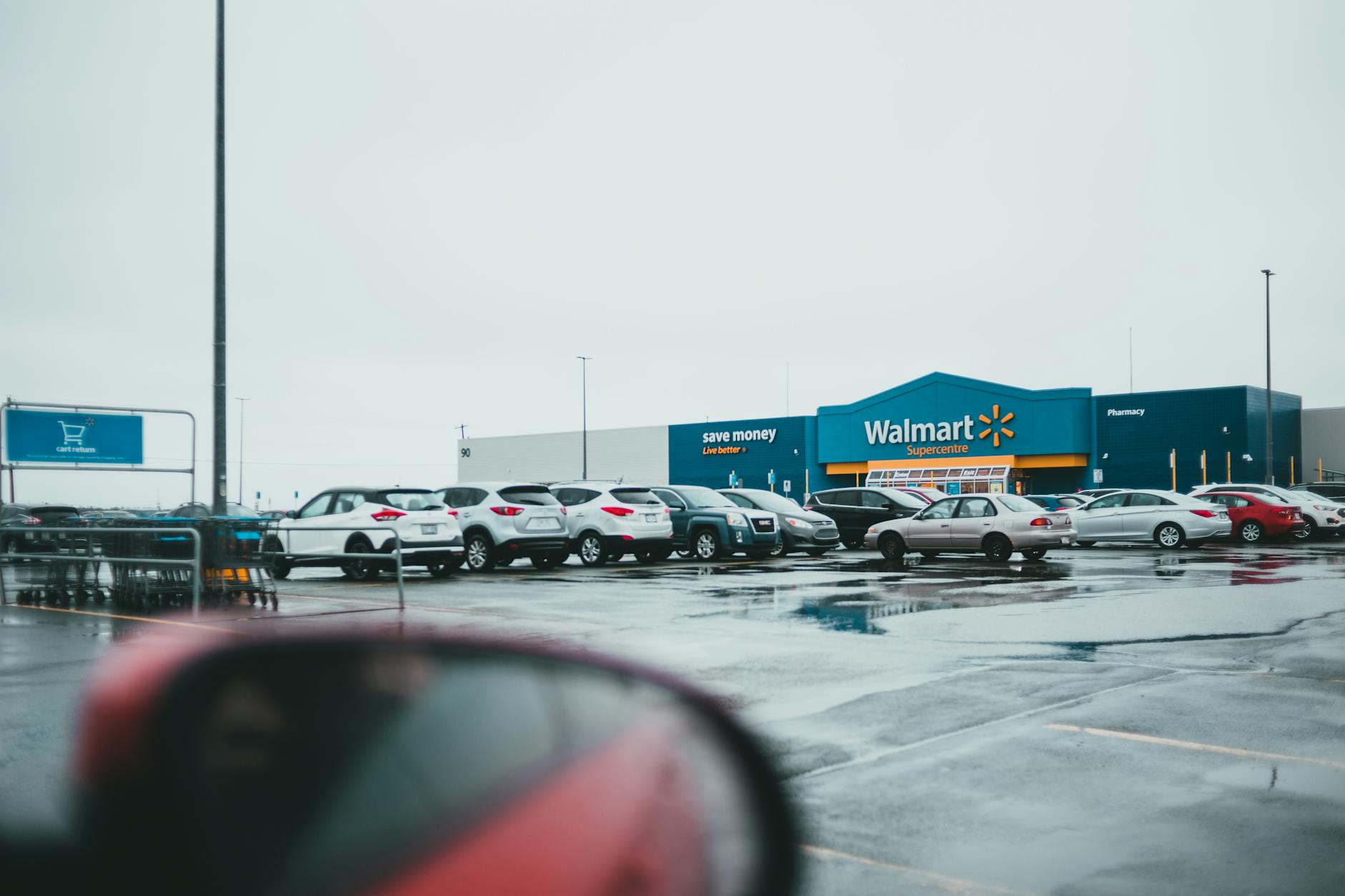
Is Walmart now a grocery store that sells some other items?

Walmart might be the quintessential American big box store. Inside a customer can purchase many items from a variety of categories. Yet, a large percentage of its revenue involves groceries:

Photo by Erik Mclean on Pexels.com

Nearly one in four grocery dollars in the US is spent at Walmart, more than double the share that shoppers spend at Kroger or Costco, according to consumer analytics firm Numerator.

That all adds up to more than $264 billion spent on groceries at Walmart US locations in 2023, up from $247 billion and $219 billion in the preceding two years.

Not only are top-line sales growing, their percentage of total division revenues is ticking up from about 55% three years ago to roughly 60% last year. And these numbers don’t even include Walmart-owned Sam’s Club.

I remember the first Walmart that opened near us in the Chicago suburbs when I was a kid. It was not a Supercenter and it was not as big as today’s stores. There were some food items there but no fresh groceries. You could buy all sorts of stuff there, from CDs to clothes to auto care items. Buying groceries often required a trip to the major grocery chains in the Chicago area, Jewel and Dominick’s at the time.

The Walmart today is a different experience. One side of the store is devoted to groceries. There are many options available for all sorts of food items. A buyer could go just for groceries and make a choice about whether to add other items to their carts from the other parts of the store.

From these experiences and their revenue streams, it sounds like Walmart is a grocery store first. It is not a conventional grocery store but as the comparative numbers indicate, its grocery sales dwarf other competitors. For younger generations of Americans, they may see Walmart as the prototypical place to get groceries as opposed to supermarkets or neighborhood grocery stores.

Grocery stores as geographic boundary markers, California edition

Could the distribution of two grocery stores demarcate the boundary between Northern and Southern California?

Photo by Matheus Cenali on Pexels.com

If you’re shopping for bananas in NorCal, you’d likely head over to the nearest Safeway. But if you travel south of King City in Monterey County, that familiar chain is no longer an option — but the inside of Vons, found throughout SoCal, will feel eerily familiar. No matter where you are, there’s a clap of thunder before the produce aisle endures a quick “rainstorm.” 

That’s because the stores are owned by the same company and have been since 1997. After decades of competition, Safeway acquired Vons and eventually the stores had the same bright interior, wide aisles and even the same loyalty numbers. They’ve even adopted the same color red for their logo. Some Californians may not even realize they’re both owned by the same company and yet, they’ll still have a preference for one or the other. 

“It’s a common industrywide practice to keep the brand name that locals are familiar with in their region. There is a sense of pride among shoppers when they shop at their local supermarket,” Safeway spokesperson Wendy Gutshall told SFGATE.

Not all might agree with this:

Plenty of Californians would be offended by this discussion altogether, with no murmur of the very real Central California designation thrown in.

Where one neighborhood ends and the next begins or where a region stops and another begins can be contentious. How many names and areas should there be/ Which trait or pattern to consider? What if public opinion is mixed or divided?

Sometimes there are official or authoritative designations that can help. If the Census Bureau says your state is in the Midwest even though might consider themselves to live in another region, that is an authoritative voice. Or if online maps start labeling a neighborhood by a particular name, this reinforces that name.

What is interesting here is that this designation involves one major grocery company that has locations of two of its brands to geographic areas that do not overlap. What would happen if Albertsons started a Safeway in San Diego or a Vons in San Jose? Would people refuse to go there? Would expats from the other region flock to a more familiar store? There are other grocery stores – such as Walmart or Costco – that span both regions.

Former Dominick’s in Schaumburg vacant for ten years until a new grocery store opened this week

The closing of Dominick’s stores in the Chicago region left a number of large vacant stores. One location in Schaumburg is now no longer vacant after ten years:

Photo by Anna Tarazevich on Pexels.com

When first elected four years ago, Dailly said negotiating an end to the vacancy was among his top priorities.

Tony’s bought the Town Center anchor site at 200 S. Roselle Road in 2015. But because of the Albertsons lease, work to prepare it for a new grocery store was stalled until 2021…

The village’s redevelopment agreement with Tony’s ensures the employment of at least 200 workers and a minimum $10 million investment in the building. The store is expected to generate more than $300,000 in annual sales taxes and food and beverage taxes for the village.

In addition to recommending approval of a Class 7b Cook County property tax break lasting 12 years, Schaumburg trustees agreed to provide $3 million in village funds for the expected $13 million renovation of the building.

The building’s vacancy potentially could have lasted until 2036 if Albertsons hadn’t stopped exercising its long-term lease options.

It is interesting to read about the tax breaks and agreements needed to help fill this vacancy. Is this standard fare in the difficult days of bricks and mortar business or is it that hard to fill a big, vacant site?

Ten years is a long time for an empty building to sit. Was Albertsons doing this to prevent competition with its own stores in the area or looking for a good payout from a new property owner or lessee?

In the long run, how many vacant properties can we expect in suburban shopping areas? If there are more coming, does this mean some retail space will be demolished or are there new uses for former shopping spaces?

Trying to organize food co-ops in the suburbs when local farms and food producers have dwindled

One suburban food co-op is hoping to launch later this year in central DuPage County. Where do they get their food from?

Photo by Engin Akyurt on Pexels.com

Prairie Food will focus on local, organic and sustainably produced food. The co-op has cultivated relationships with Walnut Acres Family Farm in Wilmette, Rustic Road Farm in Elburn, Jake’s Country Meats in southwest Michigan and “quite a few dairy farms,” Kathy Nash said…

Co-op organizers say the model — local control, local ownership — has become especially relevant after the pandemic brought on food supply issues…

Food co-ops clearly define what “local” means. The Food Shed’s goal is to source 25% of all of the store products within a 100-mile radius. The McHenry County co-op purchased land on Route 14 and Lakeshore Drive to build from the ground up. The shopping space will cover around 7,000 square feet…

The Food Shed started from a desire to connect with local farmers and “tap into the local economy,” Jensen said. The co-op was officially incorporated in 2014.

If the comparison is between a 3,000 mile salad where the ingredients come from a long ways away or having food from within 100 miles or a few hours drive, then the co-op is definitely pursuing local food.

At the same time, the desire to buy local food is made more difficult in suburban settings where development has gobbled up land for decades. Looking back at some research notes I had, I found these facts about local farms:

-The amount of land in DuPage County devoted to farming dwindled toward the end of the twentieth century – down to 11% of the county’s land in 1987 and 95 farms in 1992 – according to the Chicago Tribune.

-Also in the Chicago Tribune, the last dairy farm in DuPage County closed in 1993 with the land sold to a developer. At one point, the county was known as “the milk shed for Chicago.”

-The last beef cows in Naperville left in 2005 with the sale of a farm to developers (also according to the Chicago Tribune).

So even as some suburbanites want local food, the developments and communities in which they live are at least partly responsible for pushing food production further away?

Of changing grocery store markets and food abundance or food deserts

Three decades ago, the Chicago area grocery market was very different:

Photo by Angele J on Pexels.com

For years, Chicago was largely a two-grocery town: as recently as the late 1990s, Jewel and its No. 2 rival at the time, Dominick’s, controlled two-thirds of the local grocery market.

Times have changed:

But the grocery landscape in 2022 is vastly different. Dominick’s has been gone for nearly a decade, while Jewel and 21st-century rival Mariano’s face increased competition from major retailers such as Walmart, Costco and Amazon Fresh as well as specialty grocers, including Trader Joe’s and the Amazon-owned Whole Foods.

Jewel is still the most-commonly cited grocery-shopping destination for Chicago-area families, according to Nielsen data, but Aldi is nipping at its heels, having transformed itself from the stock-up store of the 1990s. Throw in a handful of online delivery startups that popped up during the pandemic and shoppers have more options than ever, squeezing Jewel from all sides.

Yet, newer grocery stores that once signaled hope are changing locations too:

The Whole Foods that opened in Englewood six years ago to live music, TV-ready politicians and out-the-door lines will close Sunday with little fanfare…

The city spent $10.7 million to subsidize the construction of the shopping center in which the store is located. When Whole Foods announced the 832 W. 63rd St. location’s closure in April, local activists said they felt betrayed, adding that the shuttering would limit access to fresh and healthy food in the neighborhood.

The company closed five other stores across the country “to position Whole Foods Market for long-term success” at the time, including a location near DePaul. It also opened an almost 66,000-square foot location in the Near North neighborhood the same week.

Few grocery options remain in the neighborhood. The handful of grocery stores remaining include a location for low-budget grocer Aldi close by and the smaller “Go Green Community Fresh Market” run by the nonprofit Inner-City Muslim Action Network. Another nearby Aldi in Auburn Gresham abruptly closed in June.

This highlights how much change can come to an essential market in a relatively short amount of time. New actors, new methods, new contexts.

The issue of food deserts was commonly discussed not too long ago but is not mentioned in this second article. However, these two articles highlight ongoing patterns even as the stores and brands change: some places have plenty of grocery stores (with Jewel and Mariano’s locations nearby) while others are not attractive to companies and residents have to search harder and further for food options.

Does this rapid pace of change suggest grocery stores will be quite different still in a few years? Can we imagine delivery only or virtual reality grocery shopping?

Locating a new grocery store: too close to “death trap” road? Is it actually in the city?

A letter to the editor in Fort Worth highlights two perceived issues with a new grocery store:

Photo by Matheus Cenali on Pexels.com

The new H-E-B grocery store that was just announced is not really in Fort Worth, in my book. That area is basically Keller or Alliance. If they build a store inside Loop 820, you could call it Fort Worth.

I have no intention of ever driving on Interstate 35W (also known as one of the worst death-trap highways in the state) to go grocery shopping.

In the future, I hope the company might consider North Main in the new Panther Island complex, the Hemphill corridor, Berry Street, Eighth Ave, South Main, Rosedale Street, University Drive or even Lancaster Avenue, to jump start that area.

I talked with a few of my friends, and they have told me, no way are they driving to the far north to buy some taters.

How exactly do companies decide where to locate their stores? Generally, I imagine locating near a major highway is a good thing. That road can help bring customers and suppliers to and from the location. The new location is right near an existing Kroger (as well as other big box stores). The highway might enable more access than if located in a neighborhood with smaller nearby roads.

At the same time, there might be other areas that also would like to have a grocery store. How about in a denser or walkable neighborhood? Bunching a lot of retail options near the highway might not be terribly accessible for some.

The second matter involves which community the new store is in. The official address is in Fort Worth. However, it is quite a ways north of the center of the city. It is a block or so away from the Alliance Town Center mall. This might technically be Fort Worth but it is a sprawling location. (There is also the matter of the planned community of Alliance which includes part of multiple municipalities.)

This hints at the sprawling nature of some cities in the United States, particularly in the Sunbelt. Fort Worth is surrounded by suburban neighborhoods and roadways. Just a short drive from this store location and one is in another municipality as the city sprawls northward.

Let us see how the potential grocery shoppers respond to this new store. This is a sizable investment for a company and I am guessing they imagine a good probability of success.

“Dark stores” arrive on the urban landscape

The brick and mortar retail establishment has a new member popping up across communities: “dark stores.”

Photo by Meruyert Gonullu on Pexels.com

These ghost storefronts—often called “dark stores”—are warehouses in all but name, yet they look markedly different from the gargantuan spaces where older online grocery companies like FreshDirect store their goods. Traditional warehouses are zoned to regions outside of commercial districts, meaning they will be set apart from areas with lots of walking traffic. Dark stores are located in retail storefronts on main streets, near the heart of busy neighborhoods, but they serve only ecommerce customers. And they’ve gone from a niche phenomenon discussed largely in retail industry circles to a feature of major American cities.

The rise of dark stores directly parallels the acceleration of ecommerce as a whole, especially in the grocery industry. Online sales represented 13 percent of all grocery spending in 2021, a new high, and dark stores are designed to make the delivery process smoother…

Dark stores—sprouting up in former butcher shops, convenience stores, gyms, and mattress retailers—are taking up spaces once designed to be open to the public. That shift from far-flung warehouses to accessible retail storefronts has city planners on edge. Because dark stores sit at the confusing intersection of being technically occupied, but functionally empty, they risk entrenching the worst impacts that vacant real estate can have on a community.

The fear is that dark stores, like vacant storefronts, could puncture a hole in the social landscape of a neighborhood. Vacant storefronts are bad for cities. When there are a lot of them in a tight vicinity, they mean that fewer people will walk down the street, and fewer connections between neighbors will happen. “Having people out on the street increases public safety, because more people see things that are happening,” said Noel Hidalgo, executive director of BetaNYC. “That level of social engagement makes cities safer and makes places safer.” Accordingly, neighborhoods with high numbers of vacant storefronts see increased crime rates, fire risks, and rodent activity.

I wonder how municipalities will respond to this because of the revenues such dark stores might generate. It is one thing if other retailers or businesses want to use these spaces. But, if dark stores are occupying commercial space and generating money through paying property taxes and sales taxes plus adding jobs, will they be as concerned about the social fabric? It can be difficult to fill vacant commercial properties, particularly spaces like grocery stores.

So out of the concerns expressed above, I could imagine cities limiting the number or density of dark stores within different kinds of zoning. Or, what if there was a whole block of dark stores and then none for a decent distance from there? If e-commerce is here to stay and needs to be close to those who order, perhaps warehouse districts need to be spread throughout communities at regular intervals or near transportation hubs.

Driverless trucks, dark stores, and getting groceries

How Americans get their groceries might be on the edge of a big change with the introduction of autonomous vehicles and dark stores into the mix:

Photo by Quintin Gellar on Pexels.com

Walmart and Silicon Valley start-up Gatik said that, since August, they’ve operated two autonomous box trucks — without a safety driver — on a 7-mile loop daily for 12 hours. The Gatik trucks are loaded with online grocery orders from a Walmart fulfillment center called a “dark store.” The orders are then taken to a nearby Walmart Neighborhood Market grocery store in Bentonville, Arkansas, where Walmart is headquartered…

Walmart, the nation’s biggest seller of grocery items, is testing the Gatik autonomous vehicles as part of its transition to a “hub and spoke” model for grocery delivery where dark stores are closer to the consumer and used to serve several retail stores. Walmart said the use of automated vehicles will also allow store associates more freedom to perform “higher level” tasks, including picking and packing online orders and customer assistance.

“The old architecture of delivery where you have a giant distribution center four or five hours away from the end consumer does not work anymore. Grocers are forced to set up these fulfilment centers close to the customer, and once you get close to the customer you have to shrink the size of your warehouse,” Narang said. “As the size shrinks there is a growing need for doing repeated trips from the fulfillment centers to the pickup points. That’s where we come in.”

The Kroger supermarket chain has tested autonomous delivery with start-up Nuro since 2018 and said it’s now completed thousands of “last mile” deliveries in the Houston, Texas area. Kroger is also using automated warehouses to launch online grocery delivery in Florida and other states where it does not have brick and mortar locations.

The driverless trucks are interesting in their own right. The United States needs a lot of trucks to move goods all over the place. They are a familiar sight on both local roads and highways. Would it matter much to the typical driver if the semi next to them had no driver?

Additionally, it would be worth hearing more about fulfillment centers/”dark stores.” Where are they located? How do they operate? How many of them are needed in a sizable metropolitan region to fulfill orders? Depending on some of these answers, this could change where warehouses are located (can they be as concentrated, such as in Will County?) How much more efficient is this system compared to now? Somewhere, a particular community could figure out how to maximize dark stores and reap the benefits.

Even in a country of sprawl and limited public life, there are plenty of places where people come in contact with many others

Watching reactions to the coronavirus in recent weeks presents a paradox connected to American social life and addressing contagious diseases: the country has pushed sprawl and private homes for decades and public life and community life is said to be in decline; yet, there are numerous spaces, public and private, where Americans regularly come together. And under the threat of disease, shutting down locations and/or quarantining large numbers of people would change social life dramatically even in an individualized, spread out society.

A few examples illustrate this well. One essential private space is the grocery store. Even in the age of the Internet deliveries and eating out, many Americans need to acquire food and other supplies for daily life. The experience of going to Walmart or another grocery chain is not necessarily a public experience – direct interaction with people there is likely limited – but the number of people who can cycle through a major store on a daily basis is high. Another semi-private space is churches. By choice, Americans attend religious services at a higher rate than most industrialized countries. Once there is a congregation of one hundred people or more, this brings together people who participate in a wide range of activities and go to a wide number of places.

An example of public spaces that would change dramatically are mass transit lines and transportation hubs. In a country where relatively few people take mass transit on a daily basis, there are a good number of Americans dependent on buses, trains, and subways and people who use multiple forms on a regular basis. Plus, the United States has relatively busy airports. A second example involves schools. Americans tend to think education is the secret to success and getting ahead and students from preschool to post-graduate settings gather in buildings to attend class and do related activities. For these students, school is about learning and social life, classrooms and lunchrooms, eating areas, and play or recreation areas. Schools and colleges can draw people from a broad set of backgrounds and locations.

Our public life may not be at the same level as it is in Italy; instead of sidewalk cafes, Americans can go through the drive-through of Starbucks. Perhaps this means it will be relatively easy for some Americans to quarantine or keep their social distance: many live in their private homes and have limited social interactions anyhow. At the same time, significant public health measures would change social life in ways that are noticeable and that some might miss. Indeed, could a national reminder of the social ties Americans do have lead to a revival in social interactions in times of more stability?