Nearly every high school nickname in Illinois, and across the country, is a product of a local history. Your nickname, blandly innocuous or a 300-year-old derogatory insult toward indigenous people, is not special. More than 30 schools in Illinois currently claim Native American-related nicknames. There are also 36 schools that are Eagles, 29 that are Bulldogs and 29 that are Tigers…
Heritage and lore are often behind nicknames: Outside Champaign, the Bunnies of Fisher Jr./Sr. High School took their name from a century-old tradition, when players carried rabbit-feet. The DeKalb Barbs nod to DeKalb as the origin of barbed wire. In Brighton, Southwestern High School — honoring the area’s Native background without making a whole group of people a caricature — are Piasa Birds, a reference to the mythical creatures found painted into cliffs on the nearby Mississippi River.
Some of the best Illinois nicknames play off a town’s industry: The Rochelle Hubs honor Rochelle’s history as a travel junction, where rail lines and several interstates converge. The Cornjerkers of Hoopeston — home of the National Sweetcorn Festival — is another example of a team turning an insult (here, against corn farmers) into a point of pride. There’s a similarly defiant streak about Farmington Farmers and Coal City Coalers.
Discussions of changing the mascot often invoke this history:
“My first death threat I ever got as a legislator was after I filed that first mascot bill,” West said. “You hear, ‘If I see you crossing the street, I promise to forget how to use my brakes.’ My goodness — over a mascot! You are coming for their traditions, they say. Tradition is always the main argument. Finances too — how much it will cost to get new uniforms and so on. But the energy, and anger, in these conversations is about history.”
Local history is important to many communities. But there are also plenty of moments in history where communities make decisions to go different directions. As they consider external pressures and internal pressures, communities come together and discuss how they would like to respond. My research considered decisions about development but this could also apply to mascots. Have the times changed? How do newer residents in a community feel? What is the broader purpose of schools? The discussion may be about the name of the high school names bu tit likely invokes broader questions about how communities think about themselves and the world around them.
Of the examples of high school mascots provided in the article, the names highlighting a local industry are intriguing. What might this look like in the twenty-first century? The Office Parks? The Hospitalists? The Data Centers or Warehousers? The Drivers? New traditions could begin with names fitting more recent work and industry patterns.
Illinois has a shortage of about 142,000 housing units and must build 227,000 in the next five years to keep pace with demand, a number that would require recent annual production rates to double, according to a new economic study.
The joint study published Tuesday by the Illinois Economic Policy Institute and the Project for Middle Class Renewal at the University of Illinois Urbana-Champaign found that although the rental and for-sale housing markets in Chicago and Illinois as a whole remain more affordable than many coastal cities, such as New York and Los Angeles, and some other states, Illinois still faces a severe housing shortage that is escalating affordability challenges.
National housing shortage estimates are wide-ranging, with Freddie Mac citing 3.7 million and the National Association of Realtors reporting 5.5 million.
And the recommendations for how to do this?
The authors suggest a variety of solutions, some of which Chicago officials and other state leaders are already working on, including easing zoning restrictions, quickening permitting processes, offering tax incentives to convert commercial buildings to residential units and increasing surtaxes on short-term rentals such as Airbnb. Aldermen recently took a step toward giving themselves the power to ban Airbnb and other short-term rentals from opening in their wards, a move that could potentially lead to an increase in housing supply.
This is not a new issue. And even drastic changes right now would not lead to 227,000 new units in five years. This is a long-term project that needs to be addressed.
One thought: this is an opportunity for Illinois to do something that could help lead the way in the United States. Here is why. It is a blue state and Chicago and its region dominates politics and perceptions. (This is not to ignore those living outside the Chicago area; there are just fewer of them.) It has more affordable costs compared to numerous other important cities. Chicago is still an important, world-class city. If Illinois could make a serious dent in providing affordable housing across the state, it could become a model for numerous other places. What works in Illinois might not work at all in New York City or Seattle or San Francisco or other super-heated housing markets. But it might work in Cleveland, Nashville, Denver, and other American metropolitan regions. Figure it out and Illinois and lots of areas could benefit.
For numerous reasons, it seems like politicians and business leaders in American cities and regions are hesitant to truly tackle affordable housing. But those who get out ahead of it can (1) help people living there and (2) provide models and tools for others to learn from and use.
These figures were part of a story about AI farming technologies:
In general, technology is further along for row crops because hundreds of acres of corn and soybeans are relatively simple to tend to en masse. Ag-tech conglomerates such as John Deere and CNH Industrial have also historically catered to the needs of row crop operations since they’re such a large share of the nation’s agricultural sector, accounting for $21 billion of agricultural production in Illinois alone. Specialty crops haven’t received as much attention from corporate America.
When you drive out of the Chicago area, you can see what appear to be endless fields of these two crops. Illinois may lead the country in pumpkin production but the amount of corn and soybeans grown is much higher. These may not be “exciting” crops but they are used in many ways.
Put it another way: what would Chicago area residents think if “Land of Lincoln” was changed “Land of Corn and Soybeans”? Would they associate those crops with other places (like corn with Iowa)?
And would being a state that leads in corn and soybean AI be an advantage? If so, how much so and where would the benefits go?
Even though the measure failed in Bensenville, at least 163 communities around the state have recently enacted local grocery taxes.
Gov. JB Pritzker signed a bill last year repealing the state’s 1% grocery tax, saying it hit poorer families harder. But the bill also allowed municipalities, which depend on the revenue, to implement their own tax. Bensenville put the proposal on the ballot to get voters’ input, but local officials are not required to do so. In many municipalities, local governing bodies are casting the deciding vote…
The state suspended the grocery tax for fiscal year 2022 to help fight rising inflation, but municipal leaders say losing the stream of revenue permanently forces them to consider cutting services, raising sales or property taxes, or implementing a local grocery tax. If they approve a local grocery tax by Oct. 1, it would take effect on Jan. 1, 2026, when the state tax expires…
Illinois residents already pay the highest combined state and local taxes in the nation, at more than $13,000 annually, according to a recent report by WalletHub. Food prices rose 3% in the past year as of March, and the federal government forecasts them to rise another 3.5% this year…
“If local governments believe it is necessary to tax milk, bread, eggs, etc. to fund local services/local government, then they should be responsible and accountable for that decision to local taxpayers,” Illinois Department of Revenue spokeswoman Maura Kownacki told the Tribune. “The state should not be imposing a regressive, statewide sales tax on groceries especially during a time when inflation is hitting the pocketbooks of Illinois families.”
The cynical take would be that in a state with high taxes the Illinois governor wanted to paint the state in a good light by dropping the tax. Municipalities have limited options for filling the budget hole so they quickly move to adopt a local tax. The grocery shopper notices no change in taxes while the politicians debate who was more responsible.
I get the reaction from communities. They want a balanced budget each year and don’t want to have to cut services or acquire debt. Getting money from groceries is dependable money as people need to buy food.
At the same time, adding local taxes and fees can make residents angry. They already see the amount the federal and state governments take in each paycheck. Why do local governments charge for car registration and ask for more money for schools and keep coming up with new revenue ideas?
I wonder if this is also part of the larger issue of limited growth in Illinois. If communities were growing – adding residents, businesses, energy, status – this can cover up revenue issues. New growth leads to growing budgets with new tax money coming in. But if many communities in Illinois are growing slowly or not growing at all, this means stagnant budgets. Or worse, communities have to spend more to maintain older infrastructure that supported growth decades ago.
It may just be a grocery tax but the issues could be much larger.
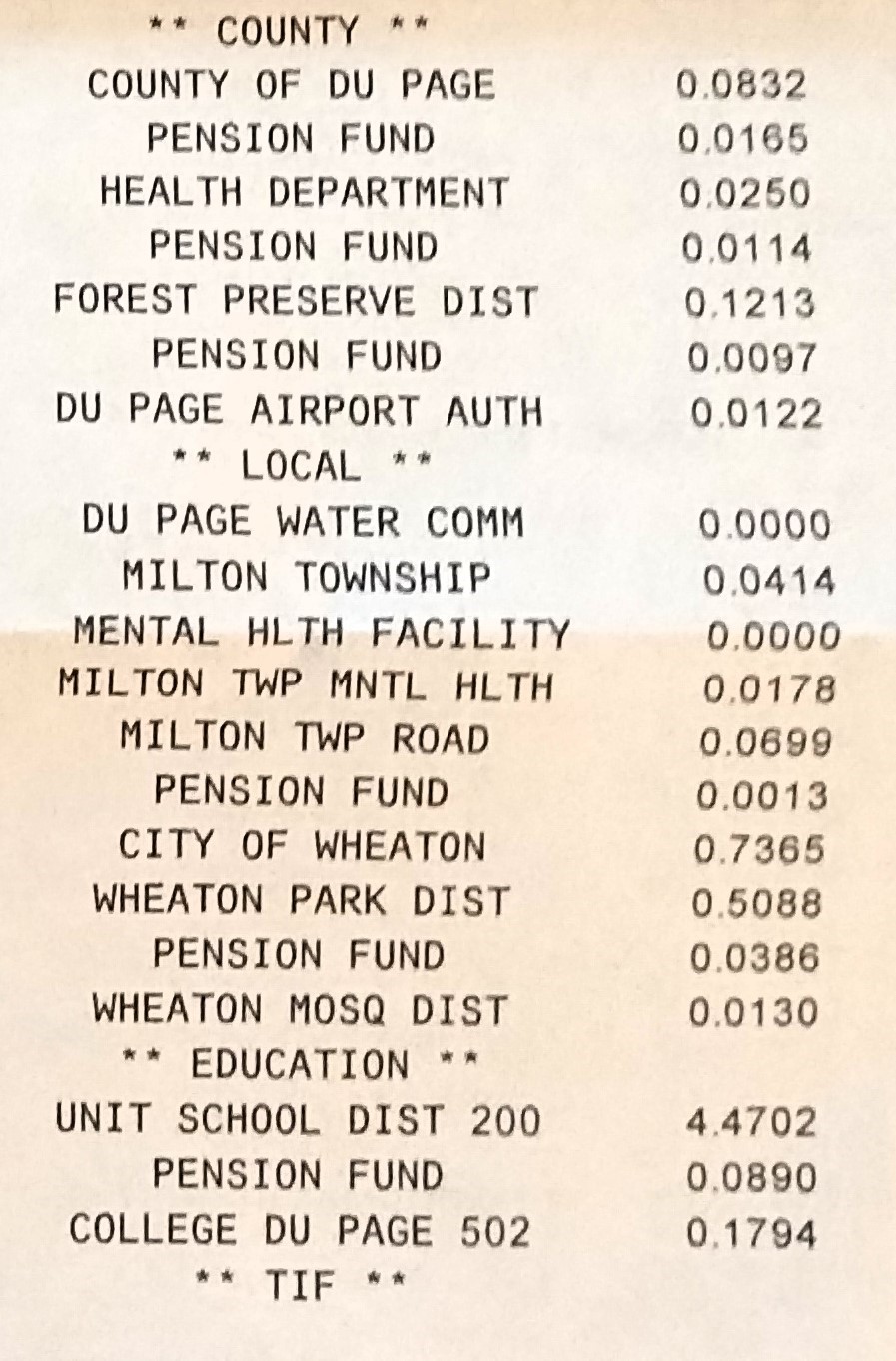
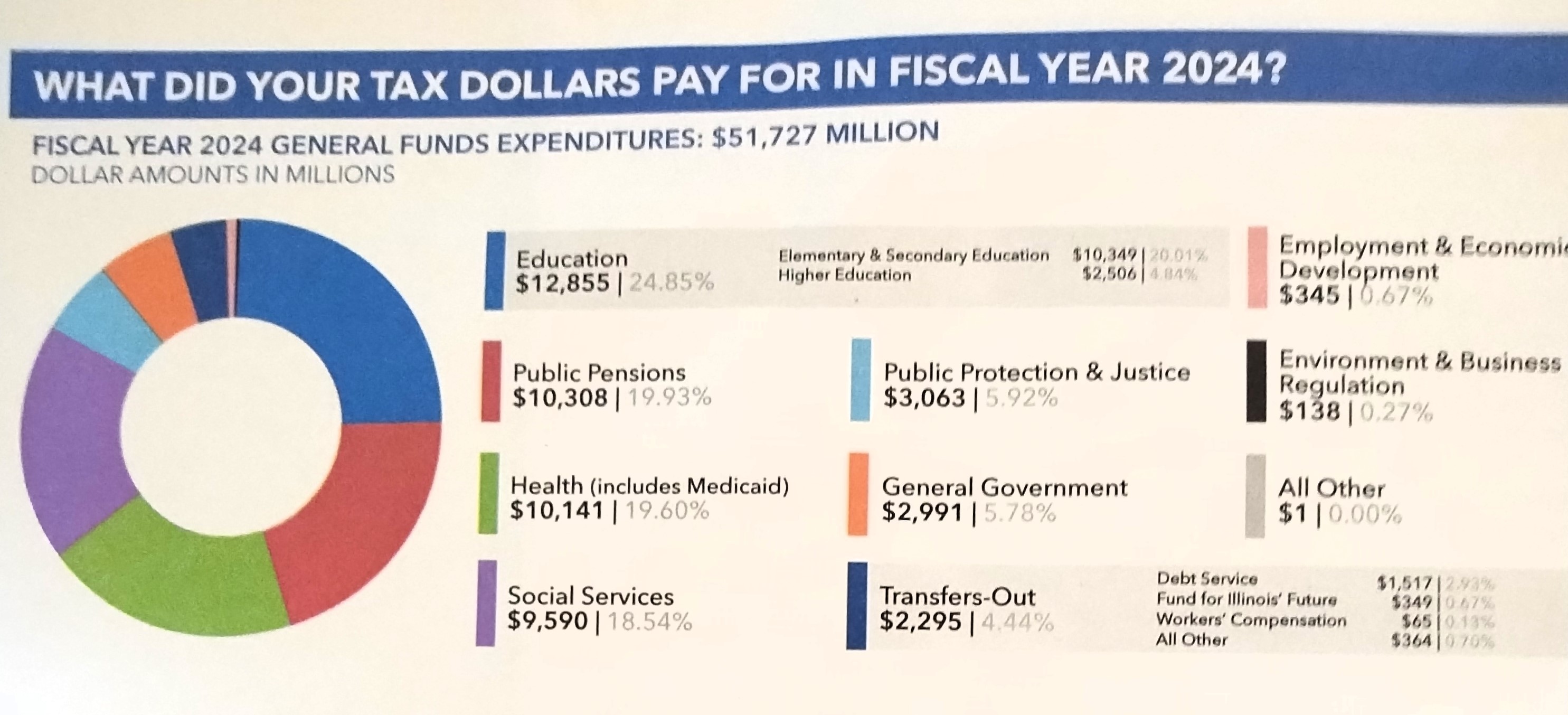
I recently received the breakdowns of where tax dollars for the State of Illinois and DuPage County went in 2024:
In both cases, education leads the way. For state expenditures, education accounts for 24.8% of spending. At the local level, education accounts for 69.4% of the total rate.
The large portions going to education are supported by multiple interests of residents:
Education is often pitched as for children, the next generation, and the future. If we do not spend on education today, how will the children succeed and/or do better than the previous generation?
The quality of local schools is often tied to housing prices and the status of communities. To not spend locally on schools might provide short-term savings but reduce the desirability of properties and communities in the long-term.
The bulk of education costs is in salaries for teachers and staff. Without quality educators, how can schools be successful?
Some might complain about the tax burden – and Illinois does have high property taxes – but it is hard to argue against spending on education. It could be more effective to reign in spending by targeting other areas where there is duplication of local services (such as townships).
I consume enough Chicago area media to occasionally hear the state referred to as “Ellinois” rather than “Illinois.” How should the state’s name be pronounced?
While we’re on the subject of how Downstaters can’t speak English, at least not as beautifully or gracefully as Chicagoans, here a few other ways they talk funny:
They ask “Do you want some melk?” and declare “I’m from Ellinois.” (Darren Bailey of Clay County, the Republican nominee for governor, does this. Beyond the pronunciation, a Chicagoan would never say “I’m from Illinois.”)
Maybe the pronunciation has been altered multiple times throughout history? One source suggests:
Interesting, but not as interesting as how the Miami word irenweewa became our Illinois. McCafferty explains that in Miami pronunciation, it is the next-to-last syllable that is stressed. The French, accustomed to hearing the final syllable of a word stressed, took the next to last syllable in irenweewa to be the final word’s syllable. “The French also changed r to l,” adds McCafferty, “and slightly altered the quality of the second vowel from e to i.” Which is just so French. Then they wrote this mishmash down in accordance with the conventions of 17th century French spelling. Voila! Illinois…
So – the French misheard the Indians, and the Americans misread the French, anticipating Rauner and Madigan in a tradition that is now more than 300 years old.
The word Illinois departs from American English as well as from Miami Algonquian in a second respect. McCafferty notes that in American English you would expect Illinois to be pronounced ILL-i-noy, not ill-i-NOY, as it would be in French. And while we do not pronounce the ois in the current French style, we at least respect the original to the extent of leaving the concluding s silent.
Legislation proposed by state Sen. Ram Villivalam, D-Chicago, takes aim at that problem by creating a pilot program to explore the viability of establishing a “road usage charge,” essentially a tax on miles driven…
Under the current tax structure, vehicles that don’t rely on gasoline, such as electric vehicles, do not pay the gas tax that helps maintain state infrastructure, said Marc Poulos, executive director of Operating Engineers Local 150, which strongly supports the proposed legislation…
On Illinois toll roads , drivers pay approximately seven cents per mile, according to Poulos. With a mileage-based system, drivers could expect to pay three to four cents per mile. That would come on top of any tolls already being paid, similar to the gas tax.
Participants in the pilot would report their car’s fuel efficiency and mileage to the Illinois Department of Transportation. Roughly 1,000 motorists could sign up for the program with the Illinois Secretary of State’s office, Poulos said.
As the article goes on to note, more states and municipalities are looking for ways to recover revenues that come through the gas tax.
Given the current economic situation – many Americans feeling anxious about higher prices and less certain about their economic future – how might people in Illinois and elsewhere respond to these proposals? Americans generally like to drive and generally do not like the idea of new taxes. But if they are paying less at the pump, would they be willing to pay for driving through a different method?
More broadly, how much would Americans be willing to pay for driving? At what point do the costs of energy to drive (gas or electric) or the price of vehicles or tolls and congestion taxes push them too far? Or at what price do they switch to alternative forms of transportation or no transportation (making fewer trips)?
There are so many units of government in Illinois that people can’t even agree on the total because of differences over what technically qualifies as a government body. The U.S. Census Bureau says 6,930, while the Illinois Department of Revenue, which tracks governments authorized to levy property taxes, reports 6,042. The state comptroller’s office lists 8,529, and a study by the Civic Federation tallied the number at 8,923 as of 2019.
Regardless of the exact answer, the number of governments in Illinois outpaces that seen in bigger states, including Texas (which has 5,533, according to the Census Bureau), Pennsylvania (4,851) and California, a state with a population three times the size of Illinois but half as many local government units…
Today the state has more than 5,700 special-purpose governments, including 851 school districts, 861 drainage districts, 838 fire protection districts, 376 library districts, 348 park districts and 320 multi-township tax assessment districts, according to the state comptroller’s office. Many of the state’s nearly 1,400 districts dedicated to roads and bridges have boundaries overlapping its 1,425 townships.
Most of these governments are outside the Chicago region and represent only a sliver of the state’s population. Nearly two-thirds of Illinois residents live in the six-county Chicago metropolitan area. Meanwhile, 51 of Illinois’ 102 counties have fewer than 25,000 residents, and 15 of those have a population under 10,000, according to a 2021 Civic Federation report. About two-thirds of Illinois’ school districts have fewer than 1,000 students enrolled, and there are 26 school districts with fewer than 100 students.
Two figures stand out:
How do the different counters get to numbers so far apart? The difference is roughly 2,000 bodies of government – what exactly is the scope or taxing ability of these bodies? On the national level, who is considered to have an official count in these area?
Americans tend to like local government that responds to local needs. On one hand, all these government bodies are exerting the will of the people to control local activity. On the other hand, this could be viewed as micromanaging. Certainly there are merges that could happen in some of these categories to take advantage of economies of scale and more efficiently serve a slightly larger population? (I have discussed townships before.)
So is one way to interpret the number of government bodies in Illinois is to suggest that the price of corruption is not enough to convince residents and/or local leaders to give up local control?
The case, Gautreaux v. Chicago Housing Authority, was a class-action lawsuit brought on behalf of public housing resident and community organizer, Dorothy Gautreaux, and it sought to end systemic racial discrimination in Chicago’s public housing. The lawsuit alleged CHA discriminated by concentrating poor black residents in high-rises in segregated communities and not allowing them the opportunity to move into public housing communities in white neighborhoods. The case went all the way to the U.S. Supreme Court, which sided with the residents and determined that they were being isolated to specific neighborhoods.
Attorneys for both sides negotiated a settlement in 2019, with CHA agreeing to continue developing scattered site housing and engage in discussions on how to improve the housing voucher mobility program. The settlement also called for CHA to provide a detailed schedule to complete mixed-income housing complexes, and create early learning childhood development programs at four existing public housing developments. The original settlement was to last for five years, and if CHA failed on its promises, it could return to court.
Both CHA and the plaintiffs returned to court recently , as they agreed there were outstanding requirements to be met at six development projects, according to a joint motion filed with the court on Tuesday…
According to the new terms of the settlement agreement, CHA will have one to three years, depending on the project, to complete certain development plans, including for Altgeld Gardens, Lakefront Properties, Madden/Wells, Rockwell Gardens, Stateway Gardens and Robert Taylor Homes. Both parties did agree, however, that CHA had met its obligations to build public housing in areas outside segregated Black neighborhoods, so the housing authority will no longer be subject to court oversight for that part of the agreement.
This is also a reminder of the long legacies of housing discrimination and residential segregation. The kind of housing discrimination in public housing experienced in Chicago in the mid-twentieth century may not be legal now but it has effects nearly six decades later. And court orders and settlements may be the most direct ways to lead to change. (See also the Mount Laurel case in New Jersey) compared to legislation (see difficulties in Illinois and other states).
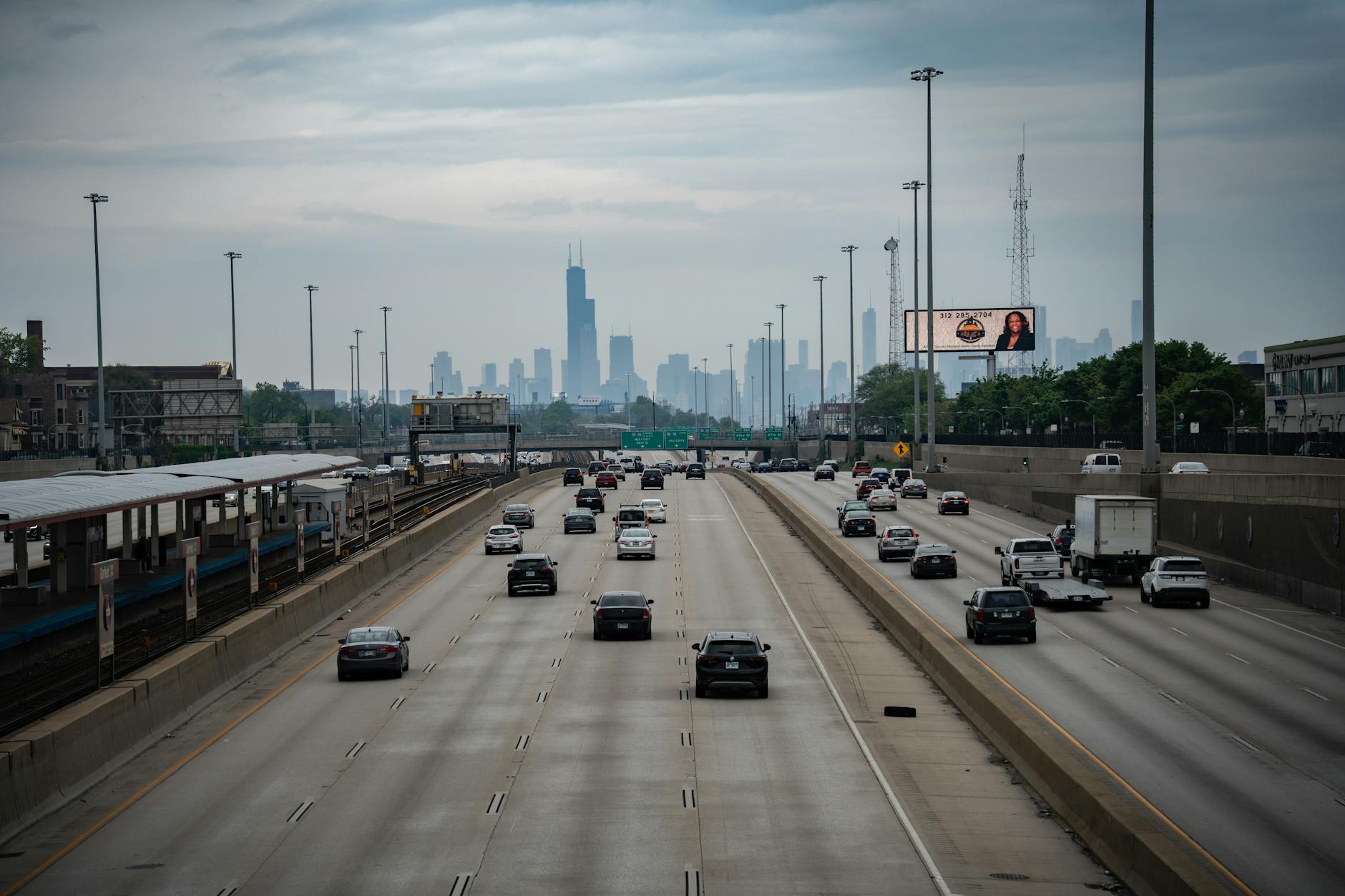
Illinois has the third-largest region in the country by population but its next largest cities are relatively small. Interstates connect all of these population centers, connect to big cities not far beyond the borders of the state (like St. Louis and Milwaukee), and link to places far away. Here is how the Illinois Department of Transportation describes the interstates:
Illinois is at the heart of the country’s interstate highway system. This vast system consists of coast-to-coast interstates I-80 and I-90, along with I-70 that extends from the east coast to Utah. These major corridors are joined by multiple north – south corridors including I-39, I-55, and I-57 and additional east – west corridors such as I-24, I-64, and I-74.
This is in part due to geographic advantages – a particular location along the Great Lakes, connections to major rivers like the Mississippi and the Ohio, and in-between other places – plus developing transportation infrastructure – highways and roads plus railroads and air options in addition to the early water transport.
Indiana may have the state motto of “The Crossroads of America” but would Illinois have a better claim to this? I am not sure it could replace the state slogan “Land of Lincoln” but it may speak more to the current state of Illinois economic and social life.