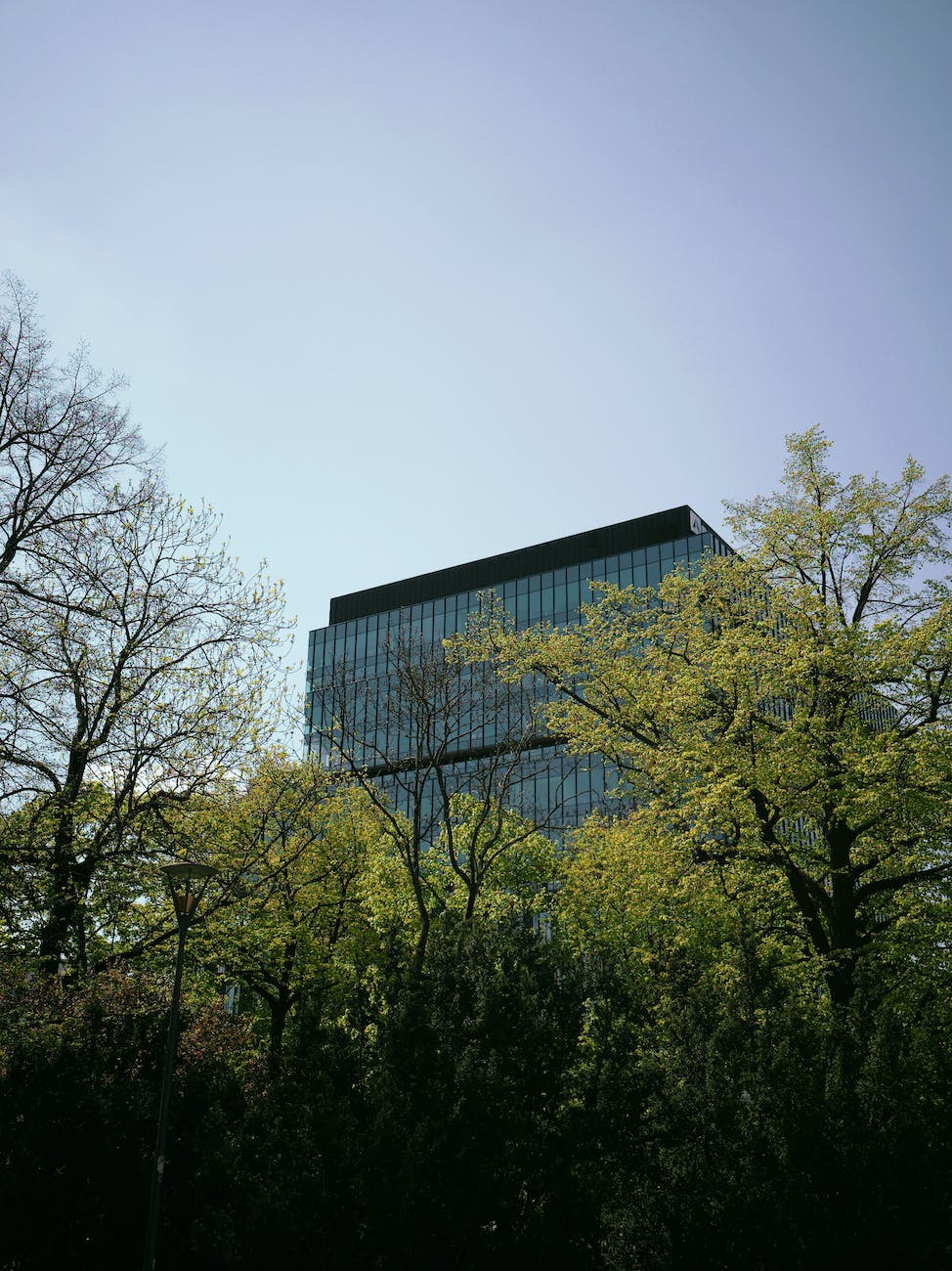
If I had to guess, I would go with open space or park space. Suburbanites would like this for multiple reasons: little noise and traffic, increased recreational opportunities, this limits future development on the location, and improved property values. Suburban homeowners do not want properties next to them to have more intensive land uses; they would prefer less activity.
At the same time, this puts communities and these suburbanites in a predicament. These office parks served particular purposes. They brought in tax revenues. They provided jobs. They provided status (particular if a big name company occupied the offices). Empty buildings are an eyesore and wasted opportunity. Warehouse and logistic parks would bring in money and jobs. Parks and open space do not generate their own revenues.
Before resisting everything that could replace suburban office parks, the suburban neighbors might want to consider what they would be willing to accept. Are there land uses that could aid the community and preserve some semblance of residential suburban life? Is there any room for compromise?
The last fifty or so years of life in the United States has included numerous NIMBY efforts by residents (see recent examples here, here, and here). One of the reasons for NIMBY activity is to protect property values. Did NIMBY efforts lead to higher property values?
NIMBY efforts could have contributed to this in multiple ways. They may have limited housing supply. One common argument regarding promoting more affordable housing prices is to build more housing units. This will reduce demand for existing units.
Or, NIMBY movements may have limited what communities will build. When they do construct housing, it is of similar or better quality of what is already there so as to not create downward pressure on prices.
These actions led by residents may not be the only reason housing and property prices have soared. Residents are not the only actors with influence in housing markets and communities; certainly the actions of those involved in real estate, local officials, and others contributed to increased property values.
However, taking the long view, if NIMBYs have acted in order to protect property values, does it appear – whether they directly caused it or not – that this was successful?
Homeowners now have increased flexibility to build more houses on less land, after the lot size required for a home was reduced from 5,750 square feet to 2,500 via the HOME initiative (Home Options for Middle-income Empowerment). The policy also increases the number of housing structures that can sit on that 2,500 square feet from two to three.
The debate over these changes continues:
The debate around a policy like this comes down to whether someone believes increased density (more housing for more people on smaller footprints) will help the situation, or will lead to overbuilding, crime, and rental cash grabs. The latter tends to sound a lot like NIMBY talking points more concerned with preserving the charm of longstanding Austin neighborhoods.
Some developers and homeowners feel that the resolution alleviates just a small part of Austin’s building woes, since the zoning codes are still complex and difficult to navigate. Jason Kahle, who owns Small Home Solutions, LLC, says he and his 10 employees are “going to be all over” the changes in a market where it seems everyone with a large-enough lot has considered building a granny pod, mother-in-law suite, or backyard office.
But being free to build on a smaller lot is not the same as being able to feasibly do it within existing rules, Kahle points out. “There’s a lot of wheels turning at the same time,” he says. “Austin Energy is a challenge. We have protected trees, impervious cover, floor-area ratio rules, the level of detail the city requires on civil engineer plans, the subchapter McMansion ordinance, temp drawings. It’s a lot to deal with.” The McMansion regulations, also known as “Subchapter F” in the city’s housing code, set detailed and strict limits, including height and setbacks from the edges of a lot.
Laura Boas, an Austin physical therapist, is building an “accessory dwelling unit” for her family behind her 1950s-era, 720-square-foot cottage in the Brentwood neighborhood. She’s seen massive 2,500-square-foot homes go up in her area, and her lot is big enough to support additional buildings. Boas lives alone and jokes, “I’m part of the problem.”
It sounds like the goal is to allow for more housing units without changing many existing lots and allowing for smaller lots. This is a different approach than promoting more multi-family housing or larger structures containing more residential units. These changes keep the single-family character and the scale of the neighborhood similar while adding more units and people.
It will be interesting to see if an approach like this solves the problems it was intended to solve. Will the number of new McMansions decrease as property owners pursue other options? Does this add enough units? Does it ease housing affordability? If not, what changes would residents and the city be willing to enact? I hope researchers and policy experts are keeping track of the changes in cities that have enabled similar regulations. This could help determine whether adding ADUs (such as in Portland) is helpful.
West Chicago is home to the county’s only garbage-transfer station — an in-between location before waste is hauled to a landfill. Earlier this year, city officials gave the green light to add a second facility that would be run by trash hauler LRS and bring 650 tons of solid waste a day and air pollution from hundreds of large garbage and semi-trailer trucks weekly to the city of 25,000…
On Thursday, lawyers for Alcántar-Garcia will argue to state officials that the trash facility should be blocked.
The Illinois Pollution Control Board has the final say in the matter, and a panel of Gov. J.B. Pritzker’s appointees will be asked to decide whether the city of West Chicago met all the criteria to determine that the new garbage site will not harm the health of nearby residents. That final decision is expected early next year.
West Chicago is around half Latino, and that raises questions for Alcántar-Garcia’s legal team as to why it is the only DuPage County community targeted for two of these waste sites. Other municipalities, including those that are largely white and affluent, would benefit.
Perhaps a thought experiment might shed some light on this problem. Imagine a metropolitan region where land uses were randomly distributed. The land uses suburbanites tend not to like, those that generate noise, traffic, and are perceived to threaten property values are randomly placed. Airports, garbage facilities, apartments, drug treatment facilities, railroad tracks, warehouses, and more are spread out. What would happen?
Assuming this is a blank landscape beyond these land uses, where would development pop up? Those with resources and influence might just happen to live and congregate in places away from those land uses. If locations are at least in part determined by the ability to purchase and develop land, those with more resources can better compete for desirable land. And those with fewer options might live closer to those less desirable land uses.
Of course, we do not have random metropolitan landscapes or centralized bodies that could make wise choices about where less desirable but necessary land uses should go. Instead, we have ongoing patterns by race, social class, and durable local history that help guide land uses to certain locations and not others.
1. Allow Area N to remain a wetland and preserve the open space in line with the South Barrington park district’s overall mission.
2. If Area N will be sold for a development, access should not be granted through Acadia Drive. Acadia Drive is within a residential community that has no sidewalks and permitting access to the development through the residential community, without sidewalks (the Woods of South Barrington), presents a nuisance and would be grossly negligent on behalf of the Village and the South Barrington park district. There is a walking trail (that is accessed from Acadia Drive or feeds residents onto Acadia Drive) where the access would be granted and children and residents are outside after school, on weekend and holidays. These are all peak worship times. The school also presents this same safety issues at the end of the school day where children who live in the residential community are walking home from being dropped off by the school bus. The residential community should remain residential and not be subject to increased development traffic. As repeatedly noted, this is a significant safety concern. The safety of our children and residents should be top priority for the Village and the South Barrington park district.
3. Further we request access not be granted on Bartlett road at all to preserve the surrounding residential communities from the same safety concerns.
Additionally, some of those signing the petition offered reasons they do not want this particular church in their community.
While this is about a particular piece of land and a particular religious group working within a particular suburban community, these reasons are fairly standard from what I have seen in my research. They have concerns about losing open space/natural space and park land. They are worried about traffic in residential neighborhoods. They do not want a group that multiple commenters call a cult in their community.
This will work its way through the legal system and local government bodies. Suburbanites who do not want certain land uses nearby can be quite persistent in their efforts to make sure proposals they do not like reach a certain outcome. Whether they can guarantee the outcome they want is another matter.
After considering several recent NIMBY cases in the Chicago region (a football stadium, addiction treatment facility, waste transfer station), I had an idea: could a region develop a central zone where important but less desirable land uses could be placed and everyone in the region could benefit without having to live near them? Noisier, dirtier, and busier facilities could be separated from residences and a central location could mean more people in the region could access them.
I suppose this could happen now without the need for a NIMBY zone. Municipalities might put less desirable land uses on their edges or against certain barriers, like bodies of water or transportation corridors. Or some communities are willing to pursue industrial and commercial land uses rather than single-family homes.
But, one big advantage of a zone managed for the whole region is that the overseers could be freed from the concerns of residents. Balancing land uses in suburbs is often tricky as existing residents and leaders often have strong opinions about what and who they think might fit. And because local government officials often need to be elected or are appointed by elected officials, there are certain consequences for land use and development decisions.
Take the Chicago region as one example. Imagine creating a zone around O’Hare Airport where a number of less desirable land uses could be clustered. It would take time to develop this and address the concerns of people who live there. But, a location near highways and a busy airport means this could be a site where clustering certain facilities could benefit the entire region.
The McCaskey family is in love with Arlington Heights? Well, me, too. I pay every nickel in property taxes I owe and am quite happy with the services I receive in return. I suggest Da Bears be required to do the same. In addition, they can build the infrastructure required at their own expense. With the full oversight and approval of the village of Arlington Heights, of course. If this is unacceptable, then please, by all means, head to Naperville. Best of luck to all…
The McCaskey family will plop a 70,000-seat domed stadium, plus sportsbook (that’s a casino, folks) on a portion of the property and sell off pieces to the highest bidders who will quickly turn the place into a national party destination. And it won’t just be eight Sundays a year. I’m quite certain they envision March Madness, Super Bowls and Taylor Swift concerts. Trains will back up through downtown; Euclid Avenue, Wilke Road and Northwest Highway will be jammed; and our perfect little town will be overrun.
“Don’t be ridiculous,” I can hear them say. “All stadium traffic will be routed to the expressways.” Uh-huh. Ever been to Wrigley Field? I have. What a cool place. What a legendary sports destination. But I don’t want to live anywhere near it. Nor do I want to live next door to the Airbnb rental on the weekend the Packers are in town.
What if the Bears back out? What will we do with a 326-acre lot? Here are some ideas: walking, running and biking paths. Lakes and paddleboats. Horseback riding would be a nice touch. Skate parks for the skateboarders in the summer, a wandering ice-skating path in the winter with a warming house. A nine-hole golf course — walking only, kids-only.
I’m sure the numbers are daunting, but why not be creative? Not every use of land has to be about growth, development and profitability. We are rushing into the arms of the first suitor that has presented us with a ring. I suggest we get it appraised. It feels like cubic zirconium to me.
On one hand, this is a specific response to a particular proposed land use. A major stadium plus surrounding development is a big deal. In mature suburbs where big pieces of land become available only rarely, decisions about this land can be very consequential. Additionally, residents of suburbs often feel they should have a say in how land in their community is used. This is one of the reasons they like living in suburbs: they are closer to local government officials and processes. After all, they pay taxes, they live in the community, and they will be affected by the new development.
On the other hand, the sentiment of “not wanting to live anywhere near it” is a common one across suburbs. This could refer to affordable housing or waste transfer stations or drug treatment facilities or religious buildings or other uses suburbanites feel will threaten their way of life. Residents may not like the idea that growth is good yet this part of the appeal of many suburbs where growth signals continued residential and business demand.
The Chicago Bears will end up somewhere and there will likely be some residents who do not like the decision to have a stadium near them. Given the billions of dollars and status at stake here, they might not be able to do much about it.
Perhaps the opponents are beginning to accept that their community is not, has never been, exclusively their own domain.
Who owns a neighborhood? In many American communities, the people who live there might feel this way. They expect to provide input and exercise some oversight of what happens in their neighborhood. They want to exercise control over their own properties and those around them.
But, they do not do this on their own. They interact with other property owners and also engage with local governments. These local governments typically represent a broader community and have regulations about what can and cannot be done in neighborhoods.
Or, here is another way to address the same questions: if every neighborhood will change over time, who gets to street this change and/or benefit from this change? Those with means and vested interests will have their own perspective and goals while a broader community might have another point of view.
Racial discrimination is abhorrent and should be prosecuted. But as a Brookings Institution analysis of the 2020 census shows, race isn’t a barrier to suburban living. Blacks are moving to the suburbs at a faster pace than whites. Anybody can be suburban. It just takes money — especially in Connecticut. In 2017, developer Arnold Karp purchased a colonial house on tree-lined Weed St. in small, ultra-wealthy New Canaan. There are no commercial or multifamily buildings on the street. He now wants to build a five-story, 102-unit apartment complex with 30% set aside for affordable housing.
This analysis of suburban and primary city portions of the nation’s major metropolitan areas shows that these big suburbs are more racially diverse than the country as a whole. Moreover, in contrast to how white flight fueled growth there in the past, most big suburbs have shown declines in their white populations over the 2010-20 decade. Their greatest growth came from Latino or Hispanic Americans, Asian Americans, persons identifying as two or more races, as well as Black Americans—continuing the “Black flight” to the suburbs that was already evident the 2000-10 decade.
Today, a majority of major metro area residents in each race and ethnic group now lives in the suburbs. And for the first time, a majority of youth (under age 18) in these combined suburban areas is comprised of people of color.
But, as a sociologist of suburbs, here is what is missing from the critics’ analysis: people of different racial and ethnic groups are not evenly distributed across suburbs and not all racial and ethnic groups have the same wealth, income, and resources to obtain suburban homeownership.
In other words, because social race and race and ethnicity in the United States are connected, it is not just about money in reaching the suburbs.
What is really at stake? From the critic:
Local control will be obliterated. Albany will call the shots on what your town looks like, how much traffic there is and ultimately what your home is worth…
Ensuring a supply of affordable housing within a region is more reasonable than demanding every town alter its character.
Suburbanites like local control and local government. These arrangements allow leaders and residents means by which to decide who can live in their community. This is often done through housing values and prices; ensure the land and homes or rental units expensive enough and the community can be exclusive.
Additionally, one of the problems of affordable housing – and other land uses less desired by suburban homeowners (including drug treatment centers and waste transfer facilities) – is that few suburban communities want it. Communities with means and political voices will keep affordable housing out. This means affordable housing is not plentiful often and is often clustered in particular locations. One reason states are pursuing this at a metropolitan level is that there is not enough affordable housing in the current system that prioritizes local decision making over what is good for the region.
Suburban residents may not like the idea of affordable housing arriving in their community. However, the legacy of housing in the United States is often one of exclusion and restriction, not about communities and residents coming together to provide housing for all.
Atherton is a small suburb – under 7,000 residents – with a median household income of over $250,000. In question is a California effort to increase affordable housing.
Are there any or many communities in the United States where the wealthy do not pursue NIMBY policies?
Could it be different in places where wealthier residents can escape by living high up in the air? I am thinking of residences like the pencil skyscrapers just south of Central Park or the new condos south of downtown LA.
Or, could it be different in places that are more rural? According to Wikipedia, Atherton “has very restrictive zoning, only permitting one single-family home per acre and no sidewalks. This policy that prohibits homes from being on less than an acre.” But, imagine a place with even bigger lots and more room. Would denser housing in part of the community be perceived as less problematic by neighbors?
I am open to hearing about wealthy communities where affordable housing is desired and pursued.