But at the same time, these are not just local issues. There are patterns across places. What happened with public housing in Chicago may not have been exactly the same as what happened in other major cities but the effects of federal legislation and monies and public perceptions about public housing influenced numerous cities. Suburbs have unique characters but types of suburbs – say edge cities or inner-ring suburbs – can have similar experiences and trajectories. The ways zoning is used to privilege single-family homes and exclude people and undesirable uses is common. National ideologies regarding desirable and undesirable housing influences leaders and residents.
Figuring out how to link these two realms regarding housing – national and state-level policies and meanings and local action and sentiment – is very important to addressing any large-scale housing issues. Abandoning larger-scale efforts because all housing is local is not helpful. Focusing efforts only at the state or national level can ignore complexities within communities and regions.
How’s that going to happen? Tax incentives for builders, perhaps an expansion of the low-income housing tax credit, but mostly, a $40 billion fund that would “empower local governments to fund local solutions to build housing [and] support innovative methods of construction financing.”
It’s not clear exactly what an innovation fund entails. Maybe the closest antecedent is a new, $85 million HUD program called “Pathways to Removing Obstacles to Housing,” or PRO Housing, which this summer issued 17 grants of a few million dollars each. The projects that got money include buying land for affordable housing in Rhode Island, retooling a digital application process in New York City, and hiring staff to fast-track affordable housing proposals in Denver.
It was a super competitive process, with $13 in requests for every $1 in award. Which raises the question: What can an annual outlay of $100 million (the PRO budget for next year) do to solve a problem as big as a deficit of 3 million homes? “State and local governments look at each other all the time, so those little examples can bear a lot of fruit,” said Chris Herbert, director of the Joint Center for Housing Studies at Harvard and a fan of the program. “There’s not a lot of money out there, but these grants can become an example for other places.”
Note what those two programs share: A focus on more housing, period, even if it’s not necessarily restricted to low-income Americans. That’s a subtle, crucial shift in federal priorities that reflects the growing sense that Washington must intervene to create more housing at all price points, not just for the poorest households with the most urgent housing needs.
Focusing on more housing overall could have several benefits:
It could be popular across residents who might be feeling the need for more and cheaper housing. Promoting such programs could garner more widespread public support.
Could fit the theory that providing more housing overall will help moderate prices across the housing spectrum.
At the same time, it is not entirely clear that such an approach would lead to the outcomes politicians and residents want. Do people generally want more housing (or is this limited to particular places)? Will reduced prices in housing brought on by increasing the supply reach the people who need the most housing help? What large-scale programs can help increase housing and flexibility even as different jurisdictions and locales approach housing differently at the local level?
All of this might just need to be worked out. Perhaps the shift above reflects an ongoing frustration among at least a few that not enough is happening regarding promoting housing.
The findings from one of the largest surveys done on these issues shows significant but varying support for 10 policy initiatives to encourage more housing. At the high end, nearly 9 in 10 (86%) say they would back efforts to expedite permitting processes, while at the lower end, about half (49%) support the concept of allowing smaller lots, and homes to be built closer together…
Support for most of the housing policies transcended the usual fault lines of political party, region, race, income, and gender. The eight most popular proposals received clear majority support from Republicans, Democrats, and independents. In addition, 9 of the 10 tested measures received majority support from both renters and homeowners. All of these policies have either already been shown to work in improving housing affordability in American cities and towns or have recently been enacted by state or city policymakers hoping to do so.
Some approaches that stood out as especially popular—earning support from more than 70% of respondents—are similar to state laws that have passed in recent years (although the survey questions themselves were not modeled on any particular laws). For example, in 2023, California, Montana, Texas, and Washington took steps to simplify permitting for new housing. In recent years, California, Massachusetts, Montana, and Utah have passed laws to enable more housing near commerce or transit. And Maine, Montana, Oregon, Utah, and Vermont, among others, have enacted legislation to allow houses to have an accessory apartment or dwelling unit, as have many cities…
Respondents also broadly supported the reasons behind efforts to create more housing, with 65% to 82% seeing each reason as excellent or good. (See Figures 3 and 4.) However, in some cases, Republicans and Democrats prioritized different reasons. For example, somewhat more Republicans (68%) than Democrats (62%) identified freedom for property owners as an excellent or good reason, while more Democrats (81%) than Republicans (49%) chose reducing racial segregation as an excellent or good reason. But large majorities of Democrats, Republicans, and independents see improving housing affordability and allowing more people to live near their preferred jobs and schools as excellent or good reasons to change housing rules to allow more homes to be built in cities and suburbs. Successful state-level efforts to allow more housing have consistently received bipartisan support, and the survey results indicate that people with different political views can come together to support policies to end the housing shortage and affordability crisis for different reasons.
Americans like the idea of owning housing. Add this to the current state of housing where both owning and renting is expensive and Americans broadly like more housing.
Thus, the expression of this majority for housing is difficult to put into practice. Even state laws are often fraught as it can run against local desires. Take the efforts in Illinois to promote affordable housing at the state level: the initial legislation had limited enforcement and more would need to be done for state-level policy to provide more housing.
As noted above, one of the routes forward that could gather more local support involves policies that provide more opportunities for current property owners. Adding ADUs, for example, provides a choice for current property owners to generate more income or provide housing for family. Other policies might be viewed as funneling money to outside developers or providing housing for people who would not be as welcome in the community. If policies can add housing units and enrich/protect homeowners, they might find more support.
Some suggest that Japan is the model to follow. There, rental prices have largely remained flat over the last 25 years, according to data from the country’s statistics bureau. The reason is that the government controls zoning nationally and is more open to development in the number of houses it allows to be built. Just over a third of Japanese citizens rent the homes they live in, protected by a 1991 law called the Act on Land and Building Leases, which makes it difficult for landlords to end leases or prevent a tenant from extending their rental contract…
So where else should we be looking, if not to Japan, for the model to fix the broken housing market in large parts of the west? One option is Singapore, where public housing is built in specially designed communities and sold to individuals with a 99-year lease below market value. Selling on that property is highly restricted to reduce profiteering, but it can happen after five years of ownership. Nearly four in five Singaporeans live in public-sector housing, according to official statistics. “Prices can never get beyond regular working families,” says Ronald. “They have this virtuous circle, and it makes it interesting to think about the role of regulating housing.”…
Until late January 2022, housing developments in Germany were subsidized by the government below market rates for the first five years after being built. “It means tens of thousands of units every year come onto the market, keeping rental prices lower and preventing scrambles to buy a property,” he says.
A similar model exists in Austria and Switzerland, where the split is roughly 55 to 45 percent (in favor of renting in Switzerland, and owning in Austria), compared to an average European home ownership rate of 70 percent. When you get to the Austrian capital, Vienna, the home ownership rate is just 7 percent.
All of these sound like they would require some fundamental changes to housing policy in the United States. This might include:
A stronger national policy. This could be through programs available everywhere or guidelines that all states and municipalities have to follow.
A stronger emphasis on renting.
More government involvement in the construction of housing and/or longer-term government oversight of housing units.
None of these options would be particularly popular in the United States or easy to implement. Here are quick explanations why for each option above:
A national policy would come at the expense of the power of more local governmental actors. With real estate being so much about location, could a national policy truly address all of the different situations? Americans expect to be able to control or at least provide input into the use of land around them.
Homeownership is ingrained in American life as part of the attainment of the American Dream. This is ensconsed in zoning policy, supported by politicians and policies for decades, and Americans can be suspicious of renters compared to homeowners. Renting is more common in some areas compared to others but it is not seen as the ideal among Americans.
This does not mean that the housing landscape in the United States cannot change. The need for more housing and more affordable housing is acute. But, changes will likely take decades and sustained efforts.
Cox was writing at a time when mainstream analysis of race in the United States made liberal use of an analogy to the Indian caste system in order to illustrate the vast gulf of experience that lay between Black and white Americans. His book was a rebuttal to this idea as well as an original argument in its own right.
Over the course of 600 pages, Cox provides a systematic study of caste, class and race relations, underscoring the paramount differences between caste and race, and, most important, tying race to the class system. “Racial antagonism,” he writes in the prologue, “is part and parcel of this class struggle, because it developed within the capitalist system as one of its fundamental traits.”
Put differently, to the extent that Cox had a single problem with the caste analysis of American racism, it was that it abstracted racial conflict away from its origins in the development of American capitalism. The effect was to treat racism as a timeless force, outside the logic of history…
“Race prejudice,” Cox writes, “developed gradually in Western society as capitalism and nationalism developed. It is a divisive attitude seeking to alienate dominant group sympathy from an ‘inferior’ race, a whole people, for the purpose of facilitating its exploitation.” What’s more, “The greater the immediacy of the exploitative need, the more insistent were the arguments supporting the rationalizations.”
Analyzing single social forces, such as ones as powerful as race in the United States, without considering how they intersect with or are intertwined with other social forces leads to incomplete analysis. It can be tempting, particularly when considering particular policy options, to reduce social phenomena to a singular factor and try to address that. But, as Cox suggests, only thinking about race without considering how it is embedded in a powerful economic system is not reflective of how the society works.
Today, it can be relatively easy to do the same: address race all by itself and attack racial prejudice and discrimination. But, race in the United States has been and continues to be tied to many other areas that also need addressing. The one that I have studied the most is residential segregation. This is both a consequence of the outworking of race and spatial patterns as well as an ongoing contributor to their continued intersection. And because where people live has consequences for numerous areas of their life, organizing residences and communities by race affects a lot. Residential segregation also is tied closely to social class both in how class is linked to race and ethnicity in the United States but also in the system of land development that privileges profits and leads to uneven development.
Numerous studies suggest that the partisanship of mayors has limited effect on much of anything: not just crime, but also tax policy, social policy and economic outcomes.
The researchers Justin de Benedictis-Kessner and Christopher Warshaw have found that Democratic mayors spend more than Republican mayors. “But the differences are pretty small,” said Mr. Warshaw, a political scientist at George Washington University. “They’re not enough to drive large differences in societal outcomes in things like crime rates.”
This is partly because mayors are constrained in their ability to execute ideological agendas. Cities can’t run deficits. States limit their authority to raise taxes and enact laws on many issues. And cities lack the power the federal government has to shape labor laws, or immigration policies that can affect their population growth…
Cities have been faced with problems far beyond their making. Deindustrialization and globalization wiped out many middle-class factory jobs, destabilizing neighborhoods of blue-collar workers. The federal policy of highway construction enabled both taxpayers and employers to leave cities. Federal housing policies dissuaded or prevented Black residents initially from joining them, cementing patterns of racial and economic segregation that persist to this day…
There are plenty of fair critiques of decisions that Democratic mayors do control — regarding charter schools, or how equitably they deploy city resources, or whether their zoning laws and school policies perpetuate segregation. And there is room to criticize the Democratic Party’s failure to devise a coherent federal urban policy.
Disentangling this from the current political moment and debate about running cities, a few themes from the article stuck out to me:
One argument is that mayors are more interested in pragmatic day to day city processes than larger ideological concerns. Mayors themselves make this argument. If a mayor cannot help solve a particular local problem, they may not be in office for long, regardless of what party they align with.
Cities are stuck between multiple bodies of government. A city may be nested within a county (and this is what might make city-county mergers appealing), a state, and then the federal system. On one hand, cities are essential to our modern society – they are economic engines, centers of culture, gathering places for residents and jobs, anchors of entire regions, etc. – but their city interests must be negotiated with other bodies of government above them. Putting it in more sociological terms, cities are between macro and micro social scales yet often are viewed as macro entities and have some capabilities at the macro level (I am thinking of conferences of mayors, transnational conversations between mayors and other mayors or heads of government, etc.)
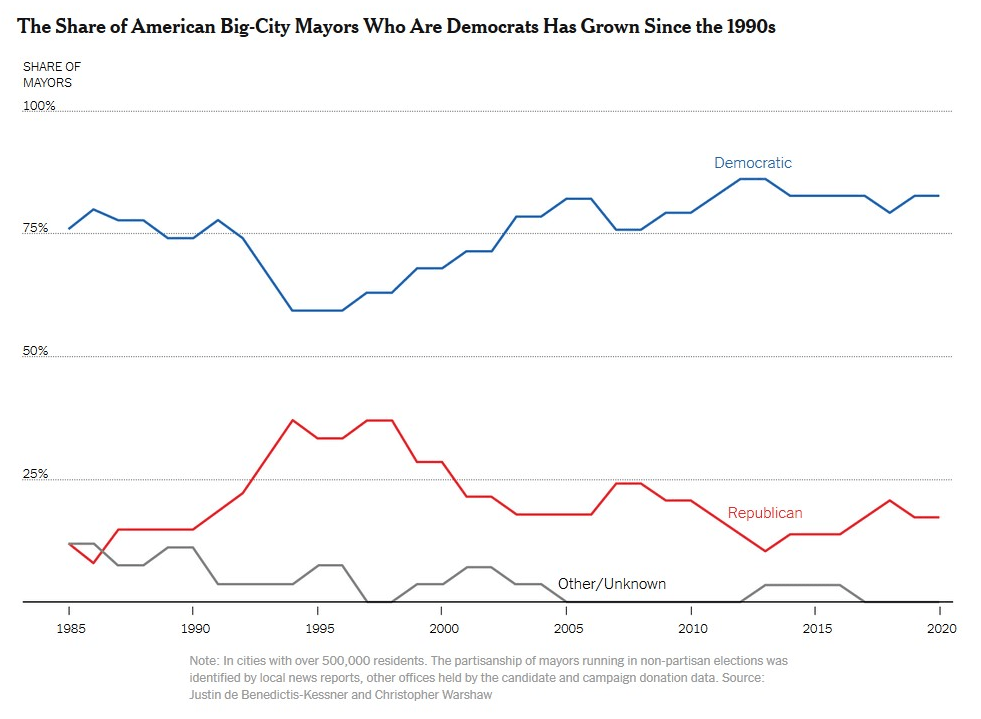
As a graph in the article shows, there are more Democratic big city mayors than Republican big city mayors and this has been true for decades. Do Republicans want to be mayors of big cities? Also noted in the story: Republican policies and appeals have been made to suburbanites and rural voters for decades, less so to urban residents.
This is not a new political issue; the United States has a long-standing divide regarding cities that goes back to the founding of the country. For more on this as it played out in the twentieth century, I recommend the 2014 book Americans Against the City by historian Steven Conn.
See how the Census Bureau calculated the risk here.
Several thoughts on the map:
1. There are some patterns. Many counties in the Northeast, Midwest, and Mountain West having lower levels of risk (outside of urban counties). In contrast, the Sun Belt and the West Coast are at higher risk.
2. Doing this at the county level makes some sense: people might travel within a county for work, errands, and other activity. At the same time, there could be significant disparities across communities within counties that a map like this covers up. For example, it looks like DuPage County is somewhere in the middle and some suburbs there have higher rates of cases than others.
3. The differences across geographies also speak to the difficulties of enacting policies across different areas. On the risk map, some states have more consistent patterns while others have a mix (ranging from more equal numbers of counties at different levels or a few heavily populated counties versus everyone else). National policies have to address places with different experiences and different futures.
4. This data cannot tell us how many people cross county lines within a region or state. There are clusters of counties with similar risk levels but this may not speak much to travel as to similar populations.
Even though I did not attend a recent debate in Washington D.C. between two mass transit commentators, I wish we could have more conversations like this one:
O’Toole opened with a whirlwind of statistical bullet points documenting the transit death spiral. He seized on the latest national transit ridership data, but his message was vintage O’Toole: Government funding of public buses, trains, light rail, and streetcars has failed and should stop. “I’m fundamentally pessimistic about the future of the transit industry,” O’Toole said. “Transit ridership has been declining steadily and it’s declining in all major urban areas, whether it’s rail or bus. I don’t see hope of recovery because the forces that are causing it to decline are not going away.”
Subsidies can’t overcome what shapes people’s preferences, O’Toole argued, and what people want is to live out in the suburbs and drive their cars. In recent years, transit ridership has really only grown in places where there’s been a dramatic boom in downtown jobs, such as Seattle…
For Walker, a consultant who works on improving transit systems in cities around the world, the narrative that O’Toole spins about declining transit ridership doesn’t frame the story quite right—it’s zoomed out too far. “A lot of what seems like an urban-rural culture war is actually just people at different densities understandably trying to solve the immediate problems of where they live. The national statistics are useless. [The decline of urban trips since 1976] is also a history of urban density, of course, because transit is a response to density.”..
Rather than directly rebutting each bullet point on O’Toole’s laundry list, Walker made a more values-based case, stressing that the big problems public transportation systems now face come down to just a few things: emissions, labor, and space. And those can be addressed with fleets of electric vehicles that are either large—think electric buses—or small e-boosted bikes and scooters. He’s optimistic about self-driving technology, but believes that their truly transformative deployment will be in city bus fleets, where they could dramatically trim labor costs.
It sounds like the debate accomplished two major tasks:
Each side was able to put forth their arguments. One goes more with data. The other talks more about values. Both can explain what they think the problems are.
The two sides had good conversation before, during, and after the debate. They found some common ground as well as points at which they still disagree.
Contrast this to two other public conversation options often employed by colleges as well as think tanks and other organizations interested in public conversations. It is common to have a single speaker present their book, article, or idea. There might be some back and forth with the audience afterward but the format generally assumes the one expert has the knowledge to share with the audience. In thirty to sixth minutes, the speaker can really get into their topic with some detail. A second option is the panel discussion where multiple people with insight to the issue talk in front of an audience. Each person might have a few minutes to share (this can’t go on too long or it becomes multiple mini-single person presentations) and there might be some robust discussion (though this can be difficult depending on the size of the panel and the temperament of the moderator and participants).
The debate seems like a better format to discuss difficult questions like the one these two debaters addressed. It works better if the two are skilled at presenting their sides and responding to others. The audience gets to hear two sides (better than the single talk but in less detail) and the conversation is only between two sides/perspectives (perhaps worse than the panel because some views will not be expressed but it is much easier to provide time for all participants).
And as for the result of such a debate? Perhaps the goal is less about winning and more about engaged listening, conversation, and trying to find a way forward between two people who might still disagree about important points.
After a recent conversation with colleagues prompted by reading together the sociological work Evicted as well as my own thinking about residential segregation, I wanted to put together a blog post summarizing possible policy solutions to housing issues. I am not optimistic but here are the possible options I see at multiple levels:
Provide incentives for developers and builders. This is a common strategy across different government levels: builders and developers are given access to choice properties or are able to build higher-end housing if they build cheaper housing or provide monies that could be used for cheaper housing. A number of major cities, including Chicago, have such incentives. However, it does not seem to have made a major dent in the amount of affordable housing that is needed. I have heard that argument that governments have simply not offered big enough incentives – there is a tipping point where this could really push builders and developers to construct cheaper housing. I don’t think I buy this argument. Even though there is clearly a market right now for cheaper housing, why would builders and developers not try to build the priciest stuff they can to bring in more profit?
Other market-driven solutions beyond incentives. I’m on the record here as skeptical that free markets can address issues of residential segregation and housing. Vouchers have their supporters since they theoretically would allow poorer residents to access areas of the housing market they otherwise could not. At the same time, introducing vouchers leads to other issues such as inflated prices/rents and negative reactions to those with the vouchers.
Local government action. Municipal officials have a good amount of control over what can be built within their boundaries. However, they are constrained by (1) local residents who want to protect their community (examples of NIMBY in action here and here) and (2) limited budgets and revenues so they are typically trying to maximize property and sales taxes while minimizing use of social services. The biggest tool municipalities have are local zoning guidelines that often constrict what can be built (see recent suburban non-housing examples here and here). One way that wealthier areas exclude those who are not so wealthy is to not allow multi-family housing or set guidelines requiring larger lot sizes.
Metropolitan action. Housing is really an issue that spans municipalities as the majority of people live in one place and commute to another for work (plus drive elsewhere for other amenities). Yet, metropolitan governance does not exist on a large-scale in the United States. Outside of a few regions, this is not a viable option: people in different communities do not have ways to collaborate nor would they necessarily want to. This is particularly true of wealthier communities. Residents would argue that this is the purpose of local government: local residents should get to make decisions about their own communities rather than handing off money and/or control to an outside body that wishes to damage their quality of life. See examples of how this can play out regarding affordable housing in one region and another involving transportation across a whole region.
State governments. States could decide to impose regulations and guidelines but then they would have to overrule municipalities. This is difficult. For example, Illinois in 2004 an affordable housing guideline where every community was supposed to have a certain percentage of their housing stock within affordable limits. The guidelines could have been useful but they had no teeth and what counted as affordable was loosely defined. As this 2015 Chicago Tribune article suggests, wealthier communities did not submit to the guidelines and “Lee acknowledged that the agency has no authority to enforce the mandate if municipalities do not submit affordable housing plans.” Nothing really changed – and I’m guessing this was intentional.
The court system. Given the relative lack of action by local and state officials, housing and zoning cases do occasionally make it to state and federal courts. I argued a few years back that I could envision the Supreme Court approving inclusionary zoning (I’m not sure I still think this given the current makeup of the court). They can indeed take action and compel other governmental bodies to address issues. Some famous cases include the Gatreaux case in Chicago where a court ordered scattered-site housing and the Mount Laurel cases in New Jersey combating exclusionary zoning. The problem with these is that they require taking legal action in the first place, they can take a long time to litigate, and while the results may be compelling, they are still often viewed unfavorably and putting the changes into action are not easy.
Non-profits and religious groups. Either sets of groups have limited resources – housing is a very expensive proposition on a large scale – or are more interested in other concerns. Groups like Habitat for Humanity may do good things but they can only build so many houses and not all communities or neighborhoods are welcoming to their projects. Churches, particularly big ones, could access a good amount of resources but housing is more of a structural issue that many conservative Christians may not want to get into.
All of these options are difficult to implement. On the whole, many wealthier suburbanites and urban residents do not want any kind of cheaper or subsidized housing in their neighborhoods or community.
If I had to pick two levels that provide the best opportunities, I might go with local government and the courts. Zoning guidelines are often developed by average citizens sitting on local committees. Get named to such committees and you can influence this process. The courts are a way to get around the unpopularity of introducing cheaper housing as such measure are unlikely to find broad support. At the same time, as noted above, the court route has its own challenges.
Perhaps the most daunting option in my mind is trying to influence the federal level. Does any political party talk seriously about housing? After all, one journalist captured this quote:
The former governor of the Bank of England, Mervyn King, told me this: “Most countries have socialized health care and a free market for mortgages. You in the United States do exactly the opposite.”
It will be hard to alter an entire system based on providing socialized mortgages for the middle-class and above.
Several sociologists, among other experts, provides reasons for hope and despair regarding the shift where “inequality in America has been on the rise. The result is an alarming concentration of wealth among the country’s very well-off.” As they discuss reasons for hope, I was struck that the policy prescriptions provided by these experts tended to be limited: generally smaller programs (like Moving To Opportunity) or local efforts. This could be the result of several factors: maybe an online article this isn’t the sort of venue to get into large-scale policy discussions; perhaps academics aren’t great at operating in the world of policy as opposed to diagnosing problems; or the scope of study among these academics has tended toward smaller-scale studies. An area where some experts did see hope was in the social movement activity of recent years which has pushed some of these issues into the larger public conversation.
It would be fascinating to ask a broader range of sociologists this question and to get specifics from them on what gives them despair or hope. It can be relatively easy to point out large trends – such as concentrated wealth – but it is more difficult to discuss and push for feasible change. I’m also reminded that the period of less concentrated wealth that people often look to as a shining example – the post World War II era – was the result of particular large events that were difficult to foresee (a worldwide depression, the biggest war the world has ever seen) and responses to these changes.







 Legally Sociable