Who should benefit more from selling a home: sellers, buyers, realtors, Zillow, others?

The process by which a single-family home or other residential property is built and sold has been under discussion in recent years. Here is one argument about who should benefit more from the process:

Photo by energepic.com on Pexels.com

So, when the National Association of Realtors recently adopted a policy allowing limited off-MLS marketing, Zillow announced it would permanently ban any listing not posted to the MLS within one day. Essentially, Zillow — a company that doesn’t sell homes — is asserting it gets to decide how you can market and sell your home. 

Zillow claims it is protecting consumers from off-MLS marketing, which it says leads to longer market times and lower prices. But a 2024 study by Midwest Real Estate Data — the MLS serving Chicagoland — shows the exact opposite. MRED offers a Private Listing Network that shares listings with all member agents without circulating them to public websites. Homes first marketed through MRED’s Private Listing Network sold 55% faster, for more money, and at a higher percentage of list price (97.5% versus 95.4%) than those listed publicly from day one.

Our own experience across tens of thousands of transactions confirms the findings of this study. At @properties Christie’s International Real Estate, we developed a “private-to-prominent” listing strategy that starts with an off-MLS marketing period and builds to a full public offering. This approach has several benefits. It allows a seller and their agent to prepare the home for sale while building interest and demand. It also gives them an opportunity to test a price without having Zillow or other websites display any reductions that might be made prior to the public listing. And the listing does not accumulate market time during this premarketing phase. (Typically, as market times increase, buyer interest decreases.) 

This approach can result in faster, higher-value sales, often before the home ever hits the MLS, or Zillow. Most importantly, it keeps the seller in control. They choose when to list publicly and can accept or reject an offer at any time. 

The key here is at the end: “it keeps the seller in control.” Should the seller be the one calling all the shots and having the advantages?

Another argument could be made that the seller having the primary options limits potential buyers. Is the home reaching all the possible purchasers? If it is on a private network first, how often does it reach the general public? Could private listings build off existing networks, reproducing inequalities?

Or should Zillow and other actors play the primary role as many Americans look for real estate online? Is this more of a tug-of-war between the established real estate industry and the online competitors who offer information for any searchers without the need to contact an agent? There are a lot of jobs and a lot of money at stake.

Is there any role for communities or people who might want to access certain communities down the road? If the strength of local real estate is often taken as a sign of local vibrancy and status, should this only involve private actors?

I suspect this discussion will continue as different actors look for an edge in real estate. Hopefully this does not come down to solely who can lobby the most effectively.

How many suburban communities will allow chickens?

Given the price of eggs, is this a moment when more suburban communities will allow residents to have chickens?

Photo by Anna Chip on Pexels.com

Americans like suburbs for multiple reasons. Some of these reasons might appear to support homeowners having chickens while others might seem to oppose it. A quick breakdown:

-Closer to nature: suburbanites keeping chickens feel they are closer to the land and to animals. Suburbs with chickens can feel more like rural areas.

-Middle-class aspirations: suburbanites pay a lot of attention to what yards should look like. For example, lush green grass is a preferred option in many places. Chickens can disturb this aesthetic. Or keeping chickens might be considered something that contributes to a lower status for a neighborhood or a community. At the same time, middle-class residents can tout the financial benefits of keeping chickens instead of paying for eggs.

-Single-family homes and the rights of property owners: suburbanites take property rights seriously. If you own your home, shouldn’t you have freedom to do with it what you want? However, many Americans live in HOAs that have particular standards or suburbanites live in communities where particular standards are maintained (such as the maximum length of the lawn). Is the ability to live a quiet suburban life with higher property values hampered if a neighbor has chickens?

Suburbanites could make arguments for chickens and against them out of the same common suburban values. This could mean that all of these debates are then local and depend on the context of the community. How many community members are in favor? How does the community view itself and do chickens fit into that vision? Do the current economic conditions push residents and leaders in one direction?

Famous NYC church sells air rights to help keep building going

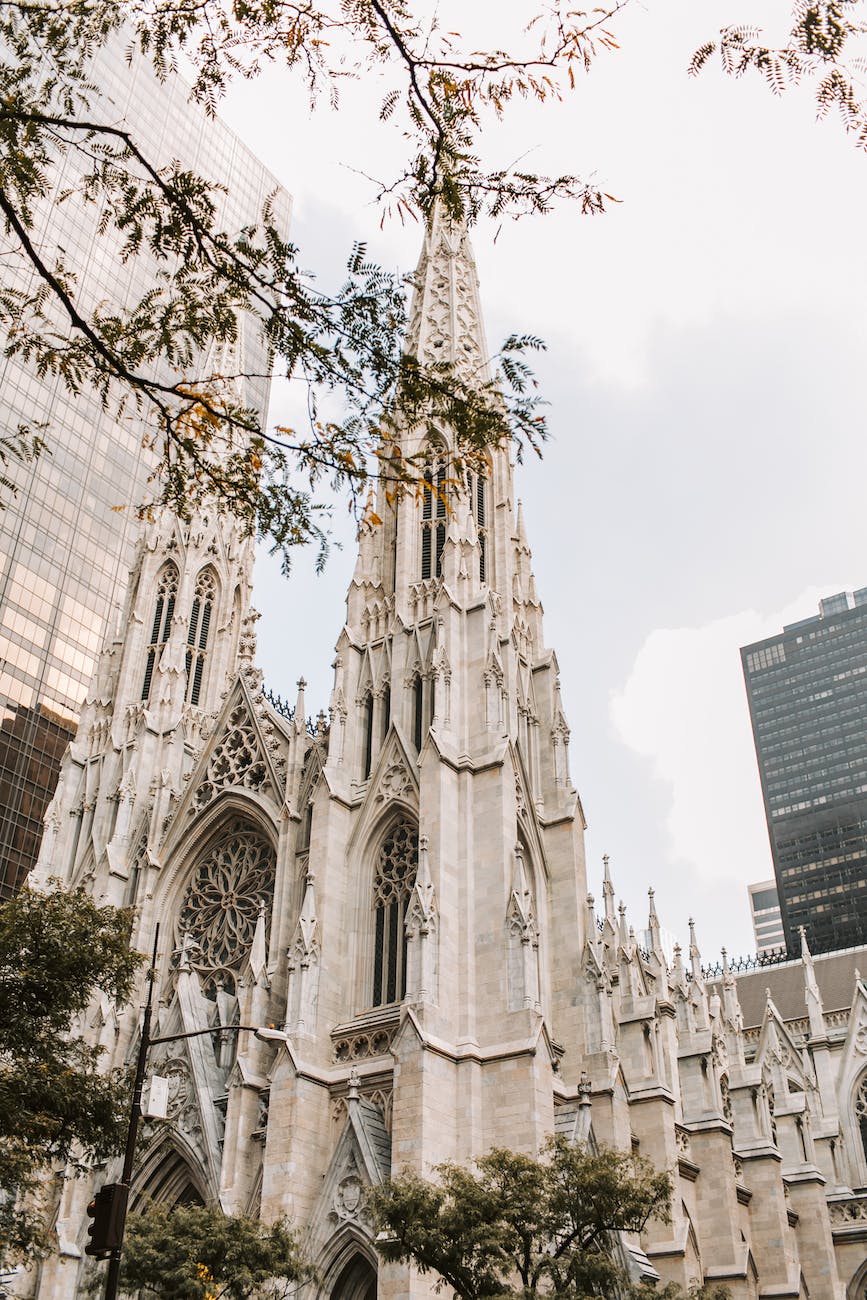
This is not an unknown story in New York City: a congregation sells part of its property or air rights to help fund its operations. This time it is St. Patrick’s Cathedral:

Photo by Vlada Karpovich on Pexels.com

Citadel’s Ken Griffin and Steve Roth’s Vornado Realty Trust agreed to buy up to 525,000 square feet of air rights from the Roman Catholic Archdiocese of New York to facilitate the development of 350 Park Avenue, PincusCo reported

The per square foot basis of the deal is arguably more important than the total purchase price, because that hasn’t been determined. Under the agreement, the developers can buy up to 525,000 square feet of air rights, but could also buy as little as 315,000 square feet. That means the purchase price ranges from $98.4 million all the way up to $164 million…

Representatives of Griffin, Vornado and Rudin did not respond to a request for comment from The Real Deal. A spokesperson for the Archdiocese of New York said that it is the church’s “hope that the money will go to the continued upkeep of the Cathedral.”…

Griffin’s Citadel is working to develop a 51-story tower at 350 Park Avenue, designed by Norman Foster. Griffin’s firm is redeveloping properties master leased from Vornado and Rudin. Citadel would occupy roughly 54 percent of the 1.7-million-square-foot property, which would stand 1,350 feet tall.

I remember at least a few of these stories while examining zoning conflict in the New York City. For a congregation with an older building and perhaps an aging congregation, allowing others to make use of their property in different ways could help pay the bills. Here, one of the wealthiest people in the United States wants to build a skyscraper, the church has the air rights, and the money paid to the church can help the Cathedral into the future.

This reminds me of some of the reasons many churches left Chicago’s Loop by the early twentieth century. Land prices were high, people had moved out of the central business district, and they could relocate to quieter, more residential streets. That left very few congregations in the downtown.

And even though this point was passed long ago, the contrast of a 51-story skyscraper near a landmark church is interesting to consider. No longer is religious activity at the center of big cities. Is this a physical manifestation that shows America’s leading religion is business?

How many landmark buildings should a suburb have?

As Napervillians debate the fate of the Scott house, a 156-year-old home constructed by one of the community’s first families, the number of historic landmarks in the suburb stood out:

Photo by Tim Mossholder on Pexels.com

As things stand right now, there are no protections that would prevent future owners from altering or tearing down the house. Its location is just outside of the Naperville Historic District, where regulations dictate standards for exterior home improvements. It is part of a federal historic district, but their rules is not nearly as restrictive, according to the Illinois Historic Preservation Office.

Preservation is possible were it to be made a city landmark, a process open to any Naperville property over 50 years old, but that requires the recommendation of the Naperville Historic Preservation Commission and the approval of the Naperville City Council.

There are only four historic landmarks in Naperville.

Heap said he and his fellow co-owners are keeping options open but acknowledges the house’s future will hinge on who it’s sold to. That also goes for whether Heap’s law practice stays on as tenants.

This is not a new debate in Naperville. As the article notes, the suburb has a historic district that developed over time and through much discussion. Naperville has lots of teardowns where public debate could pit the property rights of the owners against the interests of neighbors or the community.

Is four historic landmarks, then, good or enough? The current four include two houses, one former church, and a former library building. One way to figure this out would be to do some comparing to other suburbs. I do not know these figures but someone or an organization might have them. Another way to think about it is that Naperville has a track record of preserving its past and telling its own story, such as through Naper Settlement and other actors. A third option would be to have some sense of what leaders and residents want concerning landmarks; do they want to save particular structures or have guidelines for more buildings and properties?

The matter of preserving buildings in the suburbs is an ongoing conversation as buildings from a prior era come up against changing conditions and styles. This includes homes (even McMansions eventually?) but also civic buildings and business structures. The American suburbs have had a particular look for decades but there is no guarantee that much or all of that remain in the future unless there are dedicated efforts to the contrary.

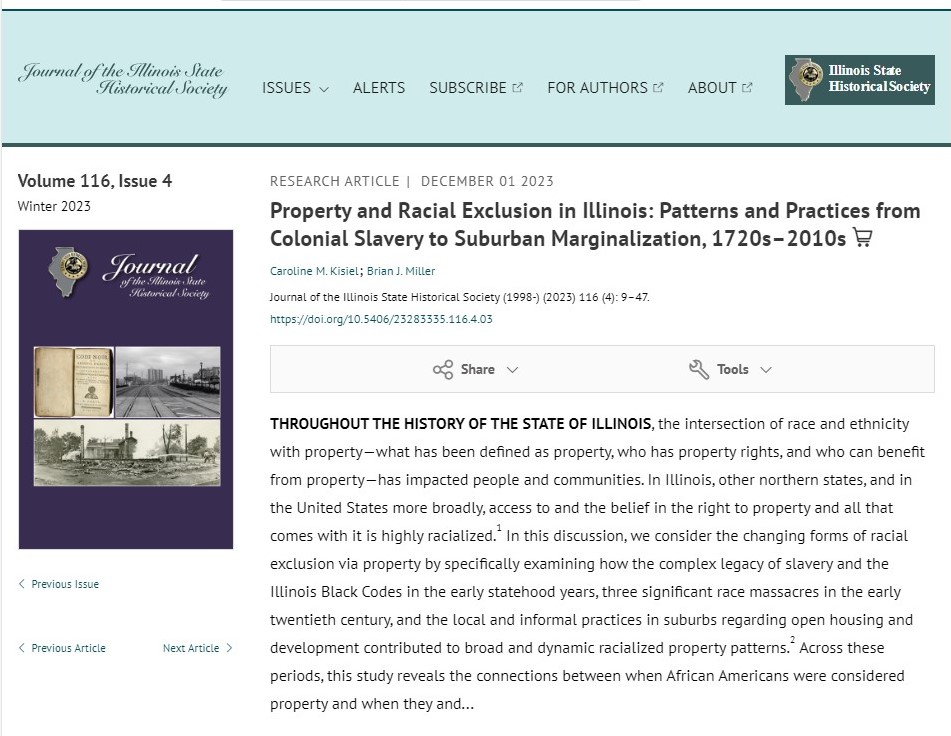
Kisiel and Miller new publication – “Property and Racial Exclusion in Illinois: Patterns and Practices from Colonial Slavery to Suburban Marginalization, 1720-2010s”

Caroline Kisiel and I have a new publication in the Journal of the Illinois State Historical Society. Here is a link to the article/journal issue:

This paper has been several years in the making and the helpful feedback we received along the way made it better.

Americans largely in favor of policies that would lead to more housing – but how many want that housing near them?

New data from Pew shows large majorities of Americans are in favor of more housing:

Photo by Maria Orlova on Pexels.com

The findings from one of the largest surveys done on these issues shows significant but varying support for 10 policy initiatives to encourage more housing. At the high end, nearly 9 in 10 (86%) say they would back efforts to expedite permitting processes, while at the lower end, about half (49%) support the concept of allowing smaller lots, and homes to be built closer together…

Support for most of the housing policies transcended the usual fault lines of political party, region, race, income, and gender. The eight most popular proposals received clear majority support from Republicans, Democrats, and independents. In addition, 9 of the 10 tested measures received majority support from both renters and homeowners. All of these policies have either already been shown to work in improving housing affordability in American cities and towns or have recently been enacted by state or city policymakers hoping to do so.

Some approaches that stood out as especially popular—earning support from more than 70% of respondents—are similar to state laws that have passed in recent years (although the survey questions themselves were not modeled on any particular laws). For example, in 2023, California, Montana, Texas, and Washington took steps to simplify permitting for new housing. In recent years, California, Massachusetts, Montana, and Utah have passed laws to enable more housing near commerce or transit. And Maine, Montana, Oregon, Utah, and Vermont, among others, have enacted legislation to allow houses to have an accessory apartment or dwelling unit, as have many cities…

Respondents also broadly supported the reasons behind efforts to create more housing, with 65% to 82% seeing each reason as excellent or good. (See Figures 3 and 4.) However, in some cases, Republicans and Democrats prioritized different reasons. For example, somewhat more Republicans (68%) than Democrats (62%) identified freedom for property owners as an excellent or good reason, while more Democrats (81%) than Republicans (49%) chose reducing racial segregation as an excellent or good reason. But large majorities of Democrats, Republicans, and independents see improving housing affordability and allowing more people to live near their preferred jobs and schools as excellent or good reasons to change housing rules to allow more homes to be built in cities and suburbs. Successful state-level efforts to allow more housing have consistently received bipartisan support, and the survey results indicate that people with different political views can come together to support policies to end the housing shortage and affordability crisis for different reasons. 

Americans like the idea of owning housing. Add this to the current state of housing where both owning and renting is expensive and Americans broadly like more housing.

Here is my question: how many want this new housing near them? Even if Americans like more housing in the abstract, they may display much more resistance when this becomes a local issue. This is part of the reason housing is such a difficult issue to address in the United States: it is often a local issue where local governments and residents who want to control their surroundings. Housing is a good thing but people often move to a neighborhood and community and want to limit who else can live there.

Thus, the expression of this majority for housing is difficult to put into practice. Even state laws are often fraught as it can run against local desires. Take the efforts in Illinois to promote affordable housing at the state level: the initial legislation had limited enforcement and more would need to be done for state-level policy to provide more housing.

As noted above, one of the routes forward that could gather more local support involves policies that provide more opportunities for current property owners. Adding ADUs, for example, provides a choice for current property owners to generate more income or provide housing for family. Other policies might be viewed as funneling money to outside developers or providing housing for people who would not be as welcome in the community. If policies can add housing units and enrich/protect homeowners, they might find more support.

Dallas neighborhood fought off McMansions with conservation districts

The Greenland Hills neighborhood in Dallas limited McMansions in recent decades by establishing conservation districts:

Photo by David Gonzales on Pexels.com

Neighbors were also concerned about tear downs and new builds. They watched as modern mega mansions took over the Park Cities. “There’s this thing coming,” Pratt says. And the residents, who founded the Greenland Hills Neighborhood Association in 1983, knew they had to do something to fight the “McMansions.”…

After that, Greenland Hills residents formed a conservation district. In the early 2000s, they surveyed the houses, and a feasibility study showed that about two-thirds of the homes were Tudors. And there was a schism in the neighborhood. There was the M Streets, between Central and Greenville, and then there was M-Streets East, which was sandwiched by Greenville and Skillman. East wanted less restrictive conservation rules, Mut says, and some blocks wanted to opt out.

Finally, the M Streets and M Streets East conservation districts formed in 2003. The M Streets Conservation District protects seven architectural styles, like neo colonial and contemporary. “We all get hung up on Tudors, and we should because that’s pretty massive,” Pratt says. “But the other styles are just as notable in the time period as well.” The district rules preserve each architectural style’s most iconic features on the front façade. The longest section is dedicated to the Tudors. There are specifications on window proportions, roof pitches, secondary gables, even doors. “We’re not going to put a Victorian door and a Tudor home,” Mut says…

And the prices of the houses increased. Homes in Greenland Hills often go for $800,000 or more. Mut can’t pinpoint the exact reasons for the surge in pricing, but he attributes it to inflation, the proximity to downtown, and demand for the homes. Mut and Pratt recognize the irony of the neighborhood’s start as an “affordable” neighborhood versus today. But it’s not an apples-to-apples comparison, Pratt says, especially now that the neighborhood is not on the outskirts of Dallas. And the overall value, she says, is still there. 

Three thoughts come to mind:

  1. The neighborhood wanted to protect its particular architecture and character. To do this, they set up guidelines that limited property owners. This is often the trade-off of historic preservation in American communities: retaining the older styles limits what current and future property owners can do.
  2. This occurs in a metropolitan region where McMansions are common. When I compared how McMansions were defined in the New York Times and Dallas Morning News, I found people in Dallas more open to McMansions. However, it sounds like people saw what was happening in other neighborhoods and decided they did not want this in their neighborhood.
  3. Home values in the neighborhood have increased. Would this have happened at the same rate if McMansions had been constructed instead? Preserving the older homes means the neighborhood appeals to certain buyers. Building McMansions means newer and bigger homes. Which option would have raised property values more?

Regulation coming for renting out suburban backyard swimming pools?

Suburbanites are renting out their pools through an app and their neighbors are not happy:

Photo by Pixabay on Pexels.com

The sounds of summer fun ripple up from ads for Swimply, an app that allows homeowners to rent out private pools to strangers looking to enjoy cool water under the hot sun. But that seasonal chorus has sharply divided suburban residents of Montgomery County as the local government considers formally regulating the short-term amenity rentals — potentially becoming the first in the nation to do so…

It is only mid-spring, but already dozens of pools in and around Maryland’s most populous county have been listed for rent on Swimply, which launched in 2020 as people sought alternatives to public pools that shut down because of the pandemic on the heels of the wild success of apps like Airbnb and Uber. Hosts set hourly rates anywhere between $25 to $100 an hour to access private backyard pools that bypass lines and crowds.

Unlike long-established home rental and ride sharing apps, newer apps that let people rent out their pools, home gyms and backyards have largely been unregulated across the United States so far. In fact, several jurisdictions, from the city of San Jose to towns across New Jersey to the state of Wisconsin, have tried over the past three years to ban the rentals or set up strict rules that require private pools to meet the same standards as a public pool…

A like-minded group of 36 county residents from Chevy Chase, Rockville, Montgomery Village, Kensington and Rosemary Hills, wrote a letter opposing the bill and asking the county instead to outlaw the amenity rentals altogether. The group argued that the rentals turn quiet residential neighborhoods into bustling business districts, without the infrastructure to support commercial activity. They raised dozens of concerns, largely over the added nuisance of strangers pouring into their neighborhoods because of the apps, congested roads, scarce parking, and noise and safety.

Should the property rights of homeowners reign supreme – they can do what they want with their property – or is this too much activity within residential neighborhoods where people expect quiet and do not want neighboring activities that they perceive will affect their property values?

If Montgomery County does not regulate this, someone will. I can imagine an alternative line of reasoning from a suburban government: this is a possible revenue stream.

Who owns a neighborhood? Or, who can make decisions to alter it?

A discussion of recent housing changes in Arlington, Virginia, an increasingly whiter and wealthier community, included this summary:

Photo by Jonathan Meyer on Pexels.com

Perhaps the opponents are beginning to accept that their community is not, has never been, exclusively their own domain.

Who owns a neighborhood? In many American communities, the people who live there might feel this way. They expect to provide input and exercise some oversight of what happens in their neighborhood. They want to exercise control over their own properties and those around them.

But, they do not do this on their own. They interact with other property owners and also engage with local governments. These local governments typically represent a broader community and have regulations about what can and cannot be done in neighborhoods.

In this particular case, the residents are single-family home owners and they have money and status. Thus, they really expect to be able to control their surroundings and they have means to back up their interests. Zoning in the United States often privileges protecting single-family homes.

In the end, however, local government has the task of considering the broader interests of a community. These may or may not align with the interests of a neighborhood. The neighborhood residents can respond by not voting for these local government officials and it is relatively easy in a smaller community to express discontent with local officials. But, action may already be underway that cannot be changed.

Or, here is another way to address the same questions: if every neighborhood will change over time, who gets to street this change and/or benefit from this change? Those with means and vested interests will have their own perspective and goals while a broader community might have another point of view.

Celebrating property owners who hold on to their land even as development surrounds them

The movie Up starts with a portrayal based on a true story: property owners continue to live in their home even as it becomes surrounded by new buildings. Their home is now isolated amidst change.

Here is a similar recent story from Australia:

https://www.facebook.com/7NEWSsydney/videos/790734838563206/

Their large five bedroom property with a sprawling 200 metre-long drive is located in The Ponds area in west Sydney, where hundreds of new homes have popped up in recent years…

The home looks bizarrely out-of-place wedged between identical chock-a-block newbuilds, where its 1.99 hectare garden could fit over 50 of the matching new homes inside.

However, when their neighbours upped and left – choosing to sell to the developers – the Zammits made a last hold out.

They refused to sell, despite being offered millions, and prevented the developers snatching up the last plot of land.

“The fact that most people sold out years and years ago, these guys have held on. All credit to them,” local agent Taylor Bredin told 7News

In short, the land could be worth over £25million, especially after ten years of their private rebellion.

The valiant resident holds on to their land despite possible riches; all they have to do is move. Such a story fits the image of the sacrosanct property owner. A home is their castle. No one can tell them what to do. If they want to stay, they can stay. The government or private actors should not be able to move them.

At the same time, we believe growth is good. If even just a few property owners hold out, they can interrupt larger plans for new buildings and activity. Imagine an important highway project or mass transi line or new tall building that need several properties to make it better for others but those owners will not sell. Are there limits to whether a property owner can hold on?

In the Seattle story referenced by Up and in this Australian suburban story, developers could not force the issue but they could build right around them. Edith Macefield’s Seattle home was boxed in on three sides. The suburban property above is surrounded on all four sides by dense single-family homes. The property owner has stayed but the surrounding area has been radically transformed.

For now, the single-family home owner reigns supreme. That there are relatively few similar cases also tells us something. It is nice to hold on to a property but it is also nice to profit tremendously from selling it. Some may not like teardowns but the initial homeowner can make a lot of money. Housing and land is an investment. Few can hold out against the available money and resulting changes.