When communities resist and protest COVID-19 testing and treatment sites

NIMBY attitudes can be present even – or maybe especially – during pandemics:

Last week, residents in Darien, Connecticut, a tony exurb of New York City, successfully lobbied to shut down plans for a coronavirus testing site, despite surging demand. The reason? Complaints from neighbors. As it turns out, the “Not In My Backyard” impulse to block new development — which has been implicated in the severe affordability crisis affecting cities from coast to coast — translates far too neatly into blocking certain measures needed to stop the spread of the virus.

In a similar case in Ewing, New Jersey, a local landlord issued a cease-and-desist letter to the operator of a coronavirus testing center amid complaints about congestion in the parking lot. As The Trentonian reported, one resident who wanted to be tested in order to protect his three-year-old child wasn’t subtle about how he felt about the decision: “It blows my f**king mind.”

Community resistance from neighbors of testing sites is a rerun of the fierce NIMBY reaction to potential coronavirus quarantine sites. Back in February, California began looking for a place to shelter Americans returning from abroad with the virus and settled on an isolated medical campus in Costa Mesa. But after local residents complained, city officials sought and received a court injunction to stop the project.

As the need for quarantine sites expanded, so did the NIMBY backlash. Finding sites that won’t suffer the same fate has proven to be a major hurdle as the federal government attempts to manage the crisis. Back when the focus was still on returning cruise ship passengers, officials in Alabama went to the mat to keep passengers of the Diamond Princess cruise ship out of a local FEMA facility, eventually forcing the federal government to scrap the plan altogether. Similar fights have played out from Seattle to San Antonio, potentially undercutting the response to the coronavirus at key early stages. As a result, the federal government largely shifted quarantining efforts to military bases, where complaining neighbors hold less sway…

At first glance, it might seem like efforts to block potentially life-saving public health screenings and complaints about community character have little in common. But in both cases, the formula is the same: Whether out of an understandable fear of the unknown or a selfish desire to shift the burden elsewhere, local impulses are given veto power over broader social needs. Under normal conditions, the inability to constructively manage this means higher rents. In a public health emergency, it could be lethal.

In addition to what is in the last paragraph quoted above, I am struck by the resistance to facilities and sites that would be home to temporary concerns. It is one thing to object to a long-term health facility (see recent posts about a drug treatment facility in the western suburbs of the Chicago area here and here) but another to resist something that is needed now and presumably not permanent. Of course, this could be part of the fear: if a site treats COVID-19, could it then later be turned into a more permanent fixture in the community?

The logical extension of the NIMBY claims would be to push COVID-19 treatment sites or testing facilities to communities that could not resist it. When this plays out in areas like housing or unwanted land uses, this means that communities with less wealth and political power tend to become home to land uses that wealthier communities refuse. If such a pattern occurs here (and there is evidence that health differs dramatically by location in the United States), it could be evidence that pandemics further locational and health inequalities.

My suburban neighborhood had the most pedestrians out that I have ever seen

We moved to a single-family home neighborhood nearly three years ago. Our street has a unique location; we have a mix of housing types within half a mile including single-family homes at several price ranges, condos, townhomes, and apartments and there is a good-sized city park around the corner. For a suburbanite, I am outside walking around pretty often and fairly observant.

Yesterday, I was outside for an hour in the afternoon. The weather was okay by Chicago-area spring standards: near 50, mostly sunny, no breeze. But, there was a big difference in the number of people walking and biking. A steady stream of people came by as couples, in family units, teenagers with friends, and single pedestrians out to walk the dog. From my front yard, I can see our street, a perpendicular arterial street, and a pathway through the park – all had a consistent set of people.

This was unusual. I am not usually out on a Tuesday afternoon but neither are all of these people. Living in a state with a shelter in place requirement, more people are home. Perhaps by the early afternoon, they want to get outside. Even though the weather was not great, it was warmer than the last few days and the snow had melted the day morning before. There is only so much Netflix someone can watch before needing a little break.

I am not sure this increased pedestrian behavior leads to more neighborliness or social interaction. We all are supposed to be six-plus feet apart. Some people wore headphones. Some of the people knew each other but others came from different micro-neighborhoods in the area. At the least, those outside saw more people than they typically would.

Will this last? Maybe as long as the shelter in place is required. A few people might turn these behaviors in uncertain times into more regular patterns in normal times. I would expect that pedestrian life will decrease significantly once work and school go back to more normal levels. And my suburban neighborhood will go back to relatively small numbers of people walking around on a regular basis.


Suburban municipalities to take own actions regarding COVID-19?

As different government bodies look to act in response to the spread of COVID-19, I was struck by the number of large cities and states that are acting (including the state in which I live). At the same time, I wonder: how are suburban communities responding?

A few thoughts:

-Many suburban communities have limited capabilities and cannot do a whole lot. They may have limited budgets, a relatively small number of employees, and not much power to compel action. Still, decisions to close public spaces – such as libraries, city/village/town halls, community centers – matter to the everyday lives of lots of people.

-Yet, some bigger suburbs in the United States are as large as small big cities. Their actions can be very consequential and they have more budget room to address issues. At this point, the news has primarily focused on the biggest cities in the United States but this matters for numerous other communities over 100,000 people (to use an arbitrary cut-off point for a larger community).

Americans tend to like local control and government but at the speed that a virus can spread and across political boundaries, individual actions across hundreds of American suburbs might not add up to much. Hence, people look to the state and federal level to mobilize resources and direct action.

-What is the role of metropolitan regions in all of this? The City of Chicago can act and affect millions of residents and workers but there are roughly seven million more people in the region. Counties can act and affect more residents. But, then the next level of action regarding COVID-19 seems to be at the state level. Are metropolitan regions working together or is the general lack of metropolitan cooperation revealed again in a time of crisis?

Infectious diseases in urban and suburban life

Americans already have a predilection for suburban life; might a global pandemic push even more people out of cities and to the edges of metropolitan regions? One take regarding safety in suburban life:

As maps like this show, major metropolitan areas are bearing the brunt of the Covid-19 infections spreading across North America. And that makes sense: Though there’s no way to know for sure how the virus arrived, it almost certainly came by way of an international flight to a major airport (or several of them). But while infectious disease spreads faster where people are more densely clustered — hence the strategy of social distancing to contain the coronavirus — that doesn’t necessarily make suburban or rural areas safer, health experts say…

That is not to say that cities aren’t Petri dishes — they are. Relative to rural areas, urban centers do provide stronger chains of viral transmission, with higher rates of contact and larger numbers of infection-prone people. And historically, urbanites paid a price for this vulnerability…

Modern transportation networks have made the population shield that rural areas once provided much more porous. Now that humans and freight can travel from, say, Hong Kong to Los Angeles in less than 13 hours — and arrive by vehicle to somewhere sparsely populated hours after that — outbreaks can happen just about anywhere. New pathogens tend to arrive sooner in global hubs, but that doesn’t mean they can’t quickly reach rural locales and proliferate from there, says Benjamin Dalziel, a professor of mathematics at Oregon State University who studies population dynamics…

But while the CDC recommends decreasing social contact to limit the spread of the virus, that’s just as doable in a downtown apartment as a countryside manor. Says Viboud: “If you’re staying at home and limiting outside contact, you’d achieve the same purpose.”

Three thoughts come to mind:

  1. This highlights the connectedness of cities and suburbs today, even if there is significant physical distance separating communities. The rate at which people travel around the world, to other regions, and throughout regions is high compared to all of human history and is relatively easy to do. Cities and suburbs are not separate places; they are parts of interdependent regions that are highly connected to other places.
  2. Safety and health was a part of creating the suburbs in the United States but it is hard to know how this might matter in the future. Given all the reasons people now settle in the suburbs, would avoiding communicable diseases be a top factor? I would think not, particularly compared to factors like housing prices or amenities (schools, quality of life, etc.), or demographics.
  3. If particular places are not that much safer, does the sprawl of American life then limit the response to any illness? Imagine the Chicago region with dozens of hospitals that need to be equipped spread throughout the region as opposed to that same number of people packed into a smaller area where it is easier to get supplies and people to medical facilities. Or, the need to supply grocery stores throughout a huge region.

A way to fight app directed through traffic: cul-de-sacs

The suburbs are full of of cul-de-sacs. Homeowners might prefer them because of the quiet and the space that they allow for kids and vehicles. They can help developers and builders fit more houses into spaces.

At the same time, cul-de-sacs may be the bane of New Urbanism as neighborhoods with many of them do not have a consistent street grid and they are primarily lined by private single-family homes. One video promoting New Urbanism put it this way: The greatest threat to our planet is…

CuldeSacsfromBuilttoLast

Yet, cul-de-sacs do provide one additional advantage in today’s world. They can limit the effectiveness of Waze and other traffic or mapping apps: cars and traffic cannot cut through cul-de-sacs. I saw this argument recently in a 2001 newspaper article where a suburban leader said they had restricted commercial development to main roads and highways and the high percentage cul-de-sacs and loops among the residential roads kept neighborhoods quiet. With more cul-de-sacs, more traffic is routed to arterial roads, streets that can usually accommodate more volume. Cul-de-sacs help make residential neighborhoods harder to navigate; I can think of several residential neighborhoods in my area that make it very difficult to find your way through if you are not familiar with it because of the winding roads and dead ends.

New Urbanists would argue that this is not ideal: more cars on arterial roads is going to lead to more congestion (as opposed to a grid system that provides drivers lots of options), arterial roads may be less friendly to pedestrians and bicyclists, and we should be working to reduce driving anyhow rather than planning communities around cul-de-sacs that depend on cars.

Speed bumps, roadside speed monitors, and other devices might not be enough to stop through traffic in residential neighborhoods. Permanent cul-de-sacs could do the trick – but at a cost to the overall fabric of the neighborhood and community.

Calculating the costs of commuting versus benefits of living further from work

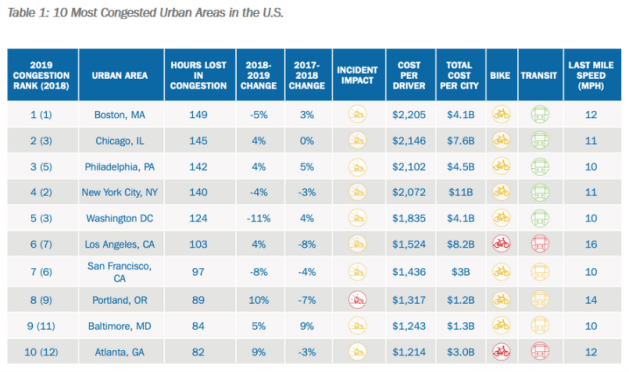
INRIX recently published data on traffic and congestion in major American cities with Boston leading the way. Here is one of the data tables:

INRIXcongestion2020

When put in these terms, it looks like commuters lose a lot of hours and money by sitting in traffic. In addition to the time it should take to commute by car, drivers in Boston lose over 6 days to congestion and over $2,000 dollars. The cost for the city/region is huge when all the drivers are added together. In New York City, $11 billion lost!

On the other hand, people keep commuting. Why would they do this in light of these costs? The pull of the suburbs and locations away from their work is strong. Perhaps workers should be able to live near their work but a good number choose or are pushed to locations far from their jobs. And they might be willing to put up with these costs because the places where they live offer other good things (and measurable benefits). In American life, suburbs offer single-family homes, places for family life, and more. Losing 100+ hours in traffic each year in the biggest cities could be tolerable if it comes with a bigger, cheaper home in a well-regarded community.

In an ideal world, workplaces and communities that people want to live in and would thrive in would be located near each other. Sometimes they are but often they are not. In a country where Americans and their government have prioritized certain things – driving over mass transit throughout metropolitan regions, for example – even the hassles of commuting make some sense.

Trying to make vacant suburban office parks more attractive

Filling vacant suburban office parks can be hard. Here are some Chicagoland efforts to renovate these spacess:

At the former OfficeMax headquarters in Naperville, his architecture firm and developer Franklin Partners cut away portions of large trees, put in new smaller ones and strategically replanted some flower beds as part of a multimillion-dollar redevelopment to make the 350,000-square-foot property more appealing to a variety of companies…

For one, grand front desks typically found just inside the entrance of office properties built in the 1980s and 1990s no longer work. Those are being hidden and replaced by amenities that generate the most activity, like coffee bars, fitness centers and conferencing space. “It’s not unlike walking into a hotel,” says principal Roger Heerema. “There’s a feeling of life that is immediately apparent.”

Strategic use of light fixtures and canopies over entrances make a difference, he says, as does making sure tenants are actually noticing them. At the Westwood, a half-empty, two-building office complex being renovated in west suburban Lisle, the tenant lounge is located near a main visitor entrance. So Wright Heerema designed new lounges for both buildings near second entrances where most employees come and go…

In the suburbs’ corporate heyday, office buildings “were machines for working—you packed people into them,” says OKW Architects Chairman and CEO Jon Talty. “That attitude has changed profoundly. The lifeless machines need to have meaning to them to be relevant.”

How office space is designed goes through phases.

It would be interesting to hear more details about these approaches:

  1. How often do the changes involve asking current employees what they want as opposed to executives or designers making decisions and/or focusing on what potential employees might want?
  2. The argument above is that a redesign is going to attract a leasee or new employees. What exactly is the return on investment in good or cool design?
  3. Do companies and designers consider larger changes, such as adding more mixed uses to these campuses or opening up the buildings and spaces to reintegrate them into the surrounding area, or is the primary goal to make a quick fix to fill them with users again? In other words, is the bigger question how to move away from office parks and separate and move to a denser and more integrated suburban landscape?
  4. Does the design for a space work until someone moves out and then a refresh is needed? How often do companies proactively change their spaces in response to changing goals or employee needs?


The development of a changing and global northern Virginia

Alongside the rise of Washington, D.C. as an American center, the suburbs of northern Virginia have expanded and evolved:

One such non-DC-centered book was published in 2013 by the scholar Andrew Friedman. “Covert Capital: Landscapes of Denial and the Making of U.S. Empire in the Suburbs of Northern Virginia” stands out as a serious application of academic history and landscape studies about the Dulles Corridor. It just may be the first 21st-century attempt to mold a critical perspective on Northern Virginia…

The book is built on Friedman’s understanding that “there is no American place that’s not also a global place.” He establishes a dichotomy between the “Overt Capital” of Washington, where the Capitol dome represents the public sphere, and the “Covert Capital” of the Dulles Corridor, where the CIA and Pentagon manage their operations in relative privacy. As Friedman examines how foreign policy and foreign interventions shaped the domestic landscape, he locates the cross-border flows of material and people that have made our region what it is today…

For Friedman, the history of the Dulles Corridor begins with the construction of the Pentagon in the 1940s, followed a decade later by the CIA headquarters. These buildings took advantage of car-oriented development to gain a new kind of hiddenness, obscured behind forests and parking lots. A drive through Langley can reveal nothing about what takes place behind the agency’s doors.

Friedman sees the seven years since his book was published as the beginning of a “third generation” in the development of the Dulles Corridor. It’s no longer characterized by leisurely semi-rural landscapes nor by McMansions, but by “lifestyle centers” and “placemaking,” as in the Mosaic District or The Boro. These centers, Friedman says, are in danger of becoming “fortified cells… reinventing the ‘urban’ into subdivisions, compartmentalized, buy-in-based.” Rather than creating an inclusive environment, he worries that lifestyle centers will only create a new form of “landscapes of denial.”

On one hand, this like the development of Sunbelt suburbs after World War Two. With defense spending, the spread of highways, and sprawling suburbs, this could describe any number of regions from D.C. to southern California. Over time, communities developed and became part of a global system: new immigration flows starting in the late 1960s brought new people, multiple generations of people lived in the new communities, and suburbs began to differentiate themselves. On the other hand, few places have the CIA and Pentagon – defense spending in suburbs could run the gamut from aircraft plants to military bases to government offices. And individual communities and regions have their own particular histories that affect local development character.

More broadly, looking at regional development – not just at cities – is a worthwhile endeavor. Major cities, like Washington, D.C., cannot be separated from their suburbs and vice versa. Considering the variation within a region versus connections between particular parts of the region and other parts of the United States is fun. Tyson’s Corner, cited above would be a good example: is it more like edge cities or northern Virginia. And what lessons could northern Virginia provide for the rest of the country about what to do or not to do?

Quick Review: Suburbicon

I try to keep up with movies, books, TV shows, and music about the suburbs. I recently watched the 2017 film Suburbicon. Here are three thoughts:

1. The basic plot of the film extends a decades-long emphasis on the underbelly of suburban life. The main focus is on what looks like a typical suburban family – white, middle-class with the father working in a corporate office, one kid, in a recently-constructed suburban community – but they turn out to have family issues. The question at the end of the IMDB summary – “Who would have thought that darkness resides even in Paradise?” – is one that dozens of works have considered.

2. The twist to this film is that the under-the-surface issues of the white family are juxtaposed with the experiences of a black family who moves into the home directly behind the white family. As soon as I heard the last name of the black family (Mayers), I thought of this incident from 1957 in Levittown, Pennsylvania:

It began on the afternoon of Aug. 13, 1957, when the Levittown Times newspaper (the precursor to the Bucks County Courier Times) reported “The First Negro Family to buy a Levittown home” had moved into a house at 43 Deepgreen Lane in the Dogwood Hollow section that morning. The family included William Myers, his wife, Daisy, and their three small children…

Day 1: Within hours after the newspaper hit the streets, small groups of agitated Levittowners are already gathering in front of the Myers home. Throughout the evening, the crowd continues to grow. By midnight, more than 200 shouting men, women and children cluster on the Myers’ front lawn. A group of teens throw rocks through the Myers’ front picture window, and 15 Bristol Township police officers are dispatched to the scene. Soon, the county sheriff arrives, and orders the crowd to disperse. By 12:30 a.m., two adults and three teens have been arrested. Now, with the violence increasing, the sheriff wires the Pennsylvania State Police asking for immediate assistance. His request states, ”…the citizens of Levittown are out of control.”…

Day 7: As darkness settles, a group estimated at about 500 men, women and children gather directly across the street from the Myers house. Despite repeated warnings to leave, many in the crowd stand defiant — screaming, shouting and cursing at police. Finally, 22 state troopers, swinging clubs, charge into their midst. Men are slapped across their backs and knocked down; women are slapped across their buttocks. Many in the crowd become hysterical. Curses, cries and shouts of “Gestapo” are hurled at the troopers. Following the melee, remnants of the crowd linger along Haines Road well into the early morning hours. At one point, they defiantly join together to sing “America” (better known as “My Country ’Tis of Thee.”).

Day 8: About 500 men, women and children gather along the Farmbrook section of Haines Road. A rock is thrown, striking a Bristol Township police sergeant on the head and knocking him unconscious. He is rushed to Lower Bucks Hospital, then transferred to Rolling Hills Hospital. He suffers a concussion and ear lacerations, but fortunately will soon recover. A 15-year-old boy is seized in the incident, but later released. State police inform the protesters, “A police officer has been injured … Absolutely no more crowds will be permitted in the area.”

By midnight, the crowd has disappeared.

There is no direct commentary about the contemporaneous fates of the two families but the connection is interesting to consider. The white family cannot hold themselves together while the black family simply wants to live a quiet suburban life? The two boys are able to interact even as the adults lose their heads? The community cares about skin color more than they do about violent acts?

3. I wonder how much narratives about the hidden negative aspects resonate with viewers. For those who already dislike the suburbs, perhaps it feeds the critiques. But, for suburbanites or for those who aspire to living in the suburbs, does a story like this seem credible? It reminds me of a quote from sociologist Bennett Berger after studying a working-class suburb:

The critic waves the prophet’s long and accusing finger and warns: ‘You may think you’re happy, you smug and prosperous striver, but I tell you that the anxieties of status mobility are too much; they impoverish you psychologically, they alienate you from your family’; and so on. And the suburbanite looks at his new house, his new car, his new freezer, his lawn and patio, and, to be sure, his good credit, and scratches his head bewildered.

If there are plenty of racists down the street in suburbia or families that fall apart, does this stop others from living in suburbia?

Seeing the nuclear family in a suburban single-family home as a historical blip

David Brooks argues the idealized American family in the suburbs is a historical anomaly:

For a time, it all seemed to work. From 1950 to 1965, divorce rates dropped, fertility rates rose, and the American nuclear family seemed to be in wonderful shape. And most people seemed prosperous and happy. In these years, a kind of cult formed around this type of family—what McCall’s, the leading women’s magazine of the day, called “togetherness.” Healthy people lived in two-parent families. In a 1957 survey, more than half of the respondents said that unmarried people were “sick,” “immoral,” or “neurotic.”

During this period, a certain family ideal became engraved in our minds: a married couple with 2.5 kids. When we think of the American family, many of us still revert to this ideal. When we have debates about how to strengthen the family, we are thinking of the two-parent nuclear family, with one or two kids, probably living in some detached family home on some suburban street. We take it as the norm, even though this wasn’t the way most humans lived during the tens of thousands of years before 1950, and it isn’t the way most humans have lived during the 55 years since 1965.

Today, only a minority of American households are traditional two-parent nuclear families and only one-third of American individuals live in this kind of family. That 1950–65 window was not normal. It was a freakish historical moment when all of society conspired, wittingly and not, to obscure the essential fragility of the nuclear family.

In a sweeping historical perspective, Brooks is right (nor is he the first to make this argument): the American arrangement of small nuclear families in large private homes is unusual. It is even relatively unusual among contemporary living arrangements throughout the world. Fifty years from now, will this period look even more like a historical blip?
And yet, the idea has a strong hold on American life. This particular lifestyle became a significant part of the American Dream, supported by the federal government, promoted by films and television, and defining much of popular twentieth century sprawling suburbs. To move away from this ideal will take some work, even if there are reasons pushing Americans away from this life. Brooks proposes some different alternatives, from multigenerational dwellings to cohousing, but each will take time to develop. It is hard enough to get politicians to talk about housing, let alone discuss all the social arrangements and family life attached to it.
At the least, this is a reminder of how social arrangements can come together through a  confluence of forces and come to seem like normal – until things have changed.