Developing suburban tourist destinations along major highways

The suburb of Naperville is looking to develop entertainment and tourist destinations on undeveloped land in the northwest corner of the community:

In the works at the two properties both using the CityGate name are an apartment building with a rooftop event center on the east side of Route 59, along with an arena for hockey games, concerts and conventions; and on the west side, a brewery or winery with a restaurant and hotel, as well as residences and offices — all designed with public art as a focal point.

What CityGate as a whole aims to do, developers and city leaders say, is become a true entertainment destination, giving visitors and residents reasons to come, places to stay — even places to live…

Still, there is optimism for CityGate plans, which eventually could include a band shell, a pedestrian bridge over Route 59 and a connection to the Illinois Prairie Path.

“From what we’ve been able to gather, Naperville is gaining a number of people visiting because of tourist attractions outside of Naperville,” Halikias said. “We’re looking at it and saying, ‘You know what? We should have the tourist attractions in Naperville.'”

And all right off the interchange of Route 59 and I-88. Three thoughts in response:

1. Even though many Americans likely do not think “suburb” when they hear about tourism, more suburbs are pitching themselves as cultural or entertainment centers. Tourism can help bring in money from visitors, which helps grow the local tax base without further burdening local residents or property owners. Additionally, the right kind of tourism can be viewed as family-friendly, a vibe many suburbs would like to cultivate.

2. One of the draws of Naperville is its vibrant downtown. Would an entertainment center on the edge of the city compete with the downtown and its restaurants, stores, and other amenities? This connects to a broader question: how many entertainment centers can thrive in the suburbs of the same region, let alone within the same community?

3. The development is said to include apartments, nearly 300 of them. While this helps provide a base for the new amenities nearby, it does not completely alleviate a problem of this development: how accessible is it to nearby residences or communities and how car dependent will the new place be? Even with access to the Prairie Path, the majority of visitors will need to come by car. Two sides of the property will be bordered by very busy roads. The majority of people will drive, park, and leave. This is a very different kind of center than Naperville’s downtown – which can be said to help contribute to Naperville’s small town charm – because of transportation. Perhaps the development will have a full range of options that can keep people there for hours. But, creating a coherent space with its own feelings and around-the-clock vibe could be hard to develop.
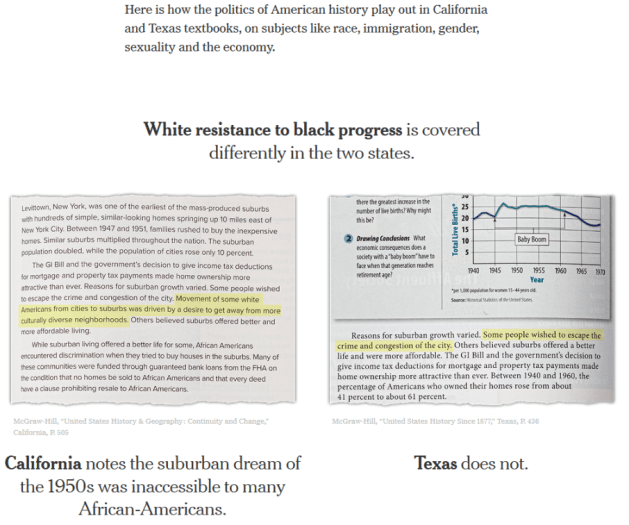
Presenting suburban growth and the role of race differently in high school textbooks

A longer look at state differences in history textbooks includes this bit about suburban growth:

HistoryTextbooksSuburbsJan1220no1

HistoryTextbooksSuburbsJan1220no2We cannot fully understand places and communities without knowing about how race and ethnicity plays a part in the story. It is clear that the past included a whole host of legal and informal structures existed from the beginning of suburbs to keep non-whites out. This included: redlining, sundown towns, refusing potential homeowners in Levittown, government policies that helped whites move from cities, and exclusionary zoning. I argue this is one of the reasons suburbanites like suburbs so much: they were able to exclude those they did not want to live near. Some of these techniques, and more recent ones, still work to help keep some suburbs more homogeneous even as more immigrants and non-white residents moved to suburbia and residential segregation has decreased.

Without widespread knowledge of how the American suburbs developed, perhaps this is why exist videos like “The Disturbing History of the Suburbs” exist. The suburbs may not be only about race – I list six other factors that matter as well though the seven factors are all intertwined – but suburbs are not simply the result of neutral free-market forces. Understanding what helped create the suburbs and gives social life in suburbs today its shape will help give future suburbanites, perhaps a majority of Americans, better operate within their context and potentially shape new kinds of suburbs.

Six suburbs for Generation Z

Homes.com surveyed Generation Z, found their preferences for where they want to live, and then matched those preferences with six suburbs:

In deciding where to buy a first home, each generation has likes and dislikes that reflect its values and priorities. Recently Homes.com surveyed more than 1,000 members of Generation Z to find out more about their home-buying plans, including what kind of neighborhood they prefer.

The survey found preferences centered around four characteristics:

Diversity. More than half prefer neighborhoods and communities that are racially and ethnically diverse;

Accessibility. Three out of four want a location that is accessible to work as well as to friends and family;

Safety. This is a priority when Generation Z-ers evaluate neighborhoods

Affordability. Generation Z is very aware of rising home prices that have kept millions of millennials from becoming homeowner.

And the six suburbs:

-Lilburn, Georgia (outside Atlanta)

-Florin, California (outside Sacramento)

-Shaker Heights, Ohio (outside Cleveland)

-Glendale Heights, Illinois (outside Chicago)

-Valley Stream, New York (outside New York City)

-Stafford, Texas (outside Houston)

Given these four traits and these six suburbs, there is limited representation from some notable big coastal cities including Los Angeles, San Francisco and the Bay Area, Seattle, Boston, and Washington, D.C. Presumably, these metropolitan are too pricey to meet the priority of affordability.

Additionally, it is interesting to not see on the list cultural opportunities or an exciting location. All big cities have hip locations or neighborhoods that might fit the bill or some of this could be rolled into other factors above. Yet, the list also does not include places like Austin and Denver which have a reputation for being cool.

Finally, I do not know the longer histories of these suburbs. Right now, they are quite diverse (at least in comparison to the image of white and wealthy suburbs) but they might not always have been that way and may not have the same composition in the future. If a lot of Generation Z buyers move to these communities, how would they shape the demographics and character of each suburb?

Questions arising from “Hidden networks of [Democratic] suburban women”

Continuing the attention paid to suburban voters in the upcoming 2020 election, one article examines groups of suburban women with political goals:

Ohio, a former swing state, has moved swiftly to the right since President Donald Trump won by 8 percentage points in 2016; Republicans have dominated, save for Democrat Sherrod Brown’s 300,000-vote Senate win in 2018. Yet, brewing in these red counties, from Geauga in the north to Warren in the south, is a contrasting rally cry: Ohio is a swing state, and suburban women who were often previously politically inert will be the ones to make it such in 2020. This is not the same crowd as the women’s marches or Indivisible groups that sprouted in 2017, and their rhetoric doesn’t have the sharp edge of Trump’s fiercest critics. Many have kept their nascent activities hidden on private Facebook groups and invite-only events, only to emerge for 2020 as a new network — unconnected to any campaign or party, but designed to boost Ohio Democrats’ flagging fortunes here.

These groups range from the Organized Progressives Standing United (OPSU) and the Bay Village Nasty Women to the Progressive Women in Westerville and Positively Blue in Dublin. The OPSU had 20 members when Julie Womack, 51, of Mason, Ohio, joined it in November 2018. Now, it has 500. In September 2019, a few months after leaving a left-leaning media job in Washington, D.C., Paris launched Red, Wine & Blue, a statewide network of blue-leaning women (and some men) pushing for higher political involvement in 12 suburban Ohio counties. A dozen groups have since joined her network…

The women often worry about drawing too much heat in communities where they have felt politically isolated. “Democrat is a dirty word down here,” says Womack, whose group was “secret” when she joined it but is now public. She sees OPSU’s rapid growth as a mirror of her own need for political outspokenness — especially in Warren County, which went for Republican Gov. Mike DeWine by 36 percentage points in 2018. “I’m at the point in my life now that I just don’t care. To label yourself a Democrat or a progressive [here], you’re going to feel ganged-up upon. You’ll stand out.”…

It might not be enough, suggests Richard Perloff, a professor of political media and communication at Cleveland State University who believes that the narrative of suburban women turning Ohio blue in 2020 may be “overly optimistic.”

Three quick thoughts:

1. By virtue of being hidden, private, or less public with their activities, it is hard to know how many such groups exist. And how many groups are on the opposite side of the political aisle?

2. Another angle to this could be a need more Americans feel to keep their personal politics quieter or at a simmering level until an opportunity (like an election or a threat of war) comes. This approach could be more popular for a number of reasons: more divisive public rhetoric, animosity toward outspoken political comments, limited support for political minorities, a decrease in confidence in and participation in traditional voluntary associations. This could help contribute to increased difficulty in using public opinion polls to predict elections. (A possible flip side to this: each private group can operate more independently without being beholden to a larger organization. And suburbanites may care about national politics but they like local control.)

3. Where are there public spaces in Ohio and other states where people can gather to talk about politics and other matters relating to community life? The missing third places or public spaces featuring regular mixing of people mean more activity and conversation takes place in private spaces or by invitation and planning rather than through spontaneity or a regular presence in a particular location.

Gendered McMansions, Part 3: suburban sprawl and raising children

Many, though not all, McMansions are located in suburban communities. From the beginning of suburbs in United States, one emphasis has been on the raising of successful children. This could include wanting to stay away from the big city and its problems (historian Robert Fishman argues this was behind the efforts of Englishman William Wilberforce in moving his family out of London) as well as developing a pervasive ideology that suburban life with its single-family homes, safety, schools, and proximity to nature as the best place to raise children (attested to in numerous studies including The Levittowners).

As part of the suburban landscape, the McMansion is then part of the goal of raising children. Young children may be less interested in the home’s status and ability to broadcast a message to neighbors but the homeowners hope they use and benefit from the safe, private space that can both host time with others (family, friends) and provide space to be alone. In addition to the benefits of the school districts and communities in which the suburban McMansions are located, those with the means to purchase and maintain a McMansion also likely have the resources to put their children in extra activities or visit places or provide lots of stuff at home.

In this suburban world, women have traditionally been responsible for child care and ensuring the success of children. Think of the typical image of the 1950s suburban family: father goes off in the morning to a corporate job and returns in the evening to be served or doted on by his family. The wife takes care of the children and all the household duties with little help from the father. And even in today’s world with more attention from fathers to caring for children and household duties, children are often still the responsibility of mothers.

So if McMansions, single-family homes devoted to nuclear family life, are often nested within suburbs, also devoted to nuclear families and children, and caring for children and family often falls to women, then one of the primary social roles of the McMansion is gendered. The large home might be a status symbol as well as an attempt to get the most house for the money but it is certainly a space intended to grow successful children.


Photo gallery: “15 photos that perfectly capture what it is like to live in the suburbs”

Insider has an interesting collection of stock and news images meant to sum up suburban life. If I had to guess, the ideas about what is going on in suburbs came before choosing the pictures (though I could be wrong). Here are the three categories I think the pictures fall into:

1. Life centered around single-family homes in neighborhoods with some interaction with nature (Pictures #1, 2, 3, 11, 12).

2. The necessity of cars (Pictures #4, 5, 7, 14)

3. Social life takes place in small downtowns (Picture #6), big box stores (#8), high school football games (#9), local schools (#10), sledding hills (#13), and state and county fairs (#15).

Does this accurately depict suburban life? Looking at my list of the seven reasons Americans love suburbs, there are several key pieces missing (showing family life, exclusion, local government) and several others underplayed (the importance of single-family homes, the middle-class nature of social life). Some of these would be difficult to show in a single photograph. Would family life look like a family unit playing in their backyard or sitting around the TV in their living room or all together in their SUV driving to one of their kid’s events? Similarly, showing a local government meeting is likely to be seen as dull – even if suburbanites like to think they have more immediate access to decision makers. Outside of showing a redlining map or a zoning map built around exclusionary zoning, how would one depict exclusion in a suburban community?

All that said, it would take me some time to think about what 15 photographs would best represent suburban life. And if the goal was to also have active and/or engaging images (not just descriptive ones accompanied by text), the task could be even harder.

The top 5 posts of 2019: the suburbs (on TV and the development of), changing households, and potholes

As 2019 comes to a close, here are the five most visited pages on Legally Sociable for the year:

  1. The exterior vs. the interior of the Brady Bunch house and architecture in TV and movies. This post continues to be popular; here are three possible reasons: there are dedicated fans of the Brady Bunch, this home is particularly iconic, and there is relatively little scholarly work about depictions of suburban homes on television (though this post helped inspire two publications of mine: one on suburban TV shows and one on the fictional McMansions of the Soprano family).
  2. A new term: the “accordion family.” Household arrangements continue to change in the United States and this is one of the changes that emerged out of the economic troubles of the late 2000s: more twenty-somethings living at home.
  3. The highest post from 2019 on this list: Rethink Rezoning, Save Main responses share similar concerns – Part One. This overview of two local zoning concerns, one a proposal to rezone property along a major road through a town and one a proposal to build a five story apartment building in a suburban downtown, had a Part Two with more sociological analysis that was nowhere near as popular.
  4. Responding to “The Disturbing History of Suburbia.” I add some scholarly sources and discussion to this video which is a good starting point to thinking about the large role race and ethnicity played in the creation and maintenance of American suburbs. It is hard to escape the importance of race in understanding the American suburbs.
  5. Song invoking filling potholes with cement (which the gov’t is not doing). There are few songs even hinting at these topics and Twenty One Pilots are popular.

Of the top posts, three involve reactions to popular culture (the Brady Bunch, Adam Ruins Everything, and a song from Twenty One Pilots), one is about a sociological concept, and three invoked sociological reaction in two areas of my research interest (suburbs on television and suburban development).

On to a new year of sociological commentary.

Kevin McCallister of Home Alone does not live in a McMansion

From a Buzzfeed list of tweets about Home Alone, here is one that considers the primary setting for the movie:

HomeAloneMcMansion

While the house may appear to be a McMansion because of its size and suburban settings, there are multiple pieces of evidence to counter this (compiled from multiple websites including fancypantshomes.com, themirror.co.uk, and census.gov:

1. The home was constructed in 1920. This construction predates McMansions by roughly six decades.

2. The home sold in 2012 for just over $1.5 million. This is beyond the price of most McMansions.

3. The home does not suffer from the architectural issues facing many McMansions (likely because it was built in 1920): it has a consistent brick facade, a symmetrical front, and not too many gables.

4. The home is not in a suburb with residents striving to look wealthy; this is a wealthy suburb with a median household income of $220,000 for its over 12,000 residents.

5. Because this is an older and smaller suburb, it is indeed possible to walk from the McCallister house to downtown which is less than half a mile away. It is possible to have big houses located in walkable neighborhoods (which is part of the appeal for some teardowns in older suburban neighborhoods).

Kevin McCallister lives in a big house, a house for wealthy people, but it is not a McMansion. The primary setting for Home Alone is a large and older single-family home far beyond the reach of most Americans and located within a walkable and wealthy suburb.

Considering regional transit in the suburbs of Detroit

Suburban voters and leaders regularly resist efforts to bring mass transit to the suburbs (see examples like Nashville). The tide might be changing in parts of suburban Detroit:

In contrast, Coulter has declared that he will be a “champion” of regional transit—and given how narrow the initial defeat was, that could make all the difference. In November, he appeared with other regional leaders to announce legislation that would give Wayne, Oakland, and Washtenaw counties the power to negotiate a transit plan among themselves—a first step toward putting a revised plan before voters in 2020.

Like his predecessor once argued of sprawl, Coulter touts better regional transit as an economic development tool: “If we’re going to try to keep our young talent here, we’re going to have to compete with other regions in the country.”

The change in leadership has Detroit’s transit boosters thinking positively. “I am pretty optimistic,” says Megan Owens, executive director of Transportation Riders United, a local advocacy group. “When Brooks Patterson passed away and Dave Coulter was appointed executive, that was a watershed moment and a huge opportunity for regional transit. Dave Coulter understands what regional transit could mean—not only for urbanized communities, but for the county as a whole.”

In that way, she says, Coulter is more in-step with changing suburban demographics and preferences in a region where immigrant communities are growing, populations are aging, and young professionals are more likely to want to live in walkable communities. “We look back 20 years ago, and there was much more of an attitude of, ‘Transit? Who cares! We’re the Motor City!’” Owens says. “Now, the conversation is more about, ‘What kind of transit?’”

Suburbanites have resisted mass transit for multiple reasons: they do not want tax money going to transportation forms they do not plan to use or going to bureaucrats they do not control; the kinds of people who might ride mass transit (particularly from the city to the suburbs); the kind of denser development that might accompany mass transit corridors or hubs; and concerns about having enough money to pay for roads since many suburbanites would prefer to drive.It is then interesting to put these reasons next to the logic expressed above: what if mass transit is an economic development tool for suburbs? If suburbs are regularly competing with other suburbs and a big city within their own metropolitan region (let alone competing with other metropolitan regions), what if they need mass transit to keep up? Putting in significant mass transit will not be easy and I assume there will always be limits on how much density suburbs will accept but it will be worth watching to see how many wealthier suburban areas go in this direction in the next decade or two.

(On a more cynical note, perhaps the demographic change in the suburbs with more non-white and lower- or working-class residents means that suburbanites can no longer easily dismiss mass transit because they are worried about city residenst accessing the suburbs.)

The little development battles happening across American suburbs

A debate over proposed development in Reston, Virginia might be indicative of debates across suburbs:

You may be well versed in this debate. “What you’ve got in Reston, and really everywhere in suburban America, is a demographic shift that’s occurring. The dominant baby-boom generation ages and expires, and the newer, younger generations look different—they have different interests and different incomes and different commuting patterns,” says Patrick Phillips, former CEO of the Urban Land Institute, who has studied Reston. “These sort of little battles”—bike lanes versus parking lots, open spaces versus outdoor shopping malls, high-rises full of two-bedrooms versus fairways framed by cherry trees—“are fractious,” Phillips says, “but they’re inevitable, too.”

The implication here is that younger suburbanites prefer more density and additional transportation options beyond having to own a car. In contrast, older suburbanites want to retain a suburban emphasis on single-family homes and quieter communities. More from Reston:

Since Metro arrived, Hays explained, traffic had become impossible, schools got crowded. As the county forged ahead with its plans, the Yellow Shirts saw each new rendering of an urban promenade or pocket park as a threat to their town’s character. They weren’t unsympathetic to Merchant’s dilemma—they just didn’t believe condos would fix it. (Were those really what a thirtysomething couple with three kids and a goldendoodle would want?) Also, the high-rises were ugly. “Azkaban Prison” and “Moscow Towers,” Hays called them.

Residents who move into a suburban community or neighborhood can become very invested in wanting to maintain the same look and feel that attracted them in the first place. With the interests suburbanites have in maintaining and growing their property values, exclusion of people who might threaten the character or property values, and the benefits of local government, residents can mobilize.

If growth is often seen as good and suburban residents should be able to protect their property rights, which side will give? The battles within communities about development then often turn into residents wanting to protect their vision versus community leaders (and possibly regional leaders) looking forward to positive changes.Some possible outcomes:

  1. Long-term conflict in the community with no changes but plenty of tension.
  2. A decisive showdown with one side winning and the others retreating for a number of years.
  3. A slow set of changes that add up to something over time.
  4. True generational change as a number of older residents leave or pass on and a new generation decides to do something different in the community.