Turning a 55 year old suburban split-level into a LEED platinum home

A couple in Arlington Heights is committed to a green home for the upcoming decades of its lifespan:

Amy Myers and Mike Baker could have torn down their 1964 split-level home in Arlington Heights and replaced it with a McMansion…

It will be the first LEED Platinum home renovation in Arlington Heights. LEED, or Leadership in Energy and Environmental Design, is governed by the U.S. Green Building Council and serves as the most widely used green building rating system in the world.

The house has been designed with such features as net zero energy consumption, smart stormwater management and integrated rainwater storage. Plans include wrapping it in a tight thermal envelope and utilizing materials like airtight drywall to maximize the home’s energy efficiency…

“We’re really trying to do everything we can to make his a model of how you can recycle a 1960s home into something for the future,” Kollman said.

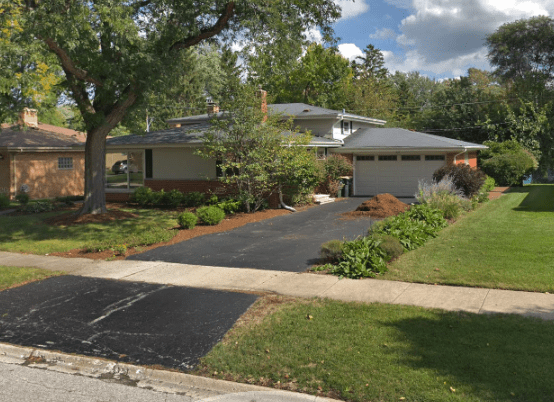
A Google Street View image of the home in question:
ArlingtonHeightsHome

This is a serious commitment to a fairly nondescript suburban single-family home. I would guess few suburbanites would make such an investment. At the same time, this does hint at possibilities for the many postwar suburban homes. Rather than being torn down for better homes, there might be relatively cost-effective ways to such homes operating as improved dwellings. (And this could apply to ranch homes as well as McMansions which are maligned early in this story.)

Does the green retrofitting of such homes help wipe out the more destructive aspects of suburban sprawl? Even if this house achieves LEED Platinum status, it is in a setting revolving around the car. The owners might have an electric or hybrid car – but driving is still required and making those vehicles is not all good for the environment. Would the reduced heating and energy costs be more efficient than living in a multifamily building? Do landscaping changes offset the changes subdivisions made to the landscape there beforehand?

I would be interested to see the possibilities of more LEED suburban homes, particularly if the costs are reasonable enough for homeowners to consider this as opposed to moving or tearing down the home. In the end, this would require more homeowners to think about keeping a home for a much longer scale and investing money in a way that might not lead to a huge return in their property values.
Suburban dream: have a McMansion 12 miles from Times Square

A profile of Hasbrouch Heights, New Jersey in the New York Times highlights the variety of housing styles available in close proximity to Manhattan:

A mile-and-a-half square atop a hill, Hasbrouck Heights is hardly the boondocks. Times Square is 12 miles east, and the Manhattan skyline is visible from some streets. On the northern end, Interstate 80 swipes past and Route 46 cuts through. Route 17, with office buildings, hotels and chain restaurants, runs down the town’s eastern edge, and Teterboro Airport is just on the other side.

Driving through Hasbrouck Heights on Route 17 offers little inkling of the residential community up the hill or beyond the cliff to the west. Bordered primarily by Hackensack and the boroughs of Lodi, Wood-Ridge and Teterboro, Hasbrouck Heights has an eclectic housing stock of Capes, Victorians, ranches, split-levels, boxy contemporaries, Tudors, McMansions and colonials of all stripes, many on 50-foot-wide lots. The architectural variety, spanning the late 1800s to the current decade, is evident on nearly every block.

“With the new construction, builders have done a good job adding style and character,” said Susan LeConte, the president and chief executive of LeConte Realty, in Hasbrouck Heights. “The homes are not cookie-cutter.”

Four quick thoughts:

  1. This kind of real estate profile, a staple in many newspapers, tend to be very positive about each community or neighborhood highlighted. This profile is no exception: it has the feeling of a small town (bikes can stay unlocked!), there is a little noise from a nearby airport but not too much, and residents can commute to New York City. If this is not an advertisement for the American Dream – single-family home in a quiet suburb not too far from the big city – then I do not know what is. (Thinking more about these profiles: it would be funny to follow them with the opposite perspective of each community.)
  2. The paragraph on different housing architecture is interesting in two ways. How would a suburban community end up with an “eclectic housing stock”? Perhaps development took place in fits and starts. Perhaps the community has a mix of housing needs (with McMansions sitting on the more expensive end). Perhaps the community is more open to different kinds of development.
  3. The second interesting part of the housing paragraph is that the mix of architectural styles only hints at two more modern styles: “boxy contemporaries” and McMansions. Neither descriptions are endearing. Boxy and sleek homes are not preferred by many. McMansions are often viewed as taking up too much space and having poor design. Does this hint that home styles have hit a dead end in recent decades? Would more buyers prefer an older, more established style that they can then update to fit their own needs?
  4. For all the density and glamour of Manhattan, there are plenty of McMansions in the New York City region (including famously in New Jersey and elsewhere).

A famous author mowing the lawn, giving purpose to caring for the suburban yard

As I raked most of the remaining leaves this weekend, I pondered again the task of taking care of the lawn. Should I continue to help uphold the class status of the neighborhood or let the leaves break down naturally and nourish the grass?

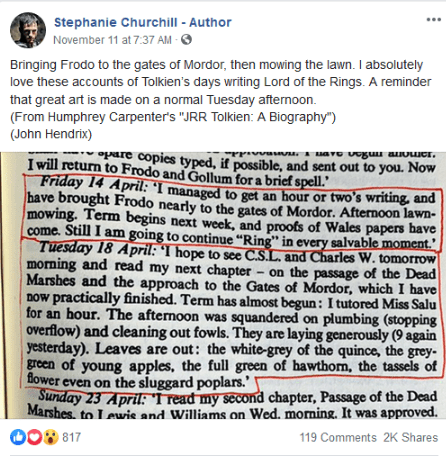
But, if a famous author also took the time to care for his lawn, perhaps so could I. From a recent Facebook post:

ChurchillTolkienMowingthelawn

Caring for a lawn (or garden or field or yard) may just be part of the human tendency to want to cultivate the land around us. Maybe the motivation matters here: if I am more interested in raking because of the property values, this is worse than wanting to get some fresh air and participate in the changing of seasons. Maybe the quotidian tasks give the brain and body a chance to to relax and recharge. Maybe the truly inspired parts of life often follow everyday tasks. Maybe only people who keep fairly regular journals can figure this stuff out (and notice how much Tolkien did not comment on).

All that said, I would guess the average American suburban homeowner would feel better about mowing the lawn or raking leaves or caring for their landscaping if they could connect it to a purpose larger than just wanting the lawn to keep up appearances.

Two criticisms of “The Death and Afterlife of the Mall”

I enjoyed watching “The Death and Afterlife of the Mall” from The Atlantic. In a little over five minutes, the video presents a short history of the shopping mall and its impact. The connection between malls and suburbs is hard to argue; few other institutions or settings better exemplify post-World War II suburban life.

At the same time, I had two quick critiques of the ideas in the video.

  1. The overarching narrative of the video suggests malls are part of a larger mistaken American project. Early in the video, James Fallows says, “After World War II, there was this misguided ideal of the suburban goal for American life with people moving away from cities.” Later in the video, I believe it Fallows saying, “The dream of modern life is not a mall-centric, car-centric dream anymore.” These are both contestable statements. As of today, a good portion of Americans still appear to like suburban life (or at least dislike the alternatives more). Perhaps we have reached peak suburbia but this does not necessarily mean the American Dream has significantly shifted to more urban or denser communities. Furthermore, the dream of suburban life has deeper roots than just the post-war era and will likely hold on for decades more.
  2. Are all malls dead? Many are in trouble. Yet, there are two big caveats to this. A number of malls are pursuing redevelopment projects ranging from adding restaurants to public facilities to residential units. Depending on the particular project, the mall footprint may still be prominent or the shopping element may never disappear even as the use of space changes. A second caveat is that shopping malls in wealthier areas may just survive and even thrive as rival malls close down. Americans still like to shop, they still drive a lot, and they occasionally like to venture into spaces where other people are there.


Going without a car in Tempe, Arizona

Is it possible to not own a car in Tempe? A new apartment project hopes the answer is yes:

The 1,000-person rental community, which broke ground this month in Tempe, won’t allow residents to park cars on site or in the surrounding area as a term of their leases. The founders say it will be the first of its kind in the U.S.

The neighborhood’s scale will be modest, with mostly three-story buildings. In place of parking spaces, the development known as Culdesac Tempe will feature significantly more retail and open spaces than are typical for its size. It will include a market hall for food vendors, coffee shop, plazas, communal fire pits and a building that residents can rent to host events.

The site is next to a light rail that connects residents to a grocery store, Arizona State University, downtown Phoenix and the airport. There will also be designated spots for ride-sharing and an on-site car-sharing service for residents traveling to other neighborhoods…

The Phoenix area might seem an unlikely spot for such an experiment, but Tempe is something of an outlier among its neighbors. The 190,000-person college town has a median age of less than 30 years old, and younger people are less interested in driving than they were in the past.

A suburban community in a sprawling region might not be the location I would first think of in embarking on this new idea. At the same time, the last paragraph cited above suggests Tempe is a unique place.

I wonder if a residential development would attract only certain kinds of residents and whether that is desirable in the long-run either for the developers or the community. The hint in the article is that this might especially appeal to younger adults. It might also appeal to older adults who want a car-free lifestyle, perhaps those who for environmental reasons do not like car ownership or those who cannot drive. There could be a market for such housing. Additionally, what kind of community or culture in the building might arise if many people come primarily because of not knowing a car? This could be interesting to explore down the road.

Going further, it would be worth knowing whether this is a viable concept in different kinds of places and different kinds of housing. It probably makes the most sense with denser housing (multi-unit apartment buildings) but could it work with rowhouses or townhomes built near a mass transit stop or hub?

The long-lasting consequences of the original conditions in Levittown

When subdivisions or communities are built, conditions at their starting point can have long-lasting effects. See Levittown.

Levittown was built on rules. No fences around the yards. Grass had to be maintained and trimmed. Clothes could only be hung to dry in the backyard on weekdays. Only white people could live there. Though these rules no longer apply, their mere existence has continued to shape and permeate the town’s culture today, particularly for Levittown’s teens, who speak about traditions and customs and the deep-rootedness of certain conservative mentalities…

Today, the museum features a model Levitt kitchen, bedroom, and living room from the 1950s and a sports memorabilia collection. Paul Manton, the president of the Levittown Historical Society and Museum, says the school kids learn about the farmland, Levitt’s mass-production techniques, and suburban expansion. When I ask about the whites-only restriction, he says, “We don’t talk too much about the deeds and restrictions because it’s a small part of Levittown, really.” His response parallels the one Kushner, the writer, heard at the museum. “Levitt was the largest real estate developer in the country, but each state you went to had those kinds of restrictions,” Manton continues. “Levitt himself was personally opposed to it. He was a progressive man. He would hire large numbers of black workers and he had a black sales manager.”…

The layouts were more or less uniform, which provides a familiar comfort still today. Things can get tricky if the design veers off course. “My front door opens to our living room in front of the stairs and I remember my friends getting lost and not knowing where anything was,” says Jacqueline Testamark, a senior at Division Avenue…

When Bill Griffith’s family moved to Levittown in 1952, it was “an old white world.” By the early ’60s, he started to feel suffocated and broke several Levittown molds. Most teens ride their bikes within the town limits. Griffith rode his to Walt Whitman’s birthplace an hour away. He didn’t learn one piece of Levittown history in school, he says. “I grew up in a time when we were being handed myths and legends. History was full of blank spaces or made-up stories.”

The character of a suburb can last for a long time, particularly if later decisions reinforce earlier conditions and choices. Some quick thoughts in reaction to the conditions in Levittown discussed above:

  1. The legacy of no blacks in the community is a long-lasting one. According to the Census, the Levittown CDP is less than 2% black (though the community is nearly 15% Latino).
  2. It would be hard to change either lot sizes or significantly increase the footprints of the original homes. And because Levittown was all roughly built at the same time, it does not offer the level of variation in housing stock that many suburbs might offer.
  3. In The Levittowners, sociologist Herbert Gans noted that teenagers are limited in Levittown and similar suburbs because so much driving is required and many of the social activities are geared around raising children in the home. This may still be the case in many suburbs as teenagers need rides and spaces friendly toward teenagers and young adults can be hard to find.

Going further, this article suggests continuity marks Levittown. Would it be possible to find signs of change or significant alterations from the original conditions? The Levittown of today could be more similar to the original Levittown but communities can follow significantly different paths given certain decisions and social forces.

Looking for stories of millennials and young adults who want to and enjoy living in suburban homes

The suburbs are indeed changing – such is the premise of Curbed‘s “The Suburbs Issue.” And the lead story seems to fit into this argument: the suburbs are changing in that millennials are not so sure about buying a large suburban home. Here is the conclusion from that story:

Scocca concludes that the dream of having a big house built just for you was “never a very good dream anyway,” and that might be true, and maybe it’s not even a revelation. Houses have always been a location where we can project our hopes, dreams, and fears. No matter how much we try to rationalize the process of owning a house, the relationship is always a bit foggy, tinted by human emotion. It doesn’t seem possible to live somewhere for any meaningful length of time without imbuing it with your own nebulous ego. Over the past few months, I kept returning to this quote from novelist Helen Oyeyemi: “I think that houses, or at least the home part of them, are so much constructed that they’re simultaneously magical and haunted anyway.” Houses are not homes, and homes are not necessarily houses. Perhaps the real American dream is to find a sense of stability, safety, and acceptance. Maybe this is a downsized version of our parents’ American dream, or perhaps it’s just more honest, taking into account all the different stories we’re fed from the outside, and all the private stories we tell ourselves behind closed doors.

There is much truth here: homeownership in the suburbs is not such an obvious path for many young Americans due to financial insecurity, watching what happened to older generations, and different priorities about what they want to get out of life. Just because Americans prioritized suburban homeownership in the last one hundred years (and propped it up through policies and cultural ideology) does not necessarily mean this will continue in the future.

At the same time, is an article like this in a long line of suburban critiques that now stretch back roughly a century? Some of the same concerns are present: what makes a home (the happy suburban facade or the difficulties many people still face even when it looks like they have the American Dream), whether the suburbs are financially possible (beyond just homes, driving is expensive and giving children all sorts of advantages is encouraged), environmental effects (using more land, driving, building individual homes), and a lack of excitement or vibrant community in the suburbs.

All of this leads me to wondering about the millennials who are still moving to suburbs by their choice. Surely they exist. Surveys suggest many millennials want to own a home in the suburbs at some point. The homeownership rate recently increased, driven by millennial’s purchases. The population of millennials in big cities recently declined. Empirical data could settle whether millennials are not settling in the suburbs at the same rate as previous generations or might be doing so at a delayed rate (which would fit with other findings regarding emerging adulthood).

Is finding these suburban millennials not a priority because it reinforces the suburban ideology? If millennials do largely settle in suburbs, would this be viewed as a failure of American society on multiple levels? Would settling in denser suburban areas be enough to make amends for decades of urban sprawl and “the ghastly tragedy of the suburbs“? Or, might slight changes among millennials be an acknowledgement that reversing long-standing narratives about the good life – the American Dream – could take decades (just as it took time to develop suburbia as the ideal on a mass scale)? What if, in the end, Americans like suburbs for multiple reasons?

Naperville gaining a reputation for racist incidents?

A recent controversy involving race at a Naperville Buffalo Wild Wings leads to considering evidence for and against the idea that Naperville has more racism than other suburbs:

The city, which census figures show is nearly three-quarters white, has also faced concerns about diversity and inclusion. After Naperville resident and state Rep. Anne Stava-Murray said the city had a legacy of white supremacist policies, the city convened a public Naperville Neighbors United discussion, where organizers said the city had work to do in areas like building minority representation among city leaders

Kevin Mumford, a University of Illinois professor who has studied race relations, said racism could be on an upswing in suburbs such as Naperville because of events in Chicago and nationally. African-Americans in high-profile positions in Chicago, such as the new mayor and leaders of the Chicago Teachers Union who were highly visible during the recent teachers strike, can cause “status anxiety” among white residents across income levels. That can be exacerbated by Trump supporters who feel a strong anti-Trump sentiment in Illinois, he said…

“I know about Naperville,” tweeted pop singer Richard Marx, who grew up in north suburban Highland Park. “And, disgusting as this is, it’s not terribly surprising.”…

Naperville has a problem with racism, but it’s no worse than in any neighboring suburb, Sullivan said. Instead, she suggested Naperville residents are more willing to confront it. Residents shared the video of the gas station confrontation and the essay from the former Naperville resident because they wanted to talk about them, she said.

The two sides presented in the article put it this way: is Naperville more racist than other suburban communities or does it just get more attention because of its status and the willingness of community members to talk about the issue? Figuring that out would require deeper knowledge of how race and ethnicity has played out in Naperville as well as insights into how race and ethnicity is treated across a variety of American suburbs, including suburbs similar in characteristics to Naperville.

No suburb wants this reputation, particularly one with lots of accolades, wealth, and a vibrant downtown. And Naperville leaders would likely point to some significant demographic changes in the community in recent decades plus efforts to encourage interaction between groups in the community as well as with local government. At the same time, communities can acquire a status or reputation through repeated events. Similarly, what leaders say is happening in a community does not always match day-to-day realities of what residents and visitors experience.

(UPDATE 11/6/19 at 10:48 AM: The character of suburban communities can change through different decisions and reactions to both internal and external social forces. In recent years, Naperville has become home to political protests, a change that would have been difficult to forecast for a traditionally conservative community.)

Suburban movements fight for and against selling marijuana in communities

Chicago area suburbs considering whether to allow marijuana sales within municipal boundaries have encountered efforts from residents on both sides of the issue:

An “Opt Out” movement that began in Naperville has spawned similar efforts in several other communities across the North, Northwest and West suburbs, pleading with city councils and village boards to ban the sales of adult-use marijuana within their boundaries…

An “Opt In” movement, though in some cases less overtly organized or connected, is present in many places, too, and just as passionate about its message that recreational marijuana stores should be allowed…

At the heart of the opt out effort, supporters say, is a desire to protect children from the potential harms of normalized marijuana use..

Supporters promote the value of potential tax revenue for municipal projects and point out marijuana use and possession will be legal no matter where the stores set up.

Three quick thoughts:

1. It sounds like the speed by which these efforts have coalesced across suburbs is partly attributable to social media. Through different platforms, it is relatively easy to promote a particular message and alert supporters about local meetings.

2. Pitting the safety of children versus potential revenue for suburbs pits important suburban values against each other. Arguably, the suburbs are all about kids: the whole structure is set up to help them get ahead, to do better than their parents, to have good educational opportunities within a safe and family-friendly environment. At the same time, budgets are tight in many suburbs and extra revenue could help provide all sorts of civic goods (including reducing the tax burdens of residents). Which argument wins out may depend on how the suburb sees itself.

3. It is hard to know at this point where the dispensaries might be located, with or without decisions made by individual communities. At first, Illinois will award 75 licenses. Given the population of the Chicago region plus the wealth present in numerous suburban communities, where will firms want to open shop? Is it as simple as going for the wealthiest customers within a certain radius of the store or are there other considerations of the best locations for marijuana dispensaries?

California’s biggest cities without blackouts, suburbs have them

A journalist looks into why California’s power blackouts have hit some suburbs but not the biggest cities:

The municipal utility that serves Los Angeles doesn’t shut off power during high winds. As the utility explained in a recent press release, the city’s miles of pavement, numerous fire stations and relatively limited open spaces help protect it from runaway fires. There’s also the chaos that could ensue from knocking out traffic lights in the capital of car culture.

L.A.’s approach, however, isn’t foolproof. The Getty fire that’s chased celebrities from their hillside homes started when a broken eucalyptus branch sailing on the wind hit a live power line owned by the city’s utility. The Los Angeles Department of Water and Power did not return a call Wednesday asking if it would reconsider its no-blackout policy as a result…

San Francisco, meanwhile, benefits from its famously odd climate. While the rest of California heats up and dries out during the summer, San Francisco shivers in a fog bank so much a part of city life that residents have given it a name (Karl). The fog typically vanishes by October, but even then, the city never gets as dry as most of its suburbs. And the dangerous Diablo winds striking this month rarely hit the city as hard as its hilly suburbs.

As a result, San Francisco isn’t included on the state’s official map of high fire threat areas. So PG&E Corp. doesn’t cut its power when winds rise, said utility spokeswoman Ari Vanrenen. That’s not to say the city couldn’t someday lose electricity if PG&E takes down a transmission line that feeds it.

These reasons make some sense. Denser urban areas are less likely to have large areas of foliage and nature in addition to exposed power lines through which fires can easily spread.

At the same time, it might be difficult to make a case when many people in the state are affected by the blackouts and others are not “sharing the burden.” Do such choices provide economic benefits to certain areas while others are hurt?

The case of Los Angeles could get pretty interesting in this regard in that there are some more natural areas surrounding the city and separating communities. The Getty fire above is a good example; the museum and the surrounding homes sit on less dense land on hillsides overlooking the city. Could a fire break out there and then end up on either side of the hills/mountains and spread to urban and suburban land?