Best sociological finding I heard at ASA 2019

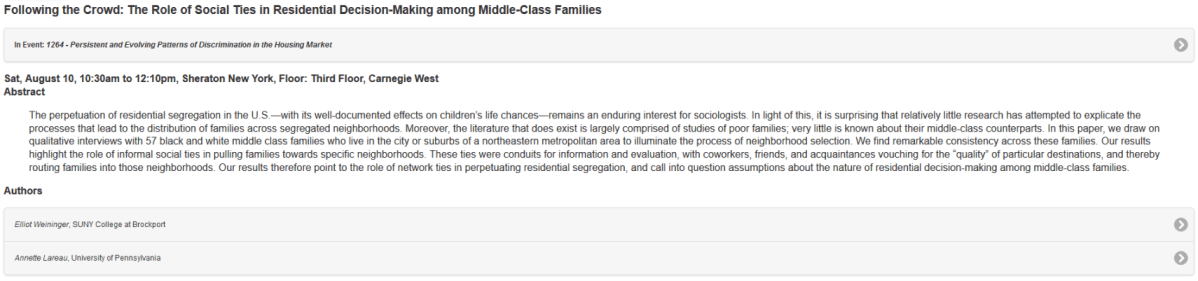
Not surprisingly, the most interesting sociological finding I heard at the annual ASA meetings this past weekend involved research into suburban life. More specifically, Weininger and Lareau looked at how middle-class parents choose where to live:

ASAsession19

As they explained in their presentation, we might imagine these relatively educated and well-off families would look at all sorts of data regarding neighborhoods, compare their relative merits, and then choose one. Instead, they found these families would rely on limited vouching for particular locations from ties in their social networks – sometimes fairly weak ties – and then make decisions based on that. This could even occasionally lead to mistakes.

I look forward to hearing more about how this all works and what this leads to. There is interesting material to consider here including:

-What if there are conflicting network recommendations (either different preferred locations or different opinions on the same location)?

-How does the process change when the respondents do or do not have much local knowledge of the communities they are considering?

-Does this effect hold for middle-class residents of different racial and ethnic groups?

-Can networks help people move into more hetereogeneous locations or do they primarily help reinforce homogeneity?

Analysis suggesting suburban women could decide 2020 election

The suburbs continue to be a key geographic battleground in national politics. Analysts suggest suburban women may decide the 2020 presidential election:

Many professional, suburban women — a critical voting bloc in the 2020 election — recoil at the abrasive, divisive rhetoric, exposing the president to a potential wave of opposition in key battlegrounds across the country.

In more than three dozen interviews by The Associated Press with women in critical suburbs, nearly all expressed dismay — or worse — at Trump’s racially polarizing insults and what was often described as unpresidential treatment of people. Even some who gave Trump credit for the economy or backed his crackdown on immigration acknowledged they were troubled or uncomfortable lining up behind the president.

The interviews in suburbs outside Philadelphia, Milwaukee, Detroit and Denver are a warning light for the Republican president’s reelection campaign. Trump did not win a majority of female voters in 2016, but he won enough — notably winning white women by a roughly 10 percentage-point margin, according to the American National Election Studies survey — to help him eke out victories across the Rust Belt and take the White House…

The affluent, largely white and politically divided suburbs across the Rust Belt are widely viewed as a top battleground, the places where Trump needs to hold his voters and Democrats are hoping to improve their showing over 2016.

If large numbers of suburban women are turned off by the action and rhetoric of the current president, it will then be interesting to see if his opponents craft messages to specifically target these same voters. If parties and candidates generally think they know what urban and rural voters want to hear, how will they adjust to suburbanites who are living in fairly complex and varied settings?

For example, the concerns of residents in more affluent suburbs may not match that well with larger political and cultural issues parties and candidates want to address. What if these voters are more akin to “dream hoarders” who want to secure their own positions more than they care about larger issues?

Henderson, NV: do not go all in with public money for a baseball stadium

The large Las Vegas suburb of Henderson is interested in acquiring a major league baseball team and willing to use a lot of taxpayer dollars to do it:

Renderings show a retractable-roof baseball stadium near St. Rose Parkway and Bermuda Road in rapidly growing west Henderson, which city officials envision as a hub for sports and entertainment. The proposed site, one of four floated by the city, sits behind the future headquarters and practice facility of the NFL’s Raiders.

According to the presentation, Henderson hired a consultant to conduct a financial analysis, assuming the ballpark would have 32,000 seats and space for 4,000 standing-room-only ticket holders. The Diamondbacks would serve as the primary tenant for a 30-year term and the stadium would be publicly owned and exempt from property tax.

The consultant estimated the ballpark would cost about $1 billion to construct…

The Diamondbacks expressed interest in creating a development at a potential new home, pointing to the entertainment district near the Atlanta Braves’ SunTrust Park as inspiration, according to documents that detailed the team’s wish list for prospective suitors.

The city said it ultimately views itself as capable of drawing major sports franchises because of a business-friendly approach, attractive demographics, socioeconomic characteristics and available land.

It sounds like the suburb of over 300,000 residents sees at least three benefits of such a move:

1. It would boost the status of the suburb. Few suburbs could boast of a collection like this with an MLB team, an NFL practice facility, and an ice rink connected to an NHL team. This could then help attract businesses and residents.

2. The potential for development around a major league stadium. Imagine restaurants, retailers, and residences near the stadium.

3. Becoming a unique location with a growing metropolitan region. As suburbs compete for corporate headquarters, residents, retailers, and entertainment centers, a stadium would stand out. It is easy for critics to stereotypes as collections of subdivisions and strip malls but Henderson would have a different collection of sites.

Yet, the research is clear: sports stadiums enrich sports teams, not communities. Suburbs that have tried this tend to run into problems (see recent examples of Glendale, Arizona and Bridgeview, Illinois). Teams will use cities and suburbs against each other to get better deals – just as big companies like Amazon do – and also leave those places behind if they can get better deals.

So before Henderson throws up to a billion dollars at a major league team, they should think twice. Can the suburb handle that amount of debt if it does not work out? Could that money be spent elsewhere on development and/or amenities that would benefit a broader swath of their residents? Is being a high-status suburb more important than being a quality place to live?

Rethink Rezoning, Save Main responses share similar concerns – Part Two

Yesterday, I summarized the redevelopment plans for the East Roosevelt Road Corridor in Wheaton and the Giesche Shoe project in Glen Ellyn. Based on online sources, I will summarize the concerns of residents. There is a common theme: they perceive the character of the community is at stake.

In Wheaton, here are some of the stated concerns:

“We are a residential city, and our city planning should reflect that,” she said. “A forward-thinking city understands that pedestrian-friendly sidewalks and bike lanes are what attract new homebuyers, keep residents, increases equity for current homeowners and subsequently increases city revenue based on increased home value and an increased tax base.”

Nancy Flannery, the chairwoman of the city’s historic preservation commission, worries about the possible demolition of another Jarvis Hunt-designed house, now converted into offices at 534 Roosevelt. Built in 1896, the house was one of the first summer cottages constructed for members of the private Chicago Golf Club.

And a few more representative comments from the same May 28, 2019 meeting:

expressed concern that the proposed changes would build up retail, contribute to congestion and be detrimental to neighboring residents. He stated there are already vacancies and the report is not clear on what types of businesses would be interested in Roosevelt Road…

stated he thinks the plan as presented harms the neighborhood in terms of traffic, safety, noise, light and visual aesthetics, and he doesn’t think there is a problem on Roosevelt Road that needs fixing…

stated she does not want developers to be able to build commercial businesses on lots behind Roosevelt Road. She stated she does not want to see 4- or 5-story buildings being constructed right near residential areas.

In Glen Ellyn, some representative comments from an online petition:

Local congestion, size out of proportion (too large and bulky), traffic pattern near local churches & private school, etc…

It’s going to ruin the quant village that we choose to live in. We want to live in a village not a city with large structures – we would have chosen to live in Wheaton Or Naperville ( village is the key word – we are not a city Or town. We are the Village of Glen ellyn )…

a number of villages used to have charms that brought shoppers and new residents (e.g. elmhurst, arlington heights, mt prospect). their boards allowed developers to build in violation of existing codes and these charms were lost. don’t let that happen here…

My husband and I moved here because the town was still lovely, quiet, and mostly unmarred by the huge, unsightly, commercial behemoths scarring most of the surrounding suburbs. Glen Ellyn still has charm and an organic feeling of development. This development does not fit in at all with the feeling and aesthetic of the town. Say no!

In both cases, the concerns residents voiced are consistent across hundreds of development and redevelopment projects in suburbs across the United States. Having studied this in multiple ways (several of my projects address similar issues including “Not All Suburbs are the Same” and “‘Would Prefer a Trailer Park to a Large [Religious] Structure’“, residents generally bring up the same concerns: increased traffic, lights, and noise; a change in scale (particularly when it comes to height); and threats to residences (usually single-family homes) and the character of a suburb.

In Wheaton, the character issue is not stated as clearly but it is present. This major road is one of the primary ways people see the suburb. How should it look compared to the stretch of Roosevelt on Glen Ellyn which is more like the strip mall approach and Winfield to the west which is more green and residential (and not coincidentally they are fought their own battles over taking advantage of possible business opportunities on such a busy road)? This is not just about a busy roadway or the homes that back up to this stretch; this is about signalling what kind of place Wheaton is. One that values businesses or homeowners, one that prioritizes vehicles or pedestrians, one that celebrates its history or is looking to simply make money?

Interestingly, Wheaton comes up in the Glen Ellyn comments as a place that some Glen Ellyn residents do not want to become. Since the late 1990s, Wheaton has pursued downtown condos and office buildings. Other suburbs come up in the comments including more lively downtowns like Naperville and Arlington Heights. These Glen Ellyn residents have some similar concerns that most redevelopment projects engender – traffic, noise – but this particular project seems to be a step too big for their downtown. Can five stories “fit” with the existing downtown? This is not just about seeing the building from a distance: it is about a sense of scale for pedestrians, how the building might tower over nearby businesses and residences, and what this portends for the future of the downtown. Let this big development in and Glen Ellyn will become just another suburban downtown chasing after tall buildings and money to the detriment of residents who liked to feel they live in a small town.

Perhaps the big question here is this: are these concerns from residents valid? Are these just NIMBY responses? Who should control what kind of development occurs in a suburban community? Americans like suburbs in part because they feel like they have access to local leaders and can influence local decisions. From my own research on suburban communities, I am fairly convinced there are some suburban residents who move into a neighborhood and community and desire to freeze the place in that exact configuration. Indeed, they moved to the suburb for particular reasons. On the other hand, cities and suburbs are encouraged to grow (stagnation or population loss is failure) and development or redevelopment opportunities do not always come along easily or in forms that local officials or residents will like. If these communities do not act now, will they lose economic opportunities to other suburbs and in the long run shoot themselves in the foot by not upgrading when they can?

If local residents are vocal enough, they can likely slow down or nix these redevelopment projects. How many residents have to voice displeasure is not clear; few suburbanites are invested in local politics even if they count on the opportunities to voice this displeasure to protect their own investments. Local officials do listen and will encounter difficulty down the road if they just ram through projects.

Here is what I suspect will happen in the long-term in these two cases (and in suburban disagreements over development and redevelopment generally): few communities are so anti-development that they keep out all changes. Suburbs generally hope to keep growing and this becomes more difficult in more mature suburbs like these two which cannot add new subdivisions. There are only so many ways Wheaton and Glen Ellyn can add businesses and residents. If these changes do not happen now, they will probably happen eventually as the opportunity costs are too steep: local leaders will have a hard time turning down these chances when the possible consequences are lost money, vacant properties, and eyesores. Some local residents will dislike the changes and some might move away. But, the very conception of suburbs may be evolving as well: outside of moving to exurban areas, many suburbs are pursuing more density and vibrant downtowns. This may make suburbs all the more complex in how they are understood and experienced and in how residents think of their community’s character.

 

Rethink Rezoning, Save Main responses share similar concerns – Part One

The suburb in which I live and the neighboring suburb both have proposed redevelopment ideas and each has attracted opposition from residents. Both sets of opposition have yard signs to voice their displeasure and residents have spoken at public meetings.

Part One of this analysis involves the basics of the proposed projects and how this fits into what suburbs generally try to do.

The Rethink Rezoning group is responding to a study commissioned by the city of Wheaton to improve development along the busy Roosevelt Road corridor that runs east-west through the center of the suburb. From the Daily Herald:

Wheaton’s East Roosevelt Road corridor has a hodgepodge of businesses and housing, obsolete office space and no consistent sidewalk network that encourages pedestrians to walk from one end of the nearly 2-mile stretch to the other…

Consultants propose a “Horizontal Mixed-Use Zone” from Carlton Avenue to West Street/Warrenville Road, currently a mix of low-intensity offices, houses and residential structures adapted into offices. In that subdistrict, the city should expand the palette of permitted land uses, including limited retail and “personal service establishments,” the report states.

Farther east, a “Commercial Core Zone” between West and President streets could concentrate new development of significant size — greater than anywhere else along the corridor — taking advantaging of proximity to the downtown and the Mariano’s grocery store. The Mariano’s intersection has traffic congestion when cars queuing up in the west turn-lane from Naperville Road to Roosevelt.

A “Mixed-Use Flexible Zone” from President to Lorraine Road “should encourage a broad range of uses, including retail, service, office and multifamily residential,” according to the report.

See a more complete draft report from earlier this year.

The Save Main group is opposed to a mixed-use five-story building to be built on the southern edge of Glen Ellyn’s downtown. Here is a 2018 description from the Daily Herald:

A new redevelopment plan for an old shoe store in downtown Glen Ellyn would replace the long-vacant building with an apartment complex that would rise above neighboring restaurants and shops…

Larry Debb and John Kosich are the two principals for the project that would demolish the Giesche store to make room for a five-story apartment building with about 5,360 square feet of first-floor commercial space. The footprint would include what is now the village-owned Main Street parking lot…

But in a letter to village planners, Kosich and Debb said they’re proposing a “condo quality” building with 107 rental units. A two-level parking garage would provide 147 public parking stalls on the first floor, with access off Main Street, Hillside Avenue and Glenwood Avenue. The garage’s second floor — reserved for apartment residents — would contain 142 stalls…

Such a mixed-use development with parking would align with the village’s 2001 comprehensive plan and 2009 downtown strategic plan, Hulseberg said. The latter recommends the village add at least 450 new residential units downtown.

Neither of these projects are unusual for suburban communities. Indeed, they both attempt to take advantage of unique traits already in the suburb.

In Wheaton, the Roosevelt Road corridor has been an area of interest for the city for decades. With tens of thousands of cars passing through each day, it presents an opportunity, particularly since it is just south of the downtown (and traffic does not necessarily turn off Roosevelt to go downtown) and north of the other major shopping area at Danada (along the busy Butterfield Road corridor). But, Wheaton has generally been conservative about what development they allow along this stretch. Compared to Glen Ellyn to the east or the Ogden Avenue corridor in northwest Naperville, the Roosevelt Road stretch in Wheaton is relatively void of strip malls, fast food restaurants, car repair places, and rundown facilities. Again: this has been an intentional effort to maintain a certain level of quality.

The proposed changes would build on this by updating some uses (most suburbs utilize single-use zoning but this can be restrictive in certain areas) and try to encourage some cohesiveness across stretches. What is now a hodgepodge of offices, some older houses, some more recent office buildings, could have a more uniform character and present a more pleasing aesthetic. I don’t know how many people will walk along such a busy road but it certainly does not lend itself to that now. All of this could help improve aesthetics and bring in more revenue from taxes in a revitalized district. Having a more uniform plan could help bring in more money for the city which then helps relieve local tax burdens.

In Glen Ellyn, such a project both fits with the village’s own goals and echoes what numerous suburbs in the Chicago region have tried to do: encourage mixed-use buildings in downtown areas near train stations and existing restaurants and shops. This new project would add to a fairly lively restaurant and retail scene while also adding more residents (and probably wealthier ones – this is not about suburban “affordable housing”) to a suburb that has little greenfield or infill development available. The new residents would patronize local businesses, utilize the train, and contribute to a density that could make the downtown even livelier. Again, one of the benefits would be increased tax revenues: the vacant property would have a more profitable use, the first-floor businesses would add sales tax monies, and the new residents who probably have limited numbers of children would bring in tax dollars.

If these projects are in line with suburban plans – let alone the long-term plans for each community – what are the residents objecting to? More on that in Part Two tomorrow.

Suburbs do not want to sully their character by allowing marijuana sales

Selling marijuana may soon be legal in Illinois but this does not mean suburbs necessarily want to be places where this happens:

Naperville, Lake Barrington and Bloomingdale plan to officially ban sales, Libertyville leans toward the same and the mayor of Batavia said he will issue a veto if necessary.

Des Plaines officials have expressed concerns and are doing more research before deciding, which also will happen in Lincolnshire and Bartlett.

To date, only South Elgin and Elburn said they are OK with allowing one marijuana retail store…

Municipalities can choose to not allow marijuana stores within their boundaries, or can enact “reasonable” zoning ordinances and regulate how many and where they are located. That can include minimum distances from “sensitive” locations such as colleges and universities, the law states.

Imagine a suburban landscape starting in January where marijuana is primarily sold in communities that are not as wealthy and/or white. Does this lessen their reputation and bolster the status of communities that do not allow sales?

It will be interesting to see if the communities that are now saying no continue to hold out against marijuana retailers in order to preserve a particular character. The carrot being offered is extra sales tax revenue that municipalities can collect. A wealthier suburb might see adjacent communities benefiting from extra funds and decide they want a cut of it. Or, perhaps they do not see that other suburbs are viewed negatively because they allow marijuana sales so they decide to jump in.

Imagining suburbs completely covered by security cameras from single-family homes

After a story from Kane County, Illinois about the extra work for prosecutors in going through video evidence from video doorbells, this got me thinking about surveillance in the suburbs. Imagine in the next few years the typical suburban neighborhood is covered by homeowner surveillance cameras of one kind or another: video doorbells plus consistently-running or motion-detection cameras mounted on the inside and outside of homes.

Traditionally, suburban areas have been more fond of privacy with the emphasis on single-family homes, interactions with neighbors by choice, and a willingness to fight local initiatives if they threaten said property and home. Big cities have long been home to more surveillance ranging from Jane Jacobs’ famous line about “eyes on the street” to the rise of CCTV in London.

What exactly is the cause of all of this? A few factors may be at work:

  1. The ease and low cost of the technology. Why have a regular doorbell when a video doorbell does not cost that much? (And the Internet suggests some people have fears of answering the door.)
  2. Fear of crime, even in relatively low crime suburban areas and after violent crime has dropped in the United States.
  3. A belief that video evidence is much more conclusive evidence compared to other types.
  4. A want to monitor/protect one’s single-family home at all times.

But, if every square inch of suburban street and sidewalk (plus a lot of yards) are covered by cameras, is something lost? Is there more trust that can disappear between neighbors? Is it truly all suburbanites for themselves even as at least some of them are fairly financially, socially, and educationally secure?

If suburban neighborhoods are increasingly under video surveillance, I wonder if this might change some decisions about where people live. Could this push people to more rural areas or perhaps to communities that more tightly control entries and exits (think gated communities with a real presence all around the perimeter? Or, would the extra surveillance encourage people to live in certain suburbs? Perhaps the decades-old neighborhood watches will be replaced by an unblinking eye on every house.

Responding to “white suburbanites are exposed to more racial diversity than ever before”

One researcher explores the increasing racial and ethnic diversity of suburbia:

The scale of these national changes is too great to leave suburbs unaffected. As a consequence, white suburbanites are exposed to more racial diversity than ever before, a process that compounds annually. In 1980, a majority of white suburban residents lived in areas greater than 95 percent white, according to my analysis of the Census data. Only about one in six lived in a neighborhood where people of color made up at least 20 percent of the population. Fast-forward to today, and the numbers flip: Fewer than one in 10 white suburban residents lives in a neighborhood greater than 95 percent white, while more than half can be found somewhere that’s more than 20 percent nonwhite. Suburbs are now home to most black Americans and Hispanic Americans.

Nonwhite residents skew younger, which means diversity is increasing in schools even faster than in cities and neighborhoods. As that happens, the racial isolation of white children has been broken in spectacular fashion. In 1988, the earliest year with digitized federal data, more than half of white children nationwide attended a school that was more than 90 percent white. In 2016–2017, the most recent school year with data, that share dropped to less than one-fifth. In public districts today, more than three-fifths of white children attend a diverse school where at least 20 percent of the student population was not white; in major metros, nine-tenths of white children do.

Lest the point get lost in a swarm of statistics, these figures represent an inversion of America’s historic racial geography. As recently as a few decades ago, almost all white people in America lived their lives in places where racial diversity was minimal or nonexistent. This is simply no longer true. In neighborhoods and, especially, schools, moderate diversity is now the norm for most white Americans. The America where busing failed was a place where islands of urban diversity drifted in an ocean of suburban whiteness. Today, the metaphor must be reversed: An archipelago of white enclaves is embedded in a sea of growing racial diversity.

And since this discussion is in the context of debates about schools and busing, the author suggests this change in diversity has implications:

By every available demographic metric, those white suburbs are losing ground in 21st-century America. The problem of segregated schools, as urgent and familiar as ever, is embedded in a deeply unfamiliar context. School integration in 2019 means moving children across racial boundaries that are already looking ragged. The communities it risks outraging have ever-shrinking political clout. People should consider whether they have overlearned the lessons of history—whether the antibusing consensus is more robust than the conditions that created it. Integrated schools are more achievable than the political system believes. The missing ingredient for desegregation may just be elected officials with the courage to stop fearing America as it was, and start leading America as it is.

The article takes a pretty optimistic view of racial change in communities. Indeed, residential segregation has decreased in recent years with more minorities living in suburbs and increased immigration.

I wonder if the same data could be interpreted differently:

1. The cutoffs for diversity cited above are low bars. More than 20% non-white is not that much diversity.

2. The article does not discuss social class and its interaction with race and class. What kind of diversity are white suburbanites interacting with in terms of class and race together?

3. The emphasis here is on the public school system as well as communities though there are plenty of white students (as well as other students) in different schooling environments and social ties and networks can operate through many institutions. Diversity by community or neighborhood may not translate into diversity in a school setting or in local government or houses of worship or friendship networks.

4. What is the end goal of such efforts? Is “moderate diversity is now the norm for most white Americans” enough or even be used a way to limit further diversity? Is representation in public schools enough or is the goal similar academic achievement or access to political power or homeownership rates or wealth (all areas with disparity)?

Waiting to hear Chicago suburb advertising lower property tax rates

In recent years, multiple Chicago suburbs have advertised for businesses and residents to move there including Elk Grove Village, Bedford Park, New Lennox, and Lemont. Their pitch often includes mention of the suburb’s transportation advantages, amenities (ranging from water supply to community atmosphere), and available land.

Here is one local feature that is missing from these advertisements: lower property taxes compared to other suburbs or Chicago. This would be a competitive edge in a region where residents and businesses face relatively high property tax rates.

There have to be communities that actually do have lower property taxes. There are a number of suburbs that have higher concentrations of commercial and industrial businesses that provide a good tax base. Industrial parks and office parks provide space for businesses and offices. Many suburbs would want this: the companies help carry more of the local tax burden and this provides extra revenue for the community. In comparison, a bedroom suburb may have really high property taxes because it is primarily residents paying the property taxes and there are limited sales tax revenues.

If the advertisements for suburbs are primarily aimed at businesses and not residents, then perhaps the property tax arguments make less sense. At the same time, a strong existing business base could be very appealing for other firms. Some proof that other businesses have thrived in a suburb plus some opportunities for local synergy in addition to lower taxes could all be very appealing.

In the super competitive race between the Chicago suburbs and the city plus competition from other nearby states like Indiana and Wisconsin (let alone Texas and Florida) for businesses and residents, I am surprised to not hear a property tax appeal. Perhaps this simply means that few Chicago area communities could offer any real advantages in this area. Or, maybe there is some reluctance to tout lower property tax rates. Yet, as suburbs compete, I would expect that their mass appeals will continue to evolve.

The sidewalk problems for walking and biking in the suburbs

Using suburban sidewalks is not easy for a variety of reasons. Here is a short list of the problems:

  1. Sidewalks with too many or too big of cracks and/or dips. This is less of an issue for walking but can range from annoying to tire-popping for bicycles.
  2. A lack of curb cuts or good ones in going between sidewalks and roads. It is can be enough work to watch out for vehicles at intersections but then many of the transitions between sidewalks and streets are poor.
  3. A lack of shade on sidewalks. This is particularly pronounced in newer developments where there is a lack of trees near the street or in places where diseases have limited trees.
  4. Too much vegetation along sidewalks so that users of the sidewalk have to dodge low branches or overgrown bushes. This is inconvenient for single users and could be really difficult when people are passing each other.
  5. No sidewalks at all. While this is a pronounced issue in more rural locations or unincorporated areas where sidewalks were never built, it can also pop up in weird in-city locations where a sidewalk will simply end, forcing a user to cross over to the over side or use the street.

All of these issues could reduce sidewalk use in a country where bicycling and walking is already dangerous and more people would benefit from moving around. The lack of sidewalk users might contribute to the poor conditions listed above and more local advocacy could help reverse these conditions.