Suburban voters were split in 2022

As the data trickles out from the midterm elections, here is one summary about how suburbanites voted:

Photo by Anna Shvets on Pexels.com

In 2018, independents went for Democrats 54 percent to 42 percent. Moderates broke for Democrats by a 26-point margin, and the suburbs split. In 2020, according to the national exit poll, independents went for Democrats 54 percent to 41 percent, moderates broke for Democrats by a 30-point margin, and Democrats won the suburbs 50 to 48 percent. Fox had similar results.

This year, independents went for Democrats narrowly. Moderates broke for Democrats by 15 points. And the suburbs narrowly went for Republicans in the national exit poll, while narrowly going for Democrats in the Fox voter analysis. Our national stalemate continued.

In the current state of national politics, both parties want the suburbs to break their way. It appears suburbanites were fairly split this year, meaning that not a whole lot changed. Will either party have a platform or message in 2024 that is more appealing to suburbanites than the other side?

Seeing these results also got me thinking about redistricting, gerrymandering, and how suburban areas are incorporated in districts. Given their volatility and patterns (suburbs closer to big cities lean one way, those on the metropolitan edges lean another way), do party leaders want to consolidate suburban votes or break them up? I would be very interested to see an analysis on this.

UPDATE: In at least one metropolitan region, Democrats continued to make inroads in the suburbs. Referring to DuPage County and the Chicago region as a whole:

The once-impenetrable GOP stronghold was considered purple territory in recent election cycles. But in a watershed moment, Democrats captured the county board chair seat and appeared to hold onto their board majority Tuesday.

The shift in DuPage is part of a political evolution in suburban areas. Four years after Democrats made significant gains in the region, several of the collar counties turned a darker shade of blue on Tuesday.

Democrats flipped key state House districts in the Northwest suburbs. They solidified control of the Lake County Board. The GOP has no representation in Congress from northeastern Illinois. And in DuPage, Democratic state Rep. Deb Conroy became the first woman elected county board chair.

As noted in the article, this is a significant change over the course of several decades.

Do not call it a shopping mall; call it a campus

With the opening of several hundreds units of housing on a former portion of the Fox Valley Mall, one leader used a different term than “mall” to describe what was unfolding on-site:

Photo by Armin Rimoldi on Pexels.com

While the mall has been around since 1975, Samson said he even has stopped calling the burgeoning “live, work, play” development by that name.

“Notice how I didn’t say mall,” Samson said. “It’s a campus.”

A shopping mall is primarily about commercial activity. A campus implies something different. Probably the most common usage of the term refers to college campuses. On such a campus, there is a variety of activity: residential spaces, social spaces, academic spaces, athletic spaces, and more.

Many shopping malls are hoping for transformations that help them move beyond just stores and a few eateries. The shopping malls that survive the next decade or two could include apartments, condos, townhouses, hotels, restaurants, entertainment venues, and cultural attractions in addition to stores. All of these options would help make the mall/campus more lively throughout the full day rather than just during shopping hours. In this sense, the goal is not that different than numerous mixed-use developments in suburbs and cities: create a home base of residents plus a steady flow of visitors who spend money and contribute to social activity.

Will the term campus catch on to describe former shopping malls? Time will tell and certain influential actors, such as developers, architects, and local leaders, can help make it happen.

I received no shortage of political mailers this year and the only thing they may have helped with was name recognition

Our home mailbox has been filled for weeks with mailers for candidates at the national, state, and local level. What have I learned from all of these mailers? Very little.

Photo by Abstrakt Xxcellence Studios on Pexels.com

However, the one use they may have is for candidates’ names to catch my attention. I consider myself a fairly informed voter yet I cannot keep up with all of the local races. In a state with so many taxing bodies, there are numerous races for the Forest Preserve, County Board, municipal positions, and more. Who has the time to look at all of the positions of those candidates? I will enter the voting booth today with limited knowledge about dozens of names for positions that the average suburbanite has little knowledge about.

Thus, a mailer might catch my eye with a name in a way that another medium might not. All those texts from candidates in recent weeks? Most were automatically marked as spam by my phone and the others I did not look at. Political ads on television or radio? Easy to avoid by switching stations or using streaming services. News broadcasts about candidates? Can click past or avoid reading.

At the least, I took each of those mailers out of the mailbox, looked at them quickly, and then recycled them. Could they have planted a name or idea in my head? Perhaps.

More Americans now living in mixed neighborhoods, especially in suburbs

Data from the 2020 Census shows that more Americans live in neighborhoods where no one racial or ethnic group is more than 80% of the population:

Photo by Almada Studio on Pexels.com

Back in 1990, 78 percent of White people lived in predominantly White neighborhoods, where at least 4 of every 5 people were also White. In the 2020 Census, that’s plunged to 44 percent.

Large pockets of segregation remain, but as America’s White population shrinks for the first time and Hispanic, Asian, Black and Native Americans fuel the nation’s growth, diverse neighborhoods have expanded from urban cores into suburbs that once were colored by a steady stream of White flight from inner cities…

More broadly, a new majority of all Americans, 56 percent, now live in mixed neighborhoods where neither White people nor non-Whites predominate – double the figure that lived in mixed neighborhoods in 1990, according to a Washington Post analysis of census data. By racial group, 56 percent of White Americans live in mixed neighborhoods, as do 55 percent of Hispanic Americans, 57 percent of Black people and 70 percent of Asian people…

Racially mixed neighborhoods continue to be less common in small towns and rural areas, and are increasing the most in the suburbs. Across large metro suburbs and medium metros, the share of people in racially mixed neighborhoods jumped by double digits over the past decade to 59 percent.

This is part of the emergence of complex suburbia where racial and ethnic populations have changed in recent decades. There still are predominantly-white neighborhoods but there are also more neighborhoods with different mixes of residents.

If people are now more likely to live near people of different racial and ethnic groups, what might this lead to? The analysis mentions backlash toward immigration. Could it also lead to positive change? How exactly is life playing out in different kinds of neighborhoods? How much does social class and the particular character and histories of a place shape outcomes in addition to these racial and ethnic changes?

Bringing large cities to the Metaverse

Meta may not have done well in this past week’s news cycle but at least one global city is headed to the Metaverse:

Photo by Bradley Hook on Pexels.com

This month, Seoul plans to launch the first stage of Metaverse Seoul, an ambitious five-year plan to code a digital re-creation of the South Korean capital. When it’s finished, residents will be able to explore historical sites, tour museums, attend virtual events, and even stop by City Hall to hack away at red tape without leaving their couches. Given Governor Jared Polis’ love of all things high-tech—including collecting state taxes in cryptocurrencies—it’s only a matter of time until Colorado follows suit, starting with our own capital city. Which is why we came up with some of Metaverse Denver’s most important points of interest.

There are a lot of possibilities here in addition to what Seoul is pursuing. Should a city aim for a brick for brick recreation? A hint or flavor of the offline city? A new kind of experience? An online site meant for tourists and/or those considering relocating? A place to try out new ideas? A gathering place for current residents?

One quick reminder as cities and communities consider this: the online and offline realms are not separate. What ends up in the Metaverse at the behest of cities will be connected to the offline city and vice versa.

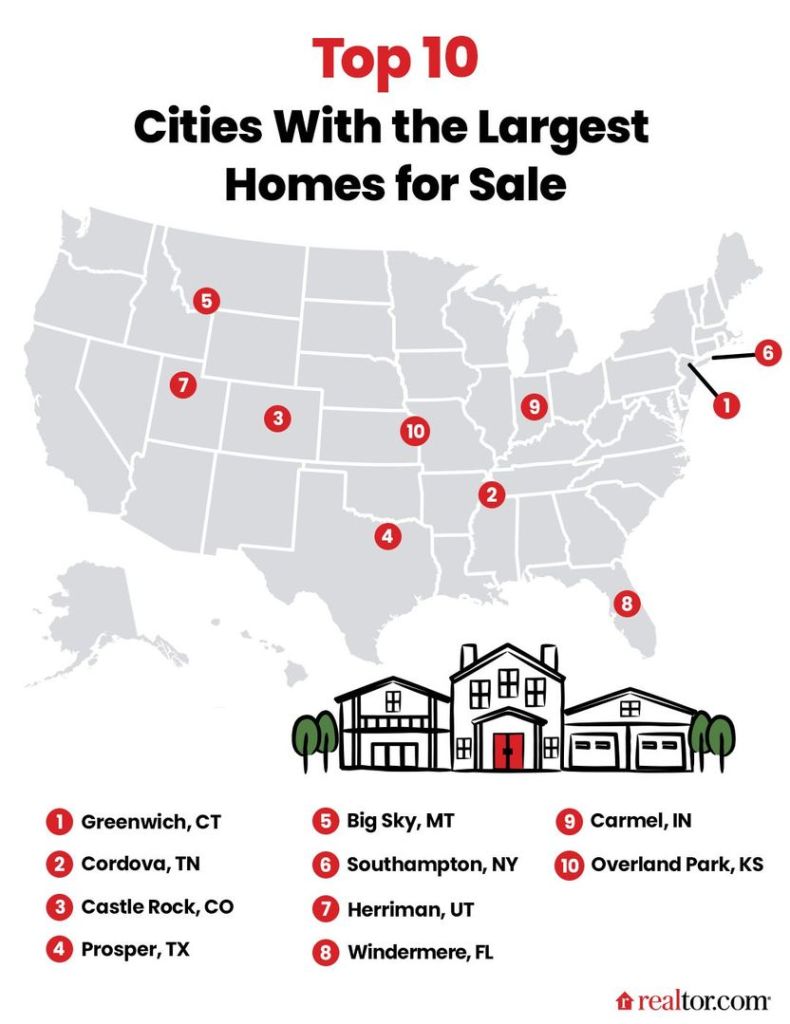
“Top 10 Cities with the Largest Homes for Sale”

Analysis of available properties at Realtor.com leads to this:

Why these places and not others?

“The places that boast the country’s largest average homes tend to be clustered in higher-priced communities either near bigger economic centers or in outdoors destinations,” says George Ratiu, senior economist and manager of economic research for Realtor.com. “On the flip side of the coin, cities [with] average home sizes [that] skew toward the smaller end are located in geographically constrained locations, where natural boundaries meet high-density development.”

But that’s not all that goes into the equation. Many older communities, such as in the Northeast, that were developed for blue-collar workers tend to be filled with smaller homes. Meanwhile, newer developments geared toward white-collar commuters often offer abodes with more square footage and amenities like open kitchens, which were not popular in the 1950s. You’re more likely to find McMansions in these areas.

In other words, larger homes are in wealthier and more sprawling communities.

I imagine zoning might also play a part in this; what kind of single-family homes are possible and/or encouraged? This is tied to historical patterns and policy decisions.

How do land and housing prices factor into this? Most of the communities listed above are not in the most expensive housing markets.

Naperville supports affordable housing for households making $100,000-$125,000

Naperville is close to final approval for a new development on its southwest side that would include some affordable housing:

Photo by Pixabay on Pexels.com

The Naperville City Council this week gave the go-ahead for a developer to pursue an annexation agreement that would absorb the Naperville Polo Club into the city and open the door for the land to be transformed into a residential subdivision.

Mayor Steve Chirico and council members expressed support for the plan that would bring 252 single-family homes and 149 townhouses to 110 acres off 119th Street just east of Route 59. But they requested project tweaks mostly focusing on traffic flow and congestion…

Pulte plans to build four different home styles at differing price points, including a percentage of affordable housing dedicated to households earning $100,000 to $125,000 a year.

This is a follow-up to a recent post where I wondered about this being labeled as affordable housing. I would like to hear more from elected officials and city employees about how they see this serving the affordable housing needs of Naperville and the surrounding rea. Who exactly do they hope moves into such affordable housing? Why not offer cheaper housing? What does Pulte think of constructing affordable housing? There is a lot more that could be explored here but I suspect the involved parties will be happy to claim they helped provide “affordable housing” in a wealthy suburb.

The % of polling places in churches by state

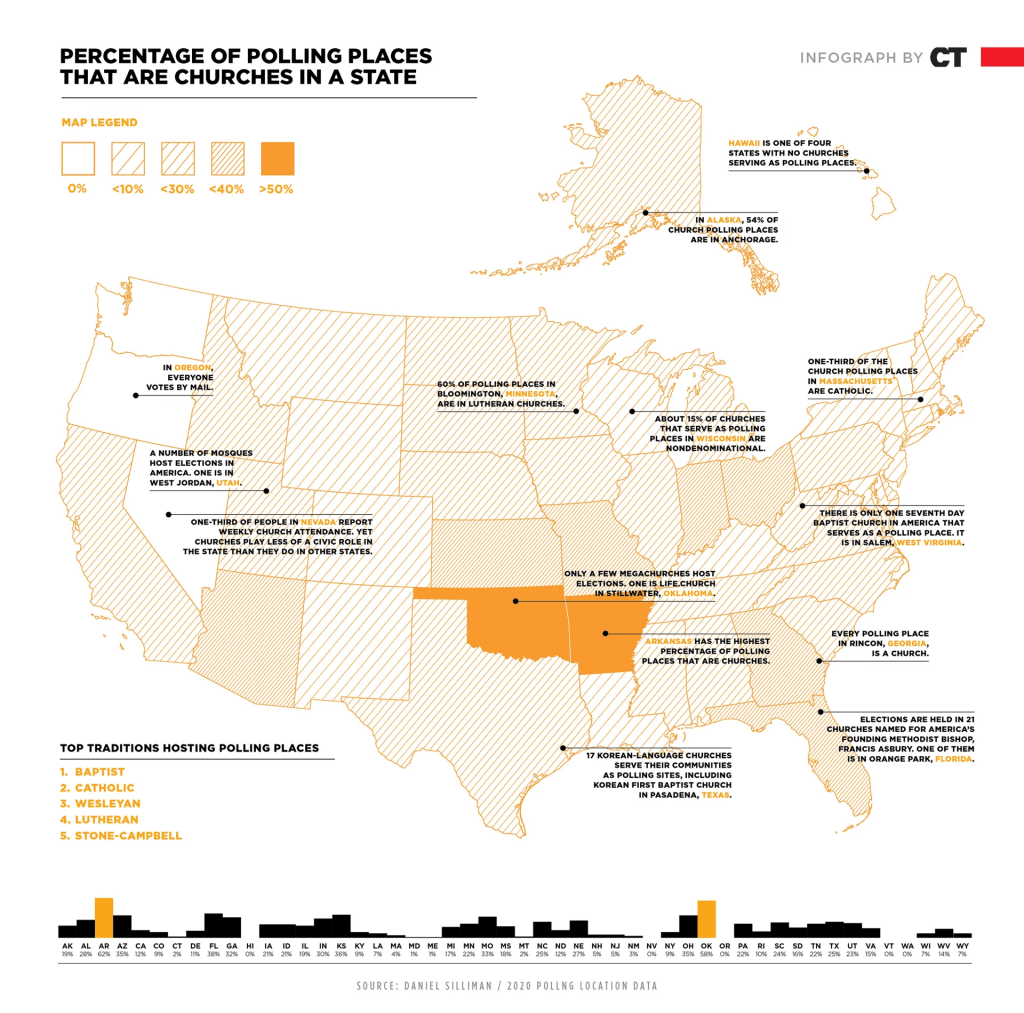
An infographic in Christianity Today highlights how many polling places are in churches:

If I am reading this correctly, here are two patterns:

  1. The percent of polling places that are churches can differ quite a bit from state to state. Generally, some of the Northwest and Northeast are less likely to have churches as polling place. The highest percentages are in more “heartland” states with some interesting exceptions (Arizona, Florida).
  2. Which religious groups host the most polling places can differ as well. It would be interesting to see more fine-grained data/ do these patterns of particular traditions hold up across states or is it because certain states have higher concentrations of certain traditions?

I imagine there might be all sorts of additional factors to consider when examining this.

Given the current political sentiments regarding the role or involvement of religious groups in politics, do these figures go up or down significantly in the coming years? And among which groups and locations?

The sentiments of suburbanites ahead of the 2022 midterm elections

As the 2022 midterm elections near, what are suburban voters thinking? Here is one report from the suburbs of Los Angeles:

Photo by Mikhail Nilov on Pexels.com

No matter where you venture along the northern fringe of metro Los Angeles, whether it’s the bustling suburbs of the Democratic-leaning San Fernando Valley or the more conservative towns that nestle in the russet-hued canyons to the north and east, you’ll find people who say they have good reason to sing the blues for their country.

They’re feeling weighed down by the onslaught of inflation, cultural conflicts and assaults on the electoral process. They fear that Americans — left, right and center — have given up trying to understand or sympathize with one another.

And they hold elected officials and political candidates responsible for sowing distrust among Americans and eroding faith in democratic institutions.

Who exactly will these suburbanites vote for at the national and local levels or will they choose not to vote? One poll suggests some change among white suburban women:

The GOP has seen a shift in its favor among several voter groups, including Latino voters and women, and particularly white suburban women. That group, which the pollsters said makes up 20% of the electorate, shifted 26 percentage points away from Democrats since the Journal’s August poll and now favors the GOP by 15 percentage points.

As in previous elections, suburbanites might sway the outcomes. Both parties have aimed their messages, at least in part, toward suburban voters who are both a sizable percentage of the electorate and where more voters might be open to shifting their votes.

Play Christmas music all day starting November 1 and ratings go up

The Chicago radio station WLIT starts their 24 hour a day Christmas music today because people and the ratings like it:

Photo by Dzenina Lukac on Pexels.com

WLIT-FM 93.9 will play only Christmas music round-the-clock beginning at 4 p.m. Tuesday.

It is the earliest date in the station’s 22 years of hosting the format that it is making the switch.

Why? Listeners love it…

“The reason stations switch in early November is so they can get a ratings boost for the final few weeks of the survey,” he wrote in an email.

Which comes first: the audience demand for the Christmas music or the supply of Christmas music? Would anyone play Christmas music this early if there was not such a direct payoff?

Such a question could be asked in all sorts of domains, ranging from other Christmas material – do stores put Christmas decorations and displays up right after Halloween to drive demand or is that demand already there? – to products of the culture industries. If such a question could be answered more predictably, there might be more hits – records, films, TV shows, etc. – and fewer flops.

In the meantime, Chicago radio listeners will later today have the option to hear Christmas music all the time. Even in an age of music streamable on demand plus all sorts of other music formats, at least a few will turn to WLIT because predictable Christmas music is available.