Suburbs consider mottos, branding efforts

In an effort to stand out, a number of Fox Valley area suburbs are considering mottos and branding campaigns:

Oswego is looking for a motto, as well as a logo and marketing strategy, to better identify its image and solidify its place in the region.

Michele Brown, community relations manager, said Oswego wants to be a regional destination for economic development and tourism…

Carpentersville’s slogan is “Building a Better Tomorrow…Today.”

Village officials, including staff and board and commission members, are working on a rebranding campaign with the goal of changing Carpentersville’s public perception…

North Aurora last year went through a rebranding process that came up with a new logo and the motto “Crossroads on the Fox.” This came after months of debate over nine design options with dozens of variations.

Usually, these are pitched as efforts to attract businesses and residents. Think of those Bedford Park or Elk Grove Village ads that run in the Chicago area – having a catchy motto or campaign sounds better in an advertisement. Whether such campaigns work or simply help the community feel better about its efforts is another story. At the least, branding is an effort at local boosterism as businesses and residents can choose among hundreds of Chicago area communities.

But, not every suburb wants such branding:

Some towns, though, have made a conscious decision to not wear the label of a slogan or motto, like Wheaton, Naperville and Carol Stream.

Presumably, these are communities that are more comfortable with who they are and/or don’t feel like they have a negative public image.

Of course, mottos can signal things other than being open to growth like New Lenox which was selling itself in ads as “home to proud Americans.”

American homeownership was originally not about an investment

One writer suggests Americans have bought into the lie that houses are good investments:

Would it surprise you to know that if there are two equally expensive houses—one for rent, one to buy—the person who buys will pay 40 percent to 50 percent more each month? That’s what happens when you factor in property taxes, insurance, maintenance fees and assorted fees like repairs—which almost nobody does…

The truth is, most of what we’ve been raised to believe about owning a house simply isn’t true…

Run the numbers. Yale economist Robert Shiller found that from 1890 to 1990, the return on residential real estate was just about zero after inflation.

ZERO.

This trend toward seeing homes as a good return on investment is a recent development. Perhaps it hints at the commodification – and a need to see a potential return on investment – of everything.

But, if owning a home is not a great investment, why do Americans still privilege homeownership? Here are some historic reasons:

  1. Land is valuable. In the past, people needed land to some degree to survive. Think of all those tenant farmers in the Middle Ages who always had to pay someone else. Or think of sharecroppers in the United States. Land equaled food or the ability to run a business on your property. Additionally, having your own piece of property meant that you could get away from others as well as the government. It is that the home is your castle thing.
  2. Owning a home is a sign of material prosperity. When you are a homeowner, you have made it enough to be able to own and maintain your own property. In other words, you have the resources to waste it. This is the realization of the American Dream as George W. Bush once put it.
  3. Additionally, homeownership is a sign of dedication to your local community. Renters are assumed to be lower-income, transient, and not committed to civic organizations. Homeowners have a stake in their community because they (1) will be there for an extended time and (2) want to protect their property values (though this is also a more recent development).
  4. Combining #2 and #3, homeownership was assumed to keep people invested in capitalism as opposed to socialism. Again, if you own your own property, you want to see it do well rather than hand it over to an outside manager (the state or a landlord).

Profile of a smaller post-World War II builder

The efforts of Levitt & Sons are well known but here is a quick overview of a smaller “merchant builder” from the Boston area:

The Campanelli Brothers of Braintree, Massachusetts, were one of these typical merchant builders. When Michael, Joseph, Nicholas, and Alfred Campanelli created a construction company in the late 1940s, they were young and inexperienced. Their parents, Francesco Campanelli and Lisa Marie Colondono Campanelli, arrived in the U.S. in 1915 from a tiny and ancient mountain village in the Italian Apennines; they settled in an immigrant neighborhood in the small city of Brockton. The boys were used to hard work, quitting school after their father died to help support the family by working at the Quincy shipyards near Weymouth. Joseph also worked on some house construction sites before World War II. The three younger brothers served short stints in the Navy during the war.

After they came home, the brothers used an army surplus truck to move gravel to big construction sites, including Logan Airport. Soon they began pouring concrete footings for new buildings. As their assets increased, they built two new houses in Brockton, one for their mother and one for their sister Ann, whose husband, Salvatore De Marco, now joined the brothers’ team. They branched out to small developments near Braintree, Massachusetts, and Warwick, Rhode Island. Success there led them to develop more ambitious subdivisions in Natick, Framingham, Peabody, and other areas near Boston. In the process, they assembled a sizable group of foremen and loyal subcontractors, many drawn from their old neighborhood and earlier shipbuilding work. Their firm rapidly grew into the leading home building enterprise in the Boston area, and later built extensively in Florida and Illinois as well.

The typical Campanelli house was attractive because, as one buyer explained it, it was “a new kind of house” for “a new time.” It discarded the old-fashioned, larger, more monumental look. It had a low-pitched roof, like contemporary ranch houses in California, but still kept shutters or an occasional bow window for a faintly “colonial” flavor. Campanelli houses usually had two or three bedrooms, a living room, a kitchen large enough to eat in, and a garage. The three-bedroom version was about 1,000 square feet of living space. In the mid-’50s, the firm extended the kitchens to form a “living kitchen” or a kind of a “family room.”

The last brother died just a few years ago and the company the brothers started did a lot of work:

Campanelli Companies built more than 30,000 single-family homes in eight states during the post-war period.

Here is the company – Campanelli – today and how they describe themselves:

Campanelli is a vertically integrated commercial real estate, construction, development and acquisitions company with over six decades of successful experience having developed, built and acquired over 20 million square feet of property. Campanelli has a trustworthy, successful and experienced team that maximizes value, consistently executes on target objectives and provides operational excellence for your company.

I would love to see a study that compares the (1) home styles (2) buyers (3) interactions with local governments and (4) organizational operations of a number of post-World War II builders. Campanelli started small and became a commercial property developer. Though there are differences, it kind of reminds me of the Harold Moser story in Naperville where a former newspaper owner turned lumber store operator started by building a few homes and then ended up constructing a sizable amount of the large city’s homes.

Additionally, are such family business stories like this still possible today or did the combination of unusual housing needs plus innovations in building create a uniquely open market?

Explaining Americans’ decline in geographic mobility

Derek Thompson highlights a decline in movement and summarizes what might be behind it:

Between the 1970s and 2010, the rate of Americans moving between states fell by more than half—from 3.5 percent per year to 1.4 percent. “It’s a puzzle and it’s the one I wish politicians and policy makers were more concerned about,” Betsey Stevenson, a former member of Obama’s Council of Economic Advisers, told The New York Times this week. Fewer Americans moving toward the best jobs and starting fewer companies could lead a less productive economy. On Thursday, the Financial Times reported that productivity “is set to fall in the U.S. for the first time in more than three decades.”…

Every dimension of declining American dynamism is connected. The slowdown in most areas’ business development comes from a shifting tide in American migration. For 100 years, population flowed from poor areas to rich areas. Now the trend has reversed. Land-use policies prevent more middle-class families from living in productive areas, because housing becomes too expensive. Meanwhile, the rich can afford to cluster in a handful of metros where entrepreneurship is a norm, while business dynamism falls in the rest of the country. There used to be too much land to settle. Now there’s not enough land to share.

Two quick related thoughts:

  1. You regularly see people make the argument that people should just pick up and move to where there are more opportunities, meaning jobs and a cheaper cost of living (generally referring to housing and maybe taxes). There is even a single case in Evicted where a person moves from a poor Milwaukee neighborhood to a southern city and seems to be doing well. However, moving is not necessarily easy (see #2).
  2. Why are economists the only ones summarized here? Are sociologists not paying much attention to this? On one hand, I can see how economics would drive decisions about moving. Yet, it is not the only factor. People have social connections wherever they live and it can be difficult to form new social networks. While Americans always have prized mobility, don’t they also celebrate finding your roots and being a presence in your community? (Granted, Americans may be doing neither: moving less and being less engaged in civic life.) This reminds me of some public housing residents who didn’t want to leave pretty bad conditions in high-rise buildings. Or, what about explanations like those in The Big Sort or The Rise of the Creative Class where people choose to live near people like themselves.

Reminder of Facebook’s goal: “to make the world more open and connected”

What exactly is the purpose of all these social media sites? A recent letter to a Senate committee clearly lays out Facebook’s aims:

Facebook’s mission is to give people the power to share and make the world more open and connected.

The rest of the document provides insights into how Facebook selects Trending Topics but the reminder is helpful: the company has broad aims with the goal of having more and more interactions between people around the world. While Zuckerberg has been pretty open about this from the beginning, it is less clear whether this goal is accomplished. My own research with data from the mid to late 2000s suggested users primarily friended and interacted with people they already know or were in some proximity to. If users aren’t making personal connections, perhaps they are more aware of the world through viral videos, news stories, and information that rockets through networks. Does that make the world (1) more open and (2) connected or is there an element of personal connection that also would help?

Majority of American jobs in the suburbs

An analysis at New Geography shows the metropolitan locations of American jobs:

The 2014 data indicates that more than 80 percent of employment in the nation’s major metropolitan areas is in functionally suburban or exurban areas (Figure 3). The earlier suburbs have the largest share of employment, at 44 percent. The later suburbs and exurbs combined have 37.0 percent, while the urban cores have 18.9 percent, including the 9.1 percent in the downtown areas (central business districts, or CBDs).

These numbers reveal dispersion since 2000. Then, the earlier suburbs had even more of the jobs, at 49.4 percent, 5.3 percentage points higher than in 2014. Virtually all of the lost share of jobs in the earlier suburbs was transferred to the later suburbs and exurbs, which combined grew from 31.4 percent in 2000 to 37.0 percent in 2014. The urban cores had 19.4 percent of the jobs (8.8 percent in the CBDs), slightly more than the 18.9 percent in 2014.

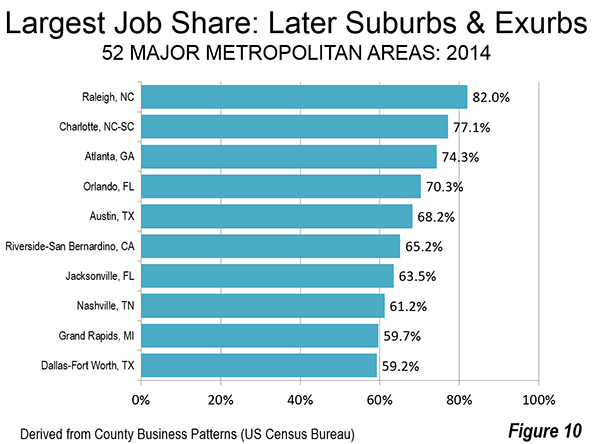
While Chicago is one of the cities with a higher percentage of jobs in the city, Sun Belt locations dominate the list of cities with more jobs in outer suburbs:

These figures counter claims or stereotypes that (1) suburbs are primarily bedroom communities where people sleep but work in the city and (2) urban cores are the primary job centers of metropolitan regions. Of course, some suburbs are bedroom suburbs and big city downtowns are still important, particularly for certain industries (think global finance). At the same time, it would be interesting to envision some of these Sun Belt cities with no downtown…how different would Raleigh or Atlanta or Orlando really be?

“Naperville named wealthiest city in the Midwest”

Add another distinction to those collected by Naperville over the last 15 years:

Naperville has been ranked the richest city in the Midwest in a list by personal finance website NerdWallet.

The city topped the region — and came in at No. 19 in the nation — in the rankings announced Monday…

NerdWallet rated cities with at least 65,000 people based on data from the U.S. Census Bureau, Zillow Research and credit bureau Experian.

In the Midwest, the runner-up — Carmel, Indiana — bested Naperville in only one category, with a median household income of $109,375, according to NerdWallet.

For its size – over 140,000 people – Naperville is unusually well-off with a high household income, a low poverty rate, and plenty of good white-collar jobs. There are certainly wealthier communities in the Chicago region and the Midwest but many of them are quite small and have little interest in growth.

How did Naperville get to this point? Two articles I have published help explain the suburb’s rise: a 2013 article in Urban Affairs Review that compares Naperville’s growth to West Chicago and Wheaton and a 2015 article in the Journal of Urban History that examines narratives about Naperville’s growth.

Renaming the Willis Tower and John Hancock buildings

Chicagoans may have to soon adjust to two new names for skyline fixtures:

Sneed hears the Willis Tower, the crown jewel of skyscrapers, is currently the subject of negotiation for naming rights.

Meanwhile, Sneed is told a name change at the John Hancock Center may be imminent…

“Selling naming rights for buildings not occupied by the company that’s named is a new phenomenon and it’s something our ordinances don’t really address,” said Ald. Brian Hopkins (2nd), who has ordered a study by the Commission on Chicago Landmarks Department to determine whether the building qualifies for landmarking status — which restricts building modifications to respect historical integrity.

Even if the names officially change, it will take a significant amount of time for the everyday use of the new titles to change. The buildings are privately owned and yet they have clearly been symbols of Chicago for decades. That the naming rights could change every few years – dependent on the global real estate market – is an odd phenomenon for structures that serve as public markers.

In the long run, perhaps this is why we need non-company names for buildings. Think the Empire State Building or the Gherkin. Firms can move in and out and the name and symbol stays the same. I’m not sure what the Chicago buildings would be named in such a scheme. The Sears/Willis/?? Tower could be the “Stack of Rectangles Tower” and the Hancock could be the “X Support Building.”

Describing Detroit at its peak

In discussing Detroit’s decline, it is good to be reminded of the city’s peak:

As Maraniss’s book opens, Detroit appears to be a city on the verge of unimagined greatness. President John F. Kennedy campaigns in the Motor City in October 1962 in support of the off-year elections. Democrat Jerry Cavanaugh is mayor of the city, then the fifth largest in the country with a population of nearly 1.7 million. Cavanaugh is the mayoral version of JFK, a relatively young man with a big Catholic family, liberal, civil rights minded. George Romney is elected governor, a Republican who also champions civil rights. Vice President Lyndon Johnson visits the city in early 1963 in recognition of the 100th anniversary of the Emancipation Proclamation. Motown, now well established, is conquering the Billboard charts. Mary Wells’ “My Guy” dislodges the Beatles from the number one spot in March of 1964. Following the best sales year in its history, Ford introduces the Mustang in the spring of ’64. The United Automobile Workers, under the leadership of Walter Reuther, has won an unprecedented standard of living for its members, setting the bar for workers across the country and building the foundation for the Affluent Society. Martin Luther King delivers the first version of his “I Have a Dream” speech to a Detroit crowd of 100,000 two months before the March on Washington in August 1963. The city nearly wins the bid for the 1968 Summer Olympics.

Of course, this is what helps make the Detroit case so interesting: the city was so large, so influential, so promising, and then the bottom dropped out over the next fifty years. Humans often make the mistake of romanticizing some sort of golden age where problems were few and life was good, but in this case there really does seem to have been a better era.

Can sociology classes keep up with the latest happenings in society?

A recent analysis of the top assigned sociology texts in the Open Syllabus Project has a number of interesting findings including a large number of texts from the mid-1970s to the mid-2000s:

Sociology is a dynamic discipline, so the inclusion of many texts published in the past 30 years is not surprising. Nor is the continued importance of the foundational sociology texts published between 1850 and 1950. But perhaps we can see another kind of generational dynamic at work here. Most of the OSP collection comes from courses taught between 2006 and 2014. Perhaps the emphasis on works published from the mid 1980s to the mid 1990s reflects a process of canonization that takes roughly 10 or 15 years, as faculty in their 40s become senior faculty in their 50s or 60s, balanced by the need to assign material that is still feels relevant to the analysis of contemporary problems, which may have a roughly similar temporal horizon. Again, the OSP offers only some data points, at present, toward an understanding of contemporary sociological knowledge. But they are suggestive ones and worth further exploration as the data set matures.

This argument makes sense: sociology faculty will tend to assign texts they are familiar with and that is likely material they know from graduate school as well work that informs their own.

But, it does raise some interesting larger questions:

  1. Certainly, it takes some time to put together good research that involves theory, data collection and analysis, and thinking about the implications. Yet, this lag in texts and current events means that individual faculty have to find ways to bridge the gap. I’m not sure the answer is to significantly speed up the publication process with journal articles and books – as it can often take years – as this limits the times needed to develop good analysis. It does suggest that other outlets – like blogs or op-eds or more popular books – might offer a solution and this may mean such work should count for something in the discipline.
  2. How much does the knowledge of faculty “freeze” in what they learned in their training or from their early career? I remember hearing that sociologists may know the most when they were doing their comprehensive exams. How well can people keep up with all the literature that arises, particularly if they have heavy teaching loads?
  3. This suggests that a lot of sociological classwork involves historical analysis as the texts used as typically from enough years ago that students don’t know all of the details of the context. How good are sociologists at doing historical analysis with undergraduates?