The mostly Christian US House and Senate

How does the religious affiliation of the members of Congress compare to the religious affiliation of Americans as a whole? This came up recently in a conversation about religiosity and government so I tracked down some data.

Photo by Kendall Hoopes on Pexels.com

For the religious affiliation of Americans as a whole, here are figures from the Pew Religious Landscape Survey with data collected in 2023-24 from more than 35,000 respondents. With 62% of American adults identifying as Christian, here are the percentages for particular religious traditions:

-23% evangelical Protestant

-11% mainline Protestant

-5% Black Protestant

-19% Catholic

-2% Latter-day Saint

-2% Jewish

-1% Orthodox Christian

-1% Muslim

-1% Buddhist

-1% Hindu

-29% religiously unaffiliated

For the religious affiliations of members of Congress, here is a summary of what Wikipedia has for House members and Senate members. The categories are not the same as the religious traditions for the Pew Religious Landscape Survey but there are points to compare. Starting with members of the House of Representatives:

-375 of the 435 (86%) are Christian. Of these Christians, 236 are Protestants in specified traditions (including 63 Baptists, 22 Methodists, 16 Episcopalians, 15 Presbyterians, 13 Lutherans, 10 non-denominationals) and 88 are unspecified Protestants. Of the 375 Christians, 126 are Catholics, 7 are Eastern Orthodox, and 6 are Latter-day Saints.

-24 of the 435 (6%) are Jewish.

-4 of the 435 (1%) are Muslim

-4 of the 435 (1%) are Hindus

-2 of the 435 (0.5%) are Buddhist

-18 (4%) are unknown or refused to state.

-4 (1%) are unaffiliated.

And here is the religious affiliation for members of the Senate:

-86 of the 100 (86%) are Christian. Of these Christians, 59 are Protestants in specified traditions (including 12 Baptists, 5 Methodists, 5 Episcopalians, 12 Presbyterians, 6 Lutherans, 6 non-denominationals) and 5 are unspecified Protestants. Of the 86 Christians, 24 are Catholics, 7 are Eastern Orthodox, and 3 are Latter-day Saints.

-9 of the 100 (9%) are Jewish.

-1 of the 100 (1%) are Buddhist

-4 (4%) are unknown or refused to state.

How does the religiosity of Congress compare to the country as a whole? Pew sums up:

Christians will make up 87% of voting members in the Senate and House of Representatives, combined, in the 2025-27 congressional session. That’s down from 88% in the last session and 92% a decade ago...

And yet, at 87%, Christians still make up the lion’s share of the Congress, far exceeding the Christian share of all U.S. adults, which stands at 62% after several decades of decline…

The new Congress is also more religious than the general population by another, related measure: Nearly three-in-ten Americans (28%) are religiously unaffiliated, meaning they are atheist or agnostic or say their religion is “nothing in particular.” But less than 1% of Congress falls into this category…

In a country where a majority of adults identify as Christian, Congress is roughly 25% more Christian than the population as a whole. This may change in the coming years as more American adults do not identify with any religious tradition or group.

No Kings protests throughout the Chicago suburbs

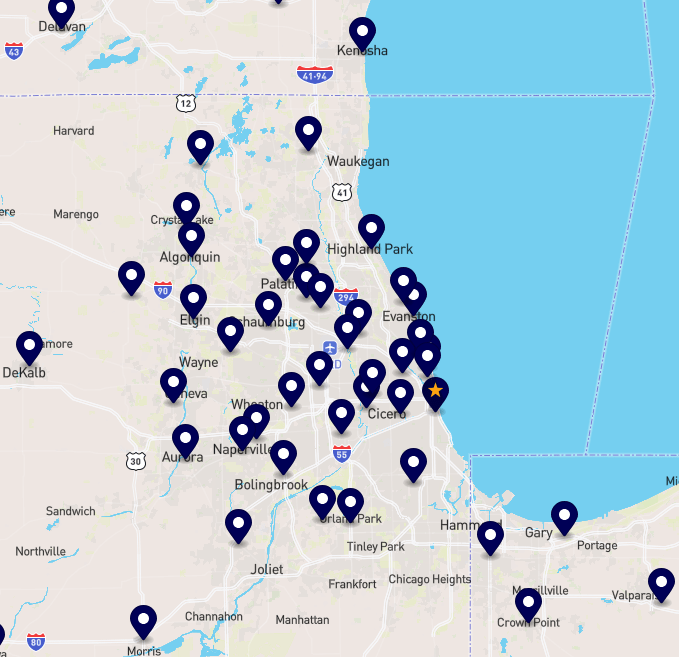
In the last decade or so, protests in the United States do not just take place in big cities. For example, the No Kings website listed over 30 gatherings in the suburbs of Chicago:

The website listed 7 sites in Chicago itself, including the primary site in the Loop which drew over 100,000 people. But people in the region had plenty of options where they could join others. Some of these locations are close to the city while others are on the edges of the metropolitan region. From what I can see on the map, most residents were with 10-15 miles of a protest site and many could access multiple options.

Three related thoughts:

  1. The portrayals of suburbia in the postwar era tended to emphasize its conservative or Republican bent. This may have been true in numerous places but is harder to sustain these days with suburbs closer to cities often leaning Democratic and suburbs on the suburban edges often leaning Republican.
  2. It would be interesting to look more closely at these suburban protest sites. Where can people gather in the suburbs for political purposes? Suburban downtowns or city halls? Shopping areas or busy streets? Public parks and public spaces? Which places helped increase the solidarity among those gathered and which ones helped them reach others who did not come?
  3. The suburbs are built around driving. How many protesters around the Chicago region drove, parked, and then protested? Protests tend to happen on foot but people have to be able to get there and options are limited in some suburban settings.

If New York City elects a progressive mayor, how many wealthy residents will flee for Westchester County?

With a mayoral election coming up in New York City, some residents are considering moving elsewhere:

Photo by cottonbro studio on Pexels.com

As the reality settles in that Zohran Mamdani — a steadfast Democratic Socialist — may soon become New York City‘s mayor, many city-dwellers are planning their escape route.

This is because the policies at the core of Mamdani’s campaign are largely unpopular with wealthy and upper-middle class New Yorkers…

‘We are absolutely seeing a correlation between Zohran Mamdani’s surprise win in the Democratic primary and an uptick in real estate interest in Westchester,’ Zach and Heather Harrison, real estate agents in the area, noted.

‘Since the summer, nearly every buyer from the city we have taken out to see homes in Westchester has mentioned the mayoral election as one of the drivers for shopping in the suburbs,’ they told Realtor.com.

Since Mamdani won the Democratic primary in June, sales going into contract in Westchester County are up 15 percent compared to the same period last year, according to The Harrison Team…

In comparison to New York City, Westchester offers more space, lower crime rates, and often lower effective taxes.

Several quick thoughts:

  1. The article is vague on numbers. How many people have moved or might move? And separate from how many do move, how many would have to move for it to be meaningful as a media story or make a substantial difference in local activity?
  2. We hear similar claims about political changes or taxes at the state or national level; people with resources will leave if they think they are being targeted and/or conditions are better elsewhere. I do not know if I have heard this before suggesting people will move from the city to that city’s suburbs.
  3. Westchester County could be a paradigmatic suburban county in the United States. It borders New York City and it grew quickly in the early 1900s. It became a wealthy suburban setting with many houses, access to the city via highway and railroad, some green spaces and waterways, and home to major corporations. Would an influx of wealthy New York City residents feed into the character of the county or alter it at all?
  4. At what point would policies or conditions need to change for most of wealthy residents of a city to leave?

Criticizing cities and ICE activity in complex suburbia

President Donald Trump often criticizes American big cities, particularly Chicago as he has mentioned the city multiple times in his first and second term. Just yesterday in the Arizona service for Charlie Kirk, Trump highlighted Chicago:

Photo by cottonbro studio on Pexels.com

Trump told mourners that one of the last things the slain conservative activist and Illinois native said to him was, “Please, sir. Save Chicago.” Trump then launched into a familiar refrain, saying, “We’re going to save Chicago from horrible crime.”

One of the Trump administration’s actions regarding Chicago includes recent ICE activity. While all the details are hard to come by, it appears however that this activity has not just affected people living in Chicago; there has been ICE activity in numerous suburbs. An ICE facility in Broadview. ICE agents approaching people in numerous suburbs, as far as 40 miles out from the city.

These actions hint at the complexity of the Chicago region and suburbs across the United States. Even as some Americans have long associated cities with racial and ethnic diversity, this diversity has increased in suburbs in recent decades. The American suburbs are full of people of different racial and ethnic groups as well as large numbers of recent immigrants to the United States.

So when Trump says Chicago has problems, does he mean just the city or is the whole region in question?Again, from the Kirk service:

Trump later took aim at Gov. JB Pritzker, declaring, “You have an incompetent governor who thinks it’s OK when 11 people get murdered over the weekend. … He says he’s got crime [under control]. No, they don’t have it under control, but we’ll have it under control very quickly.”

Both the city of Chicago and its suburbs have the same governor. Only one of the Chicago collar counties in Illinois voted for Trump in 2024: McHenry County. (There are portions of the greater Chicago area in southeastern Wisconsin and northwestern Indiana but they may not be part of the same conversation.) Are the problems some see in Chicago also ones they see present in suburbs?

Costco, American consumption, and relationships with adversarial nations

The Trump administration may limit the ability of Iranian officials to visit Costco and Sam’s Club when they visit the United Nations in New York City:

Photo by Teju on Pexels.com

The movements of Iranian diplomats are severely limited in New York, but one proposal being floated would bar them from shopping at big, members-only wholesale stores like Costco and Sam’s Club without first receiving the express permission of the State Department.

Such stores have been a favorite of Iranian diplomats posted to and visiting New York because they are able to buy large quantities of products not available in their economically isolated country for relatively cheap prices and send them home.

It was not immediately clear if or when the proposed shopping ban for Iran would take effect, but the memo said the State Department also was looking at drafting rules that would allow it to impose terms and conditions on memberships in wholesale clubs by all foreign diplomats in the U.S.

Americans may be used to Costco and big box stores but they are not necessarily available all over the world.

When I saw this story, I was reminded of the so-called “Kitchen Debate” between Nixon and Khrushchev in 1959. At an exhibition in Moscow, the United States constructed a model of an American home with the idea of showing off all that an average American household had. Khrushschev did not appear impressed but the display illustrates one of the ways the United States expanded its power and reach in the second half of the twentieth century: through consumerism and a particular lifestyle.

Put another way, pursue policies like the United States and the average home could have a kitchen like that one displayed in 1959 or the average resident could shop at a Costco in 2025. Resist the American way of life or be belligerent toward the United States and those things will not be available.

Just out of curiosity, I searched Google Maps for the Costco locations nearest to the UN Headquarters in Manhattan. There are at least 3 locations within 11 miles. This means when the diplomats and the leaders of the world come together at the UN, getting to Costco might not be too difficult.

The first presidential candidate from the suburbs

When Michael Dukakis ran for president in 1988, he did so as governor of Massachusetts and as a suburbanite:

Photo by Sergei Starostin on Pexels.com

Dukakis’s suburban origins and issue-oriented style actually served as a major asset with the other constituency that many strategists recognized as key to his and the Democratic Party’s success in the general election. Political consultant and Dukakis adviser Hank Morris saw Dukakis’s upbringing and ethos as important in galvanizing postindustrial suburban professionals in battleground states such as California, Illinois, and New York. Suburban professionals responded favorably to Dukakis’s record about quality-of-life issues like traffic and air pollution, unregulated commercial growth and sprawl, declining schools, and rising drug and crime problems. Morris urged the campaign to further underscore that “he is the first presidential nominee to grow up in the suburbs and to stay there, commuting to work and mowing the lawn and knowing the concerns of suburbanites.” Taking the advice to heart, Dukakis made frequent references to his 1963 Sears snowblower as an emblem of his suburban sensibility and frugality. (275)

This passage comes toward the end of historian Lily Geismer’s book Don’t Blame Us: Suburban Liberals and the Transformation of the Democratic Party. It serves as a culmination of several decades of history where the actions of suburbanites in Boston suburbs along Route 128 presaged larger changes in the United States.

Of course, Dukakis lost the election. But Geismer argues that he represented a shift in the Democratic party toward the educated knowledge workers of suburbia. Whereas suburbs had been viewed as conservative and Republican in the immediate postwar era, by the 1980s there were pockets of suburban liberals and today there are numerous Democratic strongholds in suburban areas outside large cities.

At the same time, Geismer notes that these suburban liberals had particular notions about liberal causes. They tended to promote individual freedom, not addressing structural issues. When asked to transform their own suburban communities for the greater good of the Boston area, these suburban liberals resisted. It is one thing to advocate for liberal causes that might help you; it is another to promote affordable housing in your community.

I would venture that we see a number of these patterns still playing out today. What happened along Route 128 has happened to varying degree across American suburbs with pockets of high-tech, knowledge industry workers clustering in suburban parts of metropolitan areas. The American suburbs are more diverse than they were in the 1980s. Many of wealthy suburbs with white-collar jobs or workers are not fully open to change or to addressing metropolitan issues or regularly resist what they see as threats to the quality of life the enjoy. The choices suburbanites like to have still gives those with resources options to find communities that they like and then push back against change.

And when will the United States have its first suburban president, someone born in the suburbs and who identifies with the suburbs?

An ongoing negative Trump narrative about cities

President Trump and his political allies continue to discuss cities in particular ways:

Photo by Moneer Ibrahim on Pexels.com

When President Donald Trump declared his third presidential candidacy in 2022, he saved his most colorful language for America’s urban areas, bemoaning “the blood-soaked streets of our once-great cities” and adding that “the cities are rotting, and they are indeed cesspools of blood.”

Later in his campaign, Trump called Milwaukee “horrible” and described Washington, D.C., as a “rat-infested, graffiti-infested shithole.” More recently he said, “These cities, it’s like living in hell.”

Other Republicans have seized on similar dystopian urban images. When Vice President JD Vance visited New York several years ago, he compared the city to a zombie apocalypse, posting: “I have heard it’s violent and disgusting there. But is it like Walking Dead Season 1 or Season 4?”

As Trump ramps up the military presence in Washington — and hints that he may move to take over other cities — his crackdown punctuates a frequent Republican message that American cities embody chaos, lawlessness and immorality, despite widespread recent drops in violent crime. With cities increasingly liberal and rural stretches ever more conservative, Republicans have a growing incentive to attack urban areas as the epitome of all that is wrong with America…

Trump’s rhetoric culminates a long history of American politicians casting cities as hotbeds of vice and social disorder, said Michael Kazin, a historian at Georgetown University and author of “The Populist Persuasion: An American History.” Left-wing populists have often been dismayed by the vast wealth inequality on display in cities, he said, while right-wing populists have recoiled from the elites, immigrants and minorities who live there.

This resonates with some Americans because there is a broader and longer history of criticizing cities in the United States. From the beginning, a number of Americans have idealized small town or rural living. The growth of major cities was accompanied by numerous concerns. When asked today, many Americans say they would prefer to live in small towns.

At the same time, it is hard to imagine the United States today without its big cities and the good things that came with them. A United States without New York, Los Angeles, and Chicago? Or San Francisco, New Orleans, and Cleveland?

Even if voting patterns by geography seem fairly set in American national elections, it would be interesting to hear more politicians articulate messages that cross these boundaries. Are people living in cities, suburbs, and rural more different than they are similar? Breaking through the existing patterns might just require addressing issues that Americans face or care about regardless of where they live.

Who will lead the way to address the need for hundreds of thousands of housing units in Illinois?

A new study suggests Illinois needs a lot of new housing:

Photo by Curtis Adams on Pexels.com

Illinois has a shortage of about 142,000 housing units and must build 227,000 in the next five years to keep pace with demand, a number that would require recent annual production rates to double, according to a new economic study.

The joint study published Tuesday by the Illinois Economic Policy Institute and the Project for Middle Class Renewal at the University of Illinois Urbana-Champaign found that although the rental and for-sale housing markets in Chicago and Illinois as a whole remain more affordable than many coastal cities, such as New York and Los Angeles, and some other states, Illinois still faces a severe housing shortage that is escalating affordability challenges.

National housing shortage estimates are wide-ranging, with Freddie Mac citing 3.7 million and the National Association of Realtors reporting 5.5 million.

And the recommendations for how to do this?

The authors suggest a variety of solutions, some of which Chicago officials and other state leaders are already working on, including easing zoning restrictions, quickening permitting processes, offering tax incentives to convert commercial buildings to residential units and increasing surtaxes on short-term rentals such as Airbnb. Aldermen recently took a step toward giving themselves the power to ban Airbnb and other short-term rentals from opening in their wards, a move that could potentially lead to an increase in housing supply.

This is not a new issue. And even drastic changes right now would not lead to 227,000 new units in five years. This is a long-term project that needs to be addressed.

One thought: this is an opportunity for Illinois to do something that could help lead the way in the United States. Here is why. It is a blue state and Chicago and its region dominates politics and perceptions. (This is not to ignore those living outside the Chicago area; there are just fewer of them.) It has more affordable costs compared to numerous other important cities. Chicago is still an important, world-class city. If Illinois could make a serious dent in providing affordable housing across the state, it could become a model for numerous other places. What works in Illinois might not work at all in New York City or Seattle or San Francisco or other super-heated housing markets. But it might work in Cleveland, Nashville, Denver, and other American metropolitan regions. Figure it out and Illinois and lots of areas could benefit.

For numerous reasons, it seems like politicians and business leaders in American cities and regions are hesitant to truly tackle affordable housing. But those who get out ahead of it can (1) help people living there and (2) provide models and tools for others to learn from and use.

Who should benefit more from selling a home: sellers, buyers, realtors, Zillow, others?

The process by which a single-family home or other residential property is built and sold has been under discussion in recent years. Here is one argument about who should benefit more from the process:

Photo by energepic.com on Pexels.com

So, when the National Association of Realtors recently adopted a policy allowing limited off-MLS marketing, Zillow announced it would permanently ban any listing not posted to the MLS within one day. Essentially, Zillow — a company that doesn’t sell homes — is asserting it gets to decide how you can market and sell your home. 

Zillow claims it is protecting consumers from off-MLS marketing, which it says leads to longer market times and lower prices. But a 2024 study by Midwest Real Estate Data — the MLS serving Chicagoland — shows the exact opposite. MRED offers a Private Listing Network that shares listings with all member agents without circulating them to public websites. Homes first marketed through MRED’s Private Listing Network sold 55% faster, for more money, and at a higher percentage of list price (97.5% versus 95.4%) than those listed publicly from day one.

Our own experience across tens of thousands of transactions confirms the findings of this study. At @properties Christie’s International Real Estate, we developed a “private-to-prominent” listing strategy that starts with an off-MLS marketing period and builds to a full public offering. This approach has several benefits. It allows a seller and their agent to prepare the home for sale while building interest and demand. It also gives them an opportunity to test a price without having Zillow or other websites display any reductions that might be made prior to the public listing. And the listing does not accumulate market time during this premarketing phase. (Typically, as market times increase, buyer interest decreases.) 

This approach can result in faster, higher-value sales, often before the home ever hits the MLS, or Zillow. Most importantly, it keeps the seller in control. They choose when to list publicly and can accept or reject an offer at any time. 

The key here is at the end: “it keeps the seller in control.” Should the seller be the one calling all the shots and having the advantages?

Another argument could be made that the seller having the primary options limits potential buyers. Is the home reaching all the possible purchasers? If it is on a private network first, how often does it reach the general public? Could private listings build off existing networks, reproducing inequalities?

Or should Zillow and other actors play the primary role as many Americans look for real estate online? Is this more of a tug-of-war between the established real estate industry and the online competitors who offer information for any searchers without the need to contact an agent? There are a lot of jobs and a lot of money at stake.

Is there any role for communities or people who might want to access certain communities down the road? If the strength of local real estate is often taken as a sign of local vibrancy and status, should this only involve private actors?

I suspect this discussion will continue as different actors look for an edge in real estate. Hopefully this does not come down to solely who can lobby the most effectively.

Suburban voters as part of larger political realignments in the US

Political changes in recent election cycles in the United States include the voting patterns of suburbanites:

Photo by cottonbro studio on Pexels.com

The realignments of recent years—the midwestern white working class toward Trump’s GOP and the suburbs toward the Democrats—can be understood as the process of ideological and education sorting coming for groups that were the most out of place in the new political realm: rich suburban Republicans and culturally conservative working-class Democrats. In 2020 and 2024, this realignment came for the nonwhite voters once at the center of Barack Obama’s coalition, especially working-class Hispanics, and most especially those in the rural outskirts of the Rio Grande Valley.

Starr County’s tradition of machine politics, manifest in an unusually strong preoccupation with local elections, marked a place ripe for a sudden political shift. Not unlike the Democratic majorities in the big cities of mid-century, which continue at some level into the present day, political dominance in the region was built not through allegiance to liberal ideals but through political machines that delivered tangible benefits and shaped the political identity of new immigrant groups. This is evident in polling today showing that nonwhite Democrats are much more moderate and conservative than their white counterparts. For a time, ideological differences were subsumed to the work of advancing group interests through machine politics. But in an era of declining party organization and an emptying out of majority-minority cities in favor of more integrated suburbs, the tide of ideological voting could be held at bay for only so long. Once it poured in, America shifted into a new era of politics, from one forged by social connections at the neighborhood level to today’s cultural and ideological polarization, where you vote Republican if you have conservative cultural beliefs, regardless of race.

Two claims here stand out:

  1. “Rich suburban Republicans and culturally conservative working-class Democrats” shifted in recent decades. As the suburbs grew quickly after World War Two, those new suburbanites were assumed to be Republicans. Now, college-educated suburbanites tend to lean toward Democrats. And it also matters where in the suburbs someone lives; those closer to big cities tend to vote Democratic and those more on the metropolitan edge tend to vote Republicans.
  2. The connection made between “more integrated suburbs” and increased polarization. Did the people moving to the suburbs lead to polarization – more residents of different racial, ethnic, and social class backgrounds living in suburbs – or did people moving out lead to polarization? What exactly changed and what led to what? How did suburbs over time become different social and political places?

The pattern seems well-established now: the political state of suburbia has changed. The reasons for it and the long-term consequences are still to be worked out.