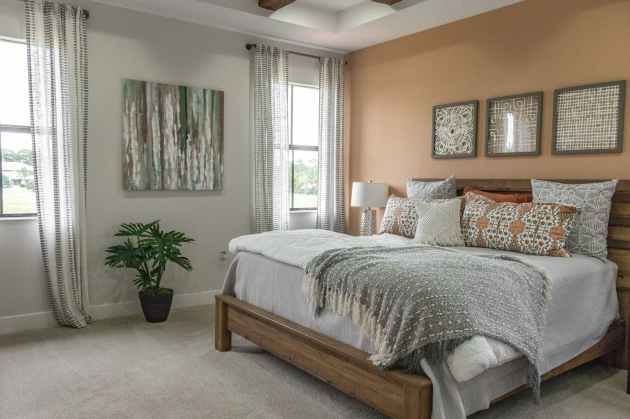
Americans like their private single-family homes – but maybe less if forced to be there

The 2000 book Suburban Nation is a New Urbanist declaration. It includes this argument regarding the public and private realms in the United States:

Americans may have the finest private realm in the developed world, but our public realm is brutal. (41)

This comes amidst a discussion of the suburban single-family home, one of the most attractive features of suburbia for Americans. American homes are large, providing plenty of space for occupants, a range of activities, and vehicles. They can be filled with all sorts of consumer goods, from electronics to clothes to media to equipment for hobbies. Through the Internet and other connected devices, occupants can access all sorts of information, videos, music, and other parts of the world. The homes can be the single largest investment for many. They are often separated from other dwellings (or at most share a wall or two). For decades, Americans have promoted, built, and purchased such homes.

All of this may be good for many Americans but what do these private realms feel like when the occupants cannot leave? It is one thing to choose these private spaces; it is another to be pushed by outside forces to stay in them. With the spread of COVID-19, people are being encouraged to stay home. Does “the finest private realm” become confining when one cannot easily leave?

We are about to find out. Even if Americans might prefer their private realms, some might miss the public realm or the easy opportunities to visit other private realms (such as stores and shopping malls). This may not lead to a revival of public spaces but it might remind some homeowners that the private realm has limitations.

Infectious diseases in urban and suburban life

Americans already have a predilection for suburban life; might a global pandemic push even more people out of cities and to the edges of metropolitan regions? One take regarding safety in suburban life:

As maps like this show, major metropolitan areas are bearing the brunt of the Covid-19 infections spreading across North America. And that makes sense: Though there’s no way to know for sure how the virus arrived, it almost certainly came by way of an international flight to a major airport (or several of them). But while infectious disease spreads faster where people are more densely clustered — hence the strategy of social distancing to contain the coronavirus — that doesn’t necessarily make suburban or rural areas safer, health experts say…

That is not to say that cities aren’t Petri dishes — they are. Relative to rural areas, urban centers do provide stronger chains of viral transmission, with higher rates of contact and larger numbers of infection-prone people. And historically, urbanites paid a price for this vulnerability…

Modern transportation networks have made the population shield that rural areas once provided much more porous. Now that humans and freight can travel from, say, Hong Kong to Los Angeles in less than 13 hours — and arrive by vehicle to somewhere sparsely populated hours after that — outbreaks can happen just about anywhere. New pathogens tend to arrive sooner in global hubs, but that doesn’t mean they can’t quickly reach rural locales and proliferate from there, says Benjamin Dalziel, a professor of mathematics at Oregon State University who studies population dynamics…

But while the CDC recommends decreasing social contact to limit the spread of the virus, that’s just as doable in a downtown apartment as a countryside manor. Says Viboud: “If you’re staying at home and limiting outside contact, you’d achieve the same purpose.”

Three thoughts come to mind:

  1. This highlights the connectedness of cities and suburbs today, even if there is significant physical distance separating communities. The rate at which people travel around the world, to other regions, and throughout regions is high compared to all of human history and is relatively easy to do. Cities and suburbs are not separate places; they are parts of interdependent regions that are highly connected to other places.
  2. Safety and health was a part of creating the suburbs in the United States but it is hard to know how this might matter in the future. Given all the reasons people now settle in the suburbs, would avoiding communicable diseases be a top factor? I would think not, particularly compared to factors like housing prices or amenities (schools, quality of life, etc.), or demographics.
  3. If particular places are not that much safer, does the sprawl of American life then limit the response to any illness? Imagine the Chicago region with dozens of hospitals that need to be equipped spread throughout the region as opposed to that same number of people packed into a smaller area where it is easier to get supplies and people to medical facilities. Or, the need to supply grocery stores throughout a huge region.

The advantages McMansions may offer for working from home

With coronavirus pushing more people to work from home, I have seen more advice about setting up a home workspace. I found one example that suggests workers in all kinds of homes face similar challenges:

First things first: As we’re learning, there’s no “normal” with the coronavirus. But that also applies to where you live. “Home workers” now include apartment dwellers, Millennials who share a house, Midwesterners with basements, suburbanites in McMansions, and more. You’ll have to figure out what works for you, within your own unique environment. Still, some rules apply to just about everyone.

Is this true? Do McMansion-dwellers have any advantages in working out of their large homes? A few ideas:

  1. All that space means McMansion occupants have plenty of options to choose from regarding where to work. They could even rotate (though these articles tend to emphasize making one space a clearly delineated work space).
  2. All that space also means they can keep their distance from all other occupants.
  3. Although the McMansion might have a lot of open common space, there are likely parts of the house that can be pretty quiet and separate from other activities.
  4. Related to #1-3, who likes open office plans?
  5. If a worker needs to bring lots of materials home, the McMansion likely has a lot of storage space. A temporary home office might barely be noticed.
  6. Because of the size of the home, the walk from the office space to the kitchen or bathroom could be a sufficient break or help the worker acquire their needed steps.
  7. The McMansion home worker pressed for cash could rent out a room or create a coworking space (while attending to local zoning codes, of course).
  8. There could be enough space to recreate the spaces in a large office building, ranging from a workout room to a large eating area to spacious bathroom to room to spread out one’s work.

Americans like their private spaces but being confined to one’s home for a few weeks may just reinforce the desire of some to have plenty of space.

A way to fight app directed through traffic: cul-de-sacs

The suburbs are full of of cul-de-sacs. Homeowners might prefer them because of the quiet and the space that they allow for kids and vehicles. They can help developers and builders fit more houses into spaces.

At the same time, cul-de-sacs may be the bane of New Urbanism as neighborhoods with many of them do not have a consistent street grid and they are primarily lined by private single-family homes. One video promoting New Urbanism put it this way: The greatest threat to our planet is…

CuldeSacsfromBuilttoLast

Yet, cul-de-sacs do provide one additional advantage in today’s world. They can limit the effectiveness of Waze and other traffic or mapping apps: cars and traffic cannot cut through cul-de-sacs. I saw this argument recently in a 2001 newspaper article where a suburban leader said they had restricted commercial development to main roads and highways and the high percentage cul-de-sacs and loops among the residential roads kept neighborhoods quiet. With more cul-de-sacs, more traffic is routed to arterial roads, streets that can usually accommodate more volume. Cul-de-sacs help make residential neighborhoods harder to navigate; I can think of several residential neighborhoods in my area that make it very difficult to find your way through if you are not familiar with it because of the winding roads and dead ends.

New Urbanists would argue that this is not ideal: more cars on arterial roads is going to lead to more congestion (as opposed to a grid system that provides drivers lots of options), arterial roads may be less friendly to pedestrians and bicyclists, and we should be working to reduce driving anyhow rather than planning communities around cul-de-sacs that depend on cars.

Speed bumps, roadside speed monitors, and other devices might not be enough to stop through traffic in residential neighborhoods. Permanent cul-de-sacs could do the trick – but at a cost to the overall fabric of the neighborhood and community.

Imagining tipping points for when Americans will not be hesitant about getting into a self-driving vehicle

A recent survey from AAA suggests Americans are not ready for self-driving vehicles:

The survey shows only 1 in 10 drivers say they would trust riding in a self-driving car, and 28% say they don’t know how they feel about the technology.

According to AAA, trust in automated vehicles can improve with more tangible information on key issues, as well as quality education and experience.

For instance, six in 10 Americans say they would like to have a clear understanding of who is legally responsible in a crash with a self-driving vehicle.

Seven in 10 Americans said they would feel safer riding in a self-driving vehicle if they had the ability to take over control is something goes wrong.

There are a few different issues to address here. Addressing just one, such as who is legally responsible, might not be enough to get people into a vehicle.

I wonder what the tipping point will be on this. Several scenarios could present themselves:

1. A government ruling or edict that makes self-driving cars more attractive. Imagine a guideline that 20% of vehicles must be self-driving in five years.

2. A company that does not make these vehicles invests heavily in them. Think a ride sharing or rental car company goes all in with a fleet of vehicles.

3. Trucking companies switch over to self-driving trucks to cut costs. Would Americans be okay with a self-driving cars if trucks are already doing this (and the alternative might be higher prices for delivered goods)?

4. There is a cool self-driving vehicle that just catches everyone’s attention. Tesla seems to capture attention but does not have a fully-functional self-driving feature yet.

5. There is a significant safety issue that arises with regular vehicles or driving is soon seen as a significant health issue. Perhaps at some point Americans will get fed up with the 30,000+ deaths a year in car accidents. (Could be connected to #1.)

Given the concerns people have, it is hard to know when self-driving vehicles will become a significant presence on the road. 2030? A number of things will need to come together for fears to subside.

Calculating the costs of commuting versus benefits of living further from work

INRIX recently published data on traffic and congestion in major American cities with Boston leading the way. Here is one of the data tables:

INRIXcongestion2020

When put in these terms, it looks like commuters lose a lot of hours and money by sitting in traffic. In addition to the time it should take to commute by car, drivers in Boston lose over 6 days to congestion and over $2,000 dollars. The cost for the city/region is huge when all the drivers are added together. In New York City, $11 billion lost!

On the other hand, people keep commuting. Why would they do this in light of these costs? The pull of the suburbs and locations away from their work is strong. Perhaps workers should be able to live near their work but a good number choose or are pushed to locations far from their jobs. And they might be willing to put up with these costs because the places where they live offer other good things (and measurable benefits). In American life, suburbs offer single-family homes, places for family life, and more. Losing 100+ hours in traffic each year in the biggest cities could be tolerable if it comes with a bigger, cheaper home in a well-regarded community.

In an ideal world, workplaces and communities that people want to live in and would thrive in would be located near each other. Sometimes they are but often they are not. In a country where Americans and their government have prioritized certain things – driving over mass transit throughout metropolitan regions, for example – even the hassles of commuting make some sense.

Even in a country of sprawl and limited public life, there are plenty of places where people come in contact with many others

Watching reactions to the coronavirus in recent weeks presents a paradox connected to American social life and addressing contagious diseases: the country has pushed sprawl and private homes for decades and public life and community life is said to be in decline; yet, there are numerous spaces, public and private, where Americans regularly come together. And under the threat of disease, shutting down locations and/or quarantining large numbers of people would change social life dramatically even in an individualized, spread out society.

A few examples illustrate this well. One essential private space is the grocery store. Even in the age of the Internet deliveries and eating out, many Americans need to acquire food and other supplies for daily life. The experience of going to Walmart or another grocery chain is not necessarily a public experience – direct interaction with people there is likely limited – but the number of people who can cycle through a major store on a daily basis is high. Another semi-private space is churches. By choice, Americans attend religious services at a higher rate than most industrialized countries. Once there is a congregation of one hundred people or more, this brings together people who participate in a wide range of activities and go to a wide number of places.

An example of public spaces that would change dramatically are mass transit lines and transportation hubs. In a country where relatively few people take mass transit on a daily basis, there are a good number of Americans dependent on buses, trains, and subways and people who use multiple forms on a regular basis. Plus, the United States has relatively busy airports. A second example involves schools. Americans tend to think education is the secret to success and getting ahead and students from preschool to post-graduate settings gather in buildings to attend class and do related activities. For these students, school is about learning and social life, classrooms and lunchrooms, eating areas, and play or recreation areas. Schools and colleges can draw people from a broad set of backgrounds and locations.

Our public life may not be at the same level as it is in Italy; instead of sidewalk cafes, Americans can go through the drive-through of Starbucks. Perhaps this means it will be relatively easy for some Americans to quarantine or keep their social distance: many live in their private homes and have limited social interactions anyhow. At the same time, significant public health measures would change social life in ways that are noticeable and that some might miss. Indeed, could a national reminder of the social ties Americans do have lead to a revival in social interactions in times of more stability?

Does being named one of the unhappiest cities lead to more unhappiness in that place?

WalletHub has a new ranking of the happiest cities in the United States. Here are the top ranked and lowest ranked cities:

Fremont, Calif., took the top spot with Plano, Texas; San Jose, Calif.; Irvine, Calif., and Madison, Wis., rounding out the top five…

The unhappiest city on the list? That’d be Detroit, Mich., the report said, followed by Charleston, W. Va.; Toledo, Ohio; Huntington, W. Va., and Cleveland, Ohio.

While it is easy to get bogged down in how the rankings were made – and WalletHub describes their methodology – I have a different question this time. Not all rankings of places include the worst places or less desirable places. What is the purpose or outcome of showing all the locations?

One reason could be simply wanting to share all the data. If you calculate all the rankings, why not publish all the results? To see how the rankings worked out, people might expect to see everything. Contrast this with the approach of Money where they show the top 100 places to live. On this list, many places are left out while only the best are highlighted.

In terms of outcomes, what does this list do the cities at the bottom of the list? Three of the cities are in the Rust Belt and two others are in West Virginia which faces similar issues. I am not sure these rankings would be a surprise to the leaders of these cities but it still could be demoralizing.

Realistically, are there ways that cities toward the bottom of the list could enact changes that would significantly change the rankings over a short period? A rankings list could motivate places, leaders, and residents. Yet, it is difficult to make it up rankings list and turn around reputations that are well established.

I wonder if such lists simply serve to add to the shame or negative reputations of the places at the bottom. The data may be more complete but how does this help Detroit or the others at the bottom?

Paper suggesting Americans adopt sufficiency limits for the size of homes

A new study looks at what amount of space might be sufficient for American single-family homes:

Social scientists have extensively documented the strategies used over the past century to purposefully upsize the preferences of consumers in high-income countries (Collins 2000; Nickles 2002; Cohen 2003; Horowitz 2004; Clarke 2007; Jacobs 2015). These practices became increasingly prevalent during the years following World War II and have been revamped and augmented to encompass an ever-expanding array of products. The most notable example of this phenomenon – abetted by builders, architects, realtors, mortgage bankers, public-policy makers, and numerous others is housing which in particular has in the United States, Canada, and Australia approximately tripled in size in just a half-century. This process of residential upsizing is understandable as individuals and organizations were for the most part responding to prevalent social and economic incentives and investing a portion of the gains accruing from increasing productivity and rising incomes into more spacious accommodation. While the trend contributed to unambiguous improvements in standards of living, evidence is now emerging that the process of residential upsizing is not contributing to gains in “house satisfaction” (Bellet 2019).

However, the contemporary era, characterized by climate change, economic inequality, and deep social divisions, requires new priorities. Rather than looking to enlargement as a panacea for all manner of problems, the targets outlined in the Paris Agreement and the United Nations 2030 Agenda for Sustainable Development require high-income countries to pursue a sustainable consumption transition. The downscaling of home size, because of the substantial volumes of resources required to meet residential needs, will be a critical part of this undertaking. While the methodology to formulate a minimum social floor and a maximum biophysical ceiling is necessarily provisional, it provides a place from which to begin to consider this important issue.

And from a summary of the article:

In the U.S., average floor space per person would need to be reduced from 754 square feet to 215 square feet, which perhaps surprisingly, is roughly comparable to the amount of space available during the baby boom of the 1950s.

While Cohen acknowledges the myriad political, commercial and cultural challenges of imparting such a sufficiency ceiling on current housing practices, he highlights five examples that he asserts point to shifting sensibilities: the tiny-house movement in the United States; the niche market for substantially smaller houses and apartments in the Nordic countries; the construction of accessory dwelling units in west coast cities of North America; the growing popularity of micro-apartments in New York City and San Francisco; and the emergence of co-living/co-working facilities in Europe.

Four quick thoughts:

  1. There are a lot of factors pushing Americans toward bigger houses in recent decades. Pushing against these factors would require a lot of time and energy. For example, reducing consumption might help people think about smaller spaces.
  2. Given the local nature of building and real estate, I have a hard time imagining this happening top-down. On the other hand, I could imagine some locales adopting such guidelines and then it spreading to similar locations or even the whole country. At the least, it could be popular in expensive real estate markets – think Bay Area or Seattle – though it would be interesting to see how wealthier homeowners deal with such guidelines. Perhaps if it was instituted for a housing units going forward, there would still be a supply of big homes for those that want them.
  3. Related to #2, I would guess more Americans would be motivated to pursue smaller homes because of cost and lifestyle preferences, not because of environmentalism and realizing that single-family homes make significant contributions to carbon emissions and require a lot of resources.
  4. How much of this is dependent on building a better public realm? People might be more willing to give up private space if they saw attractive alternatives like coffee shops, libraries, and other public settings where they could live their lives. Americans do not have developed public living spaces or many do not have regular patterns of spending important hours away from their private homes.

Keeping Boston buildings secured on wood pilings, fill

Parts of Boston rest on wood pilings on fill that reclaimed land from waterways. This has led to a lot of repairs:

Much of modern-day Boston was underwater when European settlers first arrived on the Shawmut Peninsula. From the late-1700s to the late-1800s, the city aggressively expanded, filling parts of Massachusetts Bay with soil, sand and gravel. Today, the city has about 5,250 acres of filled land, said Mr. Simonelli.

To build on the unstable surface, builders drove tree trunks into the fill until they hit firmer ground, then placed foundation stones on top of these wooden piles. This technique was used until the 1920s, when foundation-building technology changed, Mr. Simonelli said.

Wooden piles can remain intact for hundreds of years if covered by groundwater, as they were when first installed. As the city grew, construction of tunnels, sewers, basements and subways caused the groundwater level to drop in many areas, which exposed the tops of the pilings. Air causes the wood to rot, said Giuliana Zelada-Tumialan of the engineering firm Simpson Gumpertz & Heger. As the rotted wood crumbles, the foundation stones sink, and so do the structures they support…

Repair means an expensive process called “underpinning”—cutting off the rotten wood at the top of the piles and replacing it with steel. It usually involves hand-digging a series of pits in the basement floor, a laborious process that can cost more than $200,000, and another $100,000 to repair the brick damaged by settling, said Mr. Kempel of Pegasus Luxury Homes, who has bought, renovated and sold a number of Boston houses. That cost doesn’t include any repairs or renovations that would be required if that basement unit was living space, as many are in row houses.

This is a hidden dimension of many urban buildings. What exactly do they stand on? How solid is the land underneath large structures? What happens if the foundations underneath are threatened? I remember looking as a kid at diagrams of what was underground in New York City or Chicago and wondering how it all worked with subways, gas, water, and electric lines, and other items.

The focus of this article is on pretty expensive real estate in Boston, particularly residences. With this kind of money involved, property owners – who the article notes may not even know about the potential problems and/or bypass inspections – can afford to fix their foundations. What happens when this affects public buildings or property owners with fewer resources? Perhaps this has to do with the value of fill land; given its proximity to the water and the city center, such land might be more valuable on the whole across cities. But, I could also imagine where a sizable city would have to put together a significant effort to help out a range of property owners.