Need bigger garages and parking spaces for bigger vehicles

Americans’ interest in bigger vehicles means more space needs to be devoted to their storage:

Across America, the drive for bigger vehicles is bumping into physical limitations. SUVs and pickups are getting so large that they’re struggling to fit into some home and parking garages and public parking spaces.

Homeowners may need to think twice about purchasing larger vehicles, while parking lot operators are starting to charge oversize fees to accommodate behemoth SUVs and trucks…

“Nowadays, there’s people buying Dodge Rams, Ford pickups that don’t fit, and they’ll park them outside,” he said. “The difference here is this is an electric vehicle and … you need to plug it in. I’m not gonna spend $50,000, $60,000, $70,000, $80,000 on a vehicle and then have to run an extension cord outside the garage or an outside outlet.”…

While larger vehicles may pose some inconveniences, Americans don’t seem too bothered by it overall, at least if the vehicles being introduced by automakers are any indication.

This goes along with the idea that Americans should buy bigger houses to help store their stuff!

I first noticed this last year on a trip to New York City. In looking ahead of time for a parking garage, I saw that garages charged more for oversized vehicles. The article notes that this is largely confined to New York City but from other recent experiences seeing large vehicles in parking garages in the Chicago area, I would not be surprised if this idea spreads.

Another casualty to these large vehicles: lanes on roads and highways. A bigger vehicle means it takes up more of a lane, particularly on roadways with narrower lanes and tighter conditions. There is also less room for drifting from going straight ahead.

There is a focus in some places of reducing the number of parking spots as communities have long had generous numbers of spots compared to the average number of parkers. It would be interesting to see how a reduction in the number of parking spots might clash with a need to create bigger spots (which would take up more space per spot).

Separate places for home and work – even when you are working from home

The geographic and social distancing of home and work is a feature of modern, urbanized society. And it even matters when working from home:

Where you actually set up shop is entirely up to you. Maybe you have a dedicated office space with a desktop and a view. Sounds nice. If you don’t, that’s also fine; I usually work on my laptop at a kitchen counter. The point here is to clearly define the part of your house where work happens. That makes it more likely that you’ll actually get things done when you’re there, but just as importantly might help you disconnect when you’re not. Remember that when you work from home you’re always at home—but you’re also always at work. At all costs, you should avoid turning your entire house or apartment into an amorphous space where you’re always on the clock but also kind of not. It’s no way to live. (Full-time remote workers take note: You can also write off a few hundred square feet of in-home office space on your tax return.)…

Every few days I spend at least a few hours at a coffee shop. It’s a change of scenery, a good excuse to get some fresh air, and provides a tiny bit of human interaction that Slack conversations and Zoom meetings do not. Should that no longer be feasible for coronavirus reasons, at the very least see if you can walk around the block a couple of times a day. There’s no water cooler when you work from home, no snack table, no meetings down the block. It’s easy to stay locked in position all day. Don’t do it! Sitting is terrible for your health, and mind-numbing when you’re staring at the same wall or window all day…

I think what I miss the most about working in an office is the commute (I realize this may sound unhinged). Yes, traffic is terrible and subways are crowded and the weather is unpredictable. But it seems nice to have a clear separation between when you’re at work and when you’re not, and some time to decompress in between. That doesn’t exist when you work from home. It’s all on the same continuum.

I don’t have a great solution for this. Quitting out of Slack—or whatever your workplace uses—is probably a good start. People are less likely to ping you if your circle’s not green. Or maybe find a gym class or extracurricular that you have to leave the house for at a certain time every day and let that be your stopping point? In some ways it’s like figuring out how to ditch your shadow.

These tips hint at problems connected to the home-work divide Americans regularly encounter. A few examples from the paragraphs above:

  1. Creating a clear boundary between home and work is often seen as desirable or needed. This is harder to do when the same physical spaces do double duty.
  2. The need for interaction with coworkers or others is hard when working from home or even just with a clear work-home divide. There is a need for third places (and the coffee shop suggestion is a common, if problematic, solution). And with declining community life elsewhere, feeling disconnected from work might be a big loss.
  3. The Internet and other means that make it easier to connect to work or other workers from afar also threatens to pull people into never-ending work.
  4. Physical spaces actually matter for productivity, social interaction, and well-being. Simply being untethered from an office and the spaces there does not automatically lead to better outcomes. Single-family homes (or apartments, condos, townhomes, etc.) in the United States often emphasize private family space which may or may not be conducive to the kinds of work people do today.

All together, I am not convinced that people working from home or away from the office solves many of the problem of contemporary work places and social life. There are deeper issues at stake including how we design places (within buildings and across land uses), how we think about home and work (and additional places), and community and social life and what we desire for them to be.

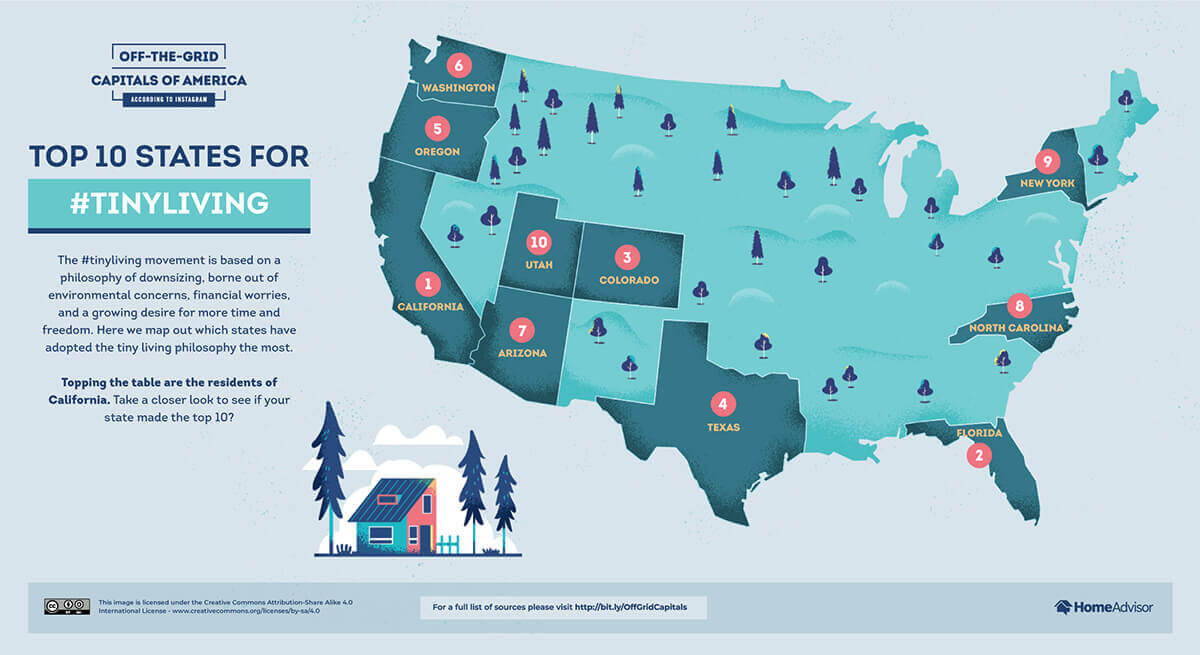
Trying to kick the consumption habit while living in a tiny house

One scholar studying people who lived in tiny houses found that a smaller space did not necessarily mean to having less stuff:

Tiny houses are often put forward as a more sustainable housing option. They are certainly a potential check on the continued pursuit of bigger houses and greater consumption of energy, building materials and so forth. Yet reducing your environmental impact by going tiny is not as simple as some have claimed.

I came across several tiny households that were using external storage spaces for items that wouldn’t fit in the home, for example. Referred to as a “dirty secret” by one interviewee, another explained her desire to keep items from her previous home in case she changed her mind about tiny living.

Over half of my interviewees had a “one in, one out” mentality, where they would throw away or donate one item to make space for something new. As one dweller in her late 30s, who lives in a state-of-the-art home in a caravan park in rural New Hampshire, said, “I have a TJ Maxx addiction. I still go out every couple months and buy a bunch of stuff then come home and decide which things to get rid of.”

Regardless of how tiny living is marketed by the enthusiasts, sustainability was not a major driver for most of the participants in my study. Instead it was almost an afterthought. It seemingly takes more than changing the size of a home to change the mentality of the people who live inside.

One reason (among many) that Americans live in large houses is in order to store all their stuff. Having a smaller dwelling does not necessarily mean that the resident will get rid of all their stuff or reduce their consumption. Because there are so many options for storing stuff, it can be easy to keep all that stuff. (Side note: I could imagine future communities of tiny houses or tiny house living quarters surrounding larger community facilities like kitchens and entertaining spaces that include storage facilities or warehouses on site.)

Furthermore, the American economy needs people to buy things and American culture celebrates buying more (and buying bigger things). There are occasional calls to curb consumption – or at least pare down the number of things one has – yet they put limited dents in the overall patterns

Perhaps the bigger change will come over time. Imagine someone who has lived in a tiny house for a decade or more. Will they still keep their stuff in a storage unit wondering if they will move to a larger dwelling? Will they learn to live without all that stuff and get rid of it? Or, imagine a kid who grows up in a tiny house. Maybe they will be less inclined to have a lot of items around given their familiarity with smaller spaces and the reduced availability of items.

Bringing the City Council meeting to a (participatory) stage

I have read through decades of City Council and other local commission minutes for research projects. Thus, I was intrigued to find out a playwright had taken real City Council experiences and put them together into a participatory performance:

Inside a hushed theater, a voice on the loudspeaker instantly lets the audience know this isn’t your typical performance.

“By joining us tonight” a soft female voice says, “you’ll be standing in for someone who was actually part of a local government meeting somewhere in the U.S. in the last three years.”

The show, for the most part, doesn’t use actors. Instead, theater goers are asked to volunteer to play the role of city council members, the mayor, and regular citizens at a city council meeting. The performance is staged just as if it were a real meeting, with real people participating in a play that reflects the good, the bad, the ugly, and the sometimes nail-biting tediousness of participatory democracy…

“How do you take someone whose way of speaking or obvious demographic might be very different from yours and respectfully put it in the room?” Landsman asks. “How do you give voice to someone else’s language? For me it’s like walking a mile in their shoes – verbally.”

I would love to see this and to participate. The play takes something mundane to most people and provides an opportunity to see how things work and different people approach their community.

Here is why this has the potential to matter: Americans say that they like local government but their involvement is often limited (as exhibited by low turnout rates for local voting). And much of the time in local government boards, committees, and groups may involve arcane discussions of local ordinances, approval of paying bills, and odd local political or interpersonal disputes. Yet, these meetings help shape the character of communities. Even if there is a sizable public discussion about a development project or an annexation or a significant change, it is in the local government meeting that the vote actually takes place. These discussions and decisions can make a difference and set a community down a particular path for decades.

I would guess those who see this play do not immediately show up at all the local meetings eager to observe. However, at the least, it could help reveal some of the local processes that have the potential to impact all of our lives and communities.

Fox Business defines a McMansion, misses teardowns and broader social patterns

McMansions are still alive and well – or at least in public conversation – if news sources are still trying to define them. Here is a recent definition on the Fox Business web site:

McMansion is a term that refers to a large house — typically in a suburban neighborhood — that looks like every other house in the neighborhood. The style was popularized during the 1980s and 1990s.

Their structures typically follows a similar pattern, as noted by Curbed, including a central core with a multistory entryway, a side wing and a garage wing.

According to real estate website Trulia, they tend to range between 3,000 and 5,000 square feet, or 1.5 to 2.5 times larger than the median-sized new home in 2000…

The word is a play on McDonalds items, indicating the homes are generic and mass-produced.

The definition above cites a Curbed article but it should really point to the author of that piece, Kate Wagner, creator of McMansion Hell. From the beginning of that piece, here is Wagner’s one sentence definition:

The typical McMansion follows a formula: It’s large, cheaply constructed, and architecturally sloppy.

These definitions do indeed get at two traits of McMansions: their size, larger than normal, and their architecture and construction, generally poor quality and mass produced. But, I argue the definitions are missing two important traits:

  1. Some McMansions are teardowns, large homes on relatively small lots within neighborhoods with smaller homes. Here, the absolute size is less important than comparative size. And these kinds of homes could appear in urban, suburban, and more rural settings.
  2. McMansions are connected to broader issues or concerns about American society, including sprawl and excessive consumption. This means that a lot of homes that might not technically fit the definition of a McMansion or might not appear on McMansion Hell could be part of broader patterns of McMansion like homes.

McMansion is a broadly used term but does not necessarily mean or refer to the same thing when different actors use the term. Big house? Yes. But, not the biggest houses and big might be relative. Problematic architecture and construction? Yes. But, not the only homes that might suffer from this (depending on who is examining the homes) and connected to larger American issues.

5G over what percent of America? T-Mobile: covering over 5,000 cities and towns, 200 million Americans

T-Mobile is running a commercial touting their new 5G network. They claim it reaches 200 million Americans and over 5,000 cities and towns. What if we put those numbers in context?

On one hand, both figures sound impressive. Two hundred million people is a lot of people. This is a lot of text messages to send, TV shows and videos to stream, and social media and web pages to visit. This is a potential large market for T-Mobile. And 5,000 cities and towns sounds like a lot. I don’t know how many places Americans could name but many would probably struggle to name 5,000.

On the other hand, the figures suggest that the 5G coverage still does not reach a good portion of Americans or certain parts of the country. According to the Census Population Clock, the US population is over 329 million. So covering 200 million people comes to roughly 61% of Americans covered. This more than half, not quite two-thirds. Additionally, 5,000 cities and towns sounds like a lot. Some older data – 2007 – suggests the United States has over 19,000 municipal governments and the Census in 2012 also counted over 19,000. With these figures, 5G from T-Mobile covers a little more than one quarter of American communities.

Perhaps T-Mobile is doing the best the can with the coverage they have. The numbers are big ones and I would guess they could catch the attention of viewers. Maybe the numbers do not matter if they are trying to be first. However, just because the numbers are large does not necessarily mean the product is great. Significant segments of Americans will not have access, even with the big numbers. The numbers look good but they not be as good for some when they look into what they mean.

Trying to convince Illinois drivers to use zipper merges

New recommendations from the Illinois Department of Transportation mean drivers should expect to see more zipper merges:

Most people aren’t familiar with the zipper merge and have never even heard of it. But with construction season just a couple months away, the Illinois Department of Transportation wants drivers to use the zipper merge technique when approaching lane closures…

Experts believe that is the quickest way to get through construction sites and entrances on highways during busy season.

So much so that a new law for 2020 mandates the zipper merge be included in this year’s Illinois Rules of the Road handbook, following many other states that already use the technique like Minnesota, Missouri, North Carolina, Montana and Nevada, to name a few…

Not only is the zipper merge a safer and more efficient way to merge into traffic, it’s the law and carries a $164 fine, not including court costs and fees.

Changing decades of ingrained patterns is not an easy task. New drivers can be trained on this from the start but many drivers have been operating with different methods for decades. However, I would guess the presence of police and the use of tickets in situations where zipper merges will now be expected could help prompt people to follow the new guidelines. Or, imagine a campaign on public media where drivers who do not follow the guidelines are highlighted.

The one thing I do not get about resistance to zipper merges and the drivers who look to block traffic is that it is inefficient to not follow the zipper merge. Theoretically, everyone wants to to get where they need to go as quickly as possible. Hence, rampant speeding and other behavior intended to save time. Zipper merges are supposed to help with this which should be a win-win for everyone.

A nation beholden to cars: a record number of pedestrians die in US in 2019

A new report highlights the dangers to pedestrians in the United States:

Based on data from the first six months of 2019, the Governors Highway Safety Association predicts there were 6,590 pedestrian deaths that year, which would be a 5 percent increase over the 6,227 pedestrian deaths in 2018.

The 2019 figure is the highest number of such deaths in more than 30 years, according to the association…

While there’s been a significant increase in pedestrian deaths over the past decade, the number of all other traffic deaths increased by only 2 percent…

“Following 30 years of declining pedestrian fatalities, there has been a complete reversal of progress,” Retting said in the release. “Pedestrians are at an inherent disadvantage in collisions, and we must continue to take a broad approach to pedestrian safety.”

While there are particular aspects of driving and pedestrian behavior that could be debated and addressed, there is a larger point that can be made with such data: the priority on American roadways goes to vehicles. This has been the case for decades and will continue to be the case for years to come. While efforts to make streets more amenable to walkers and bikers, these efforts are often limited to only a few areas. The goal of roadways in many places, included dense, populated areas, is to move as many vehicles as quickly as possible to where drivers want to go.  Tackling specific issues may help reduce the number of deaths but still leave the larger problem: Americans like cars and driving and our lives are often organized around driving.

Trying to make vacant suburban office parks more attractive

Filling vacant suburban office parks can be hard. Here are some Chicagoland efforts to renovate these spacess:

At the former OfficeMax headquarters in Naperville, his architecture firm and developer Franklin Partners cut away portions of large trees, put in new smaller ones and strategically replanted some flower beds as part of a multimillion-dollar redevelopment to make the 350,000-square-foot property more appealing to a variety of companies…

For one, grand front desks typically found just inside the entrance of office properties built in the 1980s and 1990s no longer work. Those are being hidden and replaced by amenities that generate the most activity, like coffee bars, fitness centers and conferencing space. “It’s not unlike walking into a hotel,” says principal Roger Heerema. “There’s a feeling of life that is immediately apparent.”

Strategic use of light fixtures and canopies over entrances make a difference, he says, as does making sure tenants are actually noticing them. At the Westwood, a half-empty, two-building office complex being renovated in west suburban Lisle, the tenant lounge is located near a main visitor entrance. So Wright Heerema designed new lounges for both buildings near second entrances where most employees come and go…

In the suburbs’ corporate heyday, office buildings “were machines for working—you packed people into them,” says OKW Architects Chairman and CEO Jon Talty. “That attitude has changed profoundly. The lifeless machines need to have meaning to them to be relevant.”

How office space is designed goes through phases.

It would be interesting to hear more details about these approaches:

  1. How often do the changes involve asking current employees what they want as opposed to executives or designers making decisions and/or focusing on what potential employees might want?
  2. The argument above is that a redesign is going to attract a leasee or new employees. What exactly is the return on investment in good or cool design?
  3. Do companies and designers consider larger changes, such as adding more mixed uses to these campuses or opening up the buildings and spaces to reintegrate them into the surrounding area, or is the primary goal to make a quick fix to fill them with users again? In other words, is the bigger question how to move away from office parks and separate and move to a denser and more integrated suburban landscape?
  4. Does the design for a space work until someone moves out and then a refresh is needed? How often do companies proactively change their spaces in response to changing goals or employee needs?


The development of a changing and global northern Virginia

Alongside the rise of Washington, D.C. as an American center, the suburbs of northern Virginia have expanded and evolved:

One such non-DC-centered book was published in 2013 by the scholar Andrew Friedman. “Covert Capital: Landscapes of Denial and the Making of U.S. Empire in the Suburbs of Northern Virginia” stands out as a serious application of academic history and landscape studies about the Dulles Corridor. It just may be the first 21st-century attempt to mold a critical perspective on Northern Virginia…

The book is built on Friedman’s understanding that “there is no American place that’s not also a global place.” He establishes a dichotomy between the “Overt Capital” of Washington, where the Capitol dome represents the public sphere, and the “Covert Capital” of the Dulles Corridor, where the CIA and Pentagon manage their operations in relative privacy. As Friedman examines how foreign policy and foreign interventions shaped the domestic landscape, he locates the cross-border flows of material and people that have made our region what it is today…

For Friedman, the history of the Dulles Corridor begins with the construction of the Pentagon in the 1940s, followed a decade later by the CIA headquarters. These buildings took advantage of car-oriented development to gain a new kind of hiddenness, obscured behind forests and parking lots. A drive through Langley can reveal nothing about what takes place behind the agency’s doors.

Friedman sees the seven years since his book was published as the beginning of a “third generation” in the development of the Dulles Corridor. It’s no longer characterized by leisurely semi-rural landscapes nor by McMansions, but by “lifestyle centers” and “placemaking,” as in the Mosaic District or The Boro. These centers, Friedman says, are in danger of becoming “fortified cells… reinventing the ‘urban’ into subdivisions, compartmentalized, buy-in-based.” Rather than creating an inclusive environment, he worries that lifestyle centers will only create a new form of “landscapes of denial.”

On one hand, this like the development of Sunbelt suburbs after World War Two. With defense spending, the spread of highways, and sprawling suburbs, this could describe any number of regions from D.C. to southern California. Over time, communities developed and became part of a global system: new immigration flows starting in the late 1960s brought new people, multiple generations of people lived in the new communities, and suburbs began to differentiate themselves. On the other hand, few places have the CIA and Pentagon – defense spending in suburbs could run the gamut from aircraft plants to military bases to government offices. And individual communities and regions have their own particular histories that affect local development character.

More broadly, looking at regional development – not just at cities – is a worthwhile endeavor. Major cities, like Washington, D.C., cannot be separated from their suburbs and vice versa. Considering the variation within a region versus connections between particular parts of the region and other parts of the United States is fun. Tyson’s Corner, cited above would be a good example: is it more like edge cities or northern Virginia. And what lessons could northern Virginia provide for the rest of the country about what to do or not to do?