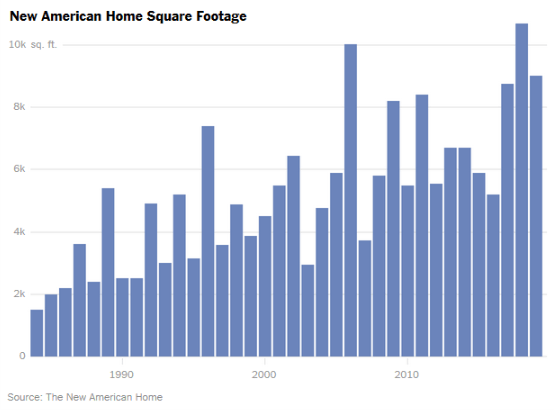
Can you tidy up with Marie Kondo in a McMansion?

A review of the new show Tidying Up with Marie Kondo contrasts organizing with purchasing a McMansion:

Stylistically, Tidying Up is gentle. Marie Kondo is a soothing presence—never soporific, somehow, but always engaging. She is twee, almost unbearably so, which is an affect not really seen in American television personalities. About 15 minutes into every episode, Kondo takes a moment to commune with the house, selecting a spot in the residence and kneeling in silent reverence. This goes on for longer than feels comfortable; sometimes the subjects join her, and sometimes they seem like they’re enjoying it. Conflict, when it happens, feels softer than it would on House Hunters, where couples routinely argue with increasing venom over the necessity of a mudroom in the home of their dreams.

The beauty of Marie Kondo’s world is that tidying is not punishment. She subverts the chore of cleaning by imbuing it with a radical sense of self-improvement. Unlike the underlying economic status anxiety that colors all of HGTV’s offerings, Tidying Up is more self-help than self-defeat. The home improvements, and by extension, life improvements, come not from buying a McMansion in Indiana, but from clearing life’s detritus out of your home to make way for something else.

The end of the review posits a dichotomous choice: either buying a McMansion to assuage status anxiety or tidying up to feel better.

But, I imagine many Americans would want to try to do both: purchase the McMansion or a large home and find a way to organize and declutter that home so that they feel better. Yet, this path seems to go against the path Kondo and others would prefer where Americans can’t have it all and have to make choices about their lives to prioritize well-being. Having a large home helps people feel like they can purchase and acquire more stuff. Having a bigger home is part of a consumer culture where buying bigger and more is a good thing.

One important step to the Kondo life would then be to not purchase the biggest home possible. How many Americans would be willing to do that or is it simply easier to buy into a tidying strategy that could be utilized in any home?

Deep Tunnel as the wrong solution to water issues (plus alternative uses)

Henry Grabar poses an interesting question: what if the Deep Tunnel project, one of the largest civil engineering feats in the world, does not solve flooding and stormwater issues in the Chicago region?

What if Chicago took a wrong turn in 1972 when, in the spirit of civic grandee Daniel Burnham (“Make no little plans”), it opted to build the world’s largest sewers instead of making all possible efforts to keep rainwater out of them? Scott Bernstein, the founder of the Center for Neighborhood Technology, says that the Deep Tunnel imposed a massive opportunity cost because the city and the district did little else to adapt. The MWRD spent billions on what engineers call “gray infrastructure” (pipes, tanks, pumps) and virtually nothing on “green infrastructure”: rain barrels, detention ponds, green roofs, porous pavements, and other adaptations that would have kept water out of the system…

The project proceeded regardless. Even with downsized reservoirs and a longer time frame, Chicago’s ambition captured the attention of civil engineers around the world. Today, most U.S. cities whose combined sewer overflows are governed by consent decrees with the EPA are working on Chicago-style digs. St. Louis, which has the fourth-largest sewer system in the country, is under a consent decree to commit $4.7 billion to ending its overflows through deep tunnels…

While engineers’ penchant for megaprojects endures, some American cities are preaching deterrence. If Chicago built a bathtub, Philadelphia is trying to transform itself into a sponge with park space, street trees, and permeable pavement. The city is spending $2.4 billion to implement the nation’s largest green infrastructure plan, an experiment that positions it as the anti-Chicago. The city thinks keeping water out of the system will save billions of dollars compared to a rejected tunnel proposal—and that green initiatives will produce positive externalities, like improving air quality and creating verdant streets.

In Chicago, meanwhile, the MWRD has committed to creating just 10 million gallons of green infrastructure capacity under its EPA consent decree. Compare that to neighboring Milwaukee, a deep-tunnel city that now believes its green infrastructure will, by 2035, surpass the capacity of the tunnels and hold up to 740 million gallons of rain where it falls.

Hindsight may always be a little tricky in these cases as we have the advantage now of being able to see the Deep Tunnel project in action. Does it actually accomplish its goals? Was all the spent money worth it? At the same time, a project of this magnitude should have generated plenty of discussion and at least a few alternative options.

If Deep Tunnel does not work as intended or does not solve all of the flooding and stormwater problems, I wonder if it could be used in other ways. I’m thinking of other major infrastructure projects that have been reversed or reused, like urban highways that are torn out (like in Boston or San Francisco) or former railroad lines turned parks or recreation areas (think the High Line). Some other options for the Deep Tunnel:

  1. Underground roads. With Elon Musk’s Boring Company working on underground roads plus Chicago’s legacy of Lower Wacker Drive, perhaps traffic could be rerouted deep underground.
  2. Underground freight movement. Given Chicago’s railroad bottleneck, this could be an interesting solution.
  3. An underground park and recreation area. It would certainly be unique. Think a combination of spelunking, rock climbing, and exploration.
  4. A military installation and testing area.

When saying that Harry Reid lives in a McMansion, is this meant as a negative?

The term McMansion is rarely used in a positive manner. Yet, a recent profile of former Senator Harry Reid’s life after politics describes his home as a McMansion:

Early on the afternoon of Dec. 11, about an hour after an Oval Office meeting between President Trump, the Senate minority leader Chuck Schumer and the incoming House speaker Nancy Pelosi devolved on live TV into a shouting match — a “tinkle contest with a skunk,” in Pelosi’s postgame grandiloquence — I pulled up to a McMansion in a gated community outside Las Vegas. I presented my ID and pre-issued bar-code pass to a security guard. Another guard emerged from a sedan in the driveway, instructed me to leave my rental car across the street and pointed me to the front door.

And a later paragraph says more about the location of the home:

Reid has decided to live out his last years in Henderson, a fast-growing and transient Las Vegas suburb. His house is in the upscale Anthem neighborhood: a fortified village of beige dwellings of various sizes and otherwise indistinguishable appearances. There is a Witness Protection Program vibe to the place, accentuated by the security detail.

The descriptions of Reid’s home draw on several traits of McMansions: an “indistinguishable appearance,” located in a gated and wealthy suburban neighborhood. Presumably, the home is large though little is said about this.

To the main point: few people use McMansion as a positive term. By saying that Reid lives in a McMansion, the writer is suggesting the home is a negative. And in the way that Americans tend to operate – what you own says something about you – then Reid himself is a negative figure. This may fit with the overall tenor of the article which suggests Reid is an unusual and odd guy:

One of Reid’s assets as a leader, when he was in office, was his willingness to feed the egos of his colleagues before his own; he was happy to yield credit, attention and TV appearances. Yet when I visited Reid in Nevada, I detected a whiff of, if not neediness per se, maybe a need to remind me that he has not been forgotten. He told me that he received a lovely call that morning from Barbara Boxer, the former Democratic senator from California. He gets calls from his former colleagues all the time, he said, and they tell Reid he is missed. He had a final conversation with John McCain over the summer, just before McCain died, punctuated with “I love you”s.

Reading Reid can be difficult. Is he playing a game or working an angle or even laughing at a private joke he just told himself? When speaking of his final goodbye with McCain, he broke into a strange little grin, his lips pressed upward as if he could have been stifling either amusement or tears. It occurred to me that Reid, typically as self-aware as he is unsentimental, could have been engaged in a gentle playacting of how two old Senate combatants of a fast-vanishing era are supposed to say goodbye to each other for posterity.

Do odd or hard-to-read politicians live in McMansions? Can a leading Senator truly be a person of the people if he lives in a McMansion in a wealthy suburban neighborhood? The choice of calling Reid’s home a McMansion at least hints at these possibilities.


Housing bubble fallout: lost jobs in land subdivision

The long-lasting consequences of the housing crisis of the late 2000s continues: an analysis of the American industries losing the most jobs by percentage includes the land subdivision sector.

9. Land subdivision

• Employment change 2008-17: -49.3%
• Employment total: 40,207
• Wage growth 2008-17: +35.5%
• Avg. annual wage: $71,744

The U.S. housing market is beginning to return to normal following the Great Recession and housing market crash. Housing starts in 2017 were similar to 2007 levels, before the crash. The land subdivision industry, which divides land into parcels for housing and other purposes, suffered as a result of the market’s struggles. As of 2017, industry employment is just about half of what it was a decade before.

This was never a large sector but a drop in jobs of nearly 50% is substantial.

Since I know little about what land subdivision requires on a daily basis, I wonder if this decrease is primarily because of a slowdown in housing starts or are there other significant changes in the industry such as new efficiencies and approaches?

Comfort of suburbia allows for the flourishing of comedy and creativity?

I recently ran across a Will Ferrell quote where he discusses where his brand of comedy developed:

“I’ve got no dark secrets, I wasn’t beaten up, my parents were kind to me and there was a low crime rate where we lived. Maybe that’s where the comedy comes from, as some sort of reaction to the safe, boring suburbs. Although, I gotta say, I never had any resentment of the place. I loved the suburbs”, he told The Observer.

Right before this quote, the profile suggests this bucolic upbringing is unusual:

Oddly for a comedian, his was a golden and uneventful Californian childhood.

Rather than a reaction to adversity, it sounds like Ferrell had a number of advantages – including later attending USC – that gave him freedom to explore comedy. Or, perhaps this relative comfort channeled his energy into more zany humor rather than dark humor.

I am not sure it is worth a full study to explore the connections between place of upbringing and how this affects comedians but a broader look at place of upbringing and artistic creativity more broadly could provide interesting. Given that America is largely a suburban nation today, are the majority of its creative types from the suburbs or from cities? The biggest cities have long been upheld as more cosmopolitan and cultured places in addition to often serving as homes of clusters of artists and performers. In comparison, stereotypes of conformist and homogeneous suburbs abound even as a good number of those who grew up there would have had opportunities that may not have been available elsewhere.

Another quick thought: how many celebrities and famous today would freely admit “I loved the suburbs”?

Ordinances and zoning against dollar stores

With evidence that dollar stores provide poor quality food options and limited jobs, some communities have used certain tools to restrict their presence:

While some local governments continue to lure dollar stores to town with tax subsidies and incentives, others are doing the opposite. A dollar store NIMBY movement has been gaining traction.

In Chester, Vermont, for example, residents argued in 2012 that allowing dollar stores to come to town “will be the beginning of the end for what might best be described as Chester’s Vermontiness,” per the New York Times—a statement that itself perhaps signals the class and race associations dollar stores have come to embody. In Buhler, Kansas, the mayor saw what happened to surrounding grocery stores in neighboring Haven and rejected the dollar store chain, also citing a threat to the town’s character.

“It was about retaining the soul of the community,” he told The Guardian. “It was about, what kind of town do we want?”

More recent efforts have used zoning tweaks to limit dollar stores, whose small footprint usually lets them breeze past restrictions big-box stores cannot. In Mendocino County, California, dollar store foes passed legislation restricting chain store development writ large. And in April, the Tulsa City Council passed an ordinance that requires dollars stores to be built at least one mile away from each other in North Tulsa. It also tacks on incentives for healthy grocers and supermarkets providing healthy food to locate in that area. “I don’t think it’s an accident they proliferate in low socio-economic and African American communities,” Vanessa Hall-Harper, a city councillor who grew up in North Tulsa and shepherded the ordinance, told ILSR. Since then, Mesquite, Texas, has followed suit with a similar move.

Communities have fairly broad powers to encourage or limit the presence of certain kinds of development. If they do not desire the building or the opening of a dollar store, then they can limit or eliminate the possibilities for a dollar store in that community.

Of course, the dollar stores can respond with their own tactics. Here are a few I could imagine (drawing from similar cases involving other businesses):

  1. Building just outside the jurisdiction of the municipality.
  2. Working with a neighboring community who is willing to have them.
  3. Mounting a public campaign against the community to tout the advantages of their business.

While the third option might be more of a nuclear option, the first two mean that another municipality could benefit from sales tax and property tax revenues, the limited number of jobs, and easier access for nearby residents.

A vote against urban McMansions in 2018

One design and architecture writer takes aim at urban McMansions as a tired trend from 2018:

Allison Arieff (columnist, New York Times):

Urban McMansions. I gotta ask these folks—was it always your dream to live in the Apple store? And if you want to live in 10,000 square feet, maybe you should move to the suburbs?”

Arieff draws attention to three traits of McMansions which she sees as negative:

  1. Their large size. She pegs the size at 10,000 square feet though I would argue that once you are at 10,000 square feet and above, this is more of a mansion than a McMansion.
  2. Their poor or low quality architecture. The comparison here is to an Apple store, presumably a structure of a lot of glass and silver metal. This may be appropriate if you are selling trendy phones and tablets but perhaps not so much in a new residence.
  3. A connection to the suburbs. Whereas McMansions are expected to arise from empty fields, plopping a large McMansion in an urban neighborhood, particularly an older one, could be viewed more negatively. How exactly does a big and poorly-designed single-family home contribute to a vibrant and cosmopolitan city scene?

Together, these homes are an inappropriate size, do not look good, and are meant for a different kind of streetscape and lifestyle. For more, refer to my four traits that can define a McMansion.

Decades-long trend: complex suburbia

A 2018 review of what we learned about American suburbs ends with this:

It all added up to a portrait of suburbia as a landscape of dynamic cultural and structural change, not sleepy stasis.

I would suggest this is a change that has been happening for decades. Here are the first four features of a more complex suburbia that come to mind. They each go back quite a while:

  1. Different kinds of suburban communities. The prototypical suburban community looks like Riverside, Illinois or Levittown, New York, places primarily for commuters, consisting of single-family homes., and attracting middle to upper-class residents. These communities had a limited numbers of jobs and local businesses and men were expected to commute to the big city (via train or automobile). The problem with this view, common to find since any book on the history of the suburbs mentions these two bedroom suburbs, is that different kinds of suburbs have been around for at least a century. Different kinds of suburbs included: working-class suburbs, suburbs of non-white residents, industrial suburbs, and suburbs with various levels of density of housing and commercial or industrial property (including edge cities).
  2. The move of industry and jobs to the suburbs. Even as a good number of early suburbs were bedroom suburbs, the suburbs also proved attractive to industry because of cheap land, access to transportation, and the ability to pollute away from millions of residents in the big city. East St. Louis, Illinois or Gary, Indiana grew as industrial suburbs. After World War Two, the number of jobs grew in suburbs as businesses moved to the suburbs to be closer to workers (or perhaps closer to their CEOs) and suburban residents desired more goods and shopping options (shopping malls, big box stores, restaurants, etc.). By more recent years, the most common commute in the United States was suburb to suburb, not the supposedly typical suburb to big city commute.
  3. Changing suburban populations. While most early suburbs were white (notwithstanding the occasional community of non-white suburbanites who could not live in white suburbs), suburbs in recent decades have become home to an increasing number of non-white residents. Additionally, poorer residents have made their way to the suburbs in recent decades. These non-white and poorer populations may have hit a certain critical mass in recent years but the trends go back at least a few decades.
  4. Growing cultural and entertainment options in the suburbs. This trend is more recent than the first three but is still relatively common across metropolitan areas: suburbanites do not need to go into the big city for entertainment and cultural options. The suburbs feature a number of restaurants, museums, parks, music venues, festivals, and other options that make it easier for suburbanites to rarely need to go into the big city for a night out. Certain cultural options may still be richer in the big cities but more regular cultural options are now often found just a few suburbs over.

All of these suburban features may be coming together in new ways or presenting challenges to more suburbs that never thought they would change dramatically from their character at founding. Additionally, thinking about these intertwined suburban traits could help us move past seeing cities and suburbs in a strict dichotomy and instead view metropolitan regions as more cohesive wholes with similar interests and problems to address.

Every house should come with pictures of the land before houses were built

While recently working on a research project, I found 1930s pictures of the place where my in-laws live. Later the home to a master-planned suburban community, the picture presents quite an alternative vision:

SuburbanFields

Having such images could help give current suburbanites a better sense of what came before their home as well as some insight into how their home fits into an altered landscape. There would be some continuity between then and now – similar natural elements including wildlife, foliage, and topography – and notable differences such as the presence of modern roads and buildings.

Tracking down these images is often not easy. Many communities have historical societies or museums that keep such images. To see them, a community member or researcher would have to go ask for them. (And there is no guarantee they have pictures of every property; they are likely to have pictures of the more famous buildings in town.) Searching online can reveal some old maps and images of places but much of the material of local historical groups is not kept online.

Americans love It’s A Wonderful Life but did not heed its main lessons, Part Two

Americans like the movie It’s A Wonderful Life (see its ranking according to the American Film Institute). Yet, I am not sure that those same viewers and reviewers have taken the morals of the film to heart. Part Two today:

George spirals downward because of financial problems at the savings and loan. Additionally, he was not sure about a life running the family business (which he thought his brother Harry would do). In the end, he finds joy in his family and friends in the community. The local relationships, from the local girl he married to the people who utilized the savings and loan, provide him reasons to keep living.

Yet, since the film came out (1946), Americans have moved away from the close-knit relationships. This has happened in two noticeable ways. The shift to suburbs from both big cities and more rural areas led to different kinds of social ties. Suburbanites can be fairly transient and build relationships around avoiding open conflict (see The Moral Order of a Suburb) and through local institutions (like school districts rather than because of immediate geographic proximity.

Additionally, sociologists and others have suggested Americans have fewer close friendships. Even if our social media and online friends and followers have exploded, these are different kinds of relationships compared to close relationships with people with interact with regularly in-person. Furthermore, advice columnists regularly suggest seeing therapists or counselors, more impartial third-party professionals, to work out issues.

Clarence shows George that the lives of those who cares about would be markedly different if he was not around. The closing scene finds the townspeople rallying around George and a proclamation that he is rich because of his relationships. How many people today would hope for such an ending? (Granted, this is a film so how often such joyous community celebrations happened is unknown.)

Of course, the appeal of It’s A Wonderful Life may just be its nostalgia for an age that seems long gone. In an often harried and disconnected world, Americans may yearn for a (fictional?) world where the good guys win, local companies and residents help each other, people have rich friendships, and people live in small towns. But, if anything, our collective decisions since the release of the film have likely moved us further away from these realities.